Category Rembrandt

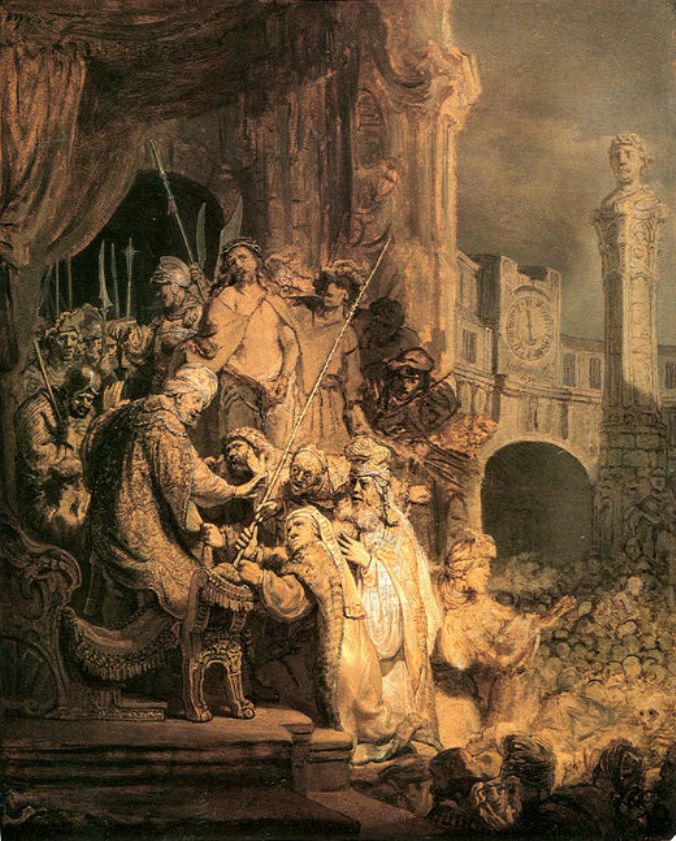
A Complete Analysis of “Ecce Homo” by Rembrandt

Large vertical painting of Pilate on a raised platform presenting the bound Christ to a crowd; officials in rich garments lean forward, soldiers’ spears rise behind, heavy drapery frames the scene, and an arch with a clock opens onto the public square.

Rembrandt’s 1634 “Ecce Homo” stages Pilate’s presentation of Christ as a civic spectacle—tiered architecture, judicial chiaroscuro, and a crowd’s psychology guide the eye from brocaded power to a still, illuminated figure who resists being reduced to display.

A Complete Analysis of “Artemisia” by Rembrandt

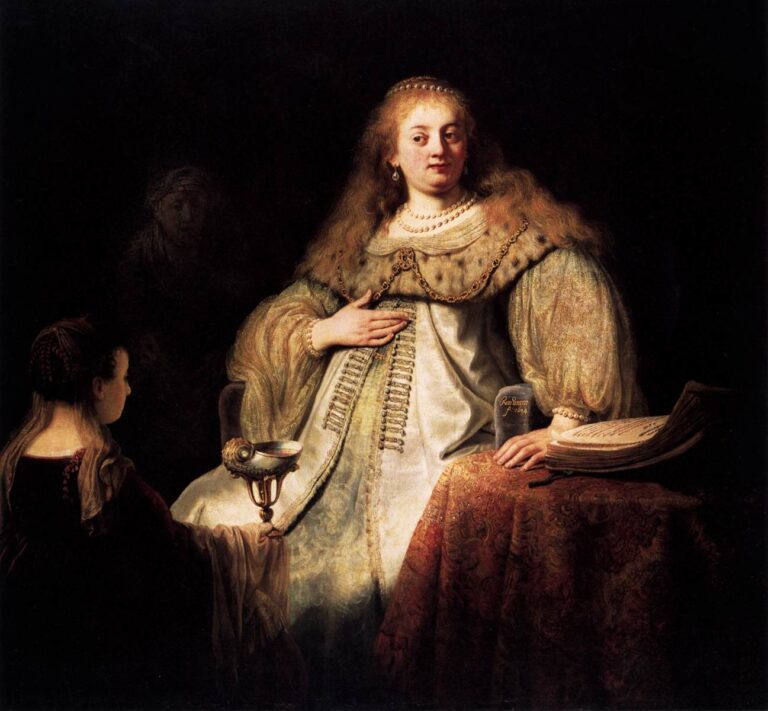
Night-interior with elaborately dressed woman seated at a table, hand to her chest, while a young attendant offers a sculptural cup; pearls, satin, and folios glow under a focused light against a deep dark background.

Rembrandt’s 1634 “Artemisia” turns a queen’s private ritual into luminous drama—pearls, satin, a servant’s cup, and concentrated chiaroscuro frame a poised decision between memory and duty, painted with tactile richness and psychological tact.