Image source: wikiart.org
First Encounter With A Conversation That Rebuilds A World
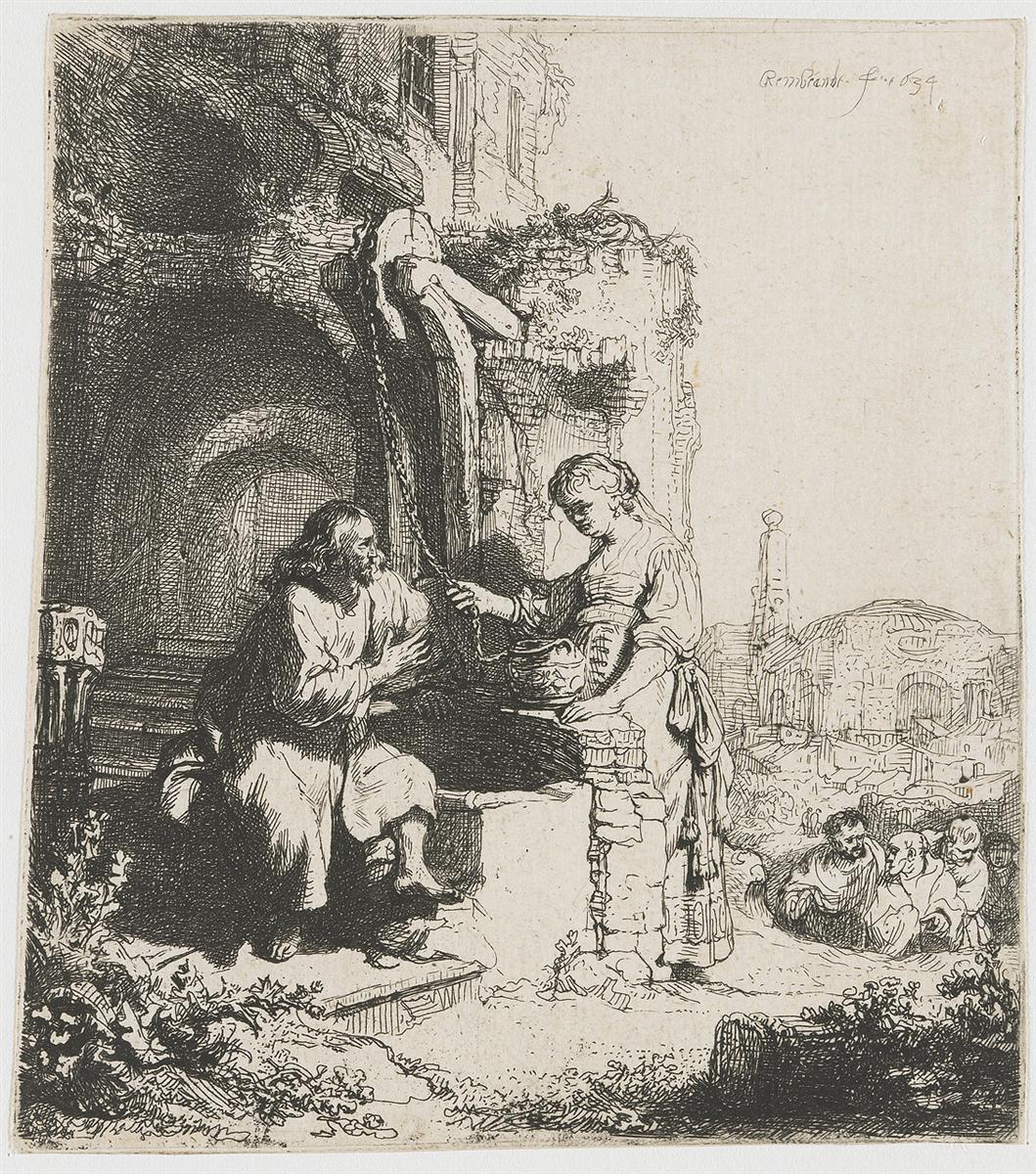
Rembrandt’s 1634 etching “Christ and the Woman of Samaria among Ruins” distills one of the New Testament’s most quietly revolutionary meetings into a compact stage of stone, shadow, and flowing water. At the lip of a broken well, Christ sits and gestures with open palm while a Samaritan woman stands with a jug and a rope, poised between task and attention. Behind them yawns a dark arch; above them the carcass of a once-grand structure drips with a runnel that has outlived its masonry. Far to the right a town stirs; a few disciples approach along a dusty road. The first impression is paradox—debris and grace, collapse and hospitality—resolved by a conversation that seems to mend the very space it inhabits.
A Composition Built On Converging Diagonals
The design turns on two diagonals that intersect at the exchange of hands. From upper left the ruined spout and crumbling cornice drop toward the wellhead; from lower right the road, the woman’s stance, and the rope climb back up toward the same point. Christ’s seated body closes the triangle, anchoring the vortex with a calm, rounded mass. The viewer’s eye travels naturally from ruin to water to gesture to face, then out along the road that will soon carry the woman back to her town with news. This vectoring transforms an intimate conversation into civic ripples: the composition is a map of how words move through space.
Chiaroscuro That Makes Theology Visible
Light operates as meaning. The left half of the plate is steeped in heavy hatching: the arch is nearly black, the well’s interior a throat of darkness, the stonework modeled in deep cross-hatched pockets. Into this penumbra lean the two protagonists, whose faces and hands receive a tender, deliberate clarity. The woman’s forearms, the rounded lip of her jug, and Christ’s open palm carry the highest light; the rope and bucket brighten just enough to show an idea being drawn upward. Rembrandt’s value structure literalizes the Johannine theme: “living water” clarifies what ruin cannot conceal, and illumination is delivered through conversation, not spectacle.
The Ruins As Frame, Allegory, And Acoustic Shell
Rembrandt’s architecture is not documentary; it is a capriccio—a fantasia of classical fragments refitted to serve narrative and symbolism. The collapsed cornice and dripping spout evoke the grandeur and failure of human systems, whether pagan temples, sectarian walls, or even the outworn habits of hostility between Jews and Samaritans. The decaying structure also acts like an acoustic shell, focusing attention on the soft drama at the well. By surrounding speech with stone, Rembrandt teaches that words can survive what buildings cannot, and that a truth large enough for a world begins in a pocket of shade with two people willing to speak and listen.
The Choice Of Moment And The Grammar Of Hands
The artist selects the hinge of the story: the instant Christ turns the literal thirst of a traveler into an invitation to “living water.” Hands create the sentence. Christ’s right hand opens, palm forward, neither commanding nor pleading. The woman’s left hand steadies the jar while her right raises the rope—a subtle sign that action continues even as attention shifts. This choreography keeps the exchange human: revelation does not freeze labor; it folds itself into it. The locals on the road become the future of the conversation; the water already trickling from the spout becomes its metaphor.
Portraits Without Emblems, Character Without Costume
Rembrandt refuses the rhetoric of halo or theatrical drapery. Christ’s face is gentle but ordinary, his beard and hair rendered with the same pen that records a stone block or a tuft of weeds. The woman’s headscarf, sleeves rolled for work, and sturdy stance belong to the day’s chores, not to the stage of allegory. By keeping costume modest, Rembrandt creates space for recognition: the figures are particular without being trapped in types. The viewer’s sympathy can therefore migrate easily from the Bible to any conversation that crosses social boundaries in a shared necessity.
The Road, The City, And The Witnesses On The Edge
At the far right, tiny figures—likely the disciples—crest the road, their scale carefully managed so they read as an aside, not an interruption. Behind them a small city rises: domes, towers, an obelisk-like marker, walls stitched with light. This strip of landscape does three jobs. It supplies depth and air so the well does not feel hermetic; it hints at the social world whose expectations the woman is about to transgress by speaking for herself; and it opens a narrative future, since John’s Gospel says that her testimony brings townspeople to meet Christ. Rembrandt compresses time by tucking yesterday’s ruin, today’s conversation, and tomorrow’s crowd into one sheet.
Etching As A Medium For Conversational Speed
Copper favors line that thinks out loud. In this print Rembrandt uses a flexible needle to vary pressure and direction with the fluency of speech. Long, slanted hatchings knit the shadow under the arch; short, elliptical strokes shape the folds of garments and the shag of vegetation; wiry cross-hatching thickens the well’s lip and the bases of broken columns. Plate tone—ink left on the plate as a soft film—acts as atmospheric bass, against which the etched lines play melody. The result is a surface that breathes: nothing feels staged for months of preparation; everything feels caught in a morning’s exactness.
Water As The Sheet’s Moving Edge
Though the story’s metaphorical “living water” is the heart of the scene, Rembrandt does not turn the fountain into visual fireworks. The liquid runs quietly from a cracked spout, gathering in a trough that disappears behind the wellhead. The restraint is the point. Water is humble and persistent; it finds a way even when masonry fails. The conversation repeats that behavior: it moves around barriers of custom and enmity and finds a path into a life. The small glints Rembrandt tucks into the stream give the plate a pulse without stealing the drama from faces and hands.
Flora, Fauna, And The Patience Of The Margins
The lower left edge sprouts weeds, a few flowers, the suggestion of creeping vines. These details are not filler. They mark the slow victory of life over ruin and supply tender counterpoints to the rigid geometries of stone. Their curling tendrils repeat the curves of the rope, the jug’s mouth, and the folds of Christ’s sleeve, binding the world of nature to the world of grace in a visual rhyme. Rembrandt is too disciplined to overstuff the plate; he gives just enough botanical truth to make the ground plausible, then stops so the figures can breathe.
A Theology Of Proximity
The entire print is a treatise on nearness. Christ sits; the woman stands; their faces reside within a hand’s breadth. This intimacy breaks several conventions at once—gender, ethnicity, religious custom—and the etching lets us feel that risk. There is no defensive space made by props or rival claimants. The viewer is invited to stand a few feet away and witness without interfering. In that respect the print is profoundly modern: it models a way of seeing other people’s conversations not as spectacles but as sacred privacy bordering on public consequence.
The Samaritan Identity And The Ethics Of Depiction
The text makes the woman’s identity crucial, yet Rembrandt refrains from exoticizing dress or inventing caricature. Her difference from Christ is social rather than pictorial. She is defined by action—drawing water—and by the decisiveness with which she turns her head and body to the speaker. This choice resists both anti-Jewish and anti-Samaritan stereotypes, presenting two members of neighboring communities in a contact defined by need and dignity. The line’s fairness is the print’s ethics.
The Well As Machine And Symbol
Technically the well is a small machine: a basin, a trough, a spout, a rope, a bucket. Rembrandt lavishes craft on each component. The bucket’s rim catches two tiny highlights; the rope is a delicate helix that tightens as it turns; the stone edge has chips that read to the fingertips. As symbol, the well is older than their quarrel and will outlast it. It has served all comers. The artist lets that neutrality color the exchange. The truth Christ offers is not sectarian novelty but the fulfillment of what every well already implies: a source deeper than the mouths that drink from it.
The Shadowed Arch As Inner Room
The enormous black of the arch does not merely dramatize contrast; it is a psychological space. It reads as a cave for the hidden self, the chamber of memory and wound into which speech travels. Many of Rembrandt’s prints lodge such dark hollows near their protagonists; they function like stage wings from which past and future emerge. Here the arch swallows architectural detail and gives back an attentive silence, the kind a listener needs to hear herself tell the truth.
The Moment Of Recognition And The Turn Of The Neck
In John’s gospel the woman moves from skepticism to recognition, from “How is it that you, a Jew, ask a drink of me?” to “Sir, I perceive that you are a prophet.” Rembrandt captures that pivot in the turn of her neck and the slight recoil of her shoulders. She is not stunned; she is recalibrating. The raised rope freezes as the mind shifts gear. It is one of the artist’s real gifts: to locate spiritual events in muscular micro-events—elbows that pause, fingers that loosen, heads that incline by a degree.
Human Scale In A Landscape Of Empire
Look again at the distant architecture: domes suggestive of the East, an obelisk, city walls. Taken together they gesture toward imperial time—the long story of conquest and rebuilding into which this provincial well fits like a footnote. Rembrandt refuses to let empire have the last word. The print’s center is human scale: a single step, a seated figure, a clay jar, hands. The kingdom announced here is measured by conversation not conquest, by a city’s thirst met at the level of a single person.
Lessons For The Eye And Hand
For artists, the sheet is a manual of decisions. Establish a big, legible silhouette for each figure before seasoning with detail. Use diagonals to move story and to tie distant space to foreground exchange. Vary hatch direction to change material: long, parallel strokes for architecture; tight curving ones for fabric; broken flicks for growth. Let plate tone provide atmosphere; resist over-etching your lights. Above all, choreograph hands with care—they carry narrative as surely as faces.
Why The Image Still Feels Contemporary
The print’s power is not tethered to doctrinal allegiance; it speaks to anyone who has felt a conversation shift from the literal to the life-defining. Its ruins could be any century’s failed project; its well, any community’s shared resource; its topic, any boundary that needs crossing with words. The dignity Rembrandt grants both figures, the restraint with which he draws a crowd at a distance, and the emphasis on listening all read as answers to our own argumentative age. The etching suggests that the only architecture that finally stands is the one made by attention.
Close Looking As Hospitality
Rembrandt invites the viewer to practice the scene’s teaching by the act of viewing itself. To read the print well, one must slow down, let the plate tone dim the outer world, attend to the details that matter and let the rest be friendly vagueness. That is precisely what the figures are doing for each other—bracketing old hostilities to see and hear anew. The print becomes both image and method: a depiction of hospitality that trains hospitable looking.
Closing Reflection On Water, Words, And What Survives
“Christ and the Woman of Samaria among Ruins” is not a spectacle of miracle; it is a choreography of attention. Water threads its patient path through failed stone; words find their way between people trained to avoid one another; light locates hands that, in giving and receiving, repair a world. The ruins are not the moral; survival is. On this small plate Rembrandt rebuilds the only sturdy architecture there is—neighborliness—and he does it with lines that carry both history’s weight and the clarity of a morning at a well.
