Image source: wikiart.org
First Encounter With Space, Light, And Two Temperaments
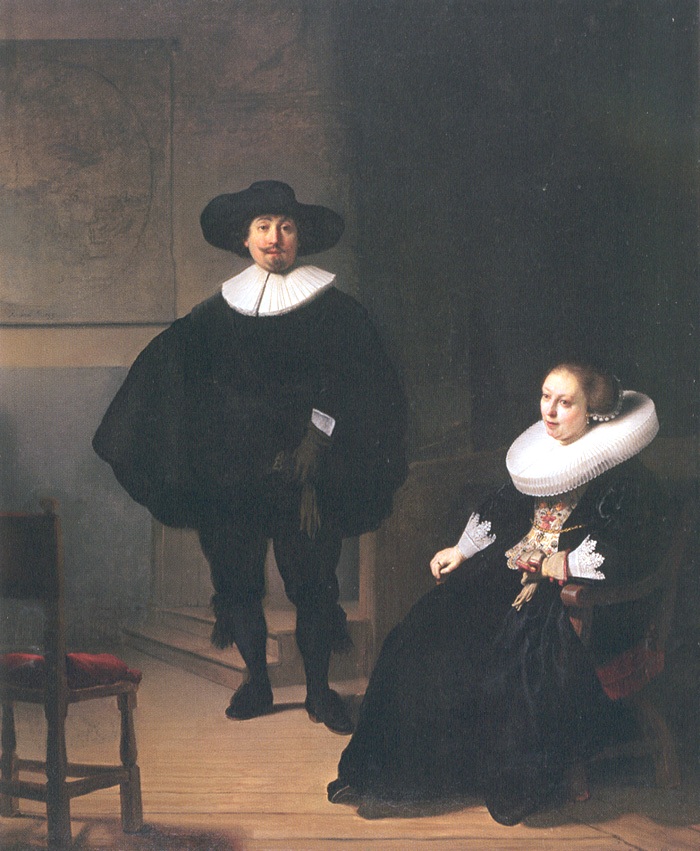
Rembrandt’s “Portrait of a Couple in an Interior” (1633) presents not only two sitters but a room that seems to think with them. The man stands, elegantly contained in black with a wide-brimmed hat and starched ruff; the woman sits, richly dressed, her immense cartwheel collar catching the light like a small moon. A map hangs on the wall; a red-cushioned chair waits at the left edge; floorboards run forward in a quiet fan. The first sensation is one of cultivated calm. Yet the longer we look, the more a drama of attention emerges: he faces us, poised to host; she turns inward and slightly away, absorbed, as if savoring the aftertaste of conversation. Rembrandt stages a relationship within architecture—presence distributed across the room’s light.
Composition That Balances Distance And Intimacy
The pictorial structure is a triangle arranged along the diagonal from lower right to upper left: seated woman, standing man, empty chair. The woman occupies the near corner, anchoring the viewer; the man stabilizes the center; the chair opens a space for us to enter. A massive block of shadow on the right creates a pocket of privacy around the sitter; the paler wall at left pushes the man forward. The map, faint and spectral, counterbalances the dark recess with a plane of quiet detail. By setting his figures far apart and allowing air to circulate between them, Rembrandt resists the tight coupling of many marriage portraits. The couple are unmistakably together, yet each keeps a sovereign zone.
Chiaroscuro As Social Grammar
Light arrives from the upper left and resolves everything into moral legibility. It flashes first on the ruffs—brilliant, authoritative discs—then on the woman’s face and hands, and finally on the man’s cheek and small glints of cloth. The background swallows what the portrait does not need. This judicial chiaroscuro assigns roles without caricature: the woman, seated and illuminated, reads as the locus of domestic distinction; the man, darker and more elastic in pose, mediates between social exterior (the map, the doorway) and the intimate interior (her sphere). Shadows are not menaces here; they are the hush that lets speech be heard.
A Room That Acts Like A Stage
Rembrandt composes the interior as a shallow stage. The left wall functions like a backdrop painted with a map; the dark portal at right is a wing into offstage space; the floorboards are stage lines guiding our approach. A red-cushioned chair sits close to the picture plane, its legs splayed like a prop abandoned moments before. This theatrically aware design does not make the scene false; rather, it admits that portraiture is performance—and, in this case, a duet.
The Man’s Poise: Host And Partner
The standing figure stakes out the middle ground with modest authority. His hat broadens the silhouette, his cloak forms a nearly geometric rhomboid, and his right hand disappears within the garment with casual assurance. A small white cuff and a folded paper or glove edge at the breast introduce a note of urbane care. His face, warmly modeled with small lights at eye and cheek, is attentive without anxiety. He stands between us and the seated woman like a polite threshold: not blocking, not deferring, but welcoming.
The Woman’s Presence: Anchor Of The Interior
Seated in a low armchair, the woman draws light to herself. Lace cuffs tremble with delicate highlights; a jeweled stomacher offers soft gleams; the colossal ruff frames a complexion that Rembrandt renders with luminous sobriety. Her head turns slightly left, away from the man and toward the window’s implied light, a pose that confers self-possession rather than detachment. The right hand rests near the chair’s arm as if she has just gestured; the left gathers fabric at the waist, a tactile sign of comfort. She is not only portrayed; she is placed—rooted within the grain of floor and the cool gravity of the wall.
Hands, Ruffs, And The Language Of Craft
Rembrandt’s attention to hands and textiles becomes a portrait within the portrait. The man’s gloved or cloaked hand disappears, signifying restraint; the visible hand hangs relaxed, index finger subtly extended, signaling readiness to converse. The woman’s fingers—unadorned except for the glow of skin—are sculpted with careful half-tones; their modest placement implies steadiness, not display. The ruffs are feats of paint: thin, luminous layers dropped across tight, rhythmic pleats. Their geometry sets a measured tempo for the image, a visual meter that suggests the sitters’ disciplined lives.
Color In A Low, Persuasive Key
The palette keeps to black, umber, pearl, and small notes of wine red and gold. Because chroma is restrained, temperature does the expressive work. Warm lights breathe across the woman’s face and the red chair; cooler greys temper the man’s black; the map holds a faint ivory cast that reads as old paper. This low-key harmony dignifies the sitters without spectacle. In seventeenth-century Amsterdam, elegance was often measured by restraint; the painting adopts that ethic as its own.
The Map On The Wall: Worldliness Without Boast
The barely legible map signals education, commerce, and the reach of the Dutch Republic without hijacking the scene. Rembrandt keeps it soft, a pale architecture of lines that whispers of voyages and trade but yields the stage to faces. As a compositional device, the map rectifies the large, empty field of the left wall and provides a counterpoint to the right-hand void. As iconography, it hints that this household’s prosperity is tied to knowledge of the world. In a subtle way, the map connects the public sphere (navigation, geography, business) to the private moment we witness.
Spatial Choreography And The Ethics Of Distance
Unlike “pendant” marriage portraits that hang side by side, this integrated double portrait uses space to think about partnership. The man stands; the woman sits; their eyes do not seek each other. Yet their bodies incline toward a shared center—the invisible axis running between ruffs, across floorboards, into the stillness of the interior. This choreography respects difference while affirming union. The painting proposes that intimacy can be architectural: you build it by arranging distance well.
Texture And The Truth Of Things
Rembrandt persuades through tactile truth. The black broadcloth of the man’s costume drinks light; the velvet sheen of the woman’s gown returns it in soft waves. Wood reads as wood: the chair’s posts are turned and slightly bruised by use; the floorboards hold faint scuffs, the sort made by shoes crossing to greet or to sit. Flesh is neither sugar nor porcelain—it is lived skin, with tiny transitions of color where blood runs near the surface. Because every material acts convincingly under this light, the viewer believes the room and thus believes the people.
Light As Time
The left-sided illumination suggests afternoon or morning, a working day rather than a ceremonial night. Time slips into the picture through small signs: the man’s hat still on, as if he has just entered or is about to leave; the empty chair presenting itself as a place recently vacated; the woman settled, yet alert. The portrait does not freeze a timeless emblem; it suspends a plausible hour of domestic and social life.
The Sound Of The Interior
Even in silence, the image has sound: the double hush of ruffs, the soft shush of broadcloth, a faint wooden creak as weight settles into the chair. Rembrandt’s paint translates those sounds into sight by modulating edges. Hard edges land like consonants (brim of hat, line of cloak); soft edges whisper (lace, flesh, shadow at the wall). The acoustic quality of the brushwork makes the interior feel occupied.
Social Context: Portraiture In Amsterdam, 1633
The picture belongs to a bustling culture of portrait commissions among merchants, regents, and their families. In such portraits, black clothing, white linen, and controlled poses declared piety, prosperity, and civic responsibility. Rembrandt satisfies these expectations but slips in modern psychological nuance. The map honors global reach; the empty chair and deep portal admit the idea of movement; the non-confrontational gazes suggest a life that respects privacy. What could have been a stiff record of status becomes a living meditation on companionship.
Rembrandt Among His Peers
Compared with Frans Hals’s quick, flickering marriages and Thomas de Keyser’s precise, elegant interiors, this painting moves more slowly and inwardly. Hals often electrifies faces with laughter and rapid brushwork; Rembrandt slows the tempo, building form through soft glazes and judicial highlights. De Keyser arranges spaces with crystalline clarity; Rembrandt lets the dark portal and faded map dissolve into atmosphere. Where others describe, he interprets. The sitters are not only like themselves; they are also participants in a larger argument about how to share a room.
The Psychology Of Looking And Being Looked At
The man’s direct gaze meets the viewer with cordial steadiness; the woman’s slightly averted look resists objectification and protects interiority. The two strategies complement each other. He manages the social exchange—“you are welcome here”—while she keeps the intimate center intact—“we are more than your eyes.” Rembrandt understood the politics of looking; his arrangement allows the sitters to remain subjects rather than mere objects of display.
The Empty Chair And The Viewer’s Place
That red-cushioned chair at the left is not a still-life afterthought; it is a structural invitation. Positioned at the picture’s edge, angled toward the couple, the chair proposes a “you” just outside the frame. Some scholars read it as a compositional counterweight, others as a symbol of hospitality or of a third presence (perhaps the painter). For the viewer, it functions experientially: we feel that we may sit, converse, and belong to the same air as the sitters. Portrait becomes meeting.
Brushwork That Records Decisions
Look closely at passages of paint and a spectrum of touch emerges. The ruffs are written with crisp, high-key strokes laid over thin, pearly grounds; faces are built from softened planes punctuated by small, high highlights at eyelids and lips; the map receives a hazy web of lines that avoid pedantry; the dark portal is a clouded mass where brushstrokes blur intentionally. Each treatment answers the needs of the thing depicted and the role it plays in the picture’s sentence. Rembrandt’s brush never shows off; it argues.
Color, Lace, And The Theater Of Modesty
Seventeenth-century restraint does not exclude pleasure. The tiny carnival of colored threads at the woman’s stomacher, the glassy pearls tucked beside her ruff, and the juicy red cushion keep the painting from puritanical dryness. These pleasures are small, localized, and contained by the discipline of black and white. The result is “theater of modesty”: delight allowed but framed by ethical light.
Narrative Possibilities The Painting Leaves Open
Rembrandt keeps storylines latent. Perhaps the couple have just received visitors—hence the open chair—and the man has turned toward the door. Perhaps the map signals a voyage discussed moments before, or an investment concluded. Perhaps the woman’s inward gaze marks a thought she is unwilling to share in public. The portrait is rich precisely because it does not answer; it holds room for the life we imagine.
Enduring Modernity Of The Image
The painting feels contemporary because it studies cohabitation—the art of sharing space without erasing self. Many viewers recognize the choreography of standing and sitting, of looking outward and inward, of being together with room to breathe. In an age that alternates between exhibitionism and privacy, Rembrandt’s couple proposes a harder, finer path: public dignity built from private attention.
Closing Reflection On Presence, Partnership, And Place
“Portrait of a Couple in an Interior” is more than exemplary costume and technical bravura. It is a humane design for domestic space. Floorboards, chair, map, portal, light, and shadow collaborate to honor two lives that meet without merge. The standing man’s cordial gravity, the seated woman’s luminous composure, and the painter’s disciplined atmosphere join in a single argument: a good room is a vessel for character. Rembrandt’s room, like his paint, gives its occupants the dignity of distance and the warmth of light. We feel welcomed, not dazzled; seen, not managed; and we leave the picture believing that quiet splendor is the most persuasive kind.
