Category Rembrandt

A Complete Analysis of “An Elephant” by Rembrandt

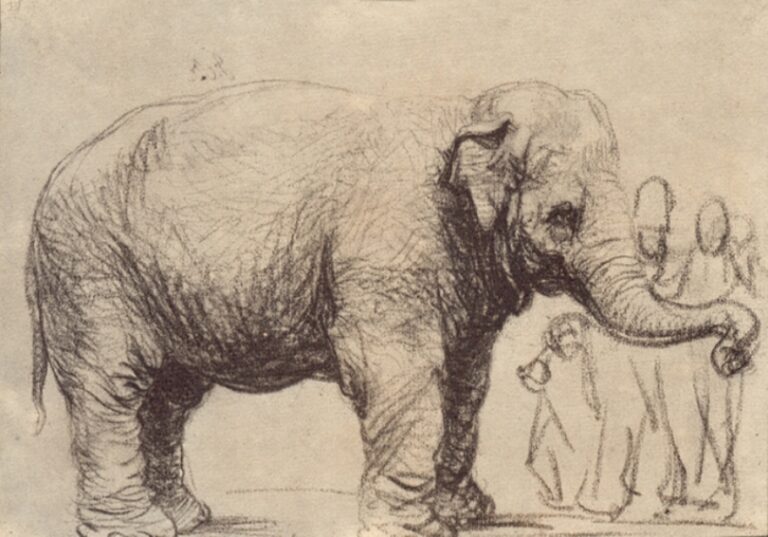
Rembrandt’s 1637 drawing of an elephant standing in profile facing right, modeled with dense hatching and wrinkles, trunk curved toward a small group of lightly sketched human figures at the sheet’s edge.

Rembrandt’s 1637 study of a live elephant—likely the touring Hansken—transforms a traveling curiosity into a dignified subject through masterful hatching, sensitive anatomy, and a balanced composition that pairs monumental weight with open space.

A Complete Analysis of “Woman Wearing a Costume of Northern Holland” by Rembrandt

Pen-and-wash drawing of a woman seen from behind in Northern Holland costume—cap, fur-edged shoulders with cross-straps, and full skirt—leaning on a stone table under an arch; a youth’s head peeks over the table at left; much of the sheet is blank paper, emphasizing light and space.

Rembrandt’s 1636 drawing “Woman Wearing a Costume of Northern Holland” captures a working woman from behind as she leans on a stone table beneath an arch. With deft pen lines, restrained washes, and expansive negative space, he transforms regional dress—cap, fur-trimmed shoulders, cross-straps, and heavy skirt—into a study of posture, identity, and civic life in the Dutch Republic. The sheet’s architectural hints and the playful head peeking over the table deepen the social narrative while showcasing Rembrandt’s masterful economy of means.

A Complete Analysis of “Parable of the Laborers in the Vineyard” by Rembrandt

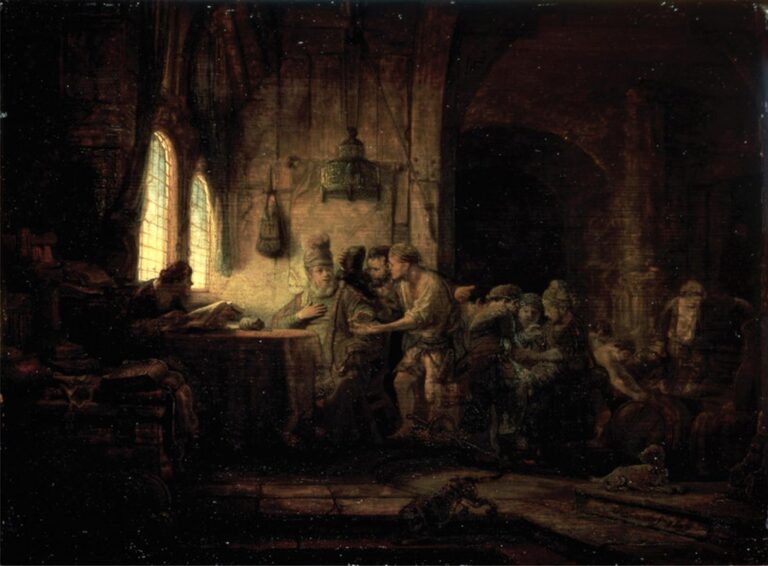
Dim interior with arched windows lighting a table where a paymaster and clerk count wages; a crowd of workers presses in from the right, some protesting, others departing; rich chiaroscuro emphasizes hands, coins, and faces in Rembrandt’s 1637 scene “Parable of the Laborers in the Vineyard.”

Rembrandt’s 1637 “Parable of the Laborers in the Vineyard” turns a Gospel lesson into a Dutch counting-house drama where light, gesture, and texture arbitrate between contract and gift. Window glow bathes the paymaster and ledger while a shadowed crowd of workers protests equal wages, creating a moral gradient from grace to grievance. Through riveting hands, tactile fabrics, and architectural depth, the painting explores how generosity disrupts strict fairness and invites viewers to judge their own posture at the pay table.

A Complete Analysis of “Five Studies of Saskia and One of an Older Woman” by Rembrandt

Etched study sheet showing six heads: a central frontal portrait of a young woman, four additional views of the same sitter around it, and one head of an older woman; lines range from crisp hatching to light sketch, arranged harmoniously on a pale ground.

Rembrandt’s 1636 sheet “Five Studies of Saskia and One of an Older Woman” turns an etching plate into a living sketchbook. A centered, frontal likeness of Saskia anchors five surrounding heads—some crisp, some vaporous—while an older woman’s study deepens the emotional range. Varied line, strategic incompletion, and intimate scale reveal how the artist thought on copper, folding affection, candor, and technical virtuosity into a single, quietly radiant page.

A Complete Analysis of “Dead Peacocks” by Rembrandt

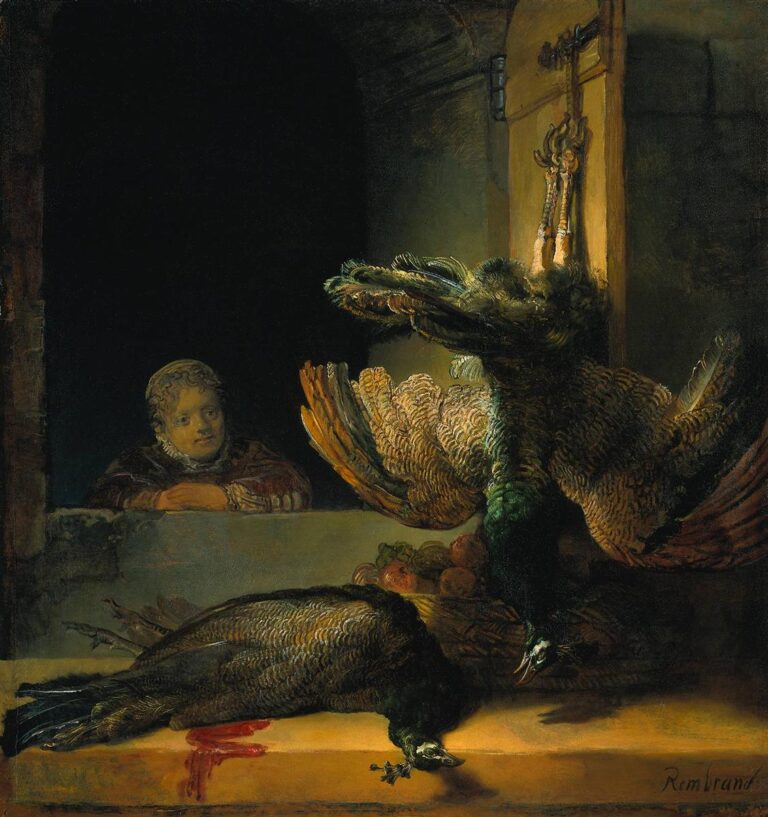
Oil painting of two dead peacocks in a dim interior: one lies on a stone ledge with a small pool of blood, the other hangs head-down from a door; a child leans in from a shadowed window to watch, while a basket of fruit and strong light from the right illuminate iridescent feathers and brass hardware.

Rembrandt’s “Dead Peacocks” (1636) transforms a Dutch kitchen piece into a charged meditation on beauty, appetite, and mortality. Two iridescent birds—one sprawled on a stone ledge, one trussed and hanging—are illuminated by a raking light while a child watches from the shadows. With virtuoso handling of color and texture, a single shock of red, and a composition that stages looking itself, the painting becomes a vanitas without emblems and a quietly ethical drama about how we behold the world.

A Complete Analysis of “Woman Carrying a Child Downstairs” by Rembrandt

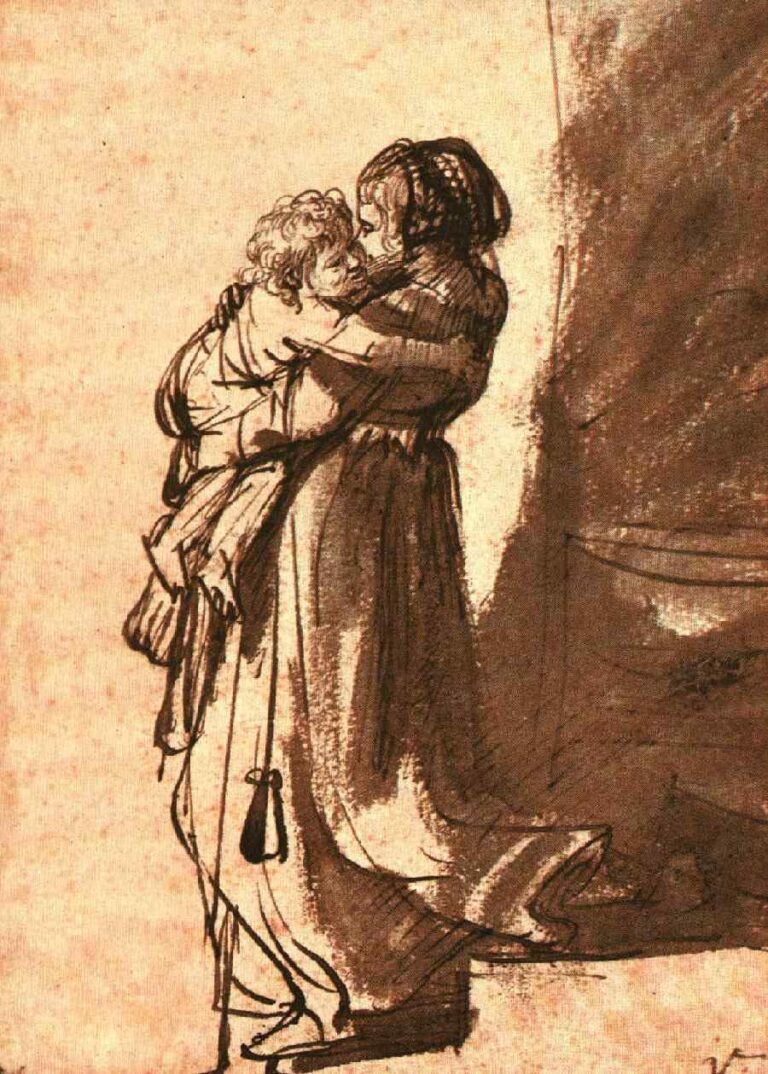
Ink and brown-wash drawing by Rembrandt showing a woman in a long robe descending the last steps while hugging a curly-haired child to her shoulder; the right side is a dark stairwell shadow, the figures highlighted by light from the left, emphasizing movement and a protective embrace.

Rembrandt’s 1636 drawing “Woman Carrying a Child Downstairs” transforms an ordinary descent into a meditation on care. With spare ink lines and warm brown wash, he stages two figures at a stairwell’s threshold, capturing weight, movement, and trust. Chiaroscuro isolates the embrace, drapery narrates motion, and the composition’s curves and counters reveal the ethics of carrying another.

A Complete Analysis of “Tobias Cured With His Son” by Rembrandt

Interior scene by Rembrandt showing the elderly Tobit reclining while his son Tobias applies a remedy to his eyes; the archangel Raphael and Anna lean close beneath a battered roof, light streaming from a window, with a wagon wheel, stool, and small dog grounding the quiet miracle.

Rembrandt’s 1636 “Tobias Cured With His Son” turns a biblical healing into intimate domestic drama. In a barnlike interior lit by a side window, Tobias applies a fish-based remedy to Tobit’s eyes as the angel Raphael and Anna look on. Through chiaroscuro, tactile textures, and a circle of caring gestures, Rembrandt binds miracle to everyday life.

A Complete Analysis of “The Standard Bearer” by Rembrandt

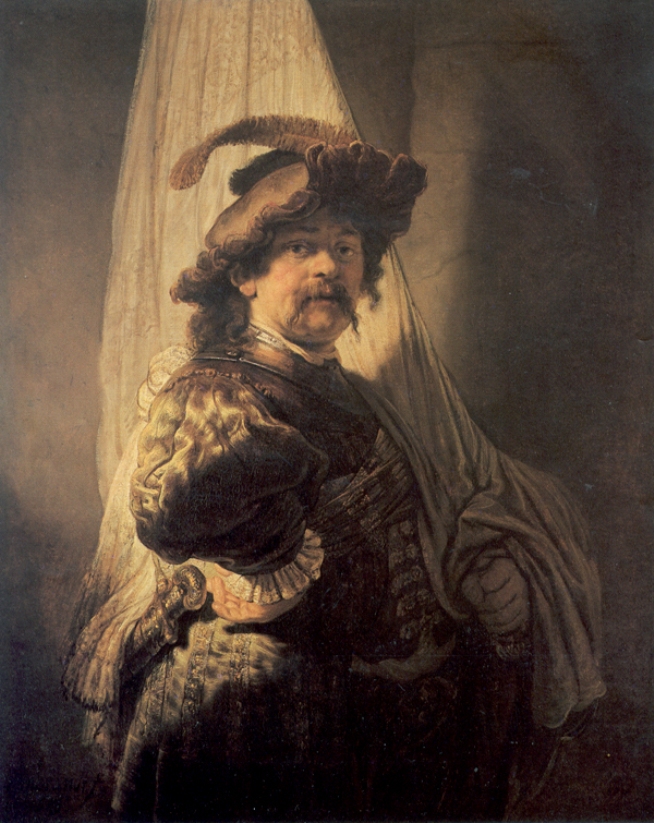
Rembrandt portrait of a militia standard bearer turning toward the viewer, right hand on hip and left gripping a pale banner that drops behind him; feathered hat, lavish satin sleeve, and gleaming details emerge from warm shadow as light highlights his face and the draped standard.

Rembrandt’s 1636 “The Standard Bearer” stages a militia officer stepping from shadow to spotlight. With a luminous banner, bravura textiles, and a psychologically alert face, the painting fuses civic pride and personal presence, demonstrating how light and texture turn costume into character.

A Complete Analysis of “The Ascension of Christ” by Rembrandt

Arched panel by Rembrandt showing Christ in a white robe rising on a column of light, arms outstretched beneath a glowing dove; small angels support his ascent while apostles gather in shadow below, their faces lit by the radiance that cuts through surrounding darkness.

Rembrandt’s 1636 “The Ascension of Christ” transforms a biblical climax into a vertical drama of light. With an arched format, blazing chiaroscuro, and exquisitely varied reactions among the apostles, the painting turns theology into lived experience, guiding the viewer’s gaze from earthbound witness to radiant glory.