Category Rembrandt

A Complete Analysis of “Self-portrait with Saskia” by Rembrandt
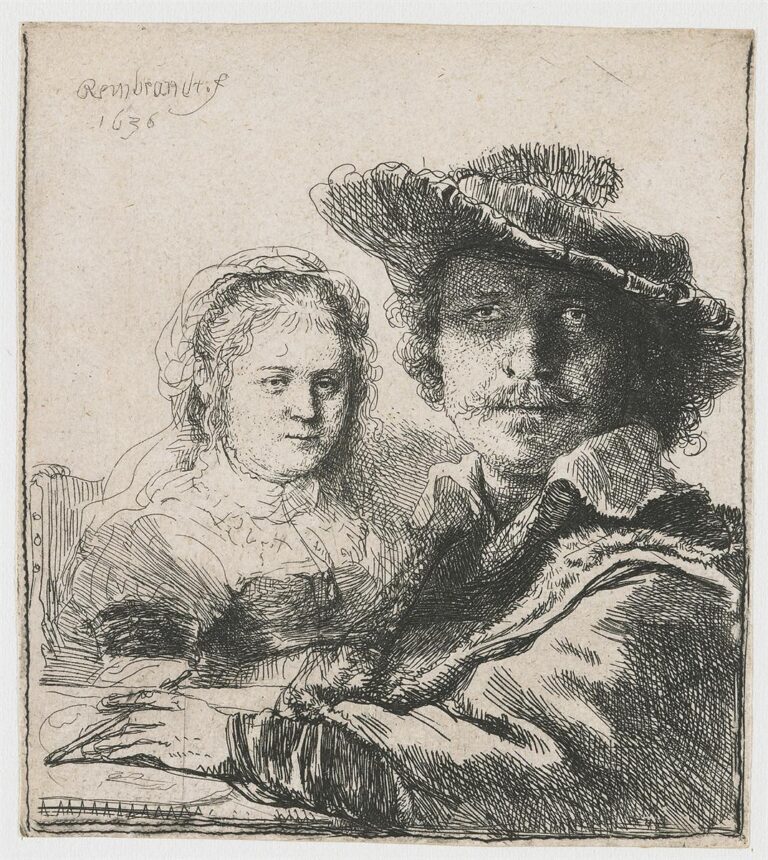
Etched double portrait by Rembrandt showing the artist in a broad hat at front right, half his face in shadow, with his wife Saskia just behind him, softly lit; their hands rest near the lower edge as if on a table, amid sparse background and a “Rembrandt f. 1636” inscription.

Rembrandt’s 1636 etching “Self-portrait with Saskia” captures newlywed intimacy with breathtaking economy. Crowding the couple to the picture plane, sculpting faces with expressive chiaroscuro, and using line like conversation, the print becomes a manifesto of partnership and artistic identity in the Dutch Golden Age.

A Complete Analysis of “Samuel Menasseh ben Israel” by Rembrandt

Etched bust portrait by Rembrandt of the rabbi-printer Menasseh ben Israel, shown three-quarters in a broad felt hat and plain collar, beard neatly trimmed, eyes calm and attentive; the figure is set within an oval frame with clear background and a small signature and date at right.

Rembrandt’s 1636 etching of Samuel Menasseh ben Israel—rabbi, scholar, and pioneering Amsterdam printer—uses spare, authoritative line to honor a life devoted to books and dialogue. The oval composition, candid gaze, and subtle hatching transform a modest bust portrait into a vivid testament to the Dutch Republic’s multi-faith republic of letters.

A Complete Analysis of “The Blinding of Samson” by Rembrandt

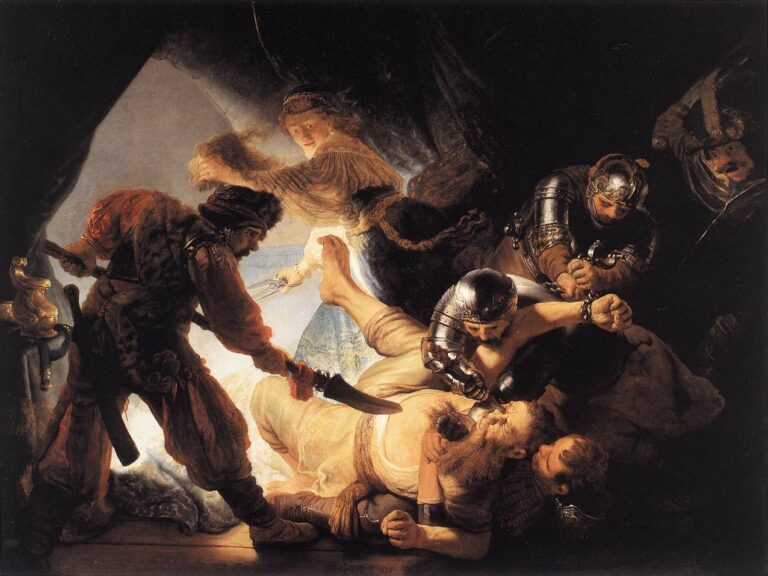
Rembrandt’s dramatic painting of Samson’s capture shows the hero pinned on the ground by armored Philistines as one soldier forces his head back and another drives a dagger toward his eye; Delilah, holding the shears and Samson’s cut hair, twists away under brilliant light while dark curtains and gleaming weapons frame the violent scene.

Rembrandt’s 1636 masterpiece “The Blinding of Samson” unleashes Baroque drama at the instant of betrayal. With shock-wave composition, scorching chiaroscuro, and granular realism, the painter turns the Old Testament episode into a visceral study of power undone by intimacy and the ethics of witnessing violence.

A Complete Analysis of “Christ before Pilate” by Rembrandt

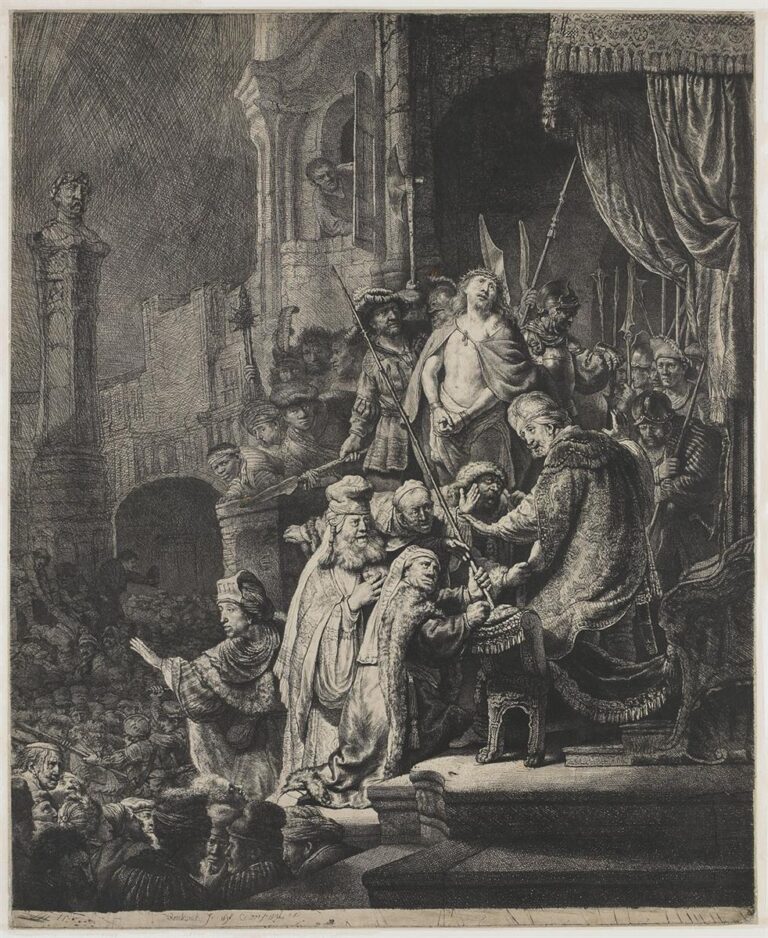
Large Rembrandt etching of the trial scene: Pilate enthroned under a canopy confers with priests, soldiers crowd the platform with spears, and a bound Christ crowned with thorns stands quietly amid the tumult; dense architecture and a packed crowd fill the left side while sharp light models key figures.

Rembrandt’s 1636 etching “Christ before Pilate” turns a public square into a moral theater. Through layered architecture, a surging crowd, and nuanced chiaroscuro, the artist contrasts political performance with Christ’s silent dignity, crafting a deeply human meditation on power, justice, and the ethics of looking.

A Complete Analysis of “Rembrandt as Shepherd” by Rembrandt

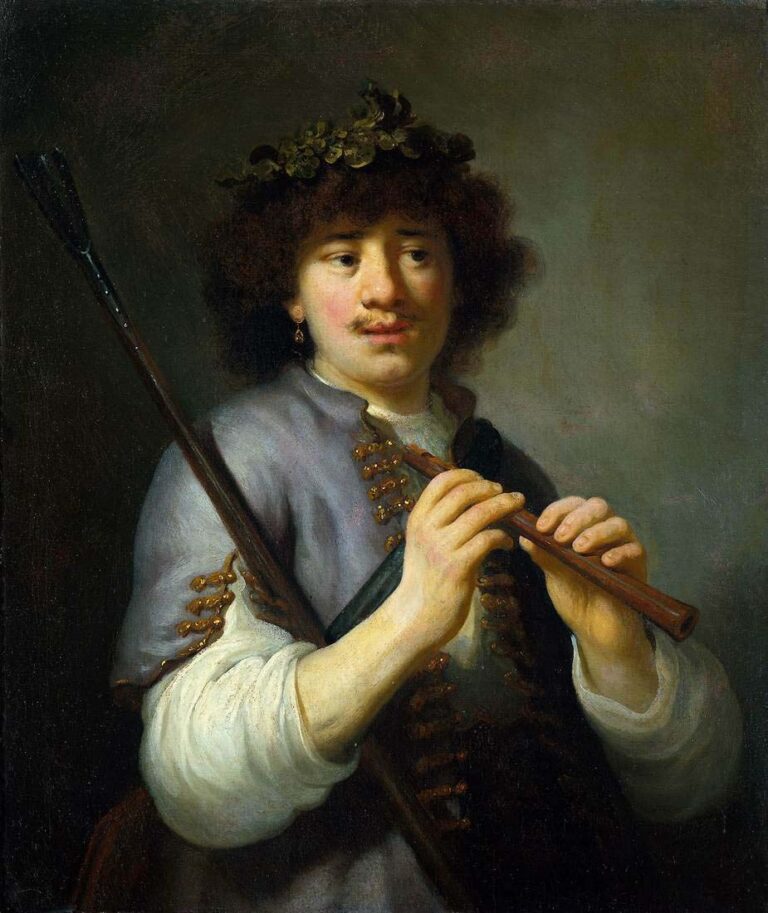
Half-length painting of Rembrandt in 1636 dressed as a shepherd, wearing a laurel wreath and violet-gray jacket, playing a wooden flute while a dark staff rests over his shoulder; soft side lighting illuminates his attentive, sideward gaze and carefully modeled hands against a quiet gray-brown background.

Rembrandt’s 1636 “Rembrandt as Shepherd” transforms self-portraiture into a pastoral meditation. With flute, staff, and laurel wreath, the artist explores identity as role, using lyrical composition, gentle chiaroscuro, and exquisitely modeled hands to present the painter as a vigilant, listening guardian rather than a mere virtuoso.

A Complete Analysis of “Abraham Caressing Isaac” by Rembrandt

Etching by Rembrandt of an elderly Abraham seated on a low bench, cloaked and capped, gently cupping young Isaac’s cheek while the child leans against him holding a small fruit; dense foliage darkens the left background, open space lightens the right, and fine lines model soft faces and heavy drapery.

Rembrandt’s 1636 etching “Abraham Caressing Isaac” transforms the aftermath of the sacrifice story into intimate, everyday tenderness. Through protective composition, expressive line, and hands that bless more than command, the print turns theology into touch and makes fatherhood a vocation of proximity.

A Complete Analysis of “The Lamentation over the Dead Christ” by Rembrandt

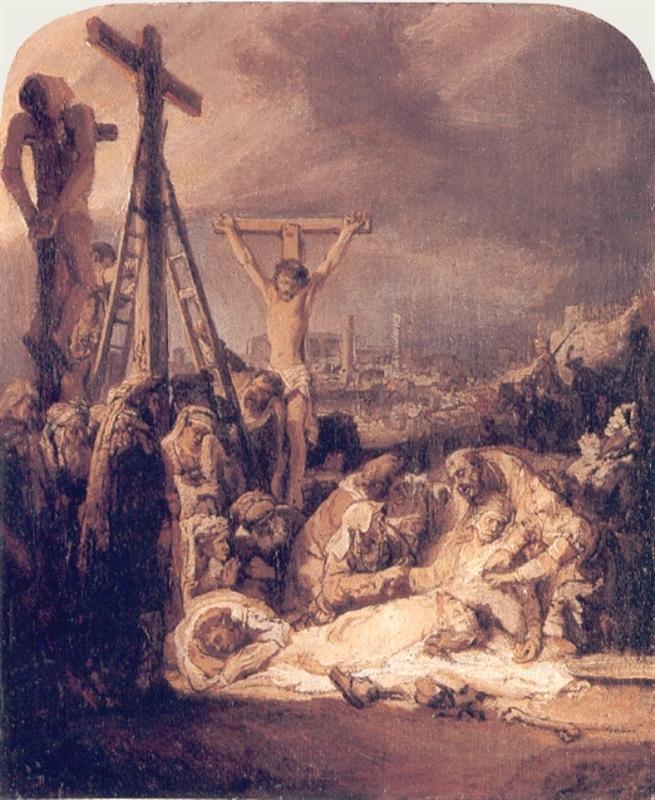
Rembrandt painting of the Lamentation: under a dark sky with ladders leaning against crosses, mourners cluster around Christ’s pale body in a white shroud; one thief still hangs, another cross rises, and a distant city lies on the horizon as figures cradle, wrap, and weep in warm brown light.

Rembrandt’s 1635 “Lamentation over the Dead Christ” unites the Descent, Lamentation, and Entombment into one scene of luminous compassion. With ladders against a stormy sky, a distant city, and figures tenderly tending Christ’s body, the painting turns grief into deliberate, loving work through masterful chiaroscuro, composition, and gesture.

A Complete Analysis of “The Tribute Money” by Rembrandt

Small Rembrandt etching of Christ answering the tribute question, hand raised as light radiates behind his head; a coin is displayed in an open palm amid a tight semicircle of robed men, while a temple-like background recedes in soft cross-hatching.

Rembrandt’s 1635 etching stages the Gospel tax debate as a compact public drama: Christ’s calm gesture, a coin lifted for inspection, and a semicircle of nuanced faces set in lucid chiaroscuro. Composition, gesture, and light become a persuasive lesson on what belongs to Caesar and what belongs to God.

A Complete Analysis of “The Mountebank” by Rembrandt

Etching of a flamboyantly dressed mountebank by Rembrandt holding a small bottle aloft while supporting a tray of remedies; belts, fur, and baggy breeches animate the figure as he steps forward against a lightly shaded backdrop.

Rembrandt’s 1635 etching isolates a traveling quack mid-pitch—vial raised, tray thrust forward, costume bristling with straps—using agile line, rich texture, and humane psychology to explore persuasion, performance, and street commerce in the Dutch Republic.