Category Henri Matisse

A Complete Analysis of “Seville Still Life” by Henri Matisse
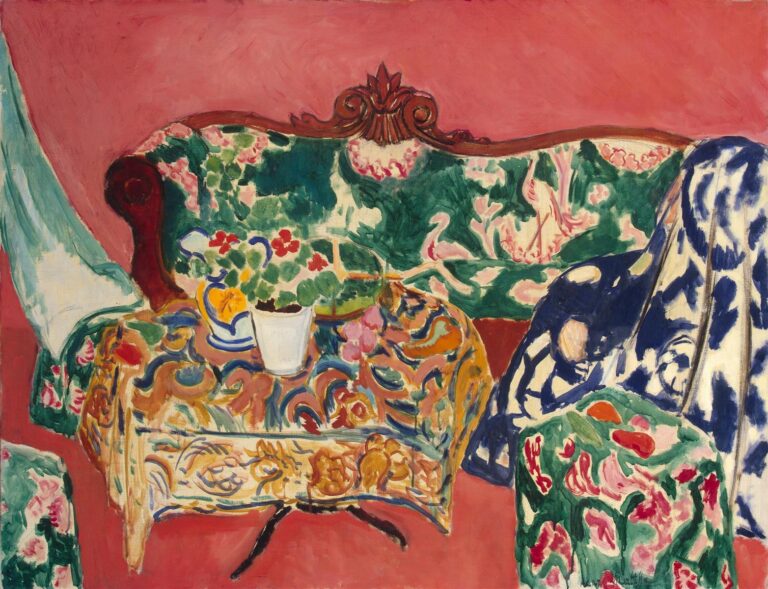
Coral-pink room with a carved green sofa upholstered in a swan-patterned fabric, an oval table draped in ocher and blue arabesque cloth holding a white pot of red and green flowers and a yellow-blue jug, a bold blue-and-white spotted shawl cascading at right, and a small floral ottoman in the foreground; all rendered with thick brushstrokes and strong complementary colors in Henri Matisse’s 1911 “Seville Still Life.”

Matisse transforms a sofa, a draped table, a spotted shawl, and a small bouquet into a complete decorative architecture. This analysis traces how the coral field sets climate, how green and blue patterns act as structure, how the still life conducts the color families, and how brush-drawn edges and adjacency-built light turn textiles into a modern, coherent interior.
A Complete Analysis of “Red Studio” by Henri Matisse

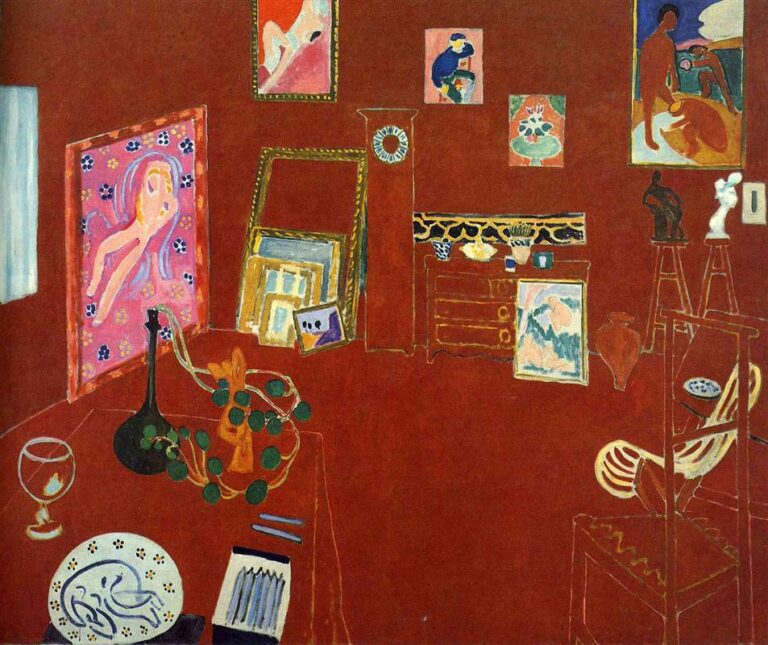
Large interior painted almost entirely in deep red with fine yellow outlines defining a table, chairs, cabinet, dresser, and scattered studio objects; framed paintings and small sculptures appear as islands of color within the red field; a clock without hands and a narrow blue window punctuate the walls in Henri Matisse’s 1911 “Red Studio.”

Matisse floods his studio with a single, steady red and redraws the room in fine yellow lines, leaving paintings, sculptures, furniture, and tools to float like clear thoughts in a warm field. This analysis shows how color becomes architecture, how figure–ground reversal creates space without shadows, and how the studio operates as a self-portrait of attention and calm.

A Complete Analysis of “Red Fish and a Sculpture” by Henri Matisse

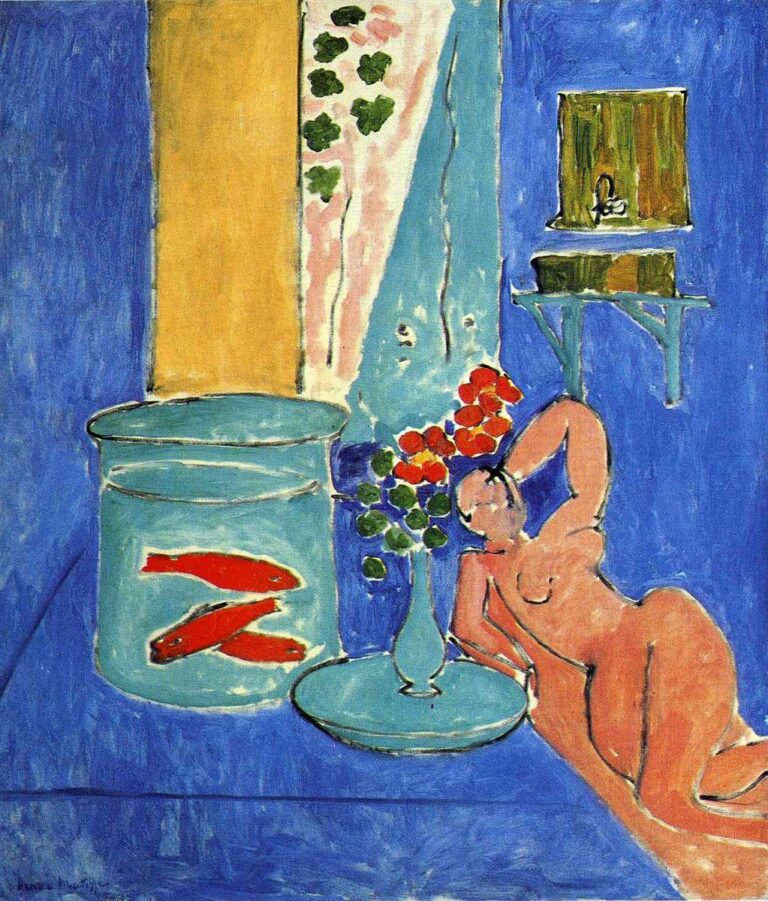
Blue interior with tall ocher and pink-aqua vertical panels; at left a turquoise glass cylinder holds three bright red fish; at center a pale platter and slender vase with red blossoms; at right a simplified reclining nude in warm coral tones; a small shelf and niche punctuate the wall, all rendered with bold contours in Henri Matisse’s 1911 “Red Fish and a Sculpture.”

Matisse’s 1911 canvas pairs a cylinder of turquoise water holding blazing red fish with a reclining coral-toned nude on a shallow blue stage. This analysis explains how limited color families, a balance of geometry and organic curves, brush-drawn contours, and light built by adjacency transform a sparse interior into a serene, modern harmony.

A Complete Analysis of “Manila Shawl” by Henri Matisse

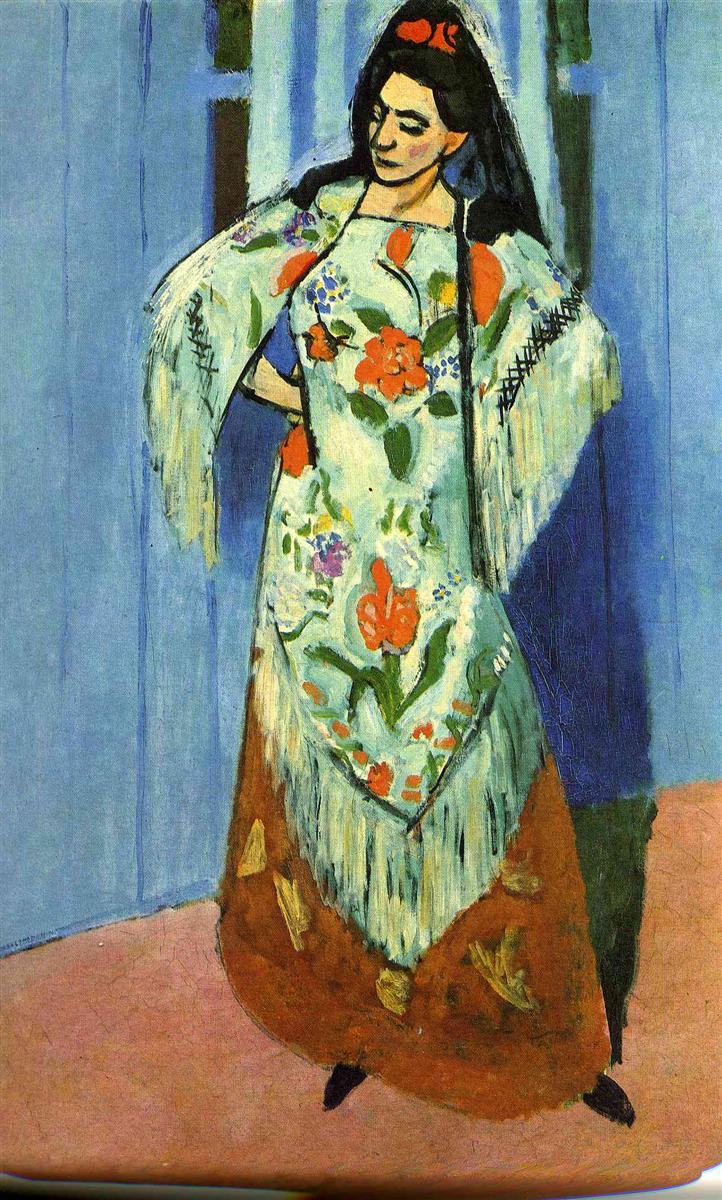
A dark-haired woman stands against cool blue wall panels on a warm pink floor, wearing a pale aquamarine Manila shawl embroidered with red and orange flowers and long fringe over a russet skirt; bold dark outlines, rhythmic fringe, and simplified planes unify the figure and setting in Henri Matisse’s 1911 “Manila Shawl.”

Matisse’s “Manila Shawl” (1911) elevates a floral, fringed garment into the architecture of an entire picture. This in-depth analysis explores how cool blue planes, warm floor tones, brush-drawn contour, and pattern used as structure convert a poised figure into a modern decorative harmony where textile, body, and space speak as one.

A Complete Analysis of “Goldfish” by Henri Matisse

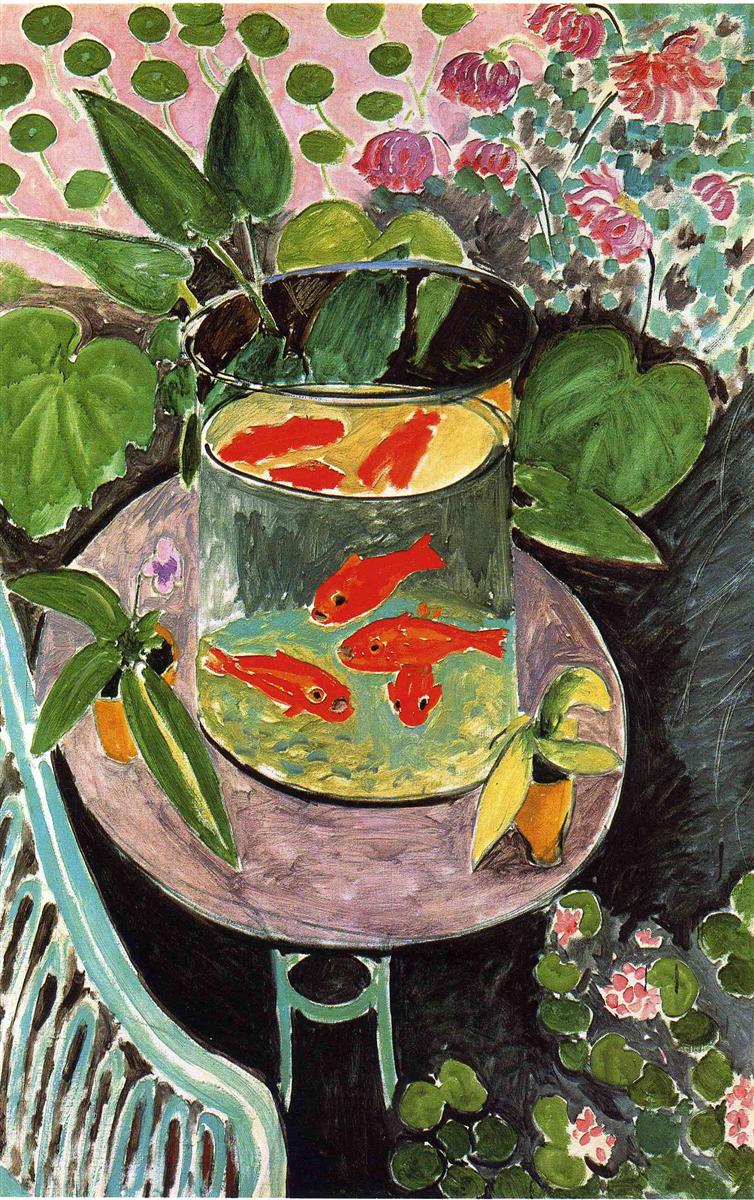
Round glass bowl of bright orange goldfish on a mauve table, surrounded by lush green leaves, a pale aqua chair, and a pink patterned backdrop; thick black contours and repeating circular leaf shapes unify the shallow garden interior in Henri Matisse’s 1911 “Goldfish.”

Henri Matisse’s “Goldfish” (1911) turns a tabletop aquarium into a decorative universe of pinks, greens, and blazing orange fish. This in-depth analysis explains how concentric curves, a limited color architecture, brush-drawn contours, reflection and refraction, and pattern used as structure create a shallow, mesmerizing world where looking itself becomes the subject.

A Complete Analysis of “Flowers and Ceramic Plate” by Henri Matisse

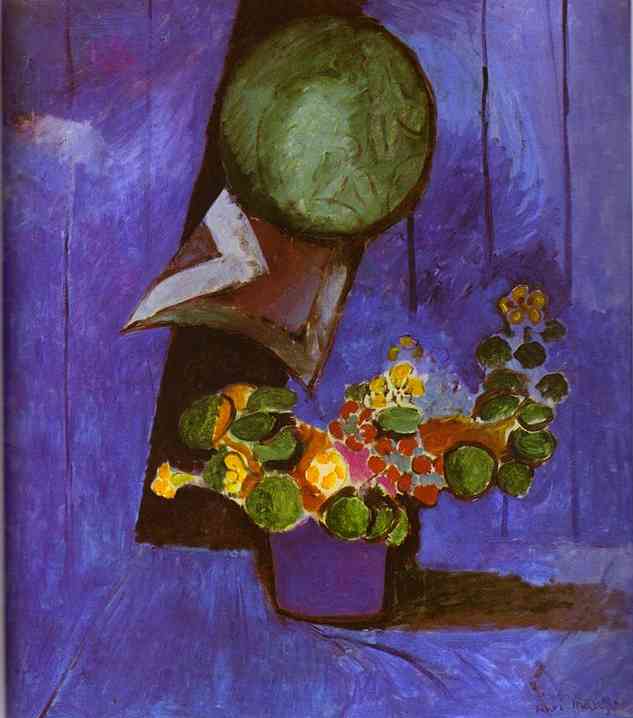
Violet interior with vertical seams; a large green ceramic plate hangs high at left above a pale triangular fold and a dark trapezoid; below, a violet pot holds a spray of yellow-orange blossoms and round green leaves that arc across the lower field, all drawn with bold contours and saturated color in Henri Matisse’s 1911 “Flowers and Ceramic Plate.”

Henri Matisse’s “Flowers and Ceramic Plate” (1911) turns a violet interior into a stage where a green circular plate, a sharp triangular fold, and a violet pot of yellow-orange blossoms balance geometric force and organic flow. This analysis explores the composition’s color architecture, contour, brushwork, shallow space, and how Matisse’s ethic of simplification transforms a few objects into enduring harmony.

A Complete Analysis of “Painter’s Family” by Henri Matisse

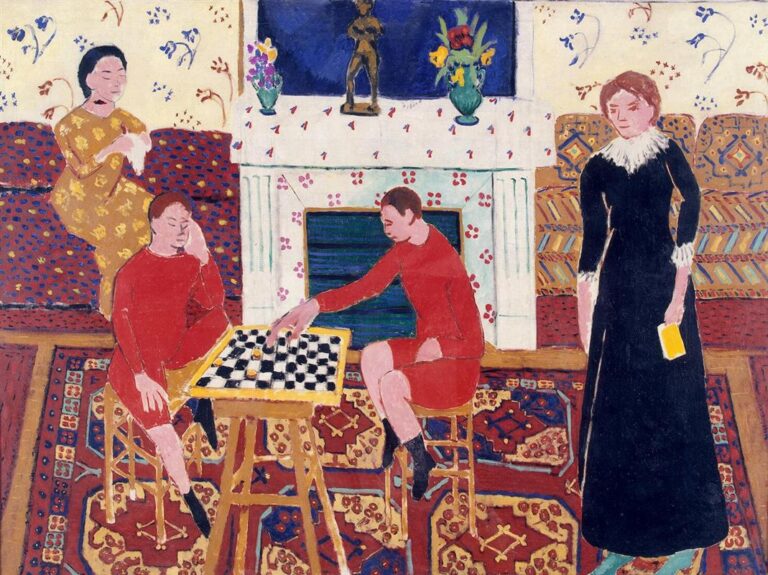
Interior with richly patterned rugs, sofa, and sprigged wallpaper; two youths in red tunics play a game on a black-and-white board at center; a seated woman in a yellow dress is at left, a woman in a long black dress holding a book stands at right; white mantel with small bronze and vases, blue fireplace opening and panel above, all rendered in bold, flat colors in Henri Matisse’s 1911 “Painter’s Family.”

Matisse’s “Painter’s Family” (1911) turns a patterned drawing room into a shallow stage where two red-clad youths play a board game as two women look on. This analysis unpacks how the chessboard grid steadies exuberant ornament, how color families and brush-drawn contours structure space, and how Matisse’s decorative order transforms everyday life into lasting harmony.

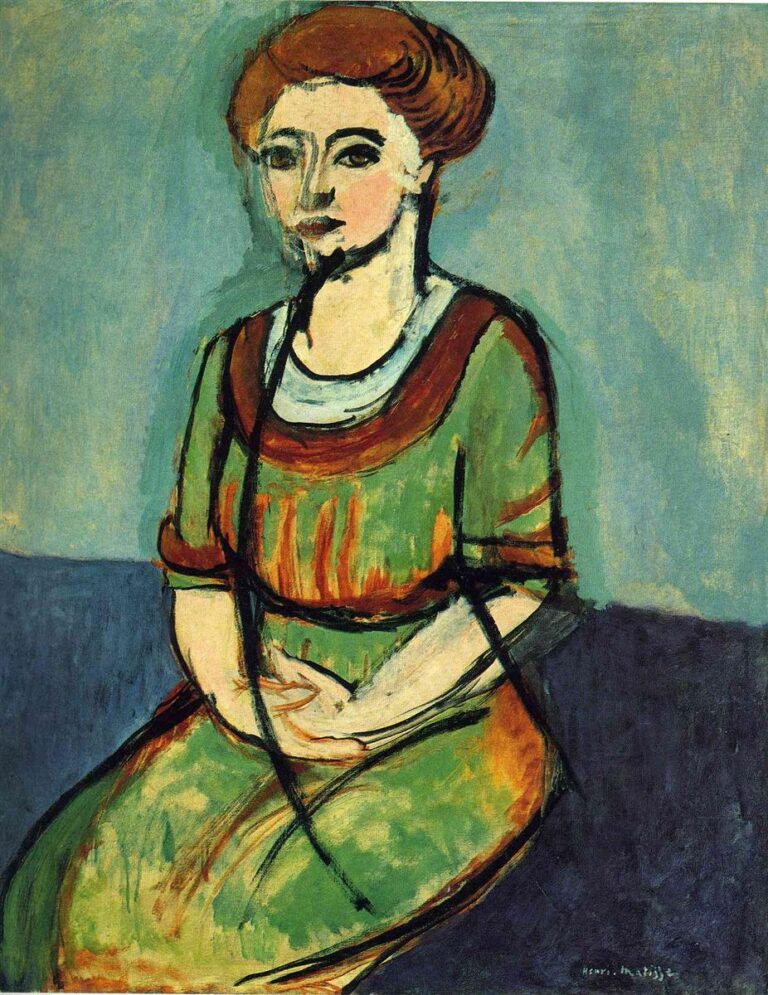
A Complete Analysis of “Olga Merson” by Henri Matisse

Seated woman with auburn hair and a green dress outlined in bold dark strokes, hands interlaced in her lap, set against a teal wall above a darker blue band; warm collar and hair contrast with cool background in Henri Matisse’s 1910 “Olga Merson.”

Matisse’s 1910 portrait “Olga Merson” turns a seated woman into a modern icon through a limited palette of blue, green, and orange, bold brush-drawn contours, and shallow decorative space. This analysis explores composition, color architecture, calligraphic outline, the expressive center of the clasped hands, and how the work exemplifies Matisse’s post-Fauvist clarity.

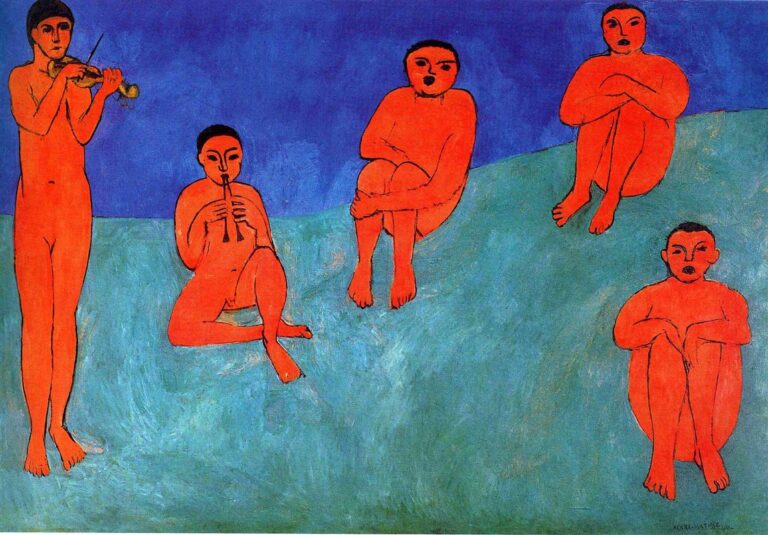
A Complete Analysis of “Music” by Henri Matisse

Five simplified red nude figures arranged across a green ridge under a solid blue field; a violinist stands at left, a flutist sits near center, and three listeners sit with clasped knees, all outlined in dark contours in Henri Matisse’s 1910 panel “Music.”

Henri Matisse’s “Music” (1910) reduces five scarlet nudes, a green ground, and a blue sky to a powerful chord about sound and attention. This in-depth analysis explores composition as musical score, the triadic color architecture, brush-drawn contour, shallow space, and the work’s dialogue with “Dance,” revealing how Matisse turns simplification into enduring resonance.

A Complete Analysis of “Girl with Tulips” by Henri Matisse

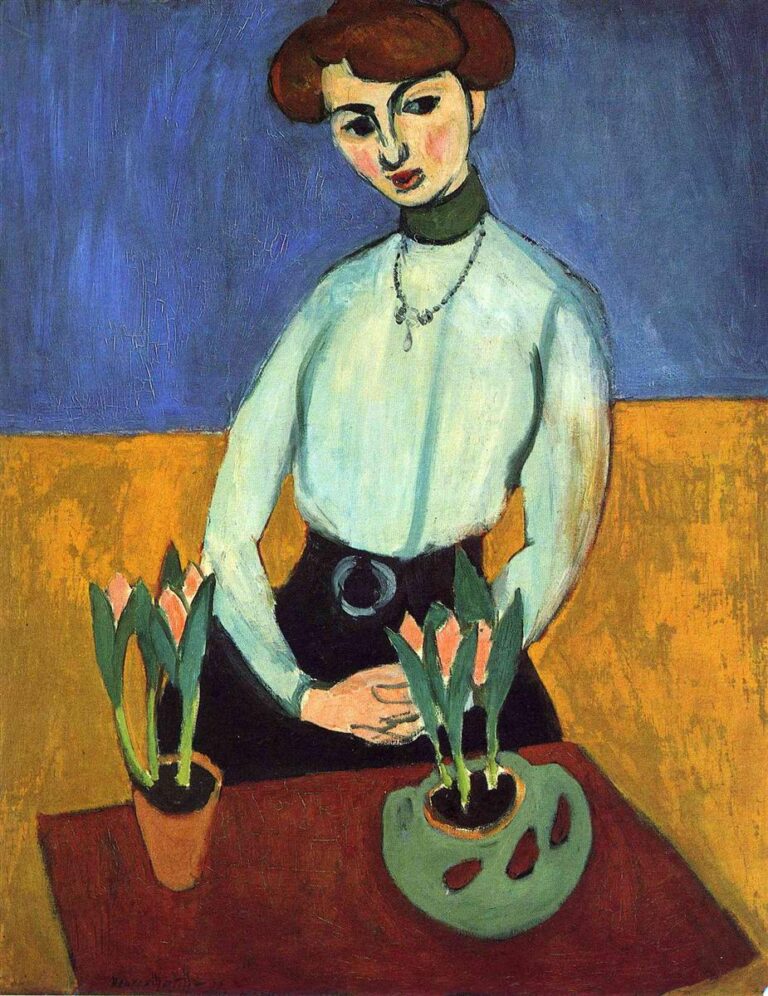
Young woman with head slightly tilted stands behind a diagonal table holding two pots of tulips; she wears a pale blouse with a dark skirt and green choker, hands clasped at a belt with a silver ring; background divided into a mauve-blue upper wall and ochre lower band in Henri Matisse’s 1910 “Girl with Tulips.”

Matisse’s “Girl with Tulips” (1910) fuses portrait and still life on a shallow, decorative stage. A cool blue wall, warm ochre field, and slanting red-brown table set the climate for a poised young woman and two pots of tulips. This in-depth analysis explains how limited palette, brush-drawn contour, diagonal-vertical counterpoint, and light built by adjacency create a calm, enduring harmony.

A Complete Analysis of “Girl with a Black Cat” by Henri Matisse

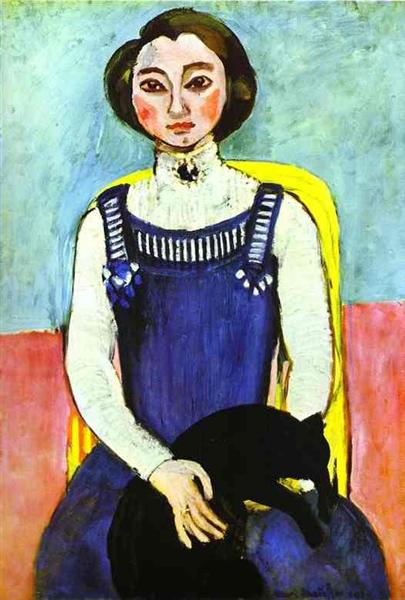
Front-facing portrait of a seated girl in a dark-blue pinafore over a pale blouse, framed by a yellow high-back chair; her cheeks are rosy, and a simplified black cat curves across her lap; behind her, a two-part background of rose and cool aqua-gray creates a calm, flat stage in Henri Matisse’s 1910 “Girl with a Black Cat.”

Henri Matisse’s “Girl with a Black Cat” (1910) transforms a child and her pet into a modern icon through a limited palette, bold brush-drawn contours, and a shallow decorative stage. This in-depth analysis explores composition, color architecture, the cat’s role as structural counterform, and how Matisse’s 1910 clarity turns domestic quiet into lasting presence.

A Complete Analysis of “Open Window at Collioure” by Henri Matisse

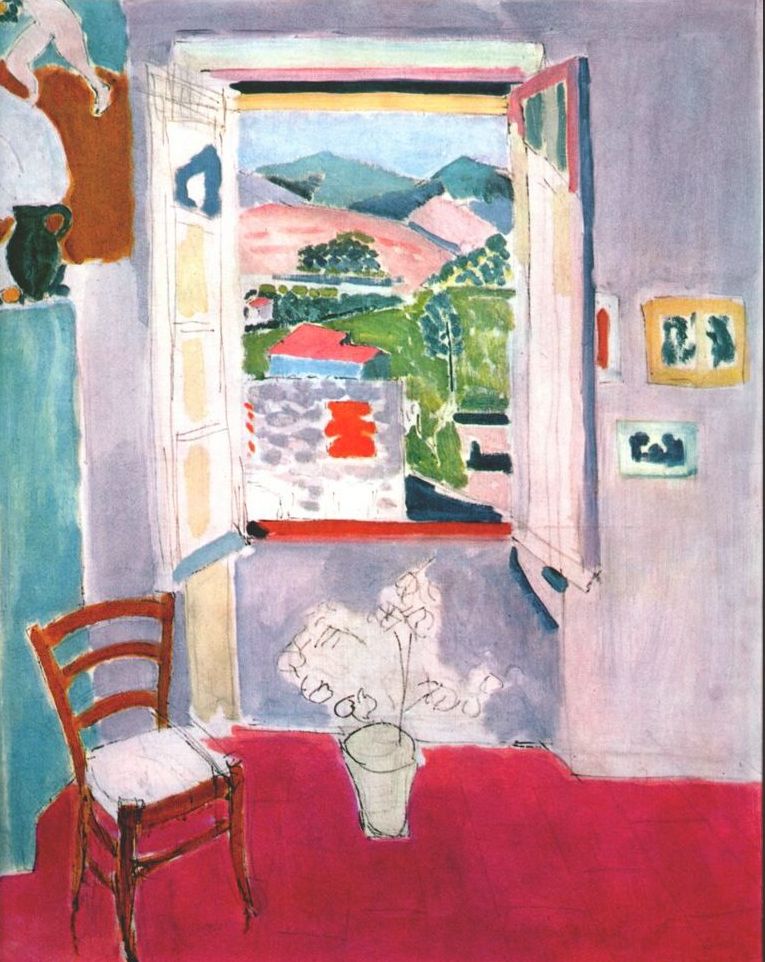
Interior with red floor, lavender-gray walls, and a wooden chair at left; open white shutters reveal a bright landscape of blue-green hills, pink fields, and a coral roof; a small potted plant sits below the sill and two framed pictures hang on the right wall in Henri Matisse’s 1910 “Open Window at Collioure.”

Matisse’s “Open Window at Collioure” (1910) turns a modest room—chair, red floor, pale walls—and a sunlit view beyond the shutters into a single, coherent harmony. This analysis explains how color architecture, nested frames, brush-drawn contour, and shallow space transform the window motif into a modern meditation on light and calm.

A Complete Analysis of “Bather” by Henri Matisse

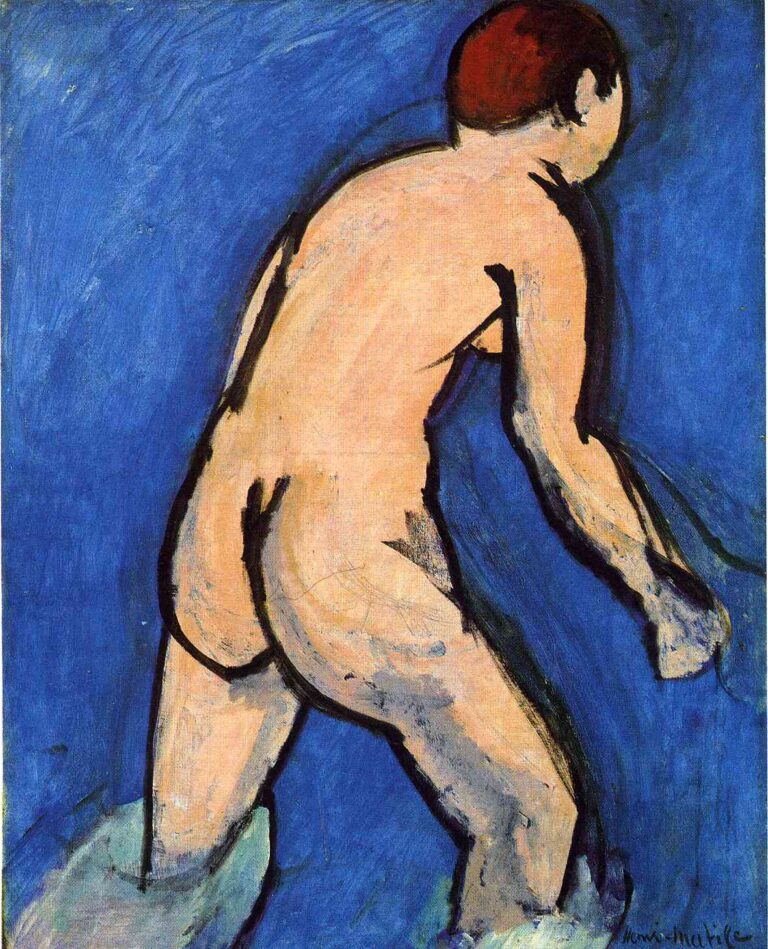
Back-view nude stepping into foamy water against an all-over ultramarine field; warm apricot skin bounded by dark contours, small russet cap of hair, and pale splashes at the ankles convey motion in Henri Matisse’s 1909 “Bather.”

Matisse’s “Bather” (1909) uses a single ultramarine field, warm flesh tones, and bold brush-drawn contours to turn a stepping nude into a modern emblem of motion and clarity. This analysis unpacks the composition’s diagonals, the triadic color architecture, shallow-space design, and the painting’s role in Matisse’s 1909 pivot from Fauvist shock to enduring decorative order.

A Complete Analysis of “Nude with a Scarf” by Henri Matisse

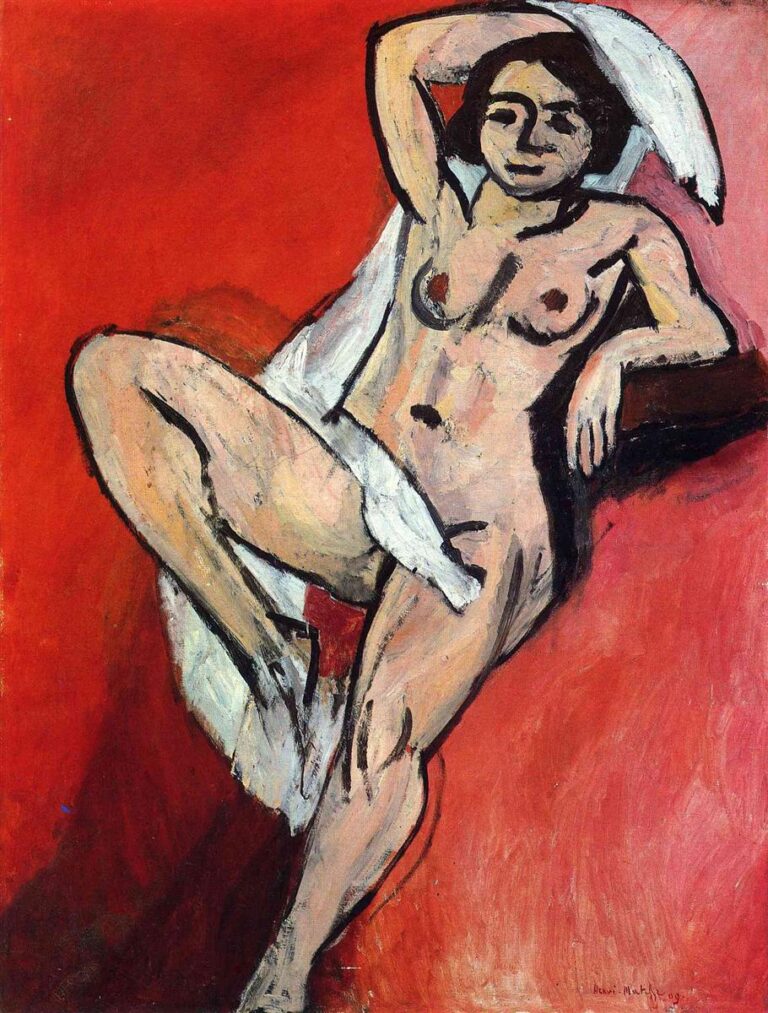
Reclining nude outlined in bold dark strokes rests against a saturated red background; a pale white scarf arcs over her head and crosses hip and thigh, while simplified planes of warm flesh and a small dark platform anchor the pose in Henri Matisse’s 1909 “Nude with a Scarf.”

Matisse’s “Nude with a Scarf” (1909) sets a reclining figure against a saturated red field, using bold contour, a cool white scarf, and planar modeling to build light and space without illusion. This analysis unpacks the composition’s diagonals, color architecture, brushwork, and how the painting embodies Matisse’s 1909 shift from Fauvist shock to lucid, decorative order.

A Complete Analysis of “Still Life with ‘Dance’” by Henri Matisse

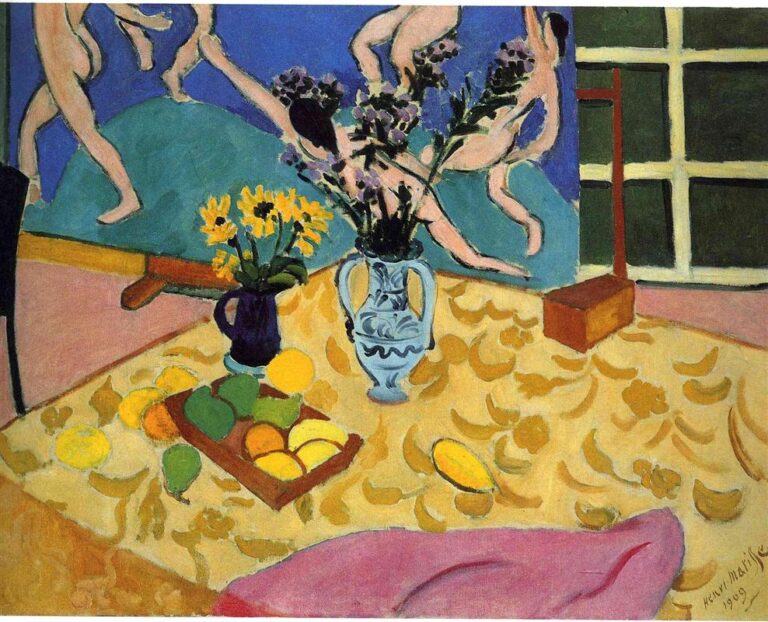
Patterned yellow table with lemons in a wooden tray, a dark violet jug of yellow flowers, a pale blue pitcher of purple blooms, a small wooden box, and a folded pink cloth in the foreground; behind, a blue panel shows pink nude dancers circling on a green hill next to a gridded green window in Matisse’s 1909 “Still Life with ‘Dance.’”

Henri Matisse’s “Still Life with ‘Dance’” (1909) unites a lavish tabletop—lemons, jugs, flowers, patterned cloth—with a backdrop of his whirling “Dance” panel. This analysis explains how Matisse balances near and far through color chords, contour, pattern, and a shallow decorative stage to create a single, breathing harmony.

A Complete Analysis of “Spanish Woman with a Tamborine” by Henri Matisse

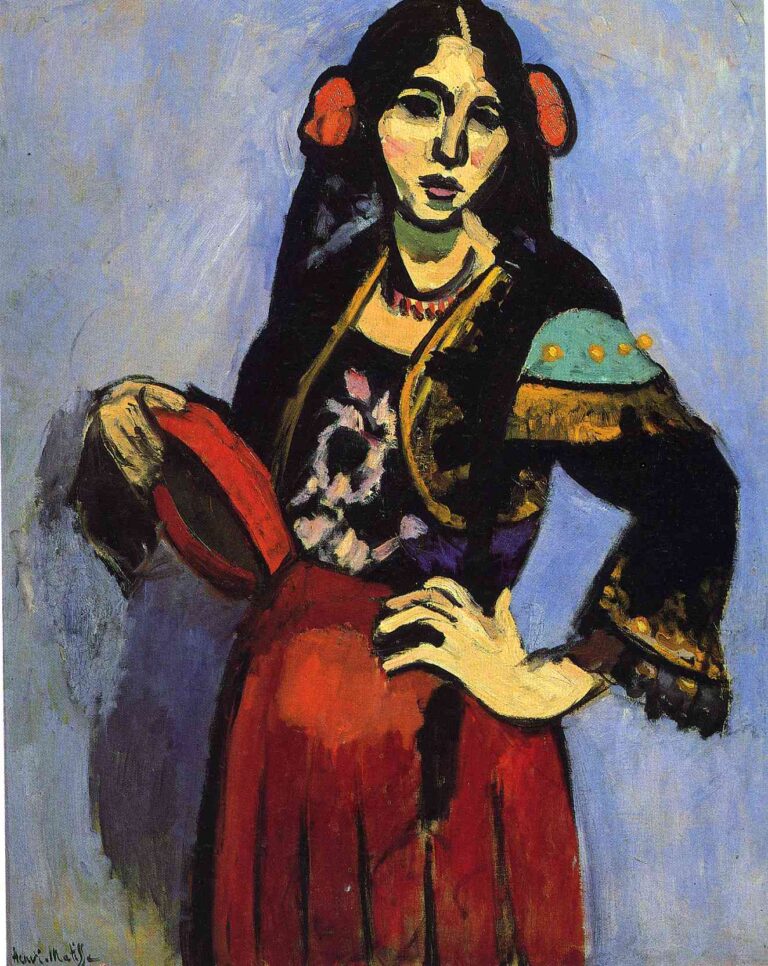
Three-quarter portrait of a woman in a black-and-gold jacket and red skirt, holding a red tamborine at her hip; red rosettes pin back her dark hair, a turquoise shoulder patch brightens the sleeve, and a cool blue background sets off bold contours in Henri Matisse’s 1909 “Spanish Woman with a Tamborine.”

Matisse’s 1909 “Spanish Woman with a Tamborine” transforms a flamenco-inflected figure into pure rhythm and color: a poised woman in black and gold jacket, red skirt, and turquoise epaulette set against a cool blue field. This analysis explores composition, color architecture, brush-drawn contour, the tamborine’s circular counterpoint, and how Matisse turns costume and gesture into a modern emblem of poise.