Image source: wikiart.org
Introduction
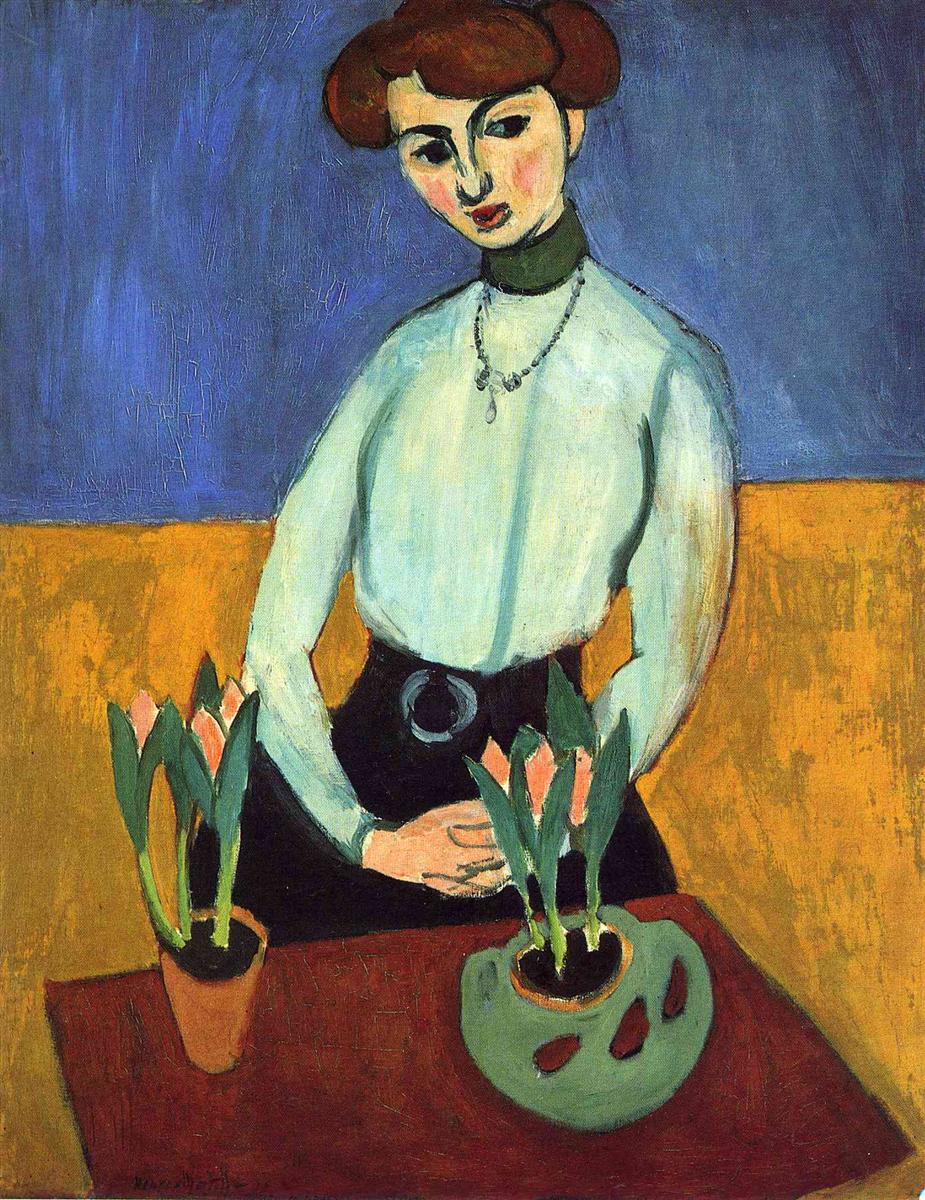
Henri Matisse’s “Girl with Tulips” (1910) is a poised conversation between portrait and still life, a picture that stages a quiet drama of color, contour, and rhythm. A young woman, head slightly inclined and gaze lowered toward the table, stands behind two pots of tulips whose pale buds are just opening. The room is simplified into two broad bands—a mauve-blue upper wall and a golden, sun-warmed lower field—while the tabletop thrusts diagonally across the foreground like a stage. With a handful of decisively placed hues and brush-drawn lines, Matisse builds a world that feels both intimate and architectonic, modern and timeless. The work belongs to the moment just after the blaze of Fauvism, when he harnessed high color to a lucid order; here, every patch of paint performs structural work.
The 1910 Turn: From Shock to Order
By 1910 Matisse had tempered his Fauvist detonations into a more deliberate grammar. Color remained saturated, but it was no longer the tumultuous protagonist; it had become architecture. “Girl with Tulips” belongs squarely to this pivot. The palette is restricted and carefully tuned: mauve-blue and ochre for the room; a red-brown table; the cool gray-green of a pierced ceramic pot; terra-cotta for the smaller one; leafy greens for the tulip blades; coral-rose for the petals; the sitter’s pale blouse and dark skirt; a black belt punctuated by a silver ring; a green choker and beaded chain. The simplification is not impoverishment; it is a promise that relations—warm against cool, vertical against diagonal, hard contour against soft interior—will carry meaning.
Composition: A Cross of Movements
The composition rests on a beautiful cross. The sitter’s torso, shoulders, and the long vertical fall of her blouse set a calm downward movement that anchors the center. Countering that, the tabletop slants steeply from lower left to upper right, becoming a powerful diagonal vector. Two upright tulip clumps mark the table like sentinels, their vertical thrust echoing the figure while also interrupting the table’s slant. The hands, gently clasped at the belt line, form a small oval rhythm at the composition’s heart—an intimate counterpoint to the large geometric moves.
Color Architecture and Climatic Chords
Matisse organizes the painting through two dominant climate chords. The upper chord is cool: the wall’s mauve-blue spans across the top third like evening air, reinforcing the sitter’s calm. The lower chord is warm: an ochre band fills the mid-ground and spills into the table’s reddish plane, radiating a steady heat that keeps the scene from drifting into chill. The tulips knit the two climates together—their blades repeat the cool of the choker and the greenish pot, while their petal pinks echo the sitter’s lips and cheeks. Because the palette is so spare, each hue has a clear job: blue steadies, ochre warms, red-brown grounds, green refreshes, pink quickens, black articulates, white illuminates.
The Face: Planes, Reserve, and Modern Poise
The sitter’s face is constructed with a few decisive planes and emphatic contours. A rosy wedge brightens the cheek; a cooler, gray-violet note cools the forehead and temple; the eyes are sculpted with dark, almond-shaped lids; the nose resolves in a single confident stroke; the small mouth holds a measured, almost meditative tilt. The head leans subtly, introducing a diagonal that echoes the table and averts the sentimentality that a straight, front-facing pose might invite. Matisse avoids theatrical expression; character comes from posture and the pressure of lines rather than from an anatomist’s modeling. The effect is dignified reserve—the portrait of a person absorbed in the shared space of plants and room.
Hands and the Loop of Attention
Placed just above the belt buckle’s silver ring, the hands form a gentle loop that magnetizes the eye. Their pale, simplified planes are outlined with elastic dark strokes; fingers interlace in a quiet knot that balances the more explicit geometry of the skirt and belt. This loop links the sitter to the tulips: the hands hover in the same horizontal register as the leaves, creating a band of human and botanical forms that ties figure to still life. It is also a psychological fulcrum, a place where self-containment, tactility, and contemplation meet.
Tulips as Counterforms and Timekeepers
The two clusters of tulips are more than botanical notes. They act as counterforms that stabilize the compositional cross. The left pot, taller and terracotta, stands like a modest column at the table’s edge; the right pot, broader and pale green with pierced ovals, spreads its weight nearer the sitter. Their upright blades are calligraphic strokes of green, somewhere between leaf and sign. The buds, not yet open, carry a temporal charge: we are at the moment just before bloom. That imminence of opening rhymes with the sitter’s lowered attention, as if both human and plant paused in the same suspended time.
Background as Active Field
Rather than detailing furniture or walls, Matisse divides the background into two painted fields. The mauve-blue upper zone is brushed in layered, directional strokes that leave a soft texture; the ochre mid-ground is warmer and a bit rougher in application, announcing the atmosphere of the room more than its architecture. The seam between the fields sits just above the sitter’s waist, giving the figure a horizon without a literal vista. This economy protects the painting’s decorative coherence: the eye reads the scene as an arrangement of weighted planes, not as a catalogue of objects.
Drawing With the Brush: Contour as Structure
As in Matisse’s best work of this period, the drawing is executed with the brush and a near-black pigment. Lines thicken and slim with the turn of form—pressing heavier around the jaw hinge, easing along the blouse’s shoulder, snapping firmly around the belt, skirting the pots with a craftsman’s certainty. The contour around the tulip leaves is particularly telling: it is not a botanical outline but a conductor’s notation, indicating direction and pace. Because so much form is carried by contour, interior modeling can remain spare; a few planar shifts suffice to turn volumes.
Light by Adjacency, Not Chiaroscuro
There are no theatrical cast shadows. Light is built through adjacency and temperature. The blouse looks luminous because its cool, milky planes sit between the warm ochre and the dark skirt; the table breathes because red-brown is broken by lighter dry-brush scrapes; the tulip buds glow because coral sits against cool leaf green; a tiny highlight on the belt ring and a pale edge on the pots complete the illusion of sheen. Matisse’s light, therefore, is a consequence of relations, not a separate layer laid over description.
Space as Shallow, Persuasive Stage
Depth is deliberately shallow. The tabletop tilts more than one would expect in natural perspective, a strategy that displays the plants like actors on a proscenium. The figure belongs to that stage without receding behind it; the diaphragm of the belt aligns with the seam between wall bands, flattening the torso just enough to keep the surface coherent. Overlaps (pot in front of table edge; hands crossed before the skirt) are sufficient cues to space. The viewer is not invited to wander into a room; we are asked to read a surface whose planes are tuned to harmony.
Ornament as Discipline, Not Frill
Matisse understood “decorative” not as prettiness but as the even distribution of visual interest. In “Girl with Tulips” this principle appears in restrained, structural ways: the necklace is a small chain of gray notes that echoes the stems; the circular belt buckle rhymes with the pierced ovals of the green pot; the blouse’s cuffs and shoulder seams supply modest accents that keep the garment from becoming a blank slab. Ornament binds parts to the whole, preventing any one area from dominating.
Psychology Without Anecdote
Although the painting includes a person and objects with potential stories, Matisse rejects anecdote. The sitter is not named; her activity is minimal; the plants have no symbolic accessory. Yet the picture carries a clear mood: concentration, inwardness, and equilibrium. The downward tilt of the head, the clasp of hands, the pause before blossoms open—together they suggest a reflective moment in which looking and waiting coincide. The absence of facial theatrics leaves the viewer room to project, and the structural calm keeps sentiment at bay.
Rhythm Across the Surface
Movement in the painting is gentle yet exact. The hard diagonal of the table sends the eye upward to the right; the head tilt returns it leftward; the twin verticals of tulip leaves slow the pace; the necklace’s tiny beads tick like a metronome across the blouse. Even the brushwork carries rhythm: in the blue wall, horizontal scumbles; in the ochre band, broader, warmer pulls; in the table, long strokes that follow its slant; in the leaves, quick, elastic darts. These rhythms create a breathing surface, a visual tempo that sustains attention without strain.
Kinships and Contrasts With Sister Works
“Girl with Tulips” sits in dialogue with “Girl with Green Eyes,” “Greta Moll,” and “Girl with a Black Cat,” portraits from the preceding years where a single figure occupies a shallow stage and color is structural. Compared with the 1908 portraits’ rawer Fauvist chords, this 1910 canvas is more measured; the blues are cooler, the warms less incendiary, the blacks more sparingly applied. It also anticipates the Nice interiors of the 1920s, in which flowers, fabrics, and women share a choreography of patterned planes. Here, the seeds of that language are already visible: a woman’s presence integrated with a tabletop still life in a climate of controlled light.
The Ethics of Simplification
The painting demonstrates Matisse’s ethical stance toward depiction: to remove the unnecessary so the necessary can speak. He refuses to enumerate details of furniture, garment weave, or plant botany. In their place he offers legible planes and clear intervals—the very aspects that allow the viewer to experience calm and order. Simplification is not a trick for speed; it is a way of respecting both subject and viewer. The sitter’s dignity grows from what is omitted as much as from what is shown.
Material Presence and Evidence of Process
Look closely and you can see the painting’s time. Dry scumbles in the blue let the linen’s tooth breathe; slight halos remain where contour was adjusted along the blouse and pots; the ochre band reveals earlier brush directions; the red-brown table shows thin places where the ground color glows through. These traces refuse a factory polish and instead give the picture the authority of decisions made on the surface. The final equilibrium feels discovered rather than engineered.
Seeing Through Color: Lessons for Today
Beyond its historical context, the canvas offers a method that remains useful. Choose a limited palette and assign each hue a structural role. Build a stable scaffold of large fields before placing accents. Let contour do the heavy lifting of form so interior modeling can stay spare. Use a tabletop as a stage where objects converse with a figure. Construct light through adjacency, not through a fog of blended shadows. If these principles are followed, the result—whether in painting, photography, or design—will read instantly and sustain prolonged looking.
Why “Girl with Tulips” Endures
More than a century later, the painting still feels new because it trusts essentials: a poised human presence, two ordinary pots of flowers, a few fields of color, and lines that carry conviction. Its serenity is not the absence of feeling but the successful choreography of it. Warmth meets coolness, curve meets diagonal, plant growth meets human stillness, all held on one breathing surface. It is exactly the kind of restorative clarity that Matisse hoped paintings could offer—art that steadies attention the way a good chair steadies the body.
Conclusion
“Girl with Tulips” is a masterclass in modern balance. Matisse converts a modest studio motif into an emblem of poise by orchestrating color climates, contour rhythms, and shallow space. The woman’s tilted head and clasped hands, the tulips’ upright blades and poised buds, the table’s assertive diagonal, and the room’s two-band backdrop all join in a measured equilibrium. Nothing is wasted; every decision is legible. In the quiet interval before flowers open, the picture itself blooms—an art of essentials, radiant in its restraint.