Category Alphonse Mucha

A Complete Analysis of “Ascension” by Alphonse Mucha

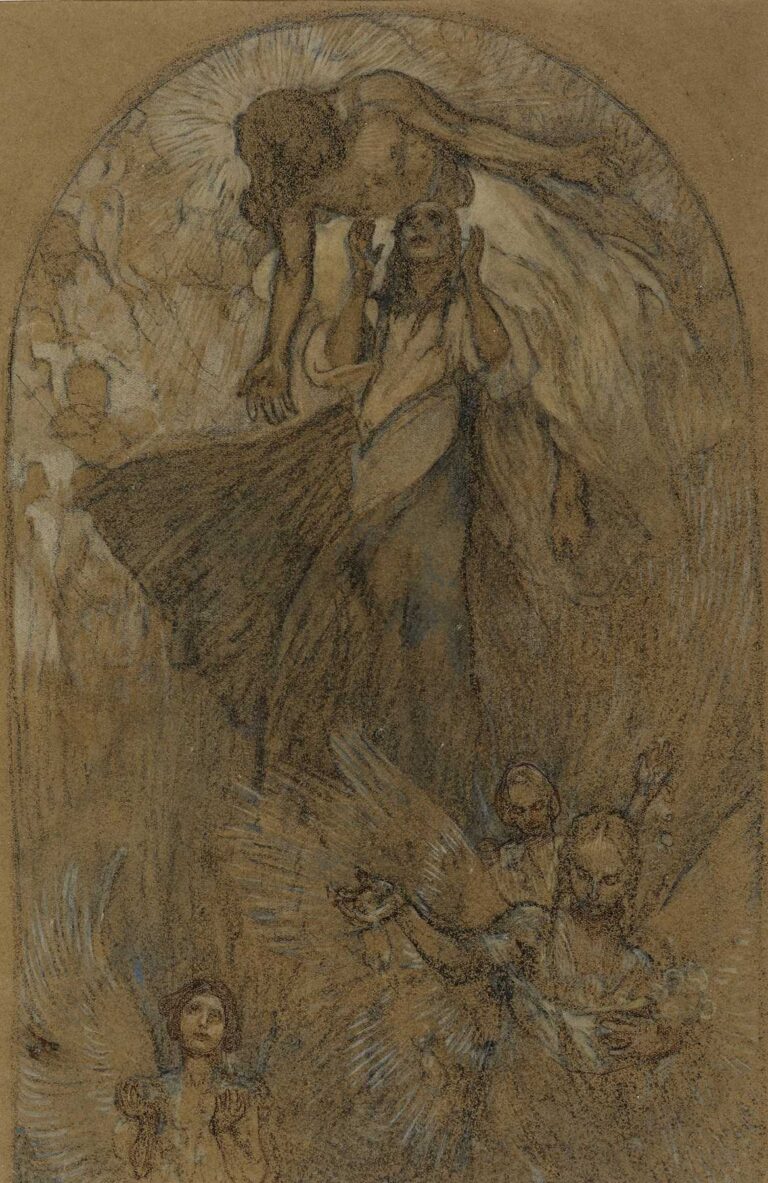
Vertical arched drawing by Alphonse Mucha showing a radiant figure rising at the top, a woman below with upraised hands, and angels with spreading wings ascending from the bottom; executed on brown paper with graphite, washes, and white chalk highlights.

Alphonse Mucha’s “Ascension” transforms the Art Nouveau master’s flowing line into a luminous devotional vision. This analysis explores composition, symbolism, materials, and the work’s dialogue with Byzantine art to show how a simple study becomes a convincing theology of light and movement.

A Complete Analysis of “Jaroslava Muchová” by Alphonse Mucha

Toned-paper drawing by Alphonse Mucha of a seated young woman with long flowing hair adorned with small flowers, turning to face the viewer; she rests one hand under her chin while a luminous white draped dress and tassels are highlighted with white, and soft swirling lines fill the background.

Alphonse Mucha’s 1920 portrait of his daughter Jaroslava blends intimate likeness with the flowing arabesque of Art Nouveau. This in-depth analysis explores composition, line, white heightening on toned paper, historical context, and the father-daughter relationship that makes the drawing one of the artist’s most tender late works.

A Complete Analysis of “Absinth” by Alphonse Mucha

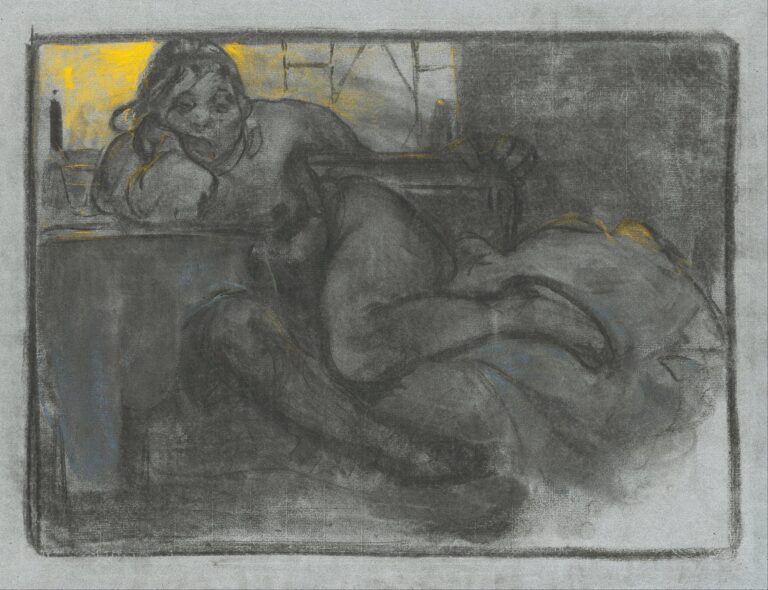
Charcoal and pastel drawing by Alphonse Mucha showing a dim interior: one figure reclines curled on a couch while another leans on a table at left; a mustard-yellow light glows from a window behind them, with deep greys and faint blue tones creating a moody, late-night atmosphere.

Alphonse Mucha’s 1905 drawing “Absinth” replaces Art Nouveau glamour with a smoky, intimate study of late-night fatigue. This in-depth analysis examines composition, light, palette, psychology, and historical context to show how charcoal, yellow backlight, and two weary figures turn the era’s infamous drink into a nuanced modern scene.

A Complete Analysis of “Young woman with folk headdress” by Alphonse Mucha

Blue-pencil portrait by Alphonse Mucha of a young woman wearing an ornate folk headdress, beaded choker, and patterned bodice; the face is carefully shaded, the garments drawn with flowing lines on warm paper, with a handwritten dedication and 1913 date at lower right.

Alphonse Mucha’s 1913 drawing “Young woman with folk headdress” unites intimate portraiture and Slavic heritage. Rendered in cool blue pencil on warm paper, the work models the face with tender hatching and describes a jeweled headdress and patterned bodice with rhythmic line, revealing how Mucha’s Art Nouveau elegance grows from close observation and cultural memory.

A Complete Analysis of “Woman Bending Over” by Alphonse Mucha

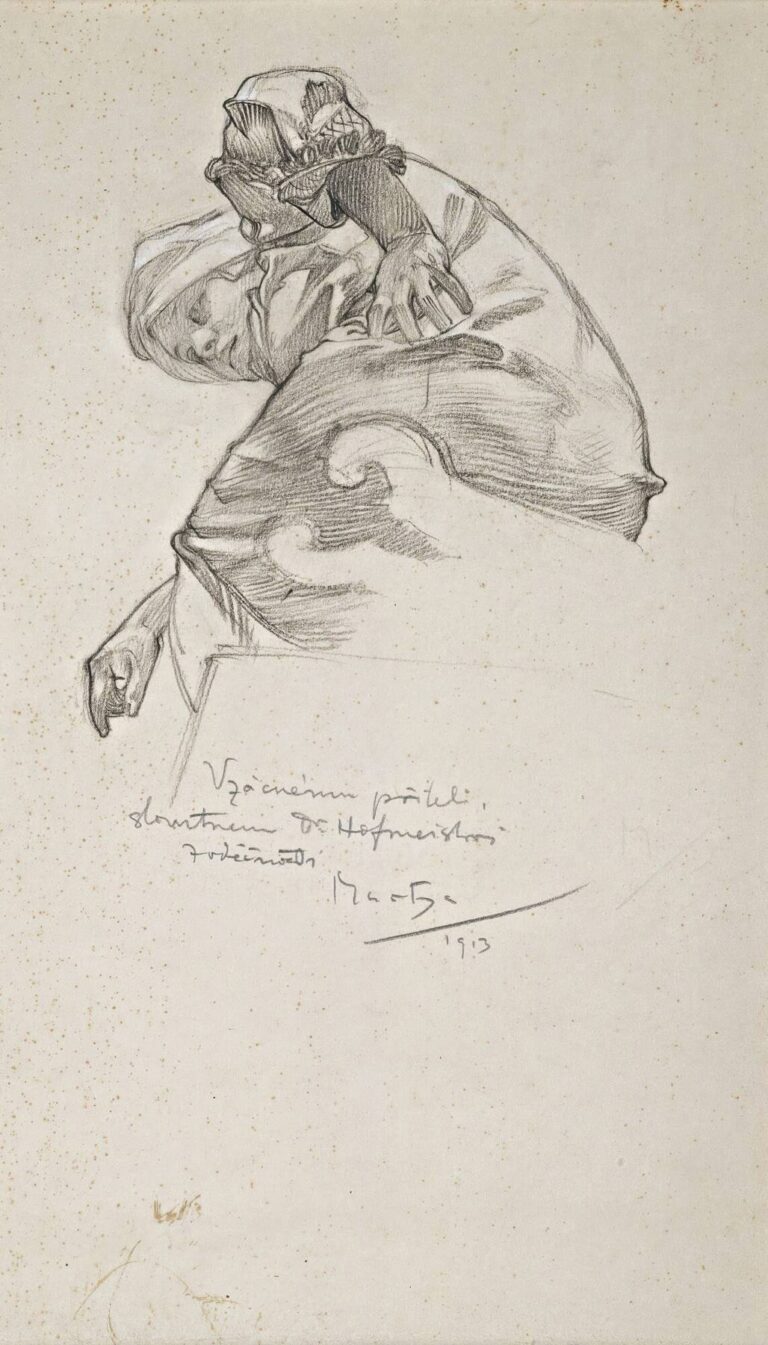
Graphite drawing by Alphonse Mucha showing a woman in a headscarf leaning forward over a rounded surface; one arm extends diagonally with a ruffled cuff while the other hand hangs relaxed at the lower left; swirling folds model the back and shoulder, with a Czech inscription and 1913 date below on a largely blank sheet.

Alphonse Mucha’s 1913 graphite drawing “Woman Bending Over” compresses motion, anatomy, and empathy into a small cluster of lines on a mostly blank page. This in-depth analysis explores composition, drapery, gesture, negative space, and the work’s place in Mucha’s career, revealing how a simple moment becomes a masterclass in drawing.

A Complete Analysis of “Czech young woman” by Alphonse Mucha

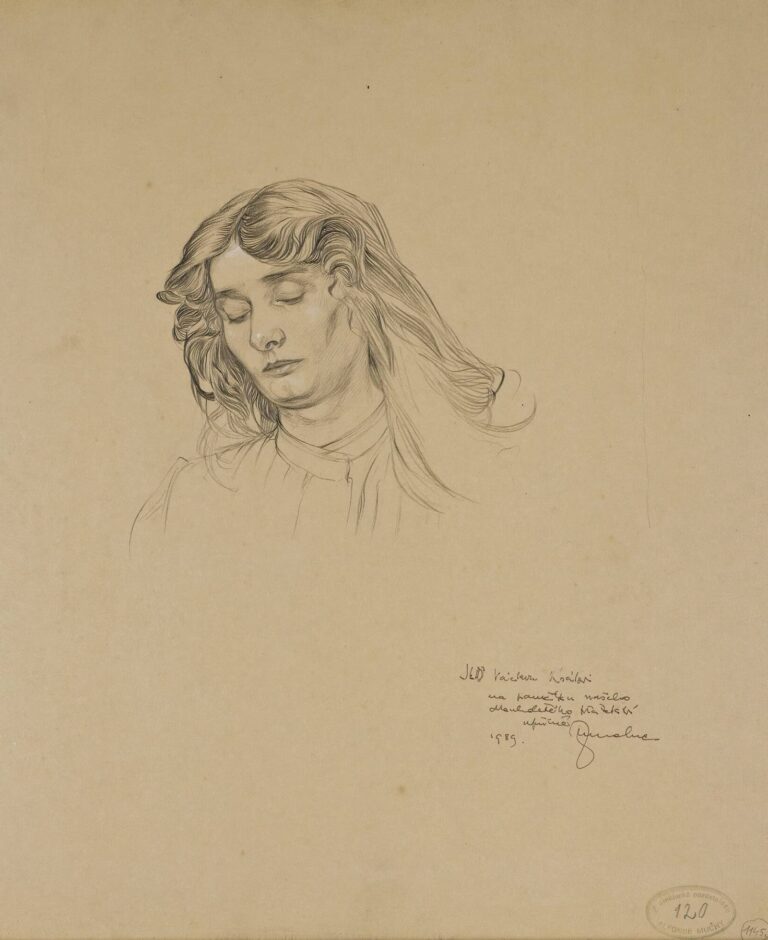
Graphite head-and-shoulders drawing by Alphonse Mucha of a young woman with long wavy hair and downcast eyes on a largely empty sheet; delicate shading models the face while the blouse is barely indicated and a handwritten inscription appears on the lower right.

Alphonse Mucha’s 1889 drawing “Czech young woman” reveals the artist’s masterful draftsmanship before his poster fame. This in-depth analysis explores composition, negative space, gesture, national identity, and the subtle graphite technique that turns a simple head study into a profound meditation on presence.

A Complete Analysis of “Jaroslava Mucha” by Alphonse Mucha

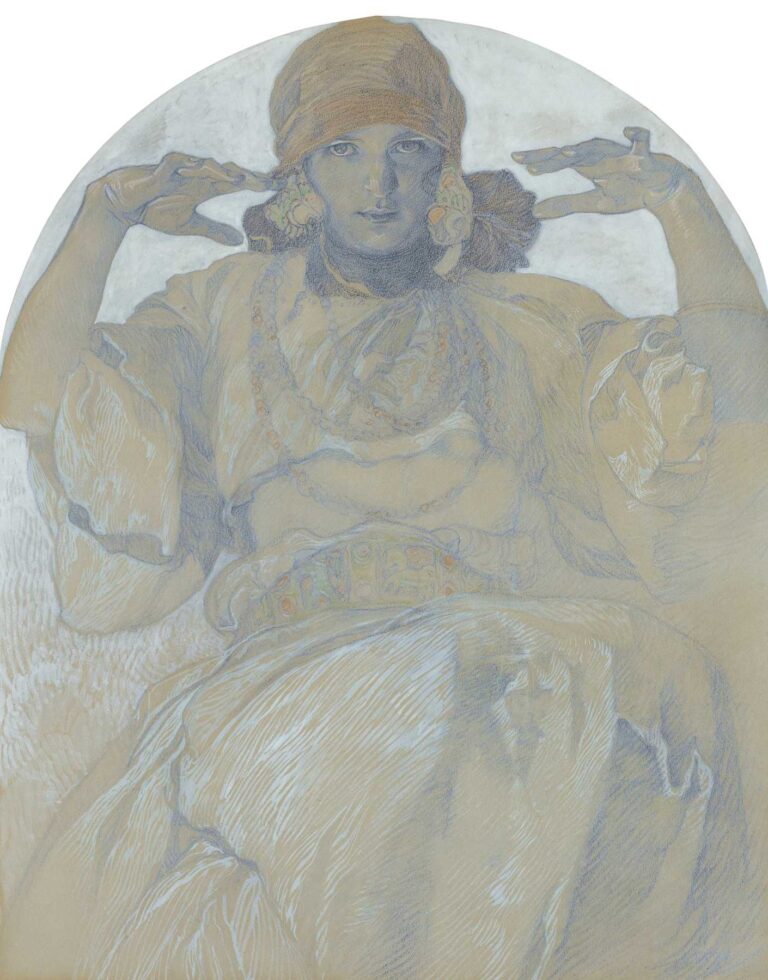
Semicircular portrait drawing by Alphonse Mucha of a young woman wearing a headscarf, earrings, and layered necklaces; she sits close to the viewer with both hands raised to frame her face, her dress rendered in blue-gray pencil with white highlights on warm toned paper.

Alphonse Mucha’s “Jaroslava Mucha” is a luminous toned-paper portrait of the artist’s daughter. With blue–gray pencil, white heightening, and restrained color, Mucha frames her face with raised hands, blending personal likeness, Slavic heritage, and Art Nouveau elegance into a poised, iconic image.

A Complete Analysis of “The Dance Of Death” by Alphonse Mucha

Monochrome ink-and-wash drawing by Alphonse Mucha showing a bat-winged skeleton lifting a terrified woman while grotesque demons surround them; ghostly figures swirl in smoke at the top, reeds and a crouching demon occupy the lower right, and a small child lies sprawled on the ground at lower left.

Alphonse Mucha’s ink-and-wash drawing “The Dance Of Death” transforms the medieval danse macabre into a modern vortex of motion: a winged skeleton seizes a woman as demons gather and a child lies below. This in-depth analysis explores composition, technique, symbolism, and the work’s unsettling place within Mucha’s art.

A Complete Analysis of “Female figure” by Alphonse Mucha

Tall Art Nouveau panel by Alphonse Mucha showing a woman in profile with raised hands, crowned with white flowers and wrapped in flowing blue drapery, set against soft ovals and diagonal bands within a border of stylized blossoms.

Alphonse Mucha’s vertical panel “Female figure” presents a woman in profile shaping air with raised hands inside a floral frame and cool blue palette. The work distills Art Nouveau ideals—whiplash line, geometric haloes, lyrical drapery—into a self-contained meditation on poise, movement, and light.