Image source: wikiart.org
Introduction
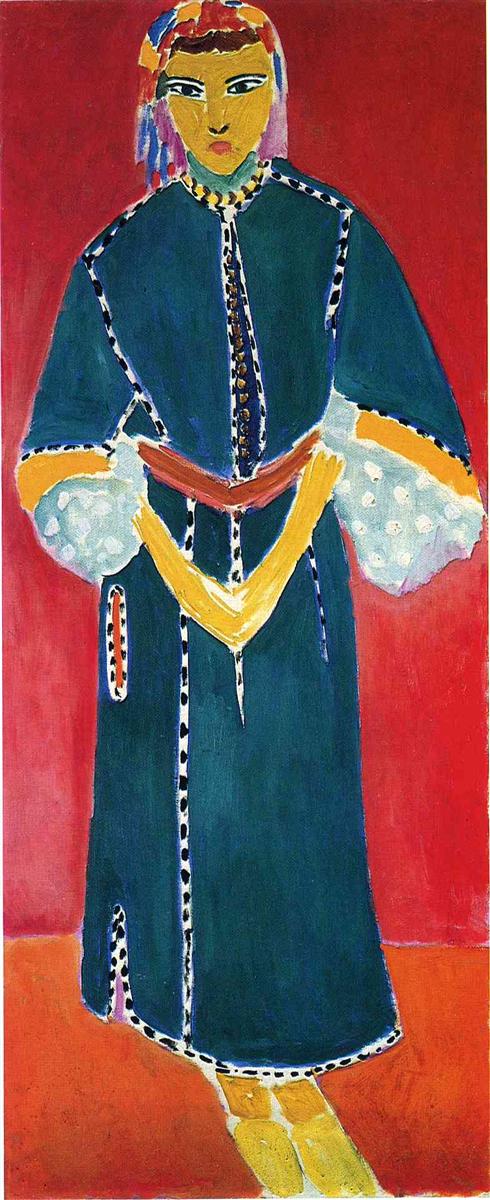
Henri Matisse’s “Zorah Standing” (1912) is a tall, radiant statement about presence. A young woman, identified as Zorah, fills nearly the entire height of the canvas. She stands frontal and unblinking, her dark teal robe edged with dotted trim, her hands folded into a precise diamond at the waist, and her head wrapped in a scarf that lets small ribbons of color fall beside the face. Behind her burns a flat red wall that drops into a warm, ocher floor. The picture is stripped of anecdote and description; what remains is an encounter between a human figure and a few immovable fields of color. The extreme vertical format, the clarity of the silhouette, and the audacity of the palette transform a simple standing pose into a modern icon.
Historical Moment
The painting belongs to Matisse’s first Moroccan period, when he worked in and around Tangier during 1912–1913. North African light, architecture, and dress confirmed his long quest for clarity. Fauvism had taught him to use saturated color as structure; Morocco pushed him to reduce modeling and perspective to a minimum and to build pictures from large, legible planes. “Zorah Standing” is particularly revealing because it shows how he adapted lessons from those sun-drenched terraces to the genre of portraiture. Instead of staging the sitter amid decorative profusion, he strips the environment to two color fields and lets costume, posture, and proportion do the work.
The Vertical Format as Thesis
The canvas is unusually narrow and tall—effectively a column. That format imposes a set of decisions that Matisse exploits. It compels a frontal presentation and denies the lateral spread common in salon portraits. It elongates the stance and turns the figure into a structural beam set against the wall of color. The vertical field is not a neutral container; it is the painting’s first argument. Everything else—the robe’s long seams, the dotted trimming, the scarf’s fall, the stacked planes of background and floor—responds to that axial climb.
Composition and Geometry
The composition organizes itself around three strong axes: the central seam of the robe, the horizon where red wall meets ocher ground, and the echoing, curved hem near the bottom. The hands form a deliberate lozenge just below the belt, punctuating the vertical with a compact shape that keeps the viewer’s gaze from simply sliding up and down. Dotted borders on sleeves and front edges behave like measured beats along the vertical staff. The head, slightly small relative to the robe’s broad planes, guards against any sense of bulk; proportion is tuned for elegance rather than anatomical correctness. The robe’s triangular opening at the neck, the V of the belt, and the diamond of the hands create a ladder of nested angles that climb toward the face.
Color Architecture
Color carries both structure and temperature. The dominant field is a deep, blue-green robe, cool enough to lie flat yet saturated enough to read as substance. It is hemmed by creamy whites and a sequence of dark dots that alternate with pale dashes—an ornamental rhythm that enlivens the edge without swallowing it. At the periphery, hot zones press forward: a red wall that occupies the entire background and an ocher ground that slides across the bottom band. These warms do not model light in the conventional sense; they create a climate. The warm belt and the yellow cuffs, together with the ocher floor and the red wall, set up complementary relations with the robe. Within this architecture, small notes—pink and lavender threads in the scarf, a sliver of yellow along the collar, a cool shadow within the hem—are calibrated so the whole remains legible from a distance and alive up close.
The Figure of Zorah
Zorah stands as a presence rather than a personality staged by props. The head is drawn with precision: almond eyes, thick brows, compressed lips, and a clear contour along the cheek. The features are simplified into planes and lines but never caricatured. Matisse avoids the psychological theatrics of European portraiture in favor of a quieter dignity. The posture—feet planted, hands folded, shoulders relaxed—projects steadiness. Nothing is fidgety; the painting’s energy is held inside the planes.
Garment and Pattern
The robe is the picture’s central actor. Its broad field allows Matisse to explore a modern kind of flatness without sacrificing weight. The dotted trim performs several tasks. It clarifies the cut of the garment, it provides a measured counter-rhythm to the expanses of color, and it links the figure to a decorative tradition without reducing the subject to costume. The sleeve frills and cuffs are painted with quick, cloudlike whites where the bristles leave gaps; those slight transparencies echo the lightness of fabric. Insets of orange and yellow at the cuffs and belt introduce warm accents at the figure’s center, binding her to the red ground behind.
Hands and Gesture
The carefully posed hands, meeting to make a diamond, are not a casual choice. In a composition built from verticals, they offer the necessary hinge, a small geometric concentration that locks the robe’s two halves and fixes the viewer’s attention at the waist before it ascends to the face. Their pale, simplified planes are painted with enough warmth to keep them from reading as cutouts. The gesture suggests reserve and composure rather than occupation or task; it is a sign of self-possession.
Face and Expression
Matisse uses a minimum of strokes to build the face’s authority. Two dark bars for brows, terser lines for the eyes, a triangle of shadow at the nose, and a single, pressed stroke for the mouth carry an outsized charge because the surrounding fields are so still. The gaze is frontal but not confrontational; it registers as presence rather than dramatic emotion. The headscarf’s bands—lavender, rose, and a pale lemon—soften the severity and provide a chromatic transition between face and wall. This economy of marks is risky: any excess would tip the balance. Its success is a measure of the artist’s confidence in simplification.
The Background as Active Field
The red ground is not merely a backdrop; it is the picture’s engine of warmth. Its saturation pulls the figure forward and, by contrast, cools the robe until it reads as an integrated plane. Near the bottom, the ocher strip operates like a stage, offering a grounding note that suggests floor without describing it. There is no cast shadow. Matisse refuses the habits of three-dimensional modeling in order to keep attention on relations of color. The wall is therefore both place and color-field, simultaneously environment and abstraction.
Line, Edge, and Brushwork
Edges do much of the drawing. The robe’s contour against red is crisp but not mechanical; a slim halo of undercolor sometimes glows, sharpening the edge while letting air in. The dotted trim alternates small touches of dark with pale, letting the hand’s rhythm show. The belt is a broad, quick stroke laid over the robe and then keyed with a darker edge, an example of Matisse’s habit of letting paint behave like fabric. Thick, opaque sweeps make up the robe; thin, stained passages carry the red wall. These differences in application give the surface its pulse without breaking its unity.
Space and Scale
Because the canvas is so tall and narrow, scale becomes a formal question. The body is elongated not by distortion but by the frame’s insistence. The feet, painted as simplified ocher forms, occupy only a small band but still carry the weight of stance. The lack of perspectival cues keeps Zorah pressed to the surface, yet the robe’s mass and the belt’s horizontal give her believable volume. The space is therefore a hybrid: shallow like a decorative panel, convincing like a person standing close.
Movement and Stillness
At first the figure seems perfectly still. Yet the eye registers small internal motions: the robe’s edges slide downward with gravity; the dotted lines tick like a metronome; the scarf’s colored ends whisper of a light breeze. The painting’s rhythm is slow and ceremonial, the opposite of the centrifugal energy of Matisse’s dancers from the same year. Here he prefers the poised beat of a standing human presence held within an architectural field of red.
Culture, Costume, and a Respectful Gaze
European artists painting abroad often risked exoticizing their subjects. Matisse’s answer is a pared-down respect. Costume is honored for its form and chromatic logic rather than displayed as curiosity. Zorah is granted the central axis, frontal stance, and height of a monumental figure. The background is not a touristic catalog; it is a color that dignifies. The painting is less about difference as spectacle than about how another culture’s clarity of dress and light allowed Matisse to refine his own language of color and form.
Dialogues Within Matisse’s Oeuvre
“Zorah Standing” converses with other canvases from 1912. The goldfish bowl that appears beside Zorah in seated portraits is absent here; instead the red wall performs the role of concentrated warmth. The format echoes the vertical emphasis of “Nasturtiums with ‘The Dance’ (II),” where a pillar-like trestle rises against a blue field; in both, a strong central figure is set against a nearly unbroken color ground. The robe’s economy and the face’s calligraphic brevity anticipate the later Nice-period portraits, while the painting’s flatness prefigures the cut-outs, in which clothing and bodies become literal color-shapes.
Process and Revision
Traces of adjustment remain legible. Along the hem, bands of white and dark suggest that Matisse tuned the curve to stabilize the base. Near the belt, one sees overlapping strokes where the red was widened to achieve the right interval with the robe. The eyes, though precise, carry softened edges where a prior position was revised. These small witnesses of change keep the picture alive; they reveal that its clarity is the product of decisions rather than formula.
Psychological Tone
The picture’s emotional climate is composed rather than dramatic. The red could have produced heat or agitation; instead, because of the robe’s cool breadth and the measure of the hands, it reads as generous warmth. Zorah’s face is alert; the lips are closed, the gaze direct. The overall impression is dignified reserve: a person entirely present within an ordered field of color. The calm is contagious; the viewer is invited to stand still and look.
Why the Painting Matters
“Zorah Standing” matters because it demonstrates how portraiture can become modern without abandoning the human. Matisse rejects modeling, deep space, and detailed narrative, yet the person before us feels undeniable. With a handful of color fields, a disciplined pattern, and a few decisive lines, he creates stature. The painting teaches that simplification is not reduction; it is concentration. It shows a way to honor a subject with clarity rather than description, with structure rather than anecdote.
Conclusion
The canvas reads like a column of calm fire: a red wall, an ocher ground, and a tall figure in cool blue-green, steadied by dots and bound by a measured belt. Zorah’s face, built from only a few strokes, gazes out without demand; her hands, forming a diamond, hold the composition together. In this extreme vertical, Matisse converts posture into architecture and color into climate. The result is an image that feels both timely—born of 1912 Tangier—and timeless, a modern icon of presence composed from the simplest, most resonant means.