Image source: wikiart.org
Introduction
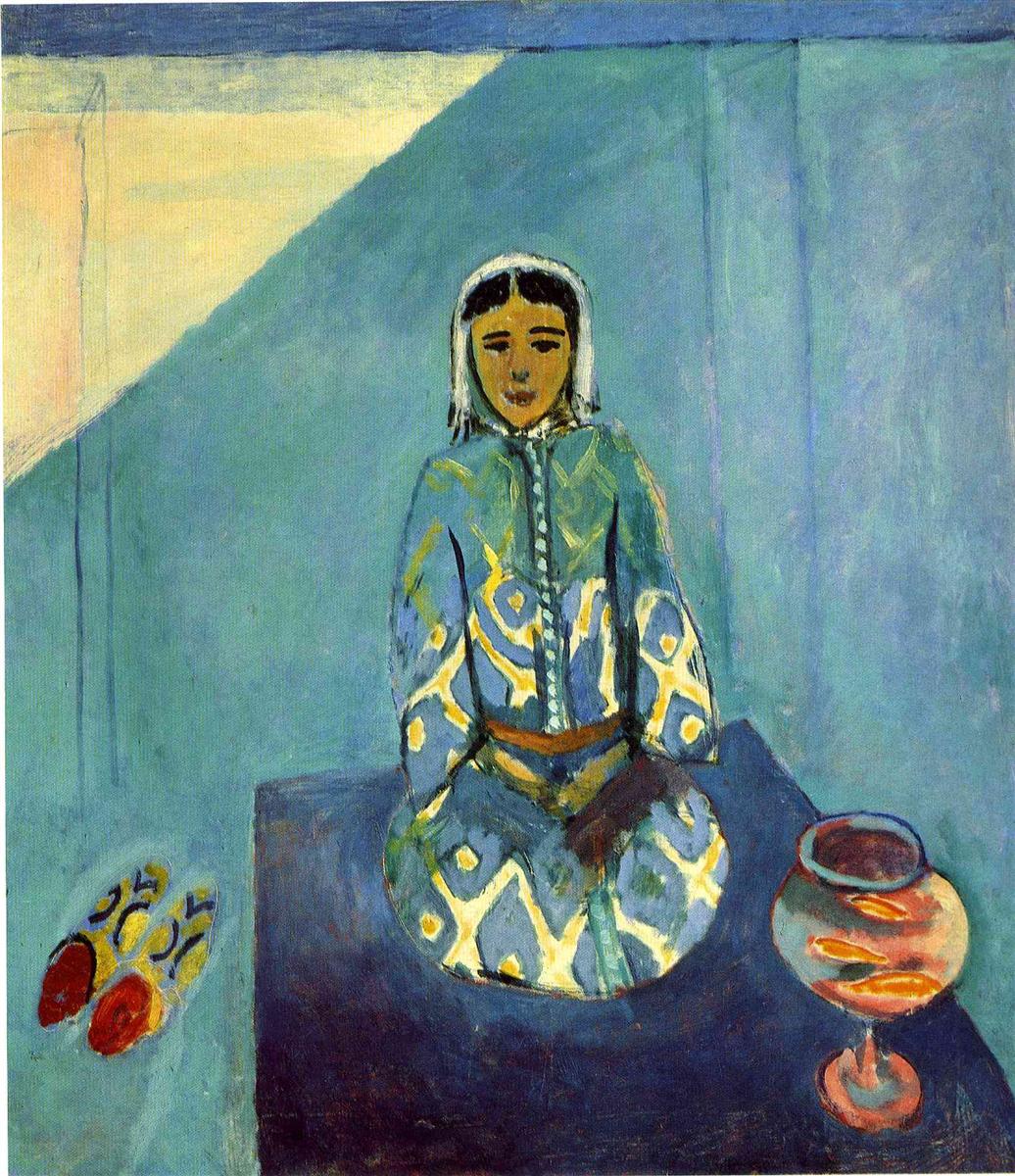
Henri Matisse’s “Zorah on the Terrace” (1912) compresses the experience of bright North African light, patterned textiles, and quiet human presence into a few large planes of color. A young sitter, identified by the artist as Zorah, rests cross-legged on a low platform. Around her, a blue world—walls, floor, air—settles into bands and wedges. To the left, a pair of embroidered slippers wait with their red toes pointing outward; to the right, a round glass bowl holds goldfish that flicker like living sparks. Above and behind, a triangular wedge of pale light breaks across the wall, setting the stage with a single decisive shape. With very little descriptive detail, Matisse turns a terrace into an interior of feeling, and a portrait into an architecture of color.
Historical Moment
The year 1912 falls within Matisse’s first Moroccan journey, when he worked in Tangier and its surroundings and found in the climate a new clarity for his painting. The intense, simplifying daylight of the region flattened forms and hardened shadows, encouraging him to trade tonal modeling for broad, legible fields. At the same time, patterned clothing, tiled courtyards, and enclosed terraces offered a decorative logic that matched his own desire for unity. “Zorah on the Terrace” belongs to this period of concentration. Rather than seeking ethnographic detail, he searches for the relationships that convey stillness, warmth, and presence with the fewest possible means.
Subject and Setting
The scene is simple. Zorah sits on a dark blue platform that reads as a low terrace bench or rug-covered dais. She wears a long, buttoned garment patterned with light diamonds and cursive yellow stripes; a pale headscarf frames her face. The slippers to the left echo the garment’s motif while introducing hot red at their tips, and the goldfish bowl at right repeats that red in flashes of living color. Behind her, the wall is divided by long verticals and a diagonal shaft of pale light that slips in from an unseen source. Everything is organized to emphasize calm, enclosure, and the pleasure of looking.
Composition and Geometry
Matisse composes the canvas like a set piece. The strong horizontal of the platform anchors the bottom third of the picture; the upper field is divided by a tall vertical seam and the slanting wedge of light. These simple structures place Zorah exactly at the junction where diagonals, horizontals, and verticals meet—an effect that steadies the composition and quietly elevates the sitter. The slippers and the bowl, set equidistantly to either side, create a broad triangle with Zorah at its apex. The design reads as clarity itself: a human figure centered within a house of measured shapes.
Color Architecture
Color does the structural heavy lifting. Nearly everything belongs to the blue family: muted teal walls, blue-green floor, deep blue platform, and cool shadows on the sitter’s clothing. Into this sea of blue Matisse drops carefully measured warm notes—yellow-white in the beam of light, ochres inside the pattern, the hot red of the slippers’ toes, and the orange of the goldfish. The complementary push and pull of blue and orange animates the surface without disturbing its calm. Green mediates between them in the leaf-tinted blues and the garment’s motifs. The palette is deliberately narrow, which is precisely why the accents ring so clearly. The fish seem to flicker because they are the most saturated warm tones in a cool world.
The Figure of Zorah
Zorah’s face is drawn with few lines and small tonal steps. Brow, eyes, nose, and mouth register as calligraphic marks—direct, unlabored, and dignified. Her posture, cross-legged and upright, reads as both formal and at ease. Matisse avoids anatomical talk; he lets the garment’s volumes describe the body’s mass. The headscarf softens the transition between face and background, making her presence feel gentle rather than abrupt. Because the rest of the canvas is so simplified, these few strokes carry disproportionate weight; the slightest turn of her mouth, the quiet arc of the brows, shape the painting’s mood.
Clothing and Pattern
The sitter’s garment, with its repeated diamonds and flowing yellow tracery, is central to the painting’s rhythm. It links the human figure to the decorative order of the terrace. The pattern is not fussed; motifs are abbreviated into signs that read legibly at a distance. The cool aquas and chalky whites within the fabric knit the figure into the surrounding blues, while the yellows relate to the light shaft and the warm notes elsewhere. In Matisse’s hands, clothing is more than costume: it is a moving fragment of the same architecture that shapes the room.
The Goldfish Bowl Motif
On the right, the round bowl adds a second kind of life. Matisse repeatedly painted goldfish in 1912. He admired the way quiet contemplation of a bowl could be a daily ritual and the way glass, water, and reflection confuse and clarify in turn. Here, the bowl’s pale rim, pinkish body, and orange fish introduce a small world of curves and glints that counter the platform’s big rectangle and the wall’s flatness. The bowl is not rendered with scientific accuracy; its material presence is announced by a few well-placed highlights and the bold color of the fish. As a motif, it stands for pause and inwardness, echoing the sitter’s calm.
Slippers as Anchors
On the left, a pair of slippers lies slightly splayed, its red tips pointing toward the lower corner. Their patterned uppers repeat the garment’s diamonds, and their red grounds the canvas in a physical, tangible way. They hint at the sitter’s presence beyond the picture—someone arrived, removed shoes, and settled in. In the broader color composition, they balance the bowl’s warm lights, preventing the right side from pulling the eye too strongly.
Terrace and Light
The terrace is not shown through descriptive tiles or a view outward; it is indicated by the behavior of light and the geometry of walls. The diagonal wedge across the upper field suggests a sunlit plane meeting a shadowed one. The tone of the light is warm—creamy with a hint of yellow—and it pours no cast shadow on the sitter, which emphasizes that the painting is about climate and atmosphere rather than optical logic. The mood is late morning or afternoon, when heat levels out colors and the eye half-closes, simplifying. “Terrace” thus becomes a state of luminous enclosure as much as a physical location.
Space and Perspective
Depth is radically compressed. The platform reads as a simple slab. The back wall rises almost vertically with only a faint change in tone to suggest distance. The bowl and slippers do not cast elaborate shadows; they exist as color statements on a flat field. Overlap provides the little depth that is needed: Zorah sits in front of the wall; objects sit beside her on the platform. This shallow space keeps the emphasis on the relationships of color and shape. Rather than inviting the viewer to walk into a deep room, Matisse invites the viewer to feel how the picture’s parts hold together at the surface.
Line and Brushwork
Drawing and painting merge. Edges are often the seam where one color meets another—a cool turquoise against a deeper blue—so that line is born from adjacency rather than added on top. Where darker outlines appear, as around the face, they are soft and elastic, keeping forms alive. Brushwork is varied but economical: the platform is covered with broad, opaque sweeps; the wall shows thin, brushed passages that let undercolor breathe; the garment’s pattern is laid in with crisp, confident strokes. These touches let the viewer sense the painting’s making without turning the surface into an account of labor.
Rhythm and Balance
The picture is orchestrated like a slow, steady piece of music. The centered figure supplies the tonic; the slippers and bowl echo each other as left and right chords; the diagonal light creates a held note across the top; the vertical seam in the wall adds a quiet counter-beat. The garment’s repeating diamonds shimmer like a tremolo under the melody of the face. Nothing is frantic. Even the brightest oranges and reds remain contained within the blue harmony, producing a sensation of deep calm punctuated by attentive highlights.
Psychological Tone
Despite the strong color contrasts, the painting feels contemplative. Zorah’s gaze is level; her mouth is neutral; her posture is relaxed but composed. The goldfish drift; the slippers wait; the terrace seems to hold its breath in heat. The absence of descriptive background or specific narrative gives the figure a universal dignity. Viewers are placed not as intruders but as quiet witnesses, sharing the still air of the terrace for a moment.
Ethics of Looking
Images of people encountered during travel can slide into exotifying spectacle. Matisse’s solution is restraint. Zorah is neither a character in a story nor an ornament. She is a person granted centrality and space, surrounded by motifs that belong to her world but do not define her entirely. The painting acknowledges difference—through dress, objects, and architecture—while holding fast to shared human presence. The clarity of the composition mirrors this ethic: no clutter, no voyeuristic detail, just a figure honored by attention.
Dialogue with Contemporary Movements
In 1912, Cubism’s analytic phase was reorganizing visual reality into facets and interlocked planes. Matisse’s modernism proceeds differently. He simplifies without breaking; he flattens without losing weight; he prizes harmony over fracture. “Zorah on the Terrace” demonstrates that a painting can be modern by clarity alone. Its radicalism lies in how little it needs to convince us: a few color fields, a disciplined pattern, and living accents of red and orange.
Relationship to Other Moroccan Works
Seen alongside contemporaneous canvases—doorways, kasbah entrances, garden views—the painting reveals shared principles. The dominance of cool fields countered by a few warm accents; the preference for thresholds and enclosures over vistas; the elevation of everyday objects (slippers, bowls) into structural actors—all recur. Zorah’s portrait integrates these principles into a human image, letting decorative and architectural concerns support, not overshadow, the sitter.
Material Surface and Evidence of Revision
Look closely and you can find small hesitations and changes: a leaf-green edge toned back toward blue to keep the wall quiet; a line of the platform repainted to sharpen its rectangle; a pattern element shifted to maintain rhythm across the garment’s folds. These traces matter because they show that the painting’s ease was earned. Matisse tuned relationships until the fewest strokes could carry the most meaning.
Afterlife and Influence
The lessons compressed here—economy of means, the authority of color, the dignity of simplified figure—recur in Matisse’s later Nice period portraits and interiors, and culminate in the paper cut-outs, where figures sit amid oceans of blue and small warm accents do decisive work. For later artists, the canvas serves as a model for how to join portraiture with decorative flatness without losing human presence.
Why the Painting Matters
“Zorah on the Terrace” matters because it shows how painting can honor a person by organizing a whole world around them with clarity and restraint. It rejects the crowded anecdote in favor of pure relations: blue field to orange fish, diagonal light to centered figure, patterned cloth to plain wall. With these tools, Matisse creates not just a likeness but a state of mind—alert, calm, and sunlit. The work stands as one of the clearest articulations of his belief that color, simply arranged, can carry both structure and emotion.
Conclusion
In a room made of blues, Zorah sits quietly while a wedge of light advances and two small warm notes keep time at her sides. The painting feels inevitable, as if this arrangement of colors and shapes is the only one that could have honored the moment. Matisse’s economy—few tones, few lines, few objects—produces abundance: dignity for the sitter, atmosphere for the terrace, and a vision of painting confident enough to be simple.