Image source: artvee.com
First Impressions and the Power of Attention
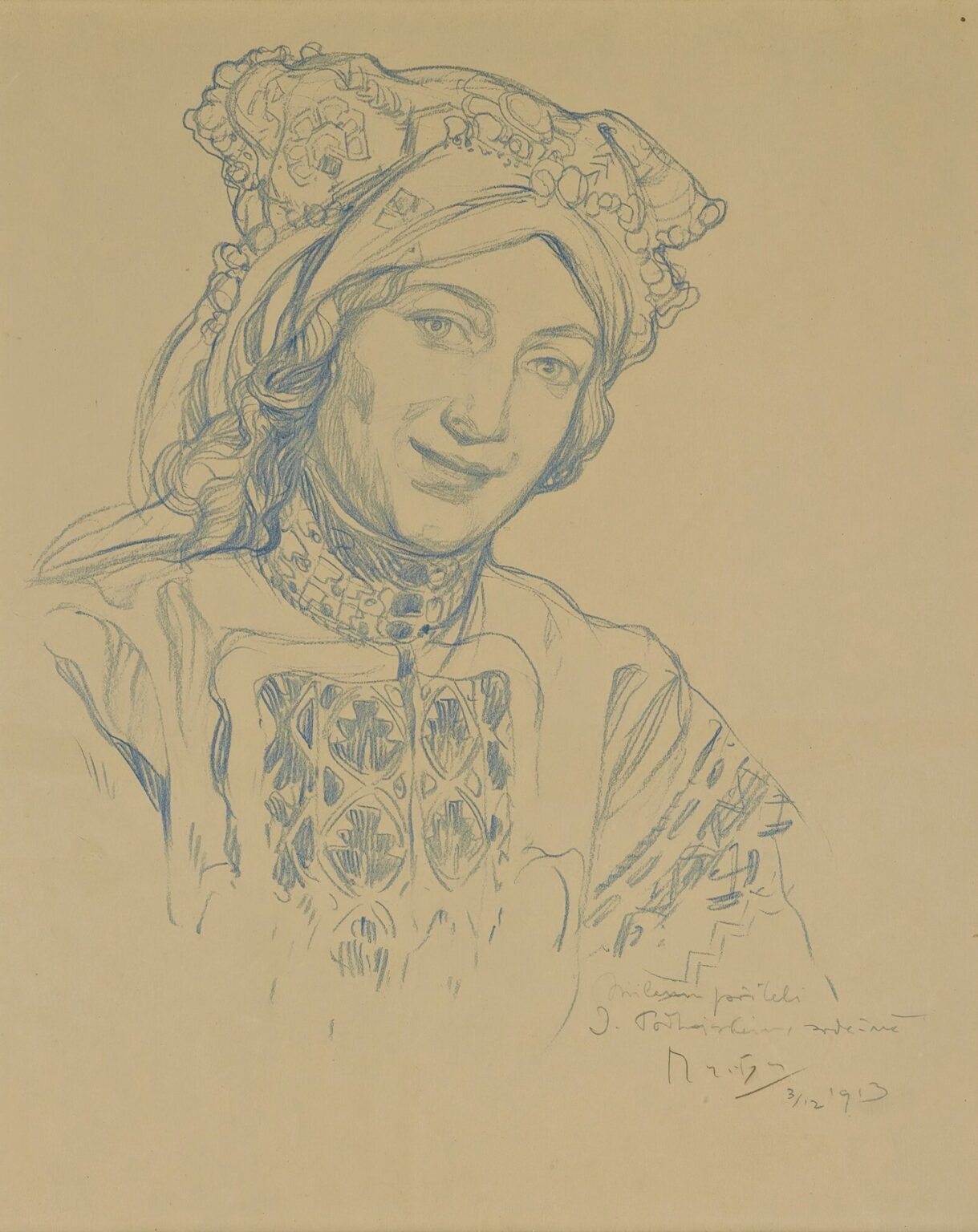
This 1913 drawing presents a poised young woman who meets the viewer with a direct, gently smiling gaze. Alphonse Mucha renders her in blue pencil on warm paper, allowing the cool line to sit lightly on the surface while the paper supplies the mid-tones. The face is the most finished area, modeled with tender cross-hatching; the ornate headdress, necklace and bodice receive confident linear description; the sleeves and lower torso remain open and suggestive. Nothing feels accidental. The artist concentrates finish where human presence lives—the eyes, the mouth, the subtle modeling of nose and cheek—then lets the rest unfold in rhythmic, calligraphic strokes. The result is immediate and luminous, a portrait that feels both intimate and emblematic.
A Portrait at the Crossroads of Intimacy and Identity
Mucha titled and conceived numerous works around Slavic heritage. Here the subject’s elaborate folk headdress, beaded choker, and patterned bodice align her with traditional “kroje,” the ceremonial costumes worn in the Bohemian and Moravian regions. The drawing is not an ethnographic plate—Mucha avoids labeling or situating the costume within a specific village—but it clearly honors the living tradition of dress that signaled communal belonging. The sitter is not staged as a distant symbol; she is encountered as a person. The slight turn of the head and the soft smile collapse the distance between viewer and model. You feel the conversation in the studio. Mucha’s nationalism was grounded in this kind of everyday dignity: the identity of a culture distilled into the presence of a single, attentive face.
The Year 1913 and a Larger Artistic Horizon
The date matters. In 1913 Mucha was immersed in studies and preparations that would culminate in his vast historical cycle, the Slav Epic. At the same time he continued to draw from life—friends, models, neighbors—gathering physiognomies and costume details that could inform the epic’s cast. “Young woman with folk headdress” reads like a bridge between those worlds. Its scale and medium are modest, yet its purpose stretches beyond the sheet. The clarity of the patterns, the calm profile turned three-quarters, the gentle authority of the gaze: these are the elements he would magnify in his public murals. The drawing thus functions both as a finished portrait and as a seedbed for the monumental.
Compositional Poise: A Halo Without a Halo
Mucha builds the composition around a quiet axis running from the headdress’s upper curve through the bridge of the nose to the central pendant on the choker. The head fills the left half of the page; open paper expands to the right where the signature and dedication sit. The headdress creates a natural halo around the face—there is no decorative ring as in the posters, yet the crown of embroidered forms and bead clusters produces that same sense of sanctified presence. The direction of the sitter’s gaze—slightly past the viewer—keeps the drawing from becoming a simple likeness; it suggests inner life and thought. The painter’s experience designing posters shows in the way he locates emphasis: the brightest modeling and densest line lie in an oval around the eyes and mouth, while the outer garments soften into flowing, half-open contours.
Drawing on Warm Paper: Techniques That Breathe
The choice of blue pencil on buff paper is more than aesthetic taste. The warm ground gently opposes the cool line, making the face appear lit from within. Mucha uses several varieties of stroke. Around the eyes, he settles into short, soft cross-hatching that wraps the spherical forms with care. Along the nose and lips, he favors broken contours so light can cross the edge. Hair is handled with long, elastic sweeps that thicken and thin—a physical demonstration of how Art Nouveau’s “whiplash” line grows from observation. Where the headdress needs structure, he compresses the line into firmer, architectural notations. The bodice pattern receives blockier shading to differentiate textile from skin. Through all of this runs a confident economy of means: a few strokes to show the cheek rounding, one assertive notch to anchor the nostril, a feathery band to mark the eyelid’s shadow.
The Face: Serenity Built from Small Decisions
At the core of the drawing is a face that radiates composure. The model’s upper eyelids carry the faintest weight, signaling a relaxed, humane alertness rather than a theatrical stare. Mucha refuses melodrama. The eyebrows are not overdrawn; they are quiet chords above the eyes. The mouth, gently upturned, conveys benevolence without slipping into sweetness. A thin dark accent marks the upper lip; a whisper of tone below it describes the fullness of the lower lip. The cheeks are turned with soft gradient shading that never hardens into contour, preserving the sensation of living skin. These small decisions create psychological temperature. She appears intelligent, kind, and self-possessed—the ideal of feminine dignity that threads Mucha’s oeuvre from advertising posters to epic allegories.
Headdress as Architecture and Memory
The folk headdress is a marvel of structural drawing. Mucha sets out its large silhouette first—a broad, winged shape that frames the skull—then populates it with tiny units: circles as beads, rectangles as folded cloth ends, organic motifs as embroidery. He avoids literal specificity, instead finding a patterned equivalence that reads as convincing decoration at a glance and reveals delightful variety up close. The tight bead clusters along the edge become a tactile border; the scarf that loops beneath the crown introduces diagonal energy; the choker’s small geometric plates suggest metal or leather inlaid with glass. Every motif supports the same cultural claim: tradition worn as living architecture. In pure design terms, the headdress gives the portrait its counterweight to the open space at right, creating a satisfying asymmetry.
The Bodice and the Logic of Ornament
Mucha’s ornament is never pasted on; it grows from construction. The bodice panel below the neck features a lattice of pointed quatrefoils enclosing dark leaf-like shapes. The artist indicates this with alternating blocks of blue hatch and untouched paper, then reinforces the structure with a few decisive diagonals. Immediately the textile appears thick and woven, distinct from the light scarf and fluid sleeves. The insight for designers is clear: treat ornament as structural rhythm, not surface prettification. Mucha’s habit of abstracting motifs from nature into repeatable units—seen here in the leaf-quatrefoil—would power his famous poster borders and the halos behind his allegorical figures.
Hair, That Soft Engine of Art Nouveau
Nestled between scarf and cheek, the hair provides a transition from ornament to flesh. Mucha draws it with undulant strokes that quicken at the tips and ease at the roots. These waves are not merely pretty; they explain the volume of the skull and the placement of the scarf. In the lower tendrils he allows a few stray curls to escape, animating the stillness of the pose. The rhythm of hair echoes the rhythms in the headdress and bodice, knitting the whole sheet into a continuous movement from top to bottom.
Negative Space and the Breath of the Page
So much of the paper remains untouched that the drawing seems to breathe. This negative space is not empty; it is a field that projects the sitter forward. By placing the head left of center and leaving a wide berth on the right, Mucha lets the gaze “travel” into space, giving the figure room to think. The signature and dedication occupy that zone lightly, a reminder that the drawing was a gift or token as well as a study. The contrast with Mucha’s crowded posters is instructive: when image must compete with a Parisian street, he fills the frame; when image is private, he trusts silence.
The Psychology of a Smile
Smiles are hard to draw without sentimentality. Mucha’s solution is restraint. He shapes the mouth primarily through the shadows at its corners and the soft pressure of the lower lip against the teeth. The smile is felt more than seen; it occurs as a change of temperature across the face rather than an isolated mouth event. The effect is one of complicity: the sitter seems to share a quiet joke or a simple contentment with the artist, and by extension with us. It is an ethics of portraiture that values mutual respect over spectacle.
Between Portrait and Emblem
Is this an individual or an allegory of a people? The answer is both. Mucha records the idiosyncrasies of a particular person—the specific width of the nose, the contours of the eyelids, the unique conversation between hair and headdress—yet he arranges those facts within a composition that reads like an emblem. The folk costume anchors the sitter in communal memory; the open paper and centered head lift her toward the timeless. This dual identity is a hallmark of Mucha’s mature vision: the private person who can also stand in for a cultural ideal without losing her individuality.
Craft Lessons Embedded in the Sheet
For artists and designers, the drawing doubles as a tutorial. It demonstrates how to lead the eye with finish, reserving exacting modeling for the face while letting costume and sleeve relax into suggestion. It showcases edge hierarchy—soft at the cheek to indicate roundness, sharp at the choker to indicate hardness. It shows how warm paper and cool line can partner to create glow. Most of all, it proves that expressive power does not require saturation; restraint is a form of richness.
Relationships and the Handwritten Note
The inscription near the lower right corner, beginning with a friendly dedication and followed by Mucha’s signature and the date, pulls us into the drawing’s social story. We are reminded that works on paper often passed between hands as personal exchanges, thanks, or mementos. This sheet likely commemorated a meeting or sitting, a specific day in 1913 when artist and model shared a small piece of time. The writing itself—swift, looping, elegant—mirrors the graphic vitality of the portrait, uniting speech and line in the same sensibility.
Resonances with Mucha’s Posters and the Slav Epic
Although this portrait is neither advertisement nor mural, it vibrates with motifs familiar from Mucha’s more public art. The headdress acts like the ornate crowns and halos that encircle his allegorical figures; the choker anticipates the carefully rendered jewelry that anchors many of his posters; the strong yet tender line that shapes the face echoes throughout his entire career. In the Slav Epic, where heroines and historical actors carry the burdens of a people, you can find faces built from the same measured hatching and gentle authority. The continuity shows that Mucha did not divide his art into “serious” history and “decorative” design. Both grew from drawings like this one, where close looking was the first loyalty.
Cultural Memory Carried by Cloth
Costume in Mucha is never merely exotic. Here it encodes memory. The beaded edges, the patterned bodice panel, the texture of the scarf recall women who passed these forms down through generations. The portrait is not a museum piece; it is a living document of how identity feels when worn. In a Europe about to be transformed by war, such images take on an added poignancy. The young woman’s calm confidence reads as a repository of stability and hope.
Why the Work Feels Contemporary
Despite the historic costume, the drawing reads as strikingly modern. Its radical economy, its reliance on negative space, and the clean, persuasive line anticipate contemporary illustration and branding. Designers will recognize in the bodice pattern a repeatable module; photographers will admire the way open space amplifies expression; painters will find a lesson in how to model with minimal tonal range. The portrait’s humanity—neither idealized nor sensationalized—feels exactly right for our moment.
A Closing Look
“Young woman with folk headdress” is more than a beautiful head study. It is a thesis on how culture, character, and craft can coexist in a single sheet of paper. Mucha offers us a person we might meet, dressed in forms that carry a people’s history, drawn with a line that still instructs. The blue pencil hums on warm paper; the eyes are alive; ornament and anatomy converse. The drawing embodies what made Mucha singular: a belief that beauty begins with attention, that identity can be honored without cliché, and that a face—rendered with care—can hold an entire world.