Image source: artvee.com
Introduction
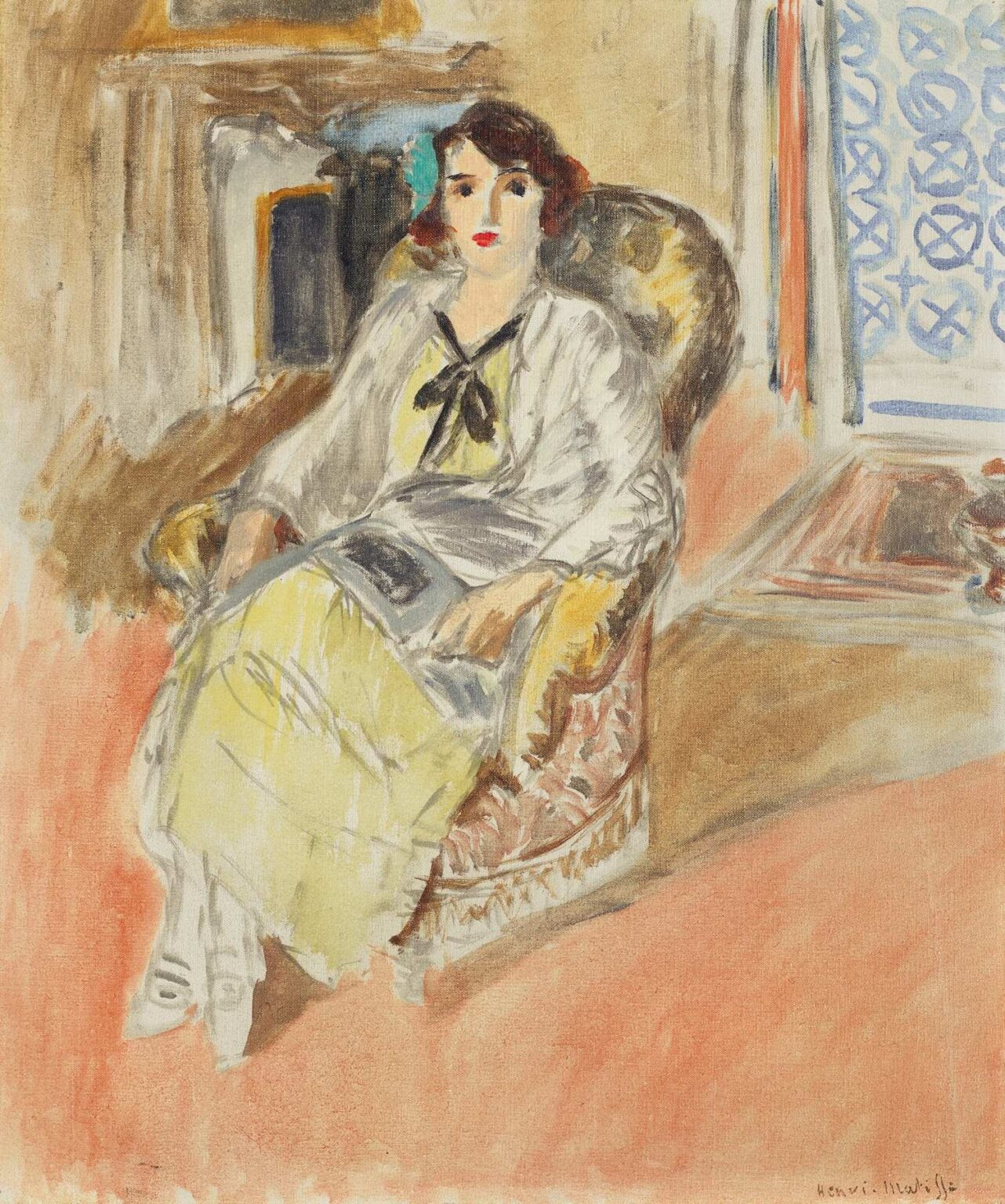
Henri Matisse’s “Young Girl Sitting, Yellow Dress” (1922) belongs to the radiant sequence of interiors he painted in Nice after the First World War. A young woman in a lemon-colored dress reclines in an ample armchair; behind her a fireplace dissolves into warm browns and creams, while at the far right a window or screen with blue arabesques sends cool light into the room. The picture is built from soft, thinned oil and quick, confident drawing, a language Matisse perfected in this period to turn ordinary rooms into theatres of color and calm. The painting appears effortless, almost tossed off, yet it is a finely balanced orchestration of hue, edge, and interval that reveals how Matisse could make atmosphere and personality with the lightest means.
The Nice Period And Why It Matters
From roughly 1917 to 1930 Matisse worked in Nice and nearby on the Côte d’Azur. The Mediterranean light, patterned shutters, tiled floors, and decorative screens of rented hotel rooms became recurring actors in his compositions. He moved away from the blunt intensity of Fauvism toward a supple classicism: luminous color, clear drawing, and a fascination with interiors populated by female sitters. “Young Girl Sitting, Yellow Dress” is exemplary of this shift. Instead of explosive contrasts, he seeks a climate—peach, cream, soft brown, pale blue, and the cool lemon of the dress—within which a figure can rest. The painting continues his lifelong project of reconciling flat decoration with convincing presence, but the temperature is serene rather than incendiary.
First Impressions And Visual Path
The viewer’s eye takes a predictable but satisfying route. The lemon dress occupies the largest single color field; its cool, acid value anchors the foreground against a coral-pink carpet. The black ribbon at the sitter’s collar punctuates the coolness and leads immediately to her face—ivory skin, red mouth, and a compact, auburn bob. From there the gaze moves outward along the curving arms of the chair, across the warm mantle, and then to the right where the patterned screen or window supplies a crisp, blue counter-rhythm. These few elements—yellow, black, red, coral, and blue—compose a pentachord that Matisse can vary endlessly without overcrowding the score.
Color As Structure More Than Description
Color in this picture does not merely fill in local tones; it is the armature of the composition. The lemon dress functions as a plane that pins the figure to the ground like a paperweight; it also throws cool light back onto the sitter’s face and hands. The coral floor is not a carpet in the descriptive sense—it is a warm field that wraps the lower half of the painting and makes the seated figure appear to float forward from the background. The blue pattern at right is a cooling agent; its arabesques echo Matisse’s lifelong love of Islamic ornament and tiled screens, and its hue balances the warmth poured into the rest of the room. The few notes of deep black—the ribbon, eyes, and the fireplace opening—tighten the lattice of color and keep the composition from dissolving into pastel.
Drawing With The Brush
Even in a painting as atmospheric as this, Matisse’s drawing is unwavering. He places the profile with a handful of decisive strokes; the line that defines the nose and the tilt of the head achieves likeness without fuss. The chair’s scrolling arm and the edge of the dress are not carefully modeled but swiftly indicated, which allows the viewer’s eye to complete the forms. Paint is thinned enough that the weave of the canvas and the warm ground show through, supplying an overall harmony and a sense of air. Where he wants emphasis—along the bow at the neck, in the contours of the face, in the patterned cushion—he allows the pigment to stand thicker, a small escalation that brings the sitter’s presence into focus.
Light, Fabric, And The Feel Of Touch
The Nice interiors are laboratories for rendering fabric and light. Here the yellow dress is more a sensation than a garment: folds are suggested by a few pale streaks, and the hem dissolves into the coral floor so that the body seems to breathe into its surroundings. The white wrap or blouse around the shoulders is less about weight than about temperature—cool, pearly tones that knit the head to the dress. The armchair reads as plush without any literal tufting because Matisse grades its browns from honey to umber and cuts those fields with short, directional strokes that mimic nap. These decisions keep the picture tactile while protecting it from burdensome detail.
Space That Is Shallow But Persuasive
Matisse’s interiors are famously shallow; he prefers a stage to a tunnel. In this painting he gives just enough indication of recession—the diagonal of the carpet at right leading toward the patterned window, the mantle and hearth stacked behind the sitter—to make the room legible. But the surfaces are flattened and linked by broad color zones so that pattern and figure belong to the same decorative order. The effect is not claustrophobic; it is intimate. We are near the sitter, as if we had entered the room and paused before speaking.
The Figure’s Psychology And The Art Of Reserve
The young woman’s expression is both candid and guarded. Her mouth, bright with red, contrasts with eyes that are simply drawn, almost mask-like, and a posture that is relaxed yet composed. One hand rests lightly on a magazine or book laid across her lap; the other belongs to the arm of the chair. This combination of openness and reserve is typical of Matisse’s Nice sitters. He avoids narrative drama yet hints at interiority through posture and the economy of facial description. The painting asserts the presence of a particular person while keeping her available as a formal element in a larger orchestration of color and light.
The Quiet Drama Of The Black Bow
The black bow at the collar is small but decisive. It acts as a fulcrum between head and torso, a punctuation mark that arrests the flood of pale tones. Because it repeats the deep blacks of the fireplace opening and the patterned cushion behind the sitter, it writes a diagonal of emphasis that counterbalances the long diagonal of the dress. Matisse often introduced such small, high-contrast elements to keep the eye alert. Here the bow confers a sense of formality, even a hint of fashion, and keeps the figure from dissolving into pure atmosphere.
Pattern, Ornament, And The Window Motif
At the right edge, the blue patterned panel—part curtain, part screen—reminds us how fully decoration shaped Matisse’s pictorial thinking. The motif does not describe a specific textile; instead it provides a measured rhythm of arabesques that repeat the curves of the chair and dress. The cool blue registers as outdoor light entering the room and as a conceptual window into another order of pattern. In Nice, such screens and shutters became Matisse’s most dependable device for connecting interior and exterior, intimacy and spectacle. In this painting the panel’s crisp geometry keeps the room from dissolving into plushness and quietly reiterates the artist’s lifelong affinity for ornament from North Africa and the Eastern Mediterranean.
After Fauvism, A New Kind Of Heat
Viewers who know Matisse’s blazing Fauvist canvases from 1905–1906 may at first read the Nice paintings as a retreat. The heat is subtler, the paint thinner, the outlines relaxed. “Young Girl Sitting, Yellow Dress” demonstrates why the judgment is unfair. Here the fire is in the calibration: coral against lemon, pale blue against brown, an unusual balance of cool and warm that makes the room glow. It is a different temperature of boldness—color as sustained climate rather than percussion. The picture has the self-assurance of a virtuoso who no longer needs to shout.
The Figure As Vessel And The Chair As Throne
Matisse often treated the body as a vessel for light. The hourglass formed by the dress and blouse reads as a receptacle, catching color and releasing it back into the room. The armchair, with its enveloping curves, functions like a throne invited into domestic scale. This staging discloses a gentle paradox at the core of the Nice interiors: the paintings celebrate the everyday while conferring on their sitters a ceremonial centrality. The young woman becomes the axis around which the room’s color turns, not through symbolic attributes but through compositional fact.
Brushwork, Ground, And The Pleasure Of Incompletion
One of the charms of this canvas is its visible incompletion. The left edge near the hearth shows thinly washed passages where the ground participates in the final effect; the carpet’s boundary with the dress is frayed and atmospheric; the patterned cushion is barely indicated. Such “unfinished” moments are not lapses but strategies. They keep the painting open and breathing, making space for the viewer’s eye to supply missing detail. They also reveal the order in which Matisse built the picture—blocking in warm and cool fields first, attaching the figure to them, and only then sharpening a few features.
Postwar Calm And The Politics Of Comfort
Painted just a few years after World War I, the work participates in a broader cultural desire for stability and pleasure. Rather than direct commentary, Matisse offers the consolation of order: a room arranged by color, a quiet afternoon, a sitter at ease. The promise is not frivolous. To make a space where attention can rest is a humanist act. The modesty of the subject matter does not diminish its ambition to restore a measure of grace to looking.
Continuities With The Later Cut-Outs
Although the cut-paper works of the 1940s are decades away, their DNA is present. The window’s blue motifs anticipate the flat, emblematic shapes of the Jazz portfolio; the lemon dress functions as a single, unmodulated field comparable to a cut silhouette; the entire composition pushes toward clarity and economy. The Nice period can be read as a hinge: still oil on canvas, still linked to studio observation, but tuned toward the decisive placements that would define Matisse’s final decade.
The Role Of Accessories: Book, Bow, And Chair
The small book or magazine on the sitter’s lap serves several purposes. It supplies a rectangle that counters the curves of the body and chair; it hints at a narrative of leisure without obliging the painting to story; and its grayed tone mediates between the yellow of the dress and the browns of the upholstery. The ornate chair wraps around her like a frame, its warmer pattern tempering the cool costume. Together with the bow, these accessories root the figure in the comfort of the room while keeping the color structure taut.
A Painter’s Economy And A Viewer’s Reward
Matisse believed in doing the most with the least. “Young Girl Sitting, Yellow Dress” is a case study in that economy. The individual elements are simple—a handful of hues, a few decisive lines, thinly brushed passages—but their relations are complex and satisfying. The painting rewards repeated looking: the small turquoise accent near the head that freshens the palette; the echo between the triangular knees and the triangular fold of the bow; the way the carpet’s coral rises to meet the chair and then recedes toward the window. Each rediscovered relation confirms the quiet intelligence under the work’s apparent ease.
Conclusion
“Young Girl Sitting, Yellow Dress” distills the Nice period’s promise: light poured into a room, a figure at ease, and color as the scaffold that holds everything together. Matisse makes atmosphere behave like structure, and structure melt into atmosphere, with nothing more than a few well-placed notes. The canvas is not a psychological portrait in the late-nineteenth-century sense; it is a portrait of presence—of a person, a chair, a room, and an hour of day—sustained by a palette tuned to pleasure. In its restraint and grace the painting shows why, for Matisse, calm and clarity were not retreats from modernity but its most durable achievements.