Image source: wikiart.org
Claude Monet’s Wooded Path as an Early Statement of Vision
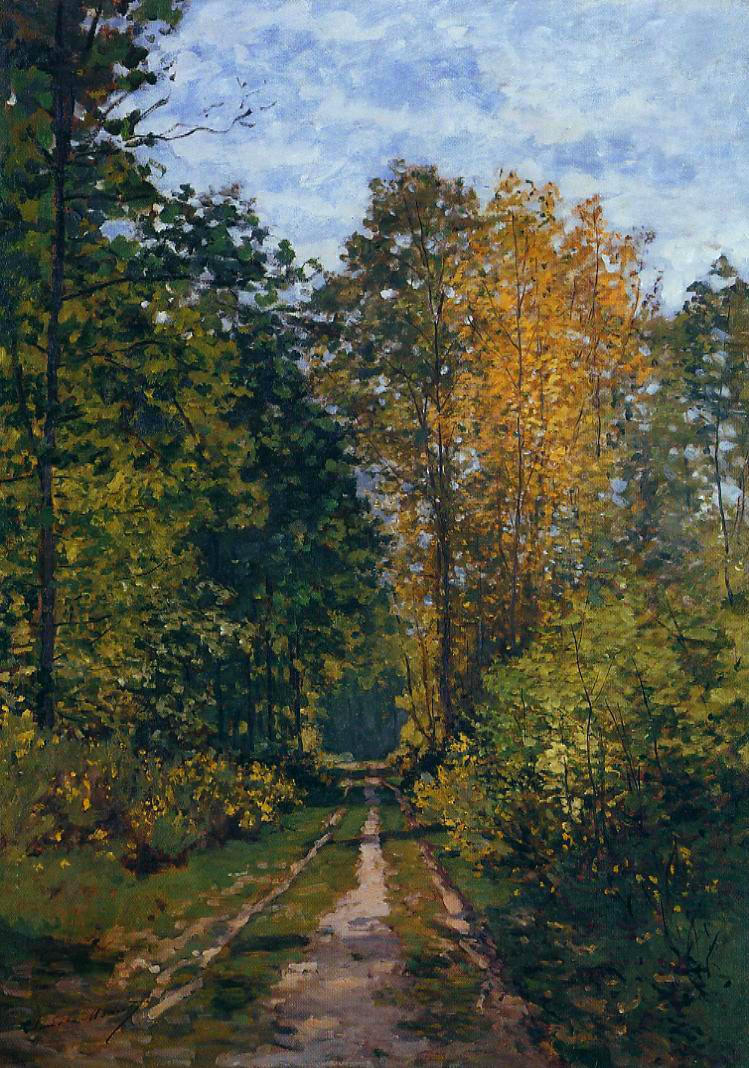
Claude Monet’s Wooded Path from 1865 is a painting that feels modest at first glance, yet the longer one studies it, the more impressive it becomes. Unlike the grand spectacle of some nineteenth century landscapes, this work does not depend on dramatic mountains, crashing seas, or theatrical human action. Its subject is simple: a narrow road running into a wooded area beneath a shifting sky. There are no figures to narrate the scene, no obvious anecdote, and no architectural monument to anchor the composition. Instead, Monet asks the viewer to look carefully at ordinary nature and to experience the visual richness of a place that might easily be overlooked in everyday life.
That choice alone says much about Monet’s sensibility. Even before he became the painter most closely associated with Impressionism, he already showed a remarkable capacity to find depth, feeling, and visual excitement in a fleeting outdoor scene. Wooded Path belongs to the earlier phase of his career, yet it already reveals many of the instincts that would later define his mature work. He is attentive to atmosphere, to changing light, to the varied colors hidden within foliage, and to the way a path can function not only as a physical route through a landscape but also as a visual invitation into pictorial space.
The painting carries a quiet confidence. Monet does not need to overwhelm the viewer. He relies instead on the subtle drama of perception itself. How does light touch leaves in early autumn? How does a pale road cut through deep green shadow? How can the sky appear both broad and broken when seen through the edge of a forest? These are the questions the painting seems to explore. In that sense, Wooded Path is not simply a landscape image. It is a study of how looking transforms a familiar scene into art.
The First Visual Impression
The most immediate effect of Wooded Path is its strong sense of entry. The viewer stands directly before the path, which begins near the bottom edge of the painting and recedes toward a darker opening in the woods. This creates an almost physical feeling of movement forward. We are not placed at a distance from nature, as if observing it from a scenic overlook. We are placed inside it, on the road itself, facing its cool shadows and warm foliage.
This kind of direct encounter is essential to the painting’s appeal. The path narrows as it moves inward, producing a clear recession into depth, but the surrounding trees and undergrowth also press inward from both sides. The viewer is therefore caught between openness and enclosure. The sky above is bright and airy, while the central wooded corridor is dimmer and more mysterious. That tension between light and shade gives the composition its emotional life.
There is also a powerful seasonal suggestion in the painting. The yellow and golden leaves at the right side of the composition contrast with the heavier dark greens on the left. This is not the lush uniformity of midsummer. It feels like a moment of transition, perhaps early autumn, when the landscape is beginning to change color but still retains much of its summer density. Monet captures that in-between state beautifully. Nature here is not fixed. It is in the process of becoming something else.
The eye travels repeatedly across the composition. It follows the road inward, rises into the trees, pauses at the cluster of gold foliage, then moves upward into the pale blue sky. The painting does not trap the viewer in one area. Instead, it encourages a slow circulation of attention. That movement is part of what makes the work so alive.
Composition and the Architecture of the Scene
The composition of Wooded Path appears natural, but it is carefully controlled. Monet organizes the painting around a strong central recession, with the path acting as the principal structural element. This road is not perfectly straight in a rigid geometric sense, yet it is clear enough to guide the viewer inward. Its pale tone makes it stand out against the darker greens and browns of the surrounding vegetation, so it functions almost like a ribbon of light entering shadow.
The flanking trees create a kind of organic frame. On the left, the tall dark trunks and dense foliage form a heavy vertical mass. On the right, the trees are somewhat lighter and more open, especially where yellow leaves catch the light. This asymmetry is important. If both sides had been equally dense, the painting might have felt static. Instead, Monet balances weight with variation. The left side anchors the composition, while the right side introduces shimmer and coloristic change.
The sky occupies a large upper section of the painting, more than one might initially expect in a woodland subject. This gives the scene breath. Without that expanse of sky, the painting might feel too enclosed. Instead, the broad pale blue field above the trees keeps the image open and fresh. It also allows Monet to contrast different kinds of visual texture. The foliage is broken, layered, and intricate, while the sky is broader and calmer, built from softer tonal transitions.
There is also a subtle theatrical quality to the composition. The path leads toward a darker center that almost resembles a stage entrance or a hidden threshold. Yet the overall effect remains natural rather than staged. Monet accomplishes this by avoiding excessive symmetry or idealization. The vegetation is irregular, the road is uneven, and the tree line does not conform to a classical formula. The scene feels discovered rather than invented, even though its structure is clearly deliberate.
This balance between naturalism and compositional order is one of the painting’s strengths. Monet makes the landscape believable, but he also makes it visually compelling. He preserves the spontaneity of an outdoor impression while giving the picture enough formal structure to hold together as a serious work of art.
Light, Color, and the Language of the Season
One of the most striking qualities of Wooded Path is its color harmony. Monet builds the scene from a restrained yet nuanced palette of greens, ochres, yellows, browns, blues, and soft grays. At no point does the color become artificial or overly decorative. Yet within this limited range, he finds a remarkable number of variations.
The greens are especially rich. They are not simply one green repeated across the surface. Some are deep and cool, nearly black in the heaviest shadows. Others are warmer, touched by yellow or olive tones. In the undergrowth, small flashes of lighter green create the sense of living vegetation catching uneven light. This ability to discover multiple colors within what might casually be called “green” is one of Monet’s great gifts.
The yellow trees at the right side of the painting provide the key chromatic accent. They are bright enough to attract immediate attention, but they are not isolated from the rest of the scene. Their warmth echoes the earthy tones of the road and the hints of brown within the woods. This gives the painting a coherent tonal unity. The gold foliage feels like a natural intensification of the whole palette rather than an inserted highlight.
The sky is another major color event. Rather than painting it as a flat blue backdrop, Monet treats it as a living atmospheric field. The blue is softened by white and gray, suggesting moving cloud cover or a day in which the light is shifting. That variation matters because it makes the sky feel observed rather than symbolic. It is a real sky, with real moisture and light in it.
The seasonal suggestion comes largely through these color relationships. The work feels poised between fullness and decline, between life at its peak and the first signs of transformation. That gives the image a quiet emotional complexity. It is not a melancholy autumn scene in the later Romantic sense, nor is it a simple celebration of verdant growth. It belongs to a transitional moment, and Monet captures that beautifully through tonal balance rather than overt symbolism.
Brushwork and Surface Energy
Although Wooded Path is more rooted in traditional landscape painting than some of Monet’s later masterpieces, the brushwork already shows a living, responsive hand. The paint surface is not polished into invisibility. Instead, one senses the artist’s activity in the varied marks used to describe sky, trees, shrubs, and road.
In the foliage, the brushwork is especially active. Leaves are not individually rendered in a precise botanical manner. Rather, they are suggested through clusters of touches, overlapping strokes, and broken passages of color. This approach allows the trees to feel full and textured without becoming stiff. It also suggests movement, as if the leaves are trembling slightly in air and light.
The road is treated differently. Here the strokes are broader and more horizontal or directional, helping the viewer read the path as a flattened surface that recedes into the picture. The pale earth tones are mixed with cooler notes, so the path seems affected by changing light and shadow. It is not simply a strip of local color. It is a responsive surface within a living environment.
The sky is built with looser, softer handling. Its brushwork seems more open and less dense than that of the trees, which helps create the distinction between airy atmosphere and solid vegetation. Monet already understands that different parts of a landscape require different pictorial languages. This sensitivity to surface would later become central to his mature style.
What is most interesting is that the brushwork never calls attention to itself in a self-conscious way. It serves perception. The broken touches, tonal shifts, and layered marks all contribute to the sensation that the scene is being seen in real time, under real conditions. Even in this early painting, Monet is moving away from landscape as mere description and toward landscape as visual experience.
Nature Without Narrative
Many nineteenth century paintings depend on story. Even landscapes often include figures, cottages, animals, or historical references that help interpret the scene for the viewer. Wooded Path does not rely on that kind of narrative support. It is compelling precisely because almost nothing happens in it. There is only a road, a stand of trees, and the shifting effects of light.
That absence of overt narrative is important. It allows the viewer to focus fully on the sensory and emotional content of the landscape itself. The path may suggest human presence, because roads are made to be traveled, but no traveler appears. This creates an interesting ambiguity. The place is accessible, yet momentarily empty. It feels inhabited by potential rather than action.
That emptiness invites projection. One can imagine walking into the woods, hearing the crunch of leaves or the quiet stillness of a secluded road. The painting becomes immersive precisely because it does not tell us what to think. It provides conditions for contemplation rather than a fixed message.
This restraint also aligns with Monet’s broader artistic development. He would become one of the great painters of modern seeing, someone more interested in how the world appears than in what anecdote it can illustrate. Wooded Path shows that this direction was present early on. Even when working within the broader traditions of landscape painting, he was already reducing the importance of literary or historical subject matter and increasing the importance of immediate perception.
Monet in 1865 and the Importance of the Early Work
Seeing Wooded Path as an 1865 painting adds another layer of significance. This was still an early moment in Monet’s career, a period in which he was absorbing influences, testing methods, and moving toward the visual language that would later transform modern painting. The work therefore stands at an important intersection. It is not yet the fully liberated Impressionist style of his later decades, but it is already far more modern in spirit than many academic landscapes of its time.
One can sense the legacy of naturalistic outdoor painting in the work, especially in its close observation of atmosphere and vegetation. At the same time, Monet’s priorities already feel different from those of more conventionally composed studio landscapes. He seems less interested in idealizing nature and more interested in recording its visual conditions. The scene does not feel arranged to illustrate a rule of beauty. It feels discovered, noticed, and translated into paint with unusual alertness.
This is one of the pleasures of early Monet. The viewer can watch the foundations of a revolutionary vision taking shape. The attention to light, the refusal of heavy narrative, the interest in seasonal transition, and the broken brushwork are all present in embryonic form. Wooded Path may not have the fame of his later water lilies or haystacks, but it shows the seriousness and sensitivity that made those later achievements possible.
It also reminds us that Monet did not emerge fully formed. His art developed through sustained looking, experimentation, and a deepening confidence in what everyday perception could offer. Paintings like this reveal the process of that growth.
Space, Silence, and Emotional Tone
The emotional atmosphere of Wooded Path is one of its finest qualities. The painting is calm, but not empty. It is quiet, but not lifeless. Its silence feels full of sensation. The combination of open sky, dense trees, and the receding road creates a mood that is reflective without becoming sentimental.
Part of this emotional effect comes from the painting’s spatial logic. The path leads inward, but the destination remains obscure. The center of the wooded corridor darkens as it recedes, so the eye moves toward a kind of visual hush. That inward pull creates a contemplative tone. The painting does not open onto a broad vista or a triumphant horizon. It invites a slower, more intimate engagement.
The balance of light and shadow also shapes the mood. The golden foliage brings warmth, but the darker masses of the left side and the shaded center prevent the scene from becoming cheerful in a simple decorative sense. There is seriousness here, a recognition that nature contains stillness and depth as well as brightness.
This emotional restraint is one reason the work ages so well. It does not depend on melodrama. It offers instead a concentrated encounter with place, season, and atmosphere. Viewers return to it because it feels true. It captures the kind of moment many people know from experience, a road through trees, light shifting overhead, a sense of being briefly alone with the landscape.
The Road Toward Impressionism
Although Wooded Path belongs to Monet’s early period, it points toward the future in meaningful ways. The most obvious connection to his later art lies in the emphasis on light as something unstable and animating. Even in this relatively solid, structured composition, light is not merely a tool for clarifying objects. It is part of the subject itself. The trees, shrubs, and road are all transformed by the changing conditions of illumination.
The painting also anticipates Monet’s lifelong fascination with repeated looking. A scene like this is valuable not because it is rare or grand, but because it offers endless visual variation. At another hour, in another season, or under another sky, the same path would appear completely different. That insight would become central to Monet’s mature practice, especially in his serial paintings. Here, in 1865, the seed of that idea is already visible.
There is also an important modernity in the painting’s subject choice. A simple wooded road may seem humble, but that humility is part of the breakthrough. Monet helps redefine what deserves artistic attention. A path, some trees, a changing patch of sky, these become sufficient. They do not need to symbolize a moral lesson or serve as background for a historical event. Their visual life is enough.
This shift may seem subtle, but it is profound. It places perception itself at the center of painting. That is one of the great transformations of nineteenth century art, and Wooded Path participates in it from an early stage.
Why Wooded Path Still Matters
Wooded Path remains compelling because it combines directness with depth. It is easy to enter visually, since the image presents a familiar natural scene in a clear and inviting way. Yet it rewards long attention because every part of the painting is alive with decisions about color, structure, light, and feeling.
The work also reminds us that Monet’s greatness was not limited to his most famous motifs. Even before the iconic gardens, water surfaces, and urban leisure scenes, he possessed an extraordinary ability to turn close observation into poetry. Here, poetry emerges not from fantasy or symbolism, but from the patient recording of how a real place looks and feels.
There is something enduringly human about that. Many viewers recognize the sensation embedded in the painting, the desire to follow a quiet road into trees, the awareness of season changing, the pleasure of light catching leaves against shadow. Monet transforms those ordinary experiences into something lasting. He shows that visual attention can be a form of reverence.
In that sense, Wooded Path is both an early Monet and a fully convincing work in its own right. It reveals the young artist’s developing language while also standing as a beautiful meditation on landscape, atmosphere, and the silent drama of a road disappearing into woods.
Conclusion
Claude Monet’s Wooded Path from 1865 is a remarkable example of how much artistic power can reside in a seemingly simple subject. Through a carefully balanced composition, subtle seasonal color, varied brushwork, and a deeply sensitive response to light, Monet transforms an ordinary forest road into a scene of immersion and contemplation. The painting offers no dramatic story and no overt symbolism, yet it communicates richly through visual means alone.
Its importance lies partly in its place within Monet’s early development. One can already see the emergence of the concerns that would later define his career: atmosphere, immediacy, shifting color, and the belief that nature is never static. At the same time, the painting does not need to be treated merely as a precursor to later achievements. It succeeds on its own terms. It is thoughtful, spacious, and emotionally resonant.
What makes Wooded Path memorable is its quiet certainty. Monet trusts that a road, a few trees, and a changing sky are enough to hold our attention when they are truly seen. More than a century later, that trust still feels justified. The painting invites us to slow down, look closely, and discover how much beauty and complexity can exist within a single, unassuming passage through the woods.
