Image source: wikiart.org
Introduction
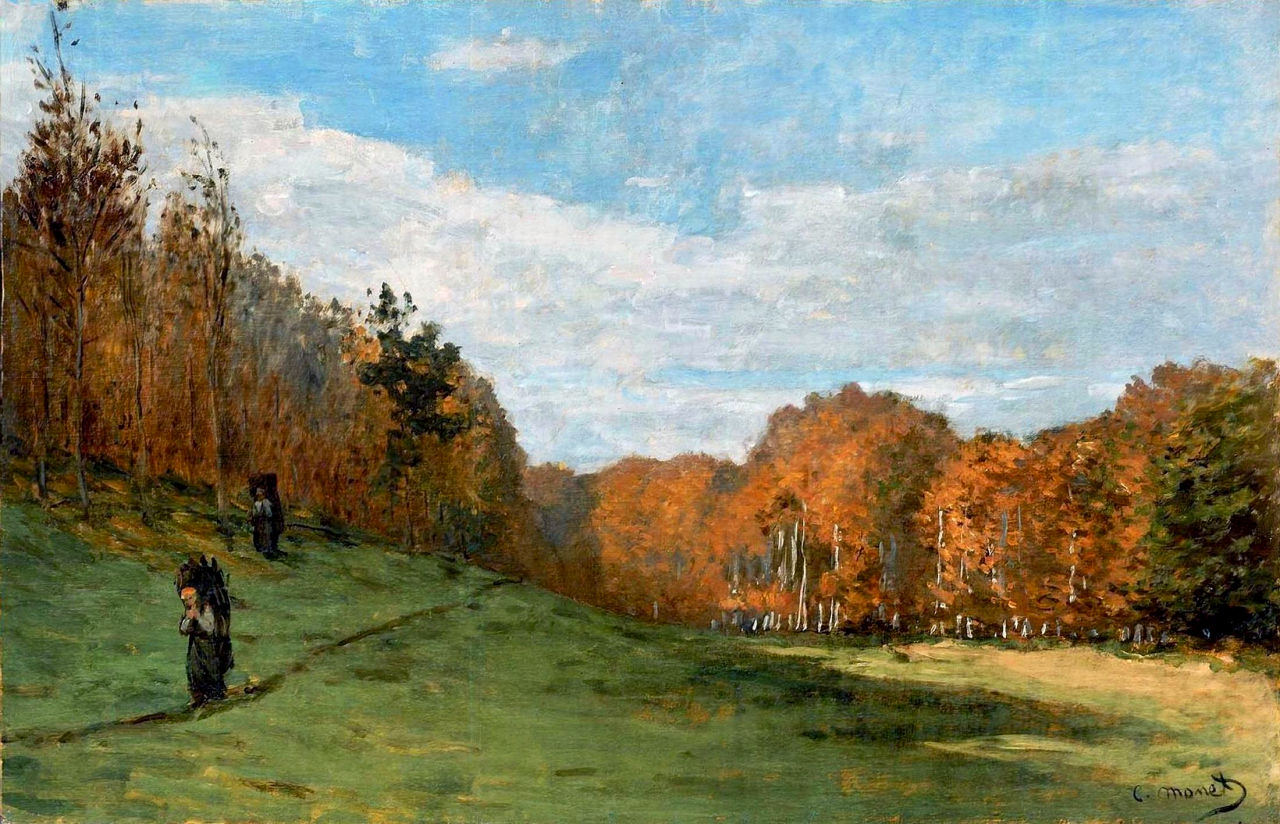
Claude Monet’s Woodbearers in Fontainebleau Forest from 1864 belongs to the earliest important phase of his career, when he was still shaping the artistic language that would later make him one of the defining painters of modern art. Although many viewers approach Monet through the bright shimmer of his mature Impressionist paintings, works from the mid 1860s reveal a different side of his talent. They show an artist studying nature with seriousness, ambition, and sensitivity, while still engaging with the traditions of landscape painting that dominated French art in the nineteenth century. In this painting, Monet presents a broad clearing edged by autumnal trees, with a few figures carrying bundles of wood across a grassy slope. The subject appears simple, even humble, yet the picture is rich in atmosphere, structure, and feeling.
What makes this painting especially compelling is the balance it achieves between observation and poetry. Monet does not dramatize the scene with grand action or theatrical narrative. Instead, he finds meaning in a passing rural moment. The labor of the woodbearers gives the composition a human presence, but the true protagonist is the forest itself, with its soft light, changing leaves, and immense quiet. This combination of ordinary life and natural grandeur would remain central to Monet’s vision, even as his style evolved. In Woodbearers in Fontainebleau Forest, one can already sense the artist’s lifelong commitment to painting the world not as a fixed arrangement of objects, but as an environment alive with weather, season, and mood.
The painting also rewards close attention because it sits at an important crossroads in Monet’s development. It still carries traces of the Barbizon painters and the broader French landscape tradition, especially in its earthy tonalities and careful spatial design. At the same time, it points toward the newer kind of painting Monet would help create, one rooted in direct outdoor observation and the fleeting effects of light. As a result, the work stands not only as a beautiful landscape in its own right, but also as a revealing document of an artist in transition.
Claude Monet in 1864
By 1864, Claude Monet was still a young painter trying to establish himself. He had not yet become the celebrated leader of Impressionism. Instead, he was part of a generation of ambitious artists searching for fresh ways to paint modern life and the natural world. The early 1860s were years of experimentation, study, and struggle for Monet. He was absorbing influences from older landscape traditions while developing his own eye for immediate visual experience.
During this period, the Forest of Fontainebleau held a special place in French art. Located southeast of Paris, it had already attracted generations of painters who sought escape from the city and inspiration in untamed nature. The artists associated with Barbizon had made the region famous as a place where one could observe trees, rocks, paths, and changing skies with unusual intimacy. For Monet, Fontainebleau offered both a practical setting for study and a symbolic landscape charged with artistic history. To paint there was to enter into dialogue with established masters while also testing one’s own independence.
This moment in Monet’s career is important because it predates the full flowering of Impressionism. He had not yet settled into the broken, high key handling that would later define so many of his masterpieces. Instead, his early paintings often show denser structure, stronger tonal contrasts, and a more traditional sense of finish. Yet even in these works, Monet’s attention to the character of light is unmistakable. He does not merely describe a place. He recreates its atmosphere.
In Woodbearers in Fontainebleau Forest, that youthful ambition is visible everywhere. The painting is carefully organized, but it never feels rigid. It is naturalistic, yet it avoids stiffness. Monet is clearly studying what he sees, but he is also editing and arranging the scene to create rhythm, depth, and emotional coherence. The result is a painting that feels both grounded in real observation and elevated by artistic intelligence.
The Setting of Fontainebleau Forest
Fontainebleau Forest was one of the great proving grounds for nineteenth century landscape painting. Its appeal lay in its variety. It contained rocky outcrops, open clearings, thick woodland, winding paths, and shifting seasonal effects. For painters, it offered a living laboratory of natural forms. Trees in particular became objects of close study, not merely as botanical specimens, but as expressive structures capable of shaping mood and meaning.
In this painting, Monet does not present the forest as dense and impenetrable. Instead, he chooses a clearing or open slope bordered by lines of trees. This decision is significant. It allows the eye to move freely through the space, from the grassy foreground into the wooded middle distance and then upward into the expansive sky. The forest is present, but it does not overwhelm. It frames the scene and gives it substance, while the open ground introduces lightness and movement.
The season appears to be autumn, and that seasonal identity matters deeply to the painting’s emotional effect. The orange and rust tones of the leaves suggest a moment of transition, when growth is giving way to decline, but also when nature achieves one of its most radiant displays. Autumn in landscape painting often carries associations of passage, labor, and reflection. Here, those associations are strengthened by the presence of the woodbearers, whose work is tied to the practical uses of the forest. The land is not a purely decorative spectacle. It is a lived environment, shaped by human need and seasonal routine.
Monet’s treatment of Fontainebleau in this work is therefore both descriptive and interpretive. He captures a recognizable environment, but he also turns it into a meditation on nature’s vastness and the modest scale of human life within it. The figures do not dominate the forest. They move through it, serve within it, and almost disappear into its larger rhythms.
Composition and Spatial Design
One of the most impressive features of Woodbearers in Fontainebleau Forest is its compositional clarity. Monet builds the picture around a sweeping diagonal slope that rises on the left and descends toward the right. This broad plane of grass establishes the basic structure of the scene and gives the eye an immediate path into the image. The hillside is not merely a patch of ground. It is the compositional engine of the painting, directing movement and linking foreground to middle distance.
The placement of the figures along the left side reinforces this diagonal flow. The nearest woodbearer appears in the lower left foreground, bent slightly by the burden carried on the back. Another figure farther uphill echoes this form at a greater distance. Their alignment creates a visual rhythm that guides the viewer upward and inward, while also emphasizing the slope’s incline. These small human presences anchor the scene and give scale to the surrounding landscape.
Across from them, on the right side of the painting, Monet places a mass of autumn trees glowing with warm color. This large wooded area balances the darker verticals on the left and creates a sense of fullness in the middle distance. Between these elements lies a low opening or valley, which allows the eye to move beyond the immediate terrain into a deeper space. The sky then crowns the whole composition with a wide horizontal field of pale blue and cloud.
The painting’s design is therefore built on a careful interplay of diagonals, verticals, and horizontals. The slope moves across the image, the trees rise upward, and the sky stretches calmly overhead. This structural balance keeps the painting stable even though its subject is quiet and understated. Nothing dramatic occurs, yet the composition feels alive because the forces within it are so well judged.
Monet’s spatial design also contributes to the painting’s mood. The openness of the foreground gives a feeling of air and freedom, while the bands of trees suggest enclosure and shelter. The distant gap between wooded masses creates a note of mystery, as if the landscape continues beyond what we can see. This subtle tension between openness and concealment makes the scene more evocative than a simple topographical record.
Color, Light, and Seasonal Atmosphere
Color is central to the emotional life of this painting. Monet sets warm autumn foliage against cool sky and muted green earth, producing a harmony that is both gentle and luminous. The orange and brown tones of the trees do not blaze with aggressive intensity. Instead, they seem softened by atmospheric light, as though filtered through thin air and drifting cloud. This restraint is important. It keeps the painting natural and believable while still allowing the season to announce itself clearly.
The sky occupies a large portion of the upper canvas, and its treatment is especially revealing. Rather than offering a pure, flat blue, Monet modulates the atmosphere with soft clouds and pale tonal shifts. The effect is one of transience. The weather seems mild but changeable, the kind of day when light spreads broadly rather than striking sharply. This diffused light helps unify the scene. It allows the grassy slope, the distant woods, and the figures to belong to the same atmosphere.
The greens of the foreground are also notable. They are not the fresh, vivid greens of spring. Instead, they are tempered, earthy, and slightly cool, which makes them an ideal counterweight to the warm foliage. This color relationship creates visual depth. The warm woods advance, the cool meadow recedes, and the sky opens the space even further. Monet uses these contrasts not for decorative effect alone, but to organize perception.
What is especially striking is the way light seems to rest on the landscape rather than merely illuminate it. The scene feels touched by a particular hour and season. The land is calm, the air is open, and the colors suggest that nature is passing through one of its most beautiful but temporary states. This sensitivity to the specific character of light is one of the strongest links between this early work and Monet’s later achievements. Even before his mature Impressionist style emerged, he was already painting atmosphere as a living presence.
The Human Figures and Their Role
The woodbearers are small in scale, but they are crucial to the painting’s meaning. Without them, the work would still be a beautiful landscape, yet it would lose much of its human resonance. Their presence transforms the scene from a study of autumn woods into an image of rural labor and daily endurance. They remind us that the forest was not just a place of beauty for artists, but also a source of fuel, livelihood, and physical effort.
Monet does not individualize these figures in a portrait like way. Their faces and features are not the point. Instead, they are integrated into the landscape as working bodies. The nearer figure, dark against the green slope, appears weighed down by the bundle carried on the back. This simple pose conveys effort with remarkable economy. The farther figure echoes the same action at a distance, reinforcing the sense of repetitive labor. Together they suggest routine rather than event, necessity rather than spectacle.
This understated treatment is one of the painting’s strengths. Monet does not sentimentalize the workers, nor does he turn them into symbols through exaggerated emphasis. He lets them remain modest presences within the larger world of the forest. That decision creates a truthful relationship between human life and nature. The figures matter, but they do not control the scene. They are part of the land’s rhythm.
Their dark clothing also serves a compositional function. Set against the lighter ground, the figures become visual accents that punctuate the broad slope. They provide scale, guide the eye, and lend gravity to the lower half of the painting. At the same time, their darkness links them tonally to the trunks and shadows of the trees, knitting human labor into the fabric of the environment.
Seen this way, the woodbearers embody one of the painting’s central ideas: the coexistence of beauty and work. The autumn landscape is radiant, yet within it people carry burdens. The scene is peaceful, yet it is not idle. Monet captures a world in which natural splendor and practical necessity exist side by side.
Brushwork and Surface
Although this painting predates Monet’s most famous Impressionist manner, its handling already reveals an artist deeply attentive to the expressive possibilities of paint. The brushwork is varied according to what is being described. In the sky, the strokes are broad and soft, blending into a gently shifting atmosphere. In the trees, the marks become more textured and lively, suggesting foliage without rigid detail. In the grassy slope, the paint is spread in a way that preserves the openness of the field while introducing enough tonal change to keep the surface active.
This variety is important because it shows Monet thinking about paint as a means of sensation, not just description. He is not mechanically filling in forms. He is adjusting the movement and density of his brush according to what the eye experiences in different parts of the landscape. That responsiveness would become even more pronounced later in his career, but its foundations are clearly present here.
The tree trunks in the distance are especially effective. Some are rendered with quick vertical touches of light color against darker masses, creating the flicker of slender birches or pale bark catching the light. These small accents animate the middle ground and keep the wooded area from becoming a flat block of color. Meanwhile, the darker passages on the left side introduce depth and contrast, preventing the composition from drifting into softness.
Monet’s surface handling also contributes to the painting’s mood. The brushwork is active, but not restless. It suggests a world seen attentively and translated with confidence. There is enough looseness to preserve freshness, yet enough structure to maintain solidity. This balance gives the painting its particular charm. It feels observed on the spot, but also carefully resolved.
Mood and Meaning
The mood of Woodbearers in Fontainebleau Forest is one of quiet seriousness. It is not melancholy in any overt way, yet it carries a reflective tone. The autumn setting, the broad sky, and the small burdened figures all contribute to a feeling of thoughtful stillness. Nothing in the scene calls attention to itself through drama. Instead, the painting invites slow looking.
Part of its emotional power comes from scale. The figures are small, the forest is expansive, and the sky is wider still. This hierarchy places human life within a larger order. The workers move across the land, but the landscape endures beyond them. At the same time, Monet does not make nature threatening or sublime in a terrifying sense. The forest is calm, the weather is mild, and the composition remains open. The result is not awe in the grand Romantic mode, but something more intimate: an awareness of human modesty within a beautiful, seasonal world.
The painting can also be read as an image of transition. Autumn marks the turning of the year, and the activity of gathering wood suggests preparation for colder days ahead. There is therefore an undertone of necessity and passage. The land is at once rich and declining, radiant and temporary. Monet does not spell out these ideas, but they are embedded in the visual language of the painting.
What gives the work its lasting appeal is that it never becomes heavy handed. Its meaning arises from observation, color, and structure rather than overt symbolism. Monet trusts the landscape to carry emotion. By doing so, he creates a painting that feels both specific and universal.
The Painting’s Place in Monet’s Development
This work is especially valuable because it helps us understand Monet before the full emergence of Impressionism. It shows how deeply rooted he was in the French landscape tradition, while also revealing the qualities that would lead him beyond it. The careful composition, tonal harmony, and rural subject connect him to earlier painters. The attention to transient light, atmospheric unity, and direct visual freshness point forward to the revolution he would later help lead.
In Woodbearers in Fontainebleau Forest, Monet is learning how to make a landscape breathe. He is moving away from a studio bound conception of painting and toward a more immediate engagement with the natural world. Yet he has not abandoned structure. This combination of discipline and freshness is what makes the painting so satisfying. It is not merely a preliminary step toward later greatness. It is an accomplished work that stands on its own.
It also reminds us that Monet’s art did not begin with water lilies, haystacks, or dazzling riverside scenes. His development was gradual, built on close study of land, weather, trees, and open air. Paintings like this one reveal the seriousness of that apprenticeship. They show an artist testing how much atmosphere a canvas can hold, how much emotion a quiet rural scene can convey, and how human presence can be woven into landscape without overwhelming it.
Conclusion
Woodbearers in Fontainebleau Forest is a deeply rewarding early painting by Claude Monet, one that combines rural realism, seasonal beauty, and emerging modern vision. Its subject is modest, yet its achievement is substantial. Through a simple scene of figures carrying wood across an autumn clearing, Monet creates a landscape full of space, light, and quiet meaning. The composition is carefully controlled, the color relationships are subtle and effective, and the atmosphere is rendered with extraordinary sensitivity for such an early work.
The painting reveals a young artist already capable of transforming observation into poetry. Fontainebleau is not presented as a grand stage for heroic action, but as a living environment where nature and labor meet. The forest glows with autumn color, the sky opens above it, and the small figures move through the land with quiet persistence. Everything in the picture contributes to a sense of calm endurance.
Seen today, the work feels both historically important and immediately accessible. It belongs to Monet’s formative years, yet it speaks with freshness and conviction. It reminds us that some of the most powerful landscapes are not those that shout, but those that linger. In this painting, Monet finds beauty in work, dignity in scale, and emotional depth in the changing face of nature. That achievement makes Woodbearers in Fontainebleau Forest not only a fascinating early Monet, but a memorable landscape in its own right.
