Image source: wikiart.org
A Room, a Chair, and the Architecture of Rest
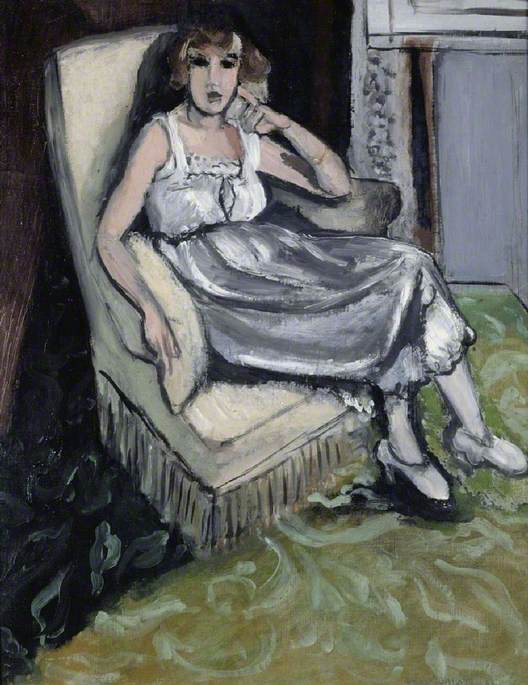
Henri Matisse’s “Woman Seated in an Armchair” (1917) turns a quiet interior into a complete world of intervals, textures, and temperaments. A young woman—often identified with the studio muse Laurette—sinks into a pale upholstered chair with fringed skirt, her white chemise and silvered skirt catching a low, even light. The floor’s green, arabesque pattern whispers around the chair’s feet; a dark wall presses from the left; the pale structure of mantel or doorway rises at the right. Nothing in the canvas shouts, yet the scene is saturated with presence. The painting condenses Matisse’s wartime language: disciplined color, black contour as architecture, large planes that breathe, and an atmosphere designed to deliver balance rather than spectacle.
A Composition Built on Diagonals and Anchors
The pose is simple—one arm hooked at the backrest, the other relaxing toward the chair’s front edge—but the geometry is intricate. Matisse tips the chair so that its long seat runs diagonally from lower left to mid-right, setting the body on a gracious incline. The woman’s shins angle forward and then down, creating a counter-diagonal that steadies the composition. The back of the chair rises like a pale trapezoid against the dark left wall, while a vertical band at the right (fireplace, doorway, or panel) functions as a second anchor. Between these supports the figure flows in a sequence of curves—shoulder, hip, knee, ankle—so the room feels ordered without stiffness. You experience rest as a designed condition, not a slump.
The Chair as Co-Star and Stage
This armchair is no neutral prop; it is the painting’s stage and co-star. Its pale upholstery provides a high-value field against which the darker chemise seams and gray-silver skirt can register. The fringe at the base introduces a rhythmic border that echoes the floor’s vegetal pattern while keeping the ensemble grounded. By squaring the chair frontally and tilting its seat, Matisse gives us two kinds of geometry at once: the rectangle that stabilizes and the diagonal that invites movement. The model’s left arm folds over the back cushion like a soft bracket, visually welding body to furniture and making comfort legible.
A Palette Tuned to Climate, Not Spectacle
The color scale is modest and exact: whites and pearly grays in chemise and skirt; a pale, creamy armchair with touches of cool shadow; deep black-browns for hair and side wall; a mossy-green floor animated by lighter arabesques; a near-lavender gray for architectural trim at the right. Because the palette is restrained, relationships do the expressive work. Cool grays keep the white blouse from turning sugary; the green carpet cools the scene and lends it breath; the chair’s warm cream lifts the figure out of the darkness at left. This is the language of 1917 Henri Matisse: chroma rationed, harmony prioritized, black used to clarify rather than to scold.
Black Contour as the Painting’s Carpentry
If color supplies climate, black provides structure. Brows, eyelids, the tight wedge of the nose, the rim of the chemise, the hemline of the skirt, the edges of shoes, the armchair’s silhouette, and the joint where carpet meets wall are all stated with elegant, weighted strokes. These are not outlines waiting to be colored in; they are decisions that bear the painting’s load, thickening and thinning in response to neighboring tones. The presence of these lines allows the broad paint fields to remain frank and unfussy. Drawing and color are not separate tasks; they are simultaneous acts—an insight central to Matisse’s mature practice.
Light as an Even Envelope
Illumination arrives as a broad, democratic wash that clarifies form without melodrama. Highlights bloom on the chemise’s lace, along the silver skirt’s folds, on the chair’s armrest, and at the top of the model’s stockings and shoes. Shadows are soft and cool, gathering under the knees, along the chair’s base, and in the carpet’s deeper greens. Because there is no spotlight carving drama into the body, repose becomes the painting’s subject. The eye moves at a human pace, unhurried and attentive, the way the sitter seems to be moving through her own thoughts.
The Body’s Rhythm: Curves that Breathe
The figure’s pose is a choreography of arcs. The right forearm and wrist curl gently as the hand meets the cheek—a gesture of alert restfulness. The torso slides into a long S-curve as it follows the tilted seat; thigh and calf repeat the curve at a different scale; the shoe’s strap and pointed toe punctuate the phrase. Matisse never literalizes musculature; he turns anatomy into rhythm. That rhythm feels modern not because it is stylized, but because it is measured: every curve meets a plane or an edge that answers it.
Fabrics as Weather and Weight
Matisse anchors the scene’s tactility in three materials: cotton, upholstery, and carpet. The chemise is a small theater of whites—cool where light retreats, warmer where it gathers, with a few decisive strokes to suggest lace and seams. The skirt carries denser silver-grays laid in horizontal passes that catch and fold the light like satin. The armchair reads as plush without fussy description; you sense a yielding cushion in the slower, broader brushwork of the seat and arm. The floor’s pattern—large, leafy arabesques—keeps the ground from feeling inert and provides a counter-surface to the chair’s solids. These material distinctions matter because Matisse uses them to keep the eye awake while maintaining calm.
The Interior as Measured Abstraction
Although the right side hints at mantel or doorframe, the room does not insist on architectural storytelling. It is a grid of values and temperatures: dark left, pale center, cool green base, light-right vertical. This abstraction supports rather than distracts from the sitter. Matisse of 1917 wants interiors to read as planned climates where his figures can breathe. You do not catalogue objects; you inhabit a set of relations.
Portrait Without Theatrics
The model’s face is made from planes and a few accents: a dark brow pair, a compact mouth with a coral deepening at center, soft cools beneath the eyes, and a shadow at the neck that clarifies tilt. Her expression is composed, a shade inward, perhaps a little wry. There is no melodrama because the psychology lives in posture and tempo. A hand at the cheek signals thinking rather than fatigue; crossed ankles and the chair’s embrace announce ease without collapse. The painting is a portrait of poise.
The Eye’s Route Through the Picture
Matisse designs a satisfying loop for the viewer’s gaze. Many eyes begin at the face, slide down the diagonal of the torso to the bright band of skirt hem, hop to the shoes, drift along the carpet’s pale swirls to the chair’s fringe, and rise back through the armrest to the forearm and cheek. Each turn is punctuated by clean contrasts—white chemise against cream upholstery, dark shoe against green, black wall against pale chair—so the circuit can repeat indefinitely without fatigue. Looking becomes a slow, pleasant walk around the room.
Wartime Discipline and the Lorette Cycle
Painted in 1917, the canvas sits squarely within Matisse’s wartime discipline and the rich Lorette cycle. Across 1916–1917 he made dozens of portraits and interiors with this model, testing how few elements could yield presence. The Fauvist blaze of a decade earlier is modulated into pearly grays, olive greens, and measured accents; black returns as a structural color; light becomes an even envelope rather than a stage effect. This discipline does not dampen lyricism. It refines it. “Woman Seated in an Armchair” anticipates the Nice period’s languor and patterned rooms while holding to the essentials of structure and calm.
The Ethics of Reduction
Part of the painting’s modernity lies in what it refuses. There is no elaborate fireplace garniture, no dense wallpaper, no virtuoso reflections on polished wood. Hands are simplified to their functional planes; the face avoids theatrical signals; the chair is rendered with just enough upholstery logic to be believed. This restraint is ethical as much as stylistic. Matisse honors sitter and viewer by giving them clarity and space. The calm you feel is not emptiness but a highly tuned order.
Pattern As Counterpoint, Not Drama
The floor’s leafy motifs and the chair’s fringe supply the composition’s decorative pulse, but they never seize control. Their scale is big enough to register, small enough to remain background music. The silver skirt rides over the pattern like a moving cloud over a field. Matisse calibrates the energy so the decorative acts as counterpoint to structure—a lesson that will serve him in the more opulent interiors of the 1920s.
Shoes, Ankles, and the Measure of Ground
The model’s feet—crossed at the ankle, strapped shoes echoing the chemise’s whites—serve as a grounding device. Their light value locks into the carpet’s pale swirls so that the body never feels suspended. The angular kink at the ankle provides a necessary small sharpness amid the composition’s many curves. It is not a display of footwear; it is a decision about how to land the body in space.
Brushwork That Records Touch
Stand close and the painting reveals the tempo of its making. The dark wall at left is laid in long, vertical passes that resist light; the chair shows broader, slower strokes that suggest plush surface; the chemise’s whites are minced and varied so highlights can bloom; the skirt includes both horizontal pulls and small, folded crescents that create satin’s particular way of catching light. Nowhere is the surface buffed into anonymity. The painting lets touch stay visible, so presence is felt as made rather than conjured.
Space by Overlap and Value
Depth is relatively shallow but convincing. The left wall pushes forward; the chair overlies the carpet; the body overlaps the chair’s cushions; and the architectural band on the right pulls the eye back just enough to break flatness. Matisse achieves space with overlap and value, not with fussy perspective. The result is a room that feels close and inhabitable, an ideal stage for quiet looking.
A Modern Dialogue With Tradition
Reclining figures and seated women populate centuries of European painting. Matisse speaks with that tradition while updating its grammar. Where an academic painter would model elaborate shadows and embroider textures to demonstrate skill, Matisse trusts large forms and lucid edges. Where a salon interior might boast possessions as signs of taste, he clears the room so that posture, color, and light can do the work. The painting is both classical in poise and modern in candor.
Why “Woman Seated in an Armchair” Endures
The canvas holds because it gets difficult things right with very little. It makes rest look like a designed state, not an accident. It lets pattern enrich without overwhelming. It uses black to carry weight, color to carry weather, and line to carry rhythm. Across a room the image reads instantly—woman, chair, carpet, quiet light. At arm’s length the surface’s varied touch and the exact fit of shapes keep you looking. The longer you stay, the more the painting calibrates your own tempo, lowering it to the room’s gentle pace.
A Closing Reflection on Balance and Presence
Matisse often spoke of an art that offers balance and serenity. “Woman Seated in an Armchair” delivers that promise without sentimentality. The sitter’s thoughtful hand, the chair’s patient geometry, the floor’s soft arabesques, and the low, truthful light accumulate into a mood that is both domestic and monumental. It is a painting that makes a chamber feel like a landscape of rest, and it gives the viewer a way of seeing that can be carried out of the museum: attention sharpened, pace steadied, ordinary things granted their full dignity.