Image source: wikiart.org
First Impressions and the Quiet Drama of a Small Action
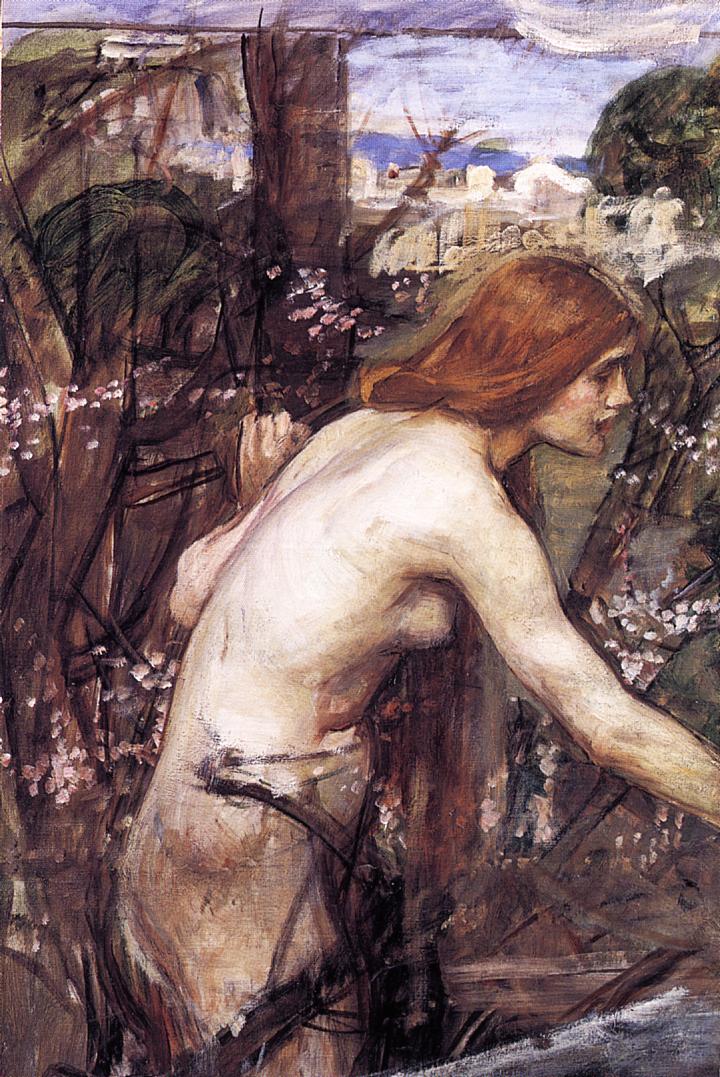
“Woman Picking Flowers” (1914) captures a moment that is almost nothing and yet emotionally loaded. A woman leans forward, intent on gathering blossoms, and the whole painting seems to pivot on that gentle reach. Waterhouse turns an everyday act into a scene of poised concentration. The figure is not posed for us so much as absorbed in her task, and that absorption becomes the painting’s true subject.
At first glance, the composition feels like a half-remembered glimpse: a body in profile, a sweep of reddish hair, an arm extending out of frame, and a surrounding landscape that reads as both real and dreamlike. The setting is not presented with crisp descriptive clarity. Instead, it is suggested through loose, layered strokes and a muted, atmospheric palette. This soft focus does not weaken the image. It strengthens it by making the viewer complete the scene in their imagination. Waterhouse invites you to look slowly, to accept ambiguity, and to feel the hush of a private moment unfolding outdoors.
Composition and the Pull of the Diagonal
Waterhouse organizes the painting around a forward-leaning diagonal that starts at the figure’s back and travels through the shoulder into the extended arm. This diagonal creates motion, even though the action is delicate. It is the line of intention. The body’s tilt implies both effort and care, as if the flowers require a particular gentleness. The diagonal also introduces an imbalance that feels natural. The figure is not centered in a symmetrical display. She is caught mid-gesture, and that makes the scene feel lived rather than staged.
The background counterbalances this forward movement with quieter horizontal bands: a pale sky, distant forms that suggest buildings or shoreline, and darker shapes of vegetation in the midground. These horizontal elements stabilize the composition so it does not tip into melodrama. The result is a steady visual rhythm: the figure presses forward, the landscape holds steady, and the viewer’s gaze oscillates between purpose and stillness.
The placement of the figure close to the picture plane enhances intimacy. We are near enough to sense the warmth of the body against the cooler air and to notice the slight turn of the head. Yet we remain outside the action. The flowers she picks are not presented as a trophy for the viewer. They are part of her world, not ours.
Brushwork, Underpainting, and a Sketch-like Energy
One of the most striking qualities here is the sense of process. Waterhouse allows the painting to show its making. Areas of the background feel brushed in with quick, searching marks. Dark linear accents, almost like drawing lines, weave through the vegetation and tree forms. This creates a layered effect: paint describing form, and line describing structure, sometimes both at once.
That interplay between painterly mass and graphic line gives the work a lively, unfinished vitality, even if it is fully resolved as an image. The viewer can sense decisions: where a contour was reinforced, where a branch was indicated, where blossoms were dotted into place. The surface feels breathable. Instead of sealing the scene behind a smooth polish, Waterhouse lets the energy of looking remain visible.
This approach suits the subject. Flower picking is brief and transient. Blossoms bruise, petals fall, seasons turn. A more rigid finish might feel too final. The looseness here carries a sense of time passing, as if the moment could slip away if the painter pressed too hard.
Color and Atmosphere: Muted Earth, Soft Sky, Warm Hair
The palette is restrained and earthy. Browns, olives, and soft grays dominate the landscape, with pale blues and whites opening the sky. Against this subdued environment, the figure’s hair becomes a warm focal point. Its reddish tone is not flamboyant. It glows quietly, offering a human warmth within the cooler, weathered setting.
The blossoms appear as small notes of pale pink and white scattered through the darker vegetation. They are not treated as botanical specimens. They function more like flickers of light, like highlights that guide the eye and suggest abundance without counting every stem. This gives the flowers a poetic role. They are not only objects to be collected. They are signs of a season, symbols of tenderness, and visual sparks that punctuate the surrounding shadow.
Waterhouse uses color to create depth without heavy perspective lines. Cooler tones recede, warmer notes advance, and the figure sits between those zones as a bridge. The atmosphere feels slightly hazy, as if the air is moist or the day is mild. That softness helps the painting feel contemplative rather than dramatic.
Light, Modeling, and the Figure as a Luminous Presence
The figure is modeled with careful attention to light, but not with harsh contrast. The illumination is gentle, spreading across shoulder, back, and arm in a way that suggests natural daylight rather than theatrical spotlighting. The shadows are soft, turning form through subtle gradations.
This creates a feeling of vulnerability and realism without sensationalism. The figure is simply present. The body is treated as a living form in space, not an excuse for display. Waterhouse’s light does not isolate the figure from the environment. It connects her to it. The brightness of skin echoes the pale sky, while the warmer midtones echo the earth and vegetation.
The head is turned slightly downward and forward, and the facial features are suggested rather than sharply detailed. That choice protects the mood. A strongly described expression could pin the narrative too firmly. Here, the woman’s inner life remains open. The viewer senses concentration, perhaps calm, perhaps thoughtfulness, but the painting never forces a single interpretation.
Nature as Setting and as Psychological Space
Waterhouse often uses nature as more than background. In this painting, the landscape feels like a psychological space, a place where attention narrows and the outside world quiets down. The surrounding vegetation, with its dark strokes and clustered blossoms, frames the figure like a thicket of thoughts. The distant horizon offers release, but it is far away and slightly indistinct.
The environment is not idyllic in a postcard sense. It is textured and somewhat rugged. There are heavy dark forms, and the ground feels uneven. This gives the scene a grounded honesty. The flowers are not gathered in a manicured garden. They are taken from a living, imperfect place.
That choice matters for meaning. A garden can suggest cultivation and control. A wilder setting suggests encounter, chance, and discovery. The act of picking flowers becomes a small negotiation with nature. You reach in, you choose, you take, and the world continues.
The Gesture of Reaching and the Theme of Desire
The painting’s central gesture, the forward reach, carries emotional weight. Reaching is never neutral. It implies desire, intention, and vulnerability. You extend yourself toward something you want, and in doing so you expose your balance. Waterhouse captures that moment of extension with remarkable tenderness.
The flowers themselves can be read in multiple ways. They can stand for simple pleasure, for seasonal ritual, for offering, or for memory. In art, flowers often speak of beauty and brevity. Picking them can suggest cherishing the fleeting, but it can also suggest the inevitable loss that follows the act of plucking.
Waterhouse keeps the symbolism quiet. The painting does not announce an allegory. Instead, it allows the viewer to feel the theme in the body’s motion. The meaning arises from the physical truth of leaning in, focusing, and taking care not to crush what you are trying to hold.
Waterhouse in 1914: Late Style and a Softer Language
As a late work, “Woman Picking Flowers” reflects a mature artist leaning into mood and touch rather than spectacle. Waterhouse is often associated with richly staged literary scenes, but here the drama is internal and subdued. The painting feels intimate, like a personal study elevated into a finished vision.
The more open brushwork can be understood as part of this late style: less concerned with crisp narrative illustration, more invested in atmosphere and sensation. The figure is still classical in her calm solidity, but the surrounding world is almost impressionistic in its looseness. That blend creates a tension between permanence and transience. The human form feels enduring. The landscape feels shifting and momentary.
This balance suits the year. Painted on the edge of a world about to change drastically, the image can be felt as a kind of pause, a moment of quiet attention held against uncertainty. The painting does not depict history, but it carries the feeling of time and fragility in its very softness.
The Viewer’s Role: Witnessing Without Interrupting
A major strength of the painting is how it positions the viewer. We are close, but not invited to intrude. The woman does not look back. She does not perform. Her focus is outward toward the flowers, away from us. That refusal of direct engagement creates respect. We are witnesses to a private act.
This choice builds the painting’s emotional tone. It is meditative rather than declarative. The viewer is encouraged to slow down, to notice subtle shifts of tone, to follow the curve of the back, to see how blossoms scatter like small moments in a day. The painting becomes less about a story with a beginning and end, and more about a feeling that can be revisited.
That is also why the background’s ambiguity matters. Because the setting is not fully specified, it becomes a space the viewer can enter imaginatively. The scene feels both particular and universal: a real woman, a real reach, and a place that could be anywhere the earth gives flowers.
Enduring Appeal: Tenderness, Restraint, and the Poetry of the Ordinary
“Woman Picking Flowers” lasts in the mind because it finds poetry in restraint. Nothing is exaggerated. The pose is natural, the mood is quiet, the landscape is suggestive rather than insistent. Yet the image holds tension: the body extended, the blossoms fragile, the background layered with shadow and light.
Waterhouse transforms a simple action into a meditation on attention. To pick flowers is to notice what is small. It is to value the delicate. It is to accept that beauty is often brief and must be met in the moment. The painting does not lecture this idea. It embodies it through the way paint touches canvas: quick where the world is passing, careful where the human form holds steady.
In the end, the painting offers a gentle kind of seriousness. It reminds us that meaning is not always found in grand events. Sometimes it is found in a quiet reach toward something bright in the undergrowth, and in the stillness that surrounds that reaching.