Image source: wikiart.org
Introduction
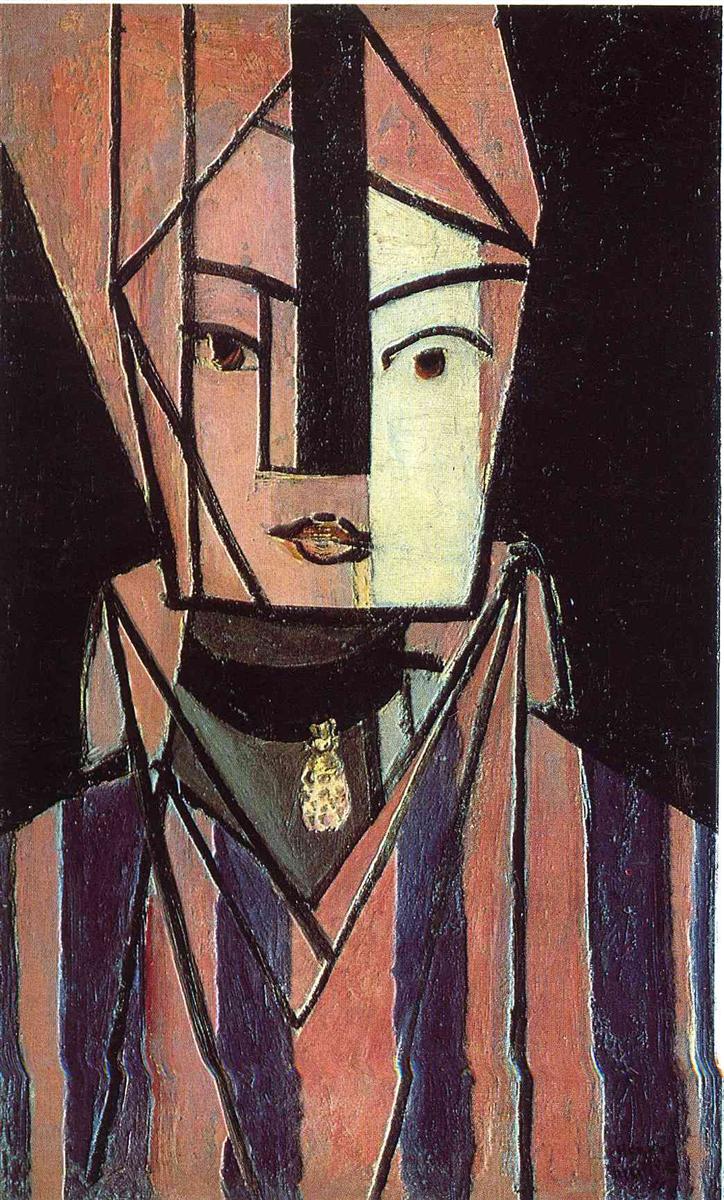
Henri Matisse’s “White and Pink Head” (1915) is a portrait that behaves like an architectural plan. A frontal bust is condensed into interlocking triangles and bars, the face cleaved by a central black seam that divides pale white from rose-pink. The background is a thick night of black, cut by planes of muted color at the edges, while the garment below the neck descends in vertical bands of violet, brick, and blue. A small pendant glows at the throat like a fixed light. Rather than building likeness through gradual modeling, Matisse constructs presence from geometry, contour, and a strictly tuned range of hues. The result is both mask and person, a modern icon whose authority comes from design.
Historical Moment
Painted during the first year of World War I, “White and Pink Head” belongs to the rigorous cycle of 1914–1916 in which Matisse pared his language to essentials. After the high-chroma rapture of Fauvism and the luminous simplifications that followed his Moroccan travels, he turned to studio interiors and portraits that were nearly schematic. Windows became tall fields crossed by a few bars; faces became assemblies of planes bound by uncompromising lines. Cubism had demonstrated that the picture could be a constructed object rather than a transparent window; Matisse absorbed the lesson without adopting Cubism’s analytic fracture. In this picture he keeps the frontal clarity of a Byzantine icon and the decorative beat of a textile, while adopting the modern conviction that structure must be visible.
First Impressions and Visual Walkthrough
From a distance the canvas resolves into a tall figure centrally aligned, surrounded by velvety black. The head is a mosaic of triangles and rectangles whose borders are bevelled with thick black paint. A vertical beam bisects the face, dividing chalk-white right from rose-pink left. The eyes are asymmetrical—one almond-shaped and framed by a soft arc, the other reduced to a dark dot beneath a floating brow. The nose becomes a flat wedge; the mouth a short bar lifted by a thin halo. Neck and collar are compressed into a set of stacked trapezoids, at the base of which hangs a pear-shaped pendant. The robe explodes into stripes, creating a downward cascade that anchors the image and connects it to the lower edge.
Composition as Structure
The composition operates like a truss. Triangular lines rise from the shoulders to the crown, locking the head within a geometric armature. The central vertical seam acts as a mast from which other lines brace outward—across the cheek, along the brow, down to the collar. The surrounding black is not emptiness but pressure, a dense negative space that pushes the figure forward. The garment’s parallel bands—rose, mauve, navy—continue the architectural rhythm, countering the vertical seam with a chorus of echoes. Because each zone is flat and clearly bounded, the picture reads instantly at scale, like a sign or emblem, even as smaller asymmetries keep it alive.
Palette and Temperature
The color scheme is concentrated: black, white, rose-pink, muted violet, and midnight blue, with small notes of ochre and pale yellow in the pendant and lips. The white right side of the face is creamy, touched by faint ochre that keeps it from chilling; the pink left is warm but not sentimental, closer to weathered plaster than to blush. Black is structural and generous; it builds the drawing and deepens the surrounding field. The stripes of the robe add cooler violets and blues, their depth and saturation balancing the warm head. Because the palette is so limited, any change in temperature carries meaning: the pendant’s warm glow concentrates attention at the throat; the faint yellow at the lips adds life without tipping into naturalism.
Drawing in Relief
Matisse draws here with paint that behaves like raised lead. The black lines are not simply outlines; they are ridges that catch light and cast micro-shadows, turning the drawing into relief. Some lines are single and unbroken, others are doubled or slightly offset, preserving the record of searching. The geometry around the eyes, nose, and mouth is crisp yet elastic, so that the face never feels trapped. This relief-like drawing produces a stained-glass sensation: colored planes are locked together by a dark armature, and the image reads as if lit from within.
Face, Mask, and Identity
The bisected face encourages a reading in which person and mask cohabit. The right half, pale and simplified, looks outward with a calm, iconic stare; the left half, warmer and more faceted, feels interior and shielded. The central seam is not a wound but a hinge, suggesting that a modern self can be both public and private, rational and sensuous. Matisse had long admired African and archaic sculpture; their clarity of plane and purposeful stylization supplied a way to convey presence without anecdote. In “White and Pink Head” the mask is not a disguise but a method: it distills identity to relationships of proportion and rhythm.
Symmetry, Asymmetry, and Poise
The portrait plays a delicate game with symmetry. The central axis promises mirror balance, but Matisse quickly subverts it. The right eye is higher and larger than the left; the mouth is slightly skewed; the planes of the forehead do not match. These deviations are small yet decisive, animating what might otherwise be static. At the same time, the garment’s vertical stripes restore equilibrium, echoing the axis and keeping the figure upright. The image feels poised because both tendencies—order and drift—are present in finely judged quantities.
The Pendant and the Throat
The pear-shaped pendant at the base of the neck is the painting’s most tactile detail. Its pale, faceted surface flickers against the surrounding dark, acting like a keystone in the stacked geometry of the collar. Metaphorically it works as a voice-node, a small light at the gateway between head and body. Formally it performs a crucial task: concentrating warmth at the center so the cooler blues and blacks do not swallow the composition. In an image shaped by austerity, the pendant introduces a precise note of luxury, demonstrating how one ornament can balance an entire field.
Surface, Texture, and Process
The paint is not smoothed to anonymity; it shows its grain. The black ground is cratered and matte, sucking light; the colored planes in the face are brushed more thinly, allowing the canvas weave to whisper. At certain borders, dry bristles leave feathery halos that soften the rigid geometry. Pentimenti—faint ghosts of moved lines—peek at the temples and along the nose, proof that the final structure was negotiated, not imposed. This visible process gives the picture moral weight. Clarity arrives through revision; discipline bears the fingerprints of choice.
Dialogues with Cubism and Icon Painting
The portrait converses with Cubism without imitating it. Like the Cubists, Matisse constructs form from planar facets anchored by decisive edges. Unlike them, he maintains a frontal address and avoids multi-angle fracture. The figure’s hieratic pose and frontal stare recall Byzantine icons; the black ground functions like a gilded field turned nocturnal. The result is a hybrid language: Cubist structure stabilised by iconic poise, decorative color tuned to liturgical calm.
Relation to Nearby Works
“White and Pink Head” sits in productive tension with portraits such as “Woman on a High Stool” and “Madame Yvonne Landsberg.” Where those paintings explore grisaille atmospheres and looping line, this one commits to blocky planes and hard seams. It also rhymes with Matisse’s 1914–1915 interiors, especially the window pictures, in which a dark structural grid supports large, luminous panels. In all of these works Matisse is testing how few elements can carry expression. Here, the experiment is applied to a human face—and succeeds without sacrificing humanity.
Psychology Without Anecdote
The canvas contains no props, no background narrative, no domestic clues. Yet it conveys a distinct psychology. The offset eyes make the gaze alert rather than frozen; the firm lips hold composure; the black ground isolates the figure in a zone of attention. Because Matisse denies theatrical detail, mood emerges from design itself. The portrait feels self-possessed, even regal, not because of symbolism but because triangles meet with authority, because the pendant catches light at the throat, because the robe falls in solemn verticals. He converts temperament into geometry.
The Decorative Ideal Reimagined
Matisse often described his aim as a balanced, restful art, akin to a “good armchair.” Even at his most severe, the decorative ideal persists. In “White and Pink Head” decoration is not added pattern; it is structural rhythm. The stripes of the robe, the pendant’s small glitter, the subtle alternation of pale and dark in the face—these elements create a surface that is pleasurable to inhabit with the eyes. The painting’s gravity never hardens into severity because proportion is tuned to welcome: wide fields balance tight seams, warm notes offset cool ones, and the whole rests on a steady vertical cadence.
Meaning of the Title
The title directs attention to color rather than person. “White and Pink Head” names a set of relations before it names a sitter. This emphasis tells viewers how to look: treat the picture as a construction of hues and planes, then allow the sense of personhood to rise from that construction. It is a practical lesson encoded in words, part of Matisse’s lifelong effort to teach viewers to see design as content.
How to Look
Begin by taking the portrait in as a complete sign: a head centered in black, divided white and pink, crowned and collared by triangles. Then move to the eyes and notice their asymmetry, the right framed by a calm arch, the left pared to a dot beneath a floating brow. Trace the central seam and feel how every contour ties into it. Drop to the pendant and register how its light holds the structure together. Finally, step back until the figure reads as a single emblem, then forward until the raised ridges of black reveal the drawing as relief. The oscillation between emblem and surface is the painting’s engine.
Legacy and Relevance
“White and Pink Head” remains instructive for portraiture that wants modernity without dehumanization. It demonstrates that the face can be simplified to a handful of planes and still deliver presence; that color fields can carry emotion; that ornament can be structural rather than applied. Designers will find in it a durable lesson about using a limited palette with maximum effect; painters will find a model for drawing with body and edge rather than outline alone. Above all, it shows how restraint can heighten character: remove anecdote, and proportion speaks.
Conclusion
In “White and Pink Head,” Matisse compresses a living person into an icon of planes, a portrait whose identity is made from geometry, temperature, and the pressure of black. The painting neither recounts a story nor advertises virtuoso illusionism. It rests its case on relations—the seam that cleaves and binds, the pendant that concentrates light, the robe’s stripes that anchor the axis. More than a century later, its clarity still feels audacious. The image proves that when structure is exact and color is tuned, a few shapes can hold the complexity of a human presence.