Image source: wikiart.org
Introduction
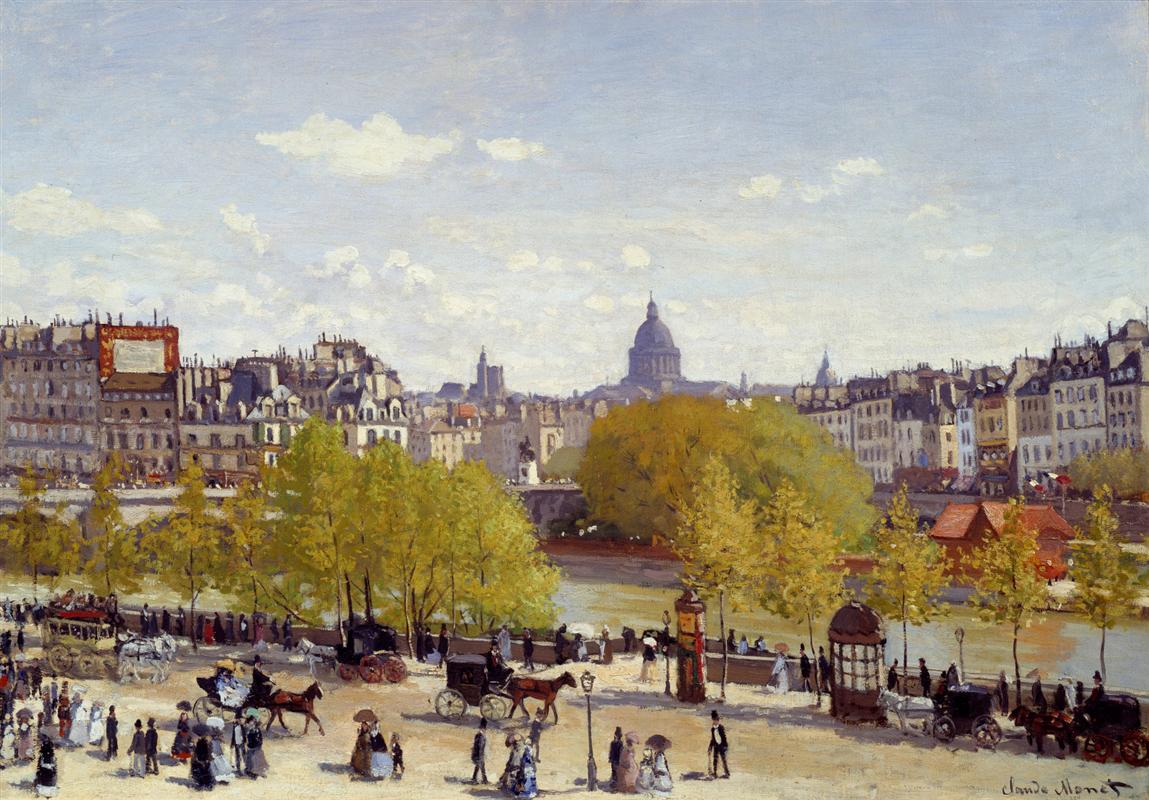
Claude Monet’s Wharf of Louvre, Paris from 1867 is a painting that captures a city in motion while still preserving a striking sense of calm. At first glance, the scene appears simple. It presents a broad urban view with trees, carriages, pedestrians, riverbank activity, and the distant architecture of Paris under a pale blue sky. Yet the more closely one looks, the more complex the painting becomes. Monet is not merely recording a location. He is studying how modern life appears when it is filtered through light, weather, distance, and movement.
This painting belongs to an important moment in Monet’s development. In the late 1860s, he was still shaping the visual language that would later help define Impressionism. Here, many of the qualities associated with his mature work are already present. The picture is attentive to fleeting effects, open air atmosphere, urban vitality, and the shifting relationships between structure and sensation. At the same time, it still retains a degree of firmness and compositional clarity that connects it to earlier landscape traditions. That tension gives the work much of its fascination.
Wharf of Louvre, Paris is not a grand historical spectacle, nor is it a dramatic narrative scene. It is a painting about seeing. Monet turns an ordinary stretch of Paris into an image of visual richness. Trees soften the architecture, sunlight warms the ground, the river opens the middle distance, and human activity animates the foreground without dominating it. The result is a cityscape that feels lived in rather than staged. Paris appears not as an abstract symbol of modernity, but as an environment breathed in and observed in real time.
Monet in 1867
The year 1867 falls within a formative phase of Monet’s career. He was still a young painter, but he had already begun moving away from the studio centered, polished finish expected by academic tradition. Alongside artists such as Pierre Auguste Renoir, Alfred Sisley, and Frédéric Bazille, Monet was exploring a new way of painting nature and contemporary life. He was interested in direct observation, in the instability of light, and in the idea that a painting could reflect immediate visual experience instead of idealized order.
This period is especially important because Monet had not yet fully arrived at the looser, more fragmented touch of his later decades. In works from the 1860s, one can often see him balancing close description with freer passages of paint. That balance is very clear in Wharf of Louvre, Paris. Buildings, carriages, and figures are legible, yet they are never overdefined. The painting remains alert to atmosphere. Monet is less concerned with outlining every detail than with translating the sensation of the whole scene.
Paris also mattered deeply to the artists who would become Impressionists. The city was changing rapidly in the nineteenth century. Its avenues, bridges, promenades, parks, and riverbanks offered endless opportunities for artists interested in contemporary life. Monet did not treat the modern city as cold or purely mechanical. Instead, he often found within it a living rhythm shaped by weather, light, traffic, and leisure. In this painting, Paris is modern, but it is also airy, open, and touched by nature.
The Viewpoint and Overall Composition
One of the most compelling aspects of Wharf of Louvre, Paris is its viewpoint. Monet presents the scene from an elevated position, allowing the viewer to look across the river and over the activity of the quay. This elevated perspective creates a broad field of vision. It lets the painting function on several levels at once. The foreground shows movement and social life. The middle ground is opened by the water and line of trees. The background rises into the skyline of Paris, crowned by monumental architecture.
The composition is carefully organized, even though it appears spontaneous. The lower portion of the painting is occupied by the busy wharf, where carriages, horses, and pedestrians move across a sunlit expanse. This zone gives the picture energy and immediacy. Beyond it, the river and embankment form a softer horizontal band. Trees, rendered in fresh yellow green tones, create a visual screen that partly conceals the built environment. Behind them, the city emerges in layers, with rooftops, towers, and the distant dome adding a dignified sense of permanence.
What makes the composition especially effective is Monet’s control of openness and density. The foreground is busy, but not crowded. The middle ground offers relief through light and air. The skyline gives the painting a strong anchor. Above all of this stretches a generous sky filled with delicate cloud forms. The sky is not an empty backdrop. It expands the visual atmosphere and prevents the city from feeling compressed. Monet uses it to give Paris breadth and breath.
Paris as a Modern Subject
This painting is deeply tied to the idea of modern urban life. Monet is not depicting a mythological scene, a biblical episode, or an aristocratic portrait. He is painting the everyday city. That choice was significant. For artists of his generation, modern life itself had become worthy of serious art. Streets, train stations, promenades, cafés, bridges, and riverbanks could now serve as major subjects.
In Wharf of Louvre, Paris, modernity appears through circulation. People walk, gather, pass, and pause. Carriages roll along the quay. The city is shown as a space of transit and encounter. Yet Monet avoids making the scene feel harsh or impersonal. The modern city is not presented as overwhelming. Instead, it feels human in scale. The figures are small, but they are numerous enough to suggest a social fabric. Their presence turns the quay into a place of shared public life.
There is also an interesting balance between urban development and natural presence. Trees line the riverbank, filtering the view and giving the city a softer rhythm. This is not a purely stone built Paris. It is a Paris in which water, foliage, sunlight, and architecture interact. Monet seems interested in how the city becomes beautiful not because it escapes nature, but because it absorbs natural effects into its daily life.
Light and Atmosphere
Light is the true subject of the painting. Everything else exists within its influence. The sky is pale and luminous, filled with a soft clarity that suggests a mild day. The light falls across the quay and picks out the dust colored or sandy tones of the ground. It also touches the tree canopies, which glow in yellow green and warm olive notes. Even the distant buildings seem less like solid blocks of masonry than like forms suspended in atmosphere.
Monet does not use light here in a theatrical way. There is no dramatic sunset, no violent storm, no exaggerated contrast. Instead, he shows a daylight effect that feels fleeting and believable. That restraint is central to the painting’s power. The beauty of the scene lies in its ordinary brilliance. Monet recognizes that even a common Paris day can be visually extraordinary when seen attentively.
Atmosphere also softens the boundaries between things. The distant architecture is less sharply defined than the foreground. The skyline seems to dissolve gently into the air. This recession into light creates depth without requiring rigid contour. Monet lets the eye move through the painting naturally. Space is built through tonal change, color temperature, and decreasing definition rather than through heavily drawn perspective lines.
The air itself feels present. One senses a slight brightness, perhaps a mild spring warmth, and the freshness of open space near the river. This atmospheric quality is one of the painting’s greatest achievements. Monet does not simply depict objects sitting in front of one another. He paints the medium that surrounds them.
Color and Tonal Harmony
The color structure of Wharf of Louvre, Paris is subtle and beautifully controlled. Monet relies on a restrained but lively palette. Pale blues dominate the sky, while creamy whites shape the clouds. The architecture is painted in muted beiges, grays, browns, and soft violets. These relatively subdued urban tones are set against the brighter greens and yellow greens of the trees. The foreground includes touches of black, deep brown, rust red, and white in the carriages and clothing.
This distribution of color is important because it prevents the painting from feeling monotonous. The city itself is relatively neutral, but the foliage introduces freshness and pulse. The trees do not merely decorate the composition. They create a chromatic bridge between earth, water, and sky. Their warmth also offsets the cooler distance of the buildings and gives the scene seasonal vitality.
Monet’s use of contrast is measured. Dark notes are placed strategically, especially in the figures, wheels, carriage interiors, and some architectural accents. These darker touches help articulate the scene and keep the light tones from becoming vague. Yet the overall impression remains luminous. Even the darker elements do not feel heavy. They participate in a larger harmony shaped by daylight.
There is also a remarkable tonal unity in the painting. No single passage feels isolated. The pale sky, sunlit ground, softened architecture, and fresh foliage all belong to the same atmospheric system. This unity gives the work coherence. Monet is not interested in decorative color for its own sake. He is using color to describe an integrated visual experience.
Brushwork and Surface
The brushwork in this painting reveals Monet at a fascinating stage of evolution. It is lively and responsive, but not yet as radically broken as in some later Impressionist works. He varies his handling according to the demands of the motif. The sky is thinly and smoothly brushed, allowing broad atmospheric continuity. The trees are more animated, built through touches that suggest leaves and light without becoming botanical description. The figures and vehicles are abbreviated, but they remain persuasive.
This variation in handling is one reason the painting feels so alive. Monet does not apply one uniform technique across the entire canvas. He adjusts his touch to distance, texture, and visual importance. The distant skyline is softened. The foreground activity is articulated through quicker, darker accents. The result is a surface that feels responsive to seeing itself.
The brushwork also helps create movement. Pedestrians are rendered through swift marks that imply posture and motion rather than fixed identity. Carriages are suggested through concise strokes that capture shape and direction. Even the trees seem to flicker slightly in the light. Nothing is overworked. Monet trusts the viewer’s eye to complete what the paint only indicates.
This trust is a key modern feature of the work. The painting does not insist on exhaustive detail. It invites participation. From a distance, the scene coheres beautifully. Up close, one notices the economy and intelligence of Monet’s touch. This double experience is central to his art.
Figures, Carriages, and Urban Rhythm
Although the figures in Wharf of Louvre, Paris are small, they are crucial to the painting’s meaning. They turn the view into a lived urban moment. Without them, the scene would become a handsome cityscape. With them, it becomes a social space.
Monet includes pedestrians strolling, conversing, waiting, or crossing the open ground. Some figures appear elegant and refined, suggesting the public character of the quay as a place for movement and display. The carriages add another layer of urban rhythm. Their horses and wheels imply a steady flow of traffic, while their dark silhouettes punctuate the brightness of the foreground.
These human elements are not individualized portraits. Monet is not interested in biography here. Instead, he paints types of movement and patterns of presence. The figures create scale, tempo, and atmosphere. They show how the city is inhabited. Their smallness also reinforces the breadth of the setting. Paris appears larger because its inhabitants are woven into it rather than dominating it.
There is a pleasing alternation between pause and motion throughout the foreground. Some groups cluster together. Some vehicles seem to advance. Some pedestrians stand almost still. This varied rhythm keeps the painting from feeling static. Monet captures not a single frozen instant, but a field of ongoing activity.
Architecture and the Paris Skyline
The skyline in this painting performs an essential compositional and symbolic role. Rising beyond the trees and river, the buildings give Paris its recognizable form. Rooftops, chimneys, towers, and the prominent dome establish the city as a place of historical depth and civic identity. Monet does not flatten the skyline into a generic backdrop. He allows its distinct forms to remain readable even as they soften in the atmosphere.
The dome at the center distance provides a visual focal point. It stabilizes the composition and gives the city an air of monumentality. Yet this monumentality is carefully balanced. The architecture does not overwhelm the scene. It is integrated into the broader play of light and air. Even the most solid buildings seem touched by transience.
This balance between permanence and ephemerality is one of Monet’s great themes. Architecture stands for endurance, order, and human construction. Light stands for change, instability, and passing sensation. In Wharf of Louvre, Paris, the two are not opposed so much as intertwined. The city is real and solid, but it is always being transformed by atmosphere.
The River and the Middle Ground
The river space and embankment serve as a crucial transition between foreground and background. Without this middle zone, the composition would feel compressed. Monet uses water and open space to create visual breathing room. The river introduces softness and reflection, even if reflections are understated rather than highly dramatic. It also reinforces the sense that Paris is a city organized around circulation and flow.
The trees along the water’s edge are especially important here. They partly veil the far bank and prevent the architecture from becoming too hard or immediate. Their foliage acts almost like a filter through which the city is seen. This screen of leaves creates depth while also enriching the painting’s seasonal mood.
The middle ground is where Monet’s interest in perception becomes especially clear. Things are neither close enough for detail nor distant enough for complete abstraction. Instead, they hover in a zone of atmospheric ambiguity. That ambiguity feels truthful. In real life, much of what we see exists in exactly this condition of partial clarity.
A Seasonal Reading of the Scene
The painting seems to convey a sense of spring or early warm weather. The trees are in fresh leaf, but not yet dense or dark with summer fullness. Their color suggests renewal. The sky is bright, open, and gentle. The overall mood is one of emergence rather than heaviness.
This seasonal aspect matters because it shapes the emotional tone of the work. The city appears freshened. There is a sense of lightness in the air and in the public activity along the quay. The painting does not merely record a place. It records a moment within the annual cycle of the city’s life.
Monet was especially sensitive to such seasonal transitions. He understood that the same location could become entirely different under changing natural conditions. In Wharf of Louvre, Paris, season modifies architecture, movement, and color alike. The urban environment feels softened by new foliage and open light. Paris is shown at a moment when it seems expansive and hopeful.
Early Impressionism and Artistic Significance
This painting is important because it shows Monet approaching the language that would soon transform modern painting. Many later Impressionist concerns are already present here. The emphasis on transient light, the preference for contemporary subject matter, the atmospheric handling of distance, and the sketch like vitality of the figures all point toward the movement that Monet would help define.
At the same time, the painting still preserves a structural clarity that makes it especially revealing. One can see Monet thinking through how to reconcile observation with composition. He is not abandoning form. He is reimagining it. The painting remains organized, balanced, and legible while also embracing immediacy and visual fluctuation.
This makes Wharf of Louvre, Paris a particularly rich work for understanding Monet’s artistic development. It stands at the threshold of a new way of painting. It looks forward without entirely severing itself from older traditions of cityscape and landscape composition.
Lasting Appeal
The lasting appeal of Wharf of Louvre, Paris lies in its combination of accessibility and sophistication. It is easy to enjoy immediately. The scene is bright, open, and full of recognizable life. Yet it also rewards sustained attention. The more one studies it, the more one notices Monet’s command of structure, atmosphere, and rhythm.
The painting also remains compelling because it presents modern urban life without cynicism or sentimentality. Monet does not idealize Paris into fantasy, nor does he reduce it to noise and congestion. He sees it as a place where beauty emerges from ordinary conditions. Light on stone, leaves against architecture, people moving through public space, and air softening distance become enough to sustain a major work of art.
That vision feels remarkably fresh even now. Monet reminds us that a city can be observed with the same sensitivity often reserved for fields, coasts, or gardens. In his hands, the urban landscape becomes a living organism shaped by time of day, season, weather, and human presence. Wharf of Louvre, Paris is therefore not only an image of nineteenth century Paris. It is also a meditation on how modern life can be seen poetically without losing its reality.
In this painting, Claude Monet turns a riverside view into a study of perception itself. The city is stable, yet changing. The scene is busy, yet calm. The forms are definite, yet softened by air and light. These tensions give the work its depth and beauty. It is a confident early statement from an artist who would go on to reshape the history of painting, and it remains one of the most engaging examples of how Monet could transform an everyday view into something luminous, intelligent, and enduring.
