Image source: wikiart.org
Introduction to Peter Paul Rubens’s “Vitellius”
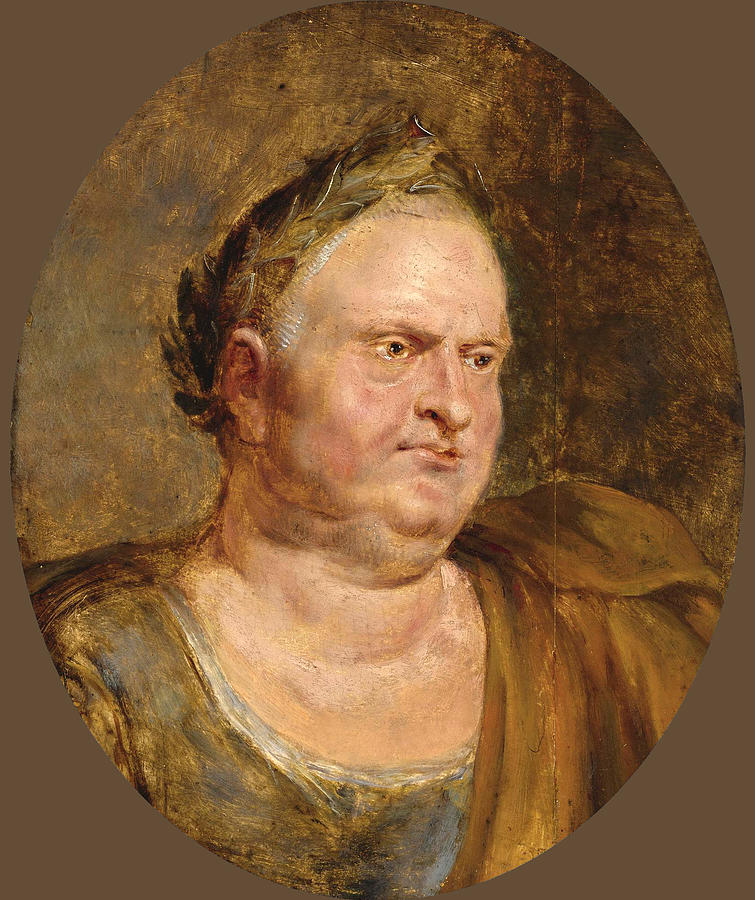
“Vitellius” by Peter Paul Rubens is a compact but powerful portrait that condenses the drama of Roman history into a single face. The painting, likely an oil sketch rather than a finished court commission, shows the Roman emperor Aulus Vitellius in a bust-length view within an oval format. His heavy, fleshy features, laurel wreath, and draped classical garment immediately identify him as an imperial figure, yet Rubens avoids any idealization. Instead, he presents a blunt, almost brutal likeness that reflects both the man’s reputation and the artist’s fascination with character.
Vitellius reigned briefly in 69 CE, the “Year of the Four Emperors,” and ancient authors such as Suetonius depicted him as gluttonous, weak, and morally compromised. Rubens, steeped in classical literature and Roman antiquities, adopts this tradition but turns it into a vivid, painterly study of power and excess. The portrait is less about historical accuracy than about the psychological and moral aura surrounding a ruler whose authority rests on unstable foundations.
The Oval Format and Compositional Focus
Rubens chooses an oval, close-cropped format that places Vitellius’s head almost flush with the picture plane. There is no elaborate architectural backdrop, no imperial throne or allegorical figures. Instead, the viewer confronts the emperor’s face and upper chest against a warm, textured ground. This compositional decision heightens immediacy; Vitellius seems to emerge directly out of the painted surface.
The oval acts like a medallion or ancient coin, echoing Roman imperial portrait types that Rubens would have known from collections of cameos and coins. By framing the emperor in this way, Rubens links his painting to the tradition of imperial images circulated throughout the empire, yet his brushwork and coloristic richness are very much Baroque. The oval also softens the corners of the composition, guiding the eye in a smooth circular motion around the head and shoulders before returning to the central focus: the face.
Within this frame, Rubens positions Vitellius slightly turned to the viewer’s left, with his gaze directed off into the distance. The diagonal line from the bottom right shoulder up to the laurel wreath leads the eye through the composition. There is a dynamic tension between the heavy, rounded forms of the head and the oblique direction of the gaze, suggesting both mass and movement, presence and inner agitation.
The Head of Vitellius: Physiognomy and Character
The most striking aspect of the painting is the uncompromising depiction of Vitellius’s physiognomy. Rubens portrays him with a broad, fleshy face, small eyes set deep in heavy lids, a short nose, and a prominent, slightly pursed mouth. The double chin, swollen cheeks, and thick neck all contribute to the sense of corpulence. This is not the cool, marble ideal of a Roman emperor; it is a very human, and rather unflattering, likeness.
Yet Rubens avoids caricature. The flesh is rendered with sensitivity and nuance. Pink and ivory tones mingle with cooler greys and subtle blues, suggesting both the softness and the weight of living skin. Highlights on the nose, cheekbones, and forehead give the face volume, while the shadows around the eyes and under the chin create depth. Vitellius may embody excess, but he also appears vividly alive.
The expression is complex. The mouth is set in a line that might be interpreted as stubbornness or suppressed irritation. The eyes, though small, glint with alertness. They do not meet the viewer; instead, they look slightly beyond, as if assessing a situation or listening to unseen advisors. This sideways gaze adds to the sense of mistrust or defensiveness that often accompanies precarious power. Rubens uses these subtle cues to suggest that Vitellius is a man who knows both the temptations and the dangers of the imperial office.
Laurel Wreath and Classical Drapery
Despite the unsparing depiction of his features, Vitellius is clearly marked as emperor through two key attributes: the laurel wreath and the draped garment. A thin crown of laurel leaves circles the top of his head, painted in muted greens and browns that almost blend with his hair. The laurel traditionally symbolizes victory and imperial authority. Rubens’s understated wreath feels more like a conventional necessity than a triumphant emblem; it seems to sit uneasily on Vitellius’s head, echoing the historian’s judgment that his reign was short-lived and unstable.
The garment around his shoulders resembles a toga or classical cloak, rendered in warm ochres and golds. Rubens indicates folds and weight with broad, energetic strokes rather than meticulous detail. The fabric frames the neck and upper chest, creating a solid base for the heavy head. At the same time, the loose, painterly handling suggests that the outward trappings of power are ultimately superficial—draped over the man rather than fully integrated with his character.
By combining these classical symbols with a brutally honest likeness, Rubens creates a tension between ideal and reality. The laurel and toga proclaim Vitellius as emperor; the flesh and expression reveal his all-too-human weaknesses.
Color, Light, and Painterly Technique
The color scheme of “Vitellius” is restrained and earthy. The background consists of mottled browns and ochres, applied in a loose, almost sketch-like fashion. This warm tonal field harmonizes with the colors of the flesh and drapery, creating a unified atmosphere. The absence of strong blues, reds, or other saturated hues keeps the viewer’s attention firmly on the modeling of the head.
Rubens uses light to sculpt the volume of the face. A soft illumination falls from the upper left, striking the forehead, nose, cheeks, and chin. The right side of the face recedes into shadow, but not so deeply that details are lost. This distribution of light and shadow—chiaroscuro—gives the head a three-dimensional presence, as though it were projecting outward from the flat surface.
The brushwork is vigorous and visible, especially in the background and drapery. In the face, Rubens’s strokes become more controlled but never overly smooth. The paint surface retains a sense of movement and spontaneity, suggesting that this work may have been a preparatory oil sketch. The liveliness of the brushwork contributes to the sense that we are seeing not just a finished image but the artist’s active engagement with his subject—each stroke a small decision about character and form.
Historical Imagination and Rubens’s Interest in Rome
Rubens was not simply copying a known ancient bust of Vitellius; he was participating in a broader early modern fascination with Roman history and imperial portraiture. Learned collectors across Europe assembled sculpted heads of Roman emperors, both originals and replicas, and used them as moral exemplars—some to emulate, others to avoid. Vitellius, associated with gluttony and moral weakness, often appeared in such series as a negative figure.
The painter’s travels in Italy and his exposure to collections of antiquities deeply informed his art. He created many oil sketches and drawings after ancient sculptures, sometimes faithfully copying them, sometimes reimagining them through his own Baroque lens. In the case of “Vitellius,” Rubens appears to draw on the famous marble head then thought to represent Vitellius—a type characterized by similar heavy features. But rather than replicating cold stone, he animates the figure with color and expression, making the ancient emperor feel immediate to a seventeenth-century audience.
For Rubens and his patrons, such portraits of Roman emperors were more than historical curiosities. They served as reflections on power, virtue, and vice. In an age of intricate dynastic politics and religious conflict, the rise and fall of Roman rulers resonated strongly. A painting like “Vitellius” could be displayed alongside portraits of more admirable emperors to form a visual gallery of moral lessons drawn from history.
Moral Reading: Power, Gluttony, and Fragility
Ancient authors described Vitellius as a man given to extravagant banquets, bribery, and weak governance. Rubens does not depict him in the act of eating or indulging in luxury, yet his physiognomy and bearing quietly echo this reputation. The fleshy jowls, overfull cheeks, and thick neck suggest a life of excess. The firm but slightly compressed lips hint at sensual appetite.
At the same time, there is no cruel mockery in Rubens’s depiction. The artist seems more interested in the universal theme of how power can coexist with weakness. Vitellius’s laurel wreath declares him victorious, but his gaze does not convey serenity or confidence. Instead, he looks burdened and wary, as if aware that his hold on authority is precarious. This ambivalence invites viewers to consider the human vulnerability behind imperial titles.
The painting therefore operates on two moral levels. On one level, it embodies a cautionary tale about indulgence and misrule. On another, it evokes empathy for an individual caught in a role he may not entirely master. Rubens’s humanizing approach prevents the image from becoming a simple caricature of vice.
Comparison with Other Rubens Portraits
Placed alongside Rubens’s portraits of contemporary monarchs and nobles, “Vitellius” offers a revealing contrast. In portraits of figures such as Charles I of England or the Archduchess Isabella, Rubens often blends idealization with likeness, accentuating dignity, elegance, and grace. Costumes are richly detailed, backgrounds elaborate, and symbols of rank clearly displayed.
In “Vitellius,” by contrast, detail is minimal and brutality of form is emphasized. The emperor’s clothing is barely indicated; the focus is entirely on the head. Yet the way Rubens studies the play of light on flesh, the subtle modulation of color, and the psychological depth of expression is consistent with his broader portrait practice. The same skills he used to ennoble living rulers are here applied to scrutinize a flawed ancient one.
This difference underscores Rubens’s range. He could fashion images that served the demands of courtly flattery, but he was equally capable of probing human imperfection with honesty. “Vitellius” belongs to the latter category—a portrait where observation outweighs diplomacy.
The Painting as Oil Sketch and Artistic Study
Many scholars consider “Vitellius” an oil sketch rather than a finished presentation piece. This is suggested by the visible, swiftly applied brushstrokes, the limited finish of the garment, and the textured, somewhat rough background. For Rubens, oil sketches were essential tools, allowing him to explore composition, color, and character quickly and freely.
Seen in this light, the painting may have functioned as part of a larger project—perhaps a series of Roman emperors or a preparatory study for a more complex work. Yet even as a sketch, it possesses remarkable completeness. The head itself is fully realized, and the emotional impact of the image is strong.
The sketch-like quality also offers viewers a rare glimpse into Rubens’s process. We can see the decisions of the brush, the layering of tones, the places where he revised or left passages unresolved. It is as if we are standing behind the artist as he works, watching Vitellius emerge from the raw material of paint.
Contemporary Resonance and Lasting Appeal
For modern viewers, “Vitellius” holds fascination not only as a historical image but as a study of power and personality. In an age that continues to scrutinize leaders’ character and bodies, Rubens’s unvarnished portrayal feels surprisingly current. The painting reminds us that behind every exalted title lies a human being with vulnerabilities and appetites.
The work also appeals to those interested in the interaction between classical antiquity and later European art. It shows how a seventeenth-century painter engaged imaginatively with Roman history, not by sterile imitation, but by breathing life into ancient figures. Through Rubens, Vitellius becomes more than a name in a text; he becomes a tangible presence, with all the complexity and ambiguity that entails.
Finally, the painting exemplifies the enduring power of portraiture itself. Without elaborate narrative or symbolic props, a single human face can carry a wealth of meaning—historical, moral, psychological. Rubens’s “Vitellius” achieves this through masterful handling of light, form, and expression, confirming why he remains one of the great portraitists of the Baroque era.