Image source: wikiart.org
Introduction
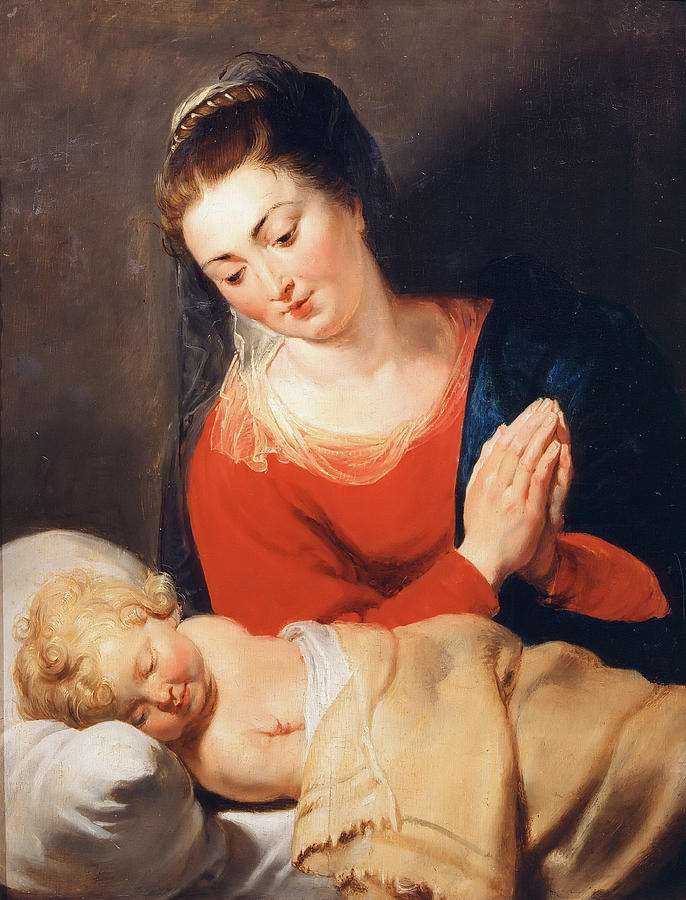
“Virgin in Adoration Before the Christ Child” by Peter Paul Rubens offers an intimate, tender view of the Madonna and Child that feels as close as a bedside vigil. Mary leans over the sleeping Christ Child, her hands folded in quiet prayer, her face softened by love and contemplation. The composition is simple, almost domestic, yet suffused with spiritual depth. Rubens distills the vast mystery of the Incarnation into a moment that any parent can recognize: watching over a sleeping child in silent adoration.
Unlike his grand altarpieces crowded with angels and saints, here Rubens focuses on just two figures. The absence of elaborate background or symbolic accessories directs all attention to the relationship between mother and son. The painting becomes a meditation on maternal love, divine humility, and the contemplative heart of Christian devotion.
Composition and Intimate Framing
The composition is closely cropped, bringing the viewer into immediate proximity with Mary and the Child. Christ lies diagonally across the lower left corner, swaddled but bare-chested, his head resting on a soft white pillow. Mary occupies the upper right, forming a protective arc around him. Her body bends forward, head slightly tilted, hands clasped at chest level.
This diagonal arrangement creates a gentle flow from Mary’s face down through her hands to the Child’s sleeping form. The curve of her torso echoes the curve of his small body, visually binding them together. There is no visible cradle; instead, the folds of cloth and pillow suggest a makeshift bed, emphasizing the poverty and simplicity traditionally associated with the Nativity.
The tight framing excludes all extraneous detail. We see no shepherds, angels, or landscape, only a neutral background that pushes the figures forward. This compositional choice intensifies the sense of privacy, as if we are witnessing a moment not meant for public spectacle but for quiet contemplation.
The Face of the Virgin: Tenderness and Reflection
Rubens renders Mary with extraordinary delicacy. Her features are soft and rounded, her complexion luminous with a gentle blush. The downward tilt of her head conveys both humility and focus; her gaze rests not directly on the Child’s face but slightly ahead, as if she is contemplating both the sleeping infant and the destiny he will one day fulfill.
Her expression blends love, serenity, and an undertone of solemn awareness. This is not simply a mother admiring her baby—though that human affection is clearly present. It is also a soul contemplating the mystery of God made flesh. The slight shadows beneath her eyes and the refined modeling of her cheeks hint at emotional depth, suggesting a woman who has already pondered many things in her heart.
Mary’s hair is gathered up with a band or ribbon, covered partly by a translucent veil that falls behind her shoulders. The veil’s subtle presence reinforces her modesty and spiritual role, while also providing Rubens with an opportunity to demonstrate his skill in painting delicate, gauzy textures.
The Sleeping Christ Child
The Christ Child, lying peacefully on his side, is perhaps the most captivating element of the painting. Rubens was renowned for his ability to depict children with robust naturalism, and here he portrays Jesus as a healthy, chubby toddler with golden curls. The softness of his skin is emphasized by the contrast with the crisp white pillow and the thicker, rougher blanket that covers his lower body.
His tiny mouth is slightly open, his cheeks flushed with sleep. One arm is tucked close to his body while the other rests gently above the blanket. The vulnerability of his pose underscores the doctrine of the Incarnation: the eternal Word has taken on the complete helplessness of infancy.
Yet small hints suggest his divine identity. The light seems to fall most strongly on his body, giving it a subtle glow. The whiteness of the linen around his torso evokes purity, while the red mark of his nipple and the soft modeling of the chest foreshadow the later wounds of the Crucifixion. Without overt symbols, Rubens hints that this sleeping child is also the future sacrificial savior.
Color Palette and Symbolic Garments
Rubens uses a restrained yet meaningful color scheme. Mary wears a vivid red dress with a dark blue mantle draped over her shoulder. These colors are traditional in Marian iconography: red represents love and the humanity that Mary shares with her Son; blue symbolizes her heavenly grace and role as Queen of Heaven. The combination visually unites earth and heaven in her person.
The warm red of her garment contrasts beautifully with the cool, neutral tones of the background and the pale flesh of the Child. The blue mantle, catching light along its folds, anchors the right side of the composition and provides a deep, rich counterbalance to the luminous skin and white linens.
The Child’s blanket is a muted beige or ochre, its rougher texture suggested through broader, more textured brushstrokes. This earthy color grounds the scene, hinting at the humble circumstances of Christ’s birth and the humanity he shares with all.
Overall, the palette is warm, favoring pinks, creams, reds, and browns. This warmth supports the emotional atmosphere of affection and safety.
Light, Shadow, and Spiritual Atmosphere
Light in this painting is gentle yet focused. It appears to fall from the left, illuminating Mary’s face and hands and bathing the Child’s body in soft radiance. The background remains relatively dark, which not only brings the figures forward but also creates a quiet, contemplative mood.
There is no dramatic chiaroscuro as in some of Rubens’s larger altarpieces; instead, the transitions between light and shadow are smooth and gradual. This soft lighting evokes the glow of lamplight or early dawn, appropriate for the intimate setting of a mother watching over her sleeping child.
The subtle halo-like effect around Mary’s head, achieved not through explicit halos but through careful highlights and shadows, adds a sense of sanctity without breaking the naturalism of the scene. Light functions not just as a physical phenomenon but as a metaphor for grace. The child, source of spiritual illumination, is literally the brightest object in the painting, and Mary’s face reflects that light in both a literal and symbolic sense.
Gesture of Prayer and Silent Adoration
Mary’s clasped hands are a crucial element in conveying the painting’s devotional purpose. Positioned close to her chest, they signal not mere watchfulness but active prayer. She is not simply a mother guarding her child; she is a believer adoring her God.
The fingers are slender and slightly tapered, with delicate knuckles and soft shading that reveals Rubens’s careful observation of anatomy. The gesture is calm and composed, lacking tension. It suggests a quiet, ongoing dialogue with God—a meditation on the mystery before her.
For the viewer, her prayerful posture sets the tone. We are invited not to intrude on a private domestic moment but to join in her adoration. The painting becomes an image suitable for personal devotion, guiding those who look at it to contemplate the humility of Christ’s incarnation and the loving response of his mother.
Human Motherhood and Divine Mystery
One of the painting’s greatest strengths is its ability to balance human tenderness with theological depth. Rubens makes Mary unmistakably human: her flushed cheeks, slightly parted lips, and the gentle tilt of her head all convey maternal affection. The closeness of her body to the Child, leaning protectively over him, evokes countless mothers who watch over their children’s sleep.
At the same time, the title and elements like the praying hands, the traditional colors, and the contemplative expression make it clear that this is no ordinary scene of motherhood. It is a visual meditation on the divine mystery that in this child, God has entered human life.
The painting thus speaks on two levels. On one level, it celebrates the sanctity of maternal love and the quiet heroism of caring for a vulnerable infant. On another, it presents Mary as model of contemplative faith, one who recognizes the presence of God in the ordinary and responds with adoration.
Rubens’s Baroque Sensibility in a Quiet Key
Though modest in scale and content compared with many of Rubens’s dramatic works, “Virgin in Adoration Before the Christ Child” still bears hallmarks of the Baroque spirit. The soft yet confident brushwork, the luminous flesh tones, and the subtle movement suggested by the folds of fabric all belong to Rubens’s mature style.
However, instead of explosive motion or complex multi-figure compositions, the dynamism here is inward. The turning of Mary’s head, the diagonal of the Child’s body, and the interplay of gazes create a quiet but powerful emotional movement. The painting invites not amazement at grand spectacle but absorption in a gentle, ongoing exchange of love and reverence.
This quieter Baroque mode shows Rubens’s versatility. He could evoke spiritual intensity not only through stormy skies and contorted bodies, but also through the delicate play of light on a mother’s cheek and the peaceful weight of a sleeping child.
Devotional Function and Viewer Engagement
Paintings like this one were often intended for private devotion, whether in a side chapel, a convent cell, or a domestic interior. Their purpose was to provide a focal point for prayer and meditation, helping viewers imagine themselves present with Mary before the Christ Child.
Rubens aids this contemplative use through the painting’s intimate scale and simple composition. The absence of elaborate narrative context allows viewers to bring their own thoughts and prayers to the image. Mary’s adoring posture becomes a model for the beholder: as she prays before her Son, so the viewer is encouraged to pray before the sacramental presence of Christ.
The emotional accessibility of the scene also fosters empathy. Those who have cared for children can immediately connect with Mary’s tenderness, making the leap to spiritual contemplation more natural and heartfelt.
Legacy and Emotional Resonance
“Virgin in Adoration Before the Christ Child” continues to resonate because it touches on universal human experiences while expressing timeless spiritual truths. The sight of a sleeping child and a parent watching in quiet love crosses cultural and historical boundaries. Rubens elevates this everyday scene into a reflection on God’s closeness and vulnerability.
The painting reminds viewers that sacred realities often appear in simple, humble forms: a baby, a blanket, a mother at prayer. In an age that often associates the divine with spectacle, Rubens’s work whispers that holiness can be found in silence and small gestures.
For admirers of Baroque art, the painting underscores Rubens’s range. He was not only a master of grand history paintings but also a sensitive interpreter of intimate, devotional themes. His ability to render flesh, fabric, and light with such tenderness ensures that the emotional impact of this artwork remains immediate and strong.