Image source: wikiart.org
Introduction to Murillo’s “Virgin Glorious”
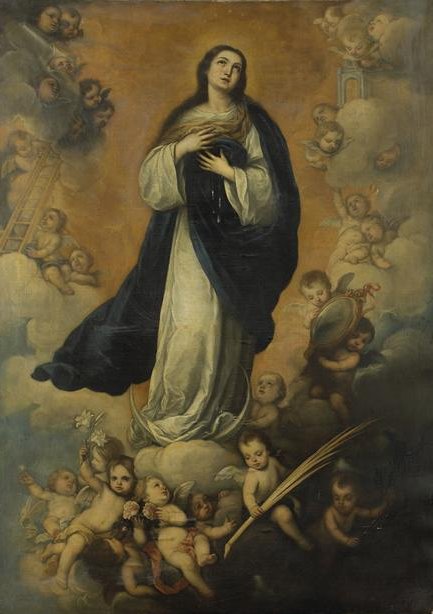
“Virgin Glorious” by Bartolomé Esteban Murillo is a radiant celebration of the Virgin Mary that captures the spiritual fervor of seventeenth century Spain. The painting shows Mary standing on clouds, wrapped in a flowing white gown and deep blue mantle, surrounded by a swirling host of cherubs and symbolic objects. She lifts her gaze toward heaven and folds her hands across her chest with a mixture of humility and serene confidence.
Although the exact date of the painting is unknown, the style clearly belongs to Murillo’s mature period, when his vision of Mary as the Immaculate, gracious and tender mother, had reached its most poetic form. “Virgin Glorious” fits into a larger group of his works dedicated to the Immaculate Conception, yet it possesses distinctive features, especially the rich array of Marian symbols carried by the surrounding angels.
This canvas is not only a work of art but a visual hymn. It invites viewers to contemplate Mary as radiant, pure, and close to God, while also deeply connected to the faithful on earth who look up to her for help and intercession.
The Immaculate Conception and the Idea of the Glorious Virgin
To understand “Virgin Glorious,” it is important to remember that seventeenth century Spain was passionately devoted to the doctrine of the Immaculate Conception, the belief that Mary was preserved from original sin from the first moment of her existence. Although this teaching would not be formally defined by the Church until the nineteenth century, Spanish theologians, artists, and ordinary believers embraced it with enthusiasm centuries earlier.
Murillo became the leading painter of the Immaculate Conception in Seville. His images of Mary floating on clouds, wrapped in blue and white, have shaped how many people imagine the pure and sinless Virgin. “Virgin Glorious” clearly belongs to this tradition. Mary is shown youthful and graceful, untouched by the weight of sin. She does not crush the serpent underfoot in this particular version, but she stands above the world on a bank of clouds, lifted into the realm of God.
The title “Virgin Glorious” highlights not only her purity but her exaltation. Mary is not simply free from sin; she is filled with grace and crowned with honor in heaven. The numerous cherubs and symbols around her underscore this glory, turning the canvas into a visual litany of Marian titles and virtues.
Composition and Spatial Organization
Murillo organizes the painting around a strong vertical axis that runs through Mary from the clouds under her feet to the top of the canvas. She occupies the central position, slightly elevated, so that her figure dominates the scene. Her long blue mantle falls in a graceful curve, closing the space around her like a protective robe, while the white gown beneath provides a luminous core.
Around Mary, the clouds open in a wide oval, filled with cherubs of different sizes. These angelic figures create a swirling movement that frames her and guides the viewer’s eye upward. Some look toward her in admiration, others hold symbolic objects, and still others seem to play among the clouds. The lower part of the composition is denser with putti, while the upper section features fewer but larger angels, enhancing the sense of ascent.
On the left side, a ladder rises from the clouds, and near the top right appears a small tower with an enclosed garden. These elements are subtle but significant symbols of Mary drawn from the litanies and the Song of Songs. Murillo integrates them seamlessly into the cloudscape, so that the entire composition becomes a symbolic heaven surrounding the Virgin.
The overall effect is dynamic yet balanced. The swirling cherubs prevent the composition from feeling static, but Mary’s vertical, almost column like presence holds everything together. She is the calm center around which heaven dances.
The Figure of Mary
Murillo’s depiction of Mary in “Virgin Glorious” combines ideal beauty with approachable humanity. She is not distant or austere. Her features are soft, her skin luminous, her hair falling loosely around her shoulders under a delicate veil. The expression on her face is particularly striking. Her eyes are slightly raised, her lips gently parted, as though she is lost in a quiet, trusting conversation with God.
Her pose is simple but eloquent. She stands firmly, yet lightly, upon the clouds, her feet hidden by drapery to emphasize the supernatural nature of her position. Her hands cross over her chest, fingers lightly touching her shoulders. This gesture suggests humility and consent, reminiscent of her response to the angel at the Annunciation. At the same time, it expresses gratitude and love for the grace she has received.
The blue mantle that wraps around her is one of Murillo’s trademarks. Its dark yet rich color contrasts beautifully with the creamy white of her gown. Blue traditionally symbolizes faithfulness and heavenly wisdom, while white represents purity and innocence. By combining these colors, Murillo visually expresses the idea of Mary as both pure and deeply rooted in God’s divine plan.
Her garments are painted with generous folds that catch the light in gentle highlights. The fabric appears heavy yet fluid, giving her body a sense of weight and presence even as she floats among the clouds. This balance between physicality and spiritual elevation is at the heart of Murillo’s Marian imagery.
Cherubs, Angels, and Symbolic Objects
One of the delights of “Virgin Glorious” is the multitude of cherubs that populate the surrounding clouds. Murillo was famous for his skill in painting angelic children, and here he lets that gift shine. The cherubs are plump, lively, and expressive, their faces full of wonder and joy. Some reach up toward Mary, others look out at the viewer, and a few interact playfully with each other.
These angels are not merely decorative; many carry symbols that help interpret the painting. At the lower right, a child holds a tall palm frond, a sign of victory and triumph. This palm can be read as a reference to Mary’s share in the victory of Christ over sin and death. Nearby, another cherub clutches what appears to be a garland or bouquet of flowers, perhaps roses and lilies that symbolize love and purity.
To the left, a cherub holds lilies, another traditional Marian flower, indicating her spotless innocence. Higher up, one angel presents a mirror, which may refer to Mary as speculum sine macula, the mirror without stain, reflecting God’s beauty without distortion. Another cherub appears to guard a tower-like structure, evoking the title turris Davidica, the Tower of David, and turris eburnea, the Tower of Ivory, both poetic images used in Marian litanies.
The ladder on the left edge alludes to Mary as the ladder by which Christ descended to earth and by which believers ascend to heaven. These symbols turn the painting into a visual encyclopedia of Marian praise, each object corresponding to a poetic title sung in prayer.
Light, Color, and Atmospheric Effects
Color and light play a crucial role in creating the sense of glory that the title promises. The background is filled with a warm golden tone that suggests the light of heaven rather than natural sunlight. This golden field melts into softer grays and blues around the edges, giving the clouds a soft, luminous presence.
Murillo uses this golden atmosphere to bathe Mary and the cherubs in a gentle glow. Highlights catch the edges of the clouds, the round cheeks of the angels, and the folds of Mary’s garments. The light is concentrated around the Virgin, so that she appears to be the central source or focus of brightness. Yet the transitions are subtle; there is no harsh contrast, only a continuous gradation from radiance to shadow.
The color palette, dominated by soft creams, warm golds, sky blues, and gentle flesh tones, creates a sense of sweetness and harmony. Even the deeper blues of Mary’s mantle are modulated with lighter reflections, ensuring that no part of the painting feels heavy or oppressive. This luminous gentleness is typical of Murillo and represents a softer approach to Baroque drama, one that emphasizes grace more than terror.
Theological Meaning and Spiritual Imagination
Beyond its aesthetic beauty, “Virgin Glorious” communicates a dense theological message. Mary is shown as a woman fully glorified, already sharing in the heavenly life promised to believers. Her presence high above the earth on clouds, encircled by angels, speaks of her exaltation as Queen of Heaven. Yet her gesture of humility and the softness of her gaze keep her from appearing distant or unapproachable.
The numerous symbols carried by the cherubs announce her virtues. She is the tower of defense, the pure mirror of God’s light, the ladder between heaven and earth, the garden enclosed where God dwells. The palm and flowers at the bottom of the composition underscore her victory over sin and the fragrance of her holiness.
For seventeenth century viewers, these symbols would have resonated strongly with prayers they recited regularly, especially the Litany of Loreto. Looking at the painting would be like seeing those poetic invocations come alive in color and form. The work thus serves as a kind of visual meditation on Mary’s role in salvation history, inviting the faithful to praise her and imitate her virtues.
Murillo’s Style and the Spanish Baroque Context
“Virgin Glorious” exemplifies Murillo’s particular contribution to the Spanish Baroque. While other Spanish painters often emphasized dramatic contrasts and intense asceticism, Murillo tended toward softer transitions and warmer emotional tones. His saints and Madonnas are approachable and tender, enveloped in light that feels more like a gentle caress than a sudden blaze.
In this painting, that softness is evident in the faces of Mary and the cherubs, in the velvety handling of clouds, and in the harmonious color palette. Yet the work still belongs to the Baroque through its dynamic composition, sense of movement, and use of light to focus attention. The swirling arrangement of angels and the upward motion of the entire scene create a dynamic baroque energy, even as the general mood remains peaceful.
The painting also reflects the particular spirituality of Seville, Murillo’s home city. Confraternities devoted to the Immaculate Conception commissioned processions, sculptures, and paintings that celebrated Mary as the patroness of the city. Murillo’s images played a central role in this civic devotion. “Virgin Glorious” would have reinforced the sense that Seville held a special relationship with the pure and exalted Virgin.
Devotional Function and Viewer Experience
Originally, “Virgin Glorious” likely hung in a church or convent where it functioned as a focal point for prayer and contemplation. Its large scale and vertical format would have made it visible from a distance, inviting worshippers to raise their eyes as they entered the space.
For a believer standing before the painting, the experience would combine awe and comfort. The upward sweep of the composition draws the gaze into the realm of heaven, while Mary’s gentle expression returns that gaze with maternal affection. The viewer is encouraged to feel part of the scene, as if standing among the cherubs at the bottom, looking up at the glorious Virgin.
The painting could accompany the recitation of the rosary or the singing of Marian hymns. As the words of praise were spoken, the eyes would travel over the symbolic objects and angelic faces, reinforcing the meanings carried by the prayers. In this way, “Virgin Glorious” functions as a bridge between the verbal language of devotion and the visual language of art.
Lasting Legacy and Contemporary Relevance
Today, “Virgin Glorious” continues to attract viewers for both its artistic merit and spiritual depth. Art historians admire Murillo’s command of composition, color, and light, as well as his ability to express complex theology with a gentle human touch. Devout visitors see in the painting an image of Mary who is powerful yet tender, exalted yet near.
Even those who do not share the specific religious background can appreciate the universal themes of purity, hope, and beauty embodied in the work. The idea of a figure who stands above the turmoil of the world yet looks down with compassion can resonate on many levels, religious or not.
The painting also invites reflection on how images shape belief and emotion. Murillo’s vision of Mary as youthful, serene, and surrounded by playful cherubs has influenced generations of artists and worshippers. In many ways, when people imagine the Immaculate Virgin today, they do so through the lens that painters like Murillo created.
Conclusion
“Virgin Glorious” by Bartolomé Esteban Murillo is more than a decorative representation of the Virgin Mary. It is a rich, multi layered meditation on her purity, glory, and maternal closeness. Through a masterful arrangement of figures, luminous color, and symbolic detail, Murillo draws the viewer into a heavenly world where Mary stands at the center as a radiant figure of grace.
The swirling cherubs, the ladder, the lilies, the mirror, and the palm all contribute to a visual litany of praise. Mary’s calm face and humble gesture invite trust and imitation. Light bathes the scene in warm gold, turning the canvas into a window opening onto the realm of God.
Centuries after its creation, this painting still speaks with clarity and beauty. It remains a powerful example of how art can embody theological ideas, nurture personal devotion, and offer viewers a glimpse of glory through color, light, and form.