Image source: wikiart.org
Introduction to “Virgin and Child” by Peter Paul Rubens
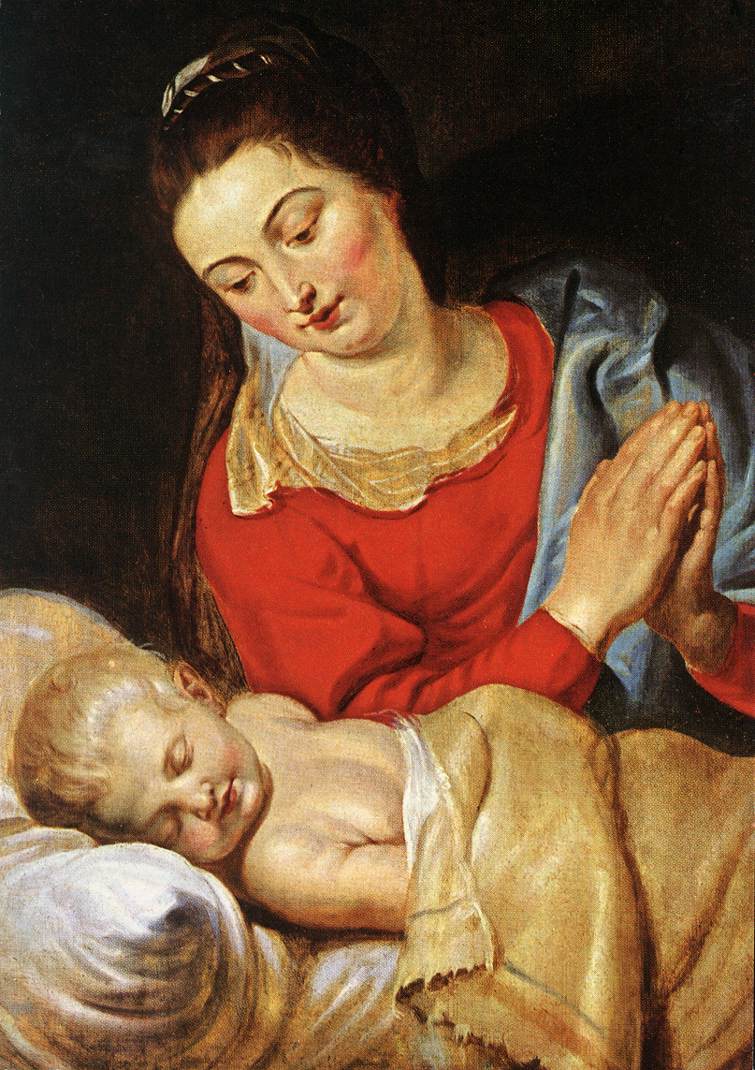
“Virgin and Child” by Peter Paul Rubens captures one of the most familiar themes in Christian art with remarkable tenderness and simplicity. Instead of a grand throne room or celestial glory, Rubens places the Virgin Mary and the sleeping Christ Child in a quiet, intimate setting. Mary leans over the child, her hands folded in prayer, her face softened by a gentle, contemplative expression. The infant lies on a white pillow and blanket, wrapped loosely in warm fabric, his body relaxed in deep sleep.
The painting radiates warmth through its deep reds, soft golden tones, and the subtle blue of Mary’s mantle. Rubens focuses less on symbolic accessories and more on the emotional bond between mother and child. This approach invites viewers into a domestic moment that feels both human and sacred. The result is a work that speaks to the universal experience of motherhood while also expressing central truths of Christian belief about the Incarnation and divine love.
Composition and the Intimacy of the Diagonal
The composition of “Virgin and Child” is based on a strong diagonal that runs from the upper left to the lower right. Mary’s head and shoulders occupy the upper left corner, while the sleeping child fills the lower part of the canvas. Her inclined head directs the viewer’s gaze downward toward the infant, creating a visual link between the two figures.
This diagonal movement generates a sense of shelter. Mary’s body and gaze form a protective arc over the child. Her folded hands, placed near the center of the canvas, create a point of stillness within the diagonal flow. The viewer’s eye moves naturally from Mary’s face to her hands and then to the peaceful face of Jesus, who becomes the quiet focus of the entire work.
Rubens keeps the background dark and unobtrusive. There are no distracting architectural elements or landscape vistas. The darkness behind Mary helps highlight the luminous skin of both figures and intensifies the sense that we are sharing a private moment in a dimly lit room. The economy of elements in the composition serves to concentrate attention on the loving interaction at the heart of the painting.
The Human Warmth of the Virgin
Rubens portrays the Virgin Mary as a young woman with a gentle, slightly downcast gaze. Her hair is pulled back, held by a simple band, and falls behind her shoulders. Her face is softly rounded, with full cheeks touched by a delicate blush. The expression on her lips is neither smiling nor sorrowful. Instead it conveys quiet devotion and thoughtful contemplation.
Her clothing combines rich color with simple forms. She wears a red dress that clings modestly yet naturally to her figure, with a golden collar visible at the neckline. Over her shoulders she drapes a blue mantle, the traditional color associated with Mary, which adds a cool accent to the warm tones of flesh and fabric. The mantle’s folds are rendered with Rubens’s characteristic fluency, capturing the play of light across its surface.
Mary’s hands are folded in prayer, but their position also emphasizes closeness to the child. They are held near her heart, and the direction of her prayerful posture is toward the infant. This visual relationship suggests that her prayer centers entirely on him. Her devotion is maternal as well as spiritual. She is not only praying to God but also contemplating the mystery of the child who is both her son and, in Christian belief, the Son of God.
The Sleeping Christ Child and the Peace of Innocence
The Christ Child lies curled on a soft white pillow, his head turned slightly toward the viewer. His body is partially covered by a golden blanket that mirrors the warm tones of Mary’s dress. One arm rests above the cloth, the fingers relaxed, while the other is tucked closer to his body. His features are serene. Closed eyes, slightly parted lips, and the smooth curve of his cheek convey the deep, untroubled sleep of a small child.
Rubens paints the child’s skin with exceptional delicacy. The subtle gradations of color from rosy cheeks to pale forehead create a sense of living flesh. Highlights along the forehead, nose, and shoulder catch the gentle light, giving the impression that his skin almost glows. This luminosity has a double effect. It emphasizes the vulnerability of the infant body, but it also hints at his divine nature.
The choice to show Christ sleeping is significant. In Christian theology, sleep often prefigures death and resurrection. The peaceful repose of the child can be read as a quiet foreshadowing of the future Passion, when Christ will lie in the tomb before rising again. At the same time, the image of a sleeping baby is universally moving, appealing to the viewer’s sense of tenderness and care. Rubens skillfully balances these layers of meaning, allowing viewers to experience both simple affection and deeper contemplation.
Color, Light, and the Atmosphere of Devotion
Color and light play crucial roles in shaping the mood of this painting. The overall palette is warm, dominated by reds, golds, and soft skin tones. Mary’s red dress injects vivid energy into the composition, symbolizing love and perhaps hinting at the sacrificial future of Christ. The blue mantle provides a cool counterpoint, associated traditionally with purity and spiritual truth. Together, red and blue create a harmonious contrast that has become iconic in depictions of the Virgin.
The bedding and blanket around the child are painted in creamy whites and muted golds. These lighter tones draw the eye toward the infant and serve as a reflective surface for the soft light that falls from the upper left. This light gently models the forms of both figures without creating harsh shadows. The effect is intimate and quiet, as if lit by a single candle or small lamp.
The dark background absorbs much of the light, heightening the sense that Mary and Jesus are enclosed in their own small world. The darkness is not threatening. Instead, it functions like a curtain that closes out distractions, focusing attention on the scene of prayer and rest. The overall effect is one of hushed devotion, a visual analog to a lullaby or whispered prayer.
Gesture, Expression, and the Silent Dialogue
Although this painting contains no dramatic action, it is rich in silent communication. Mary does not touch the child directly in this moment, yet her whole posture leans toward him. Her head is tilted, her eyes lowered in his direction, and her hands are clasped as if she is entrusting him to God while also keeping watch. The slight downturn of her mouth suggests a mixture of affection and awe.
The Christ Child, for his part, communicates through stillness. His relaxed posture and the softness of his features express complete trust. He is entirely dependent on Mary for care and protection, yet he sleeps without fear. This vulnerability invites the viewer to share Mary’s protective concern.
The interplay of these gestures creates what might be called a silent dialogue of trust and love. Mary prays for the child and contemplates the mystery of his identity. The child sleeps in secure dependence on her. The viewer, drawn into this dialogue, is encouraged to reflect on themes of trust, responsibility, and the tender balance between strength and vulnerability that characterizes caregiving relationships.
Theological Meanings and Symbolic Layers
Beyond the immediate human emotion of the scene, “Virgin and Child” carries several theological implications. The most obvious is the doctrine of the Incarnation. By portraying the divine Christ as a small, sleeping baby, Rubens underscores the belief that God took on real human flesh, subject to fatigue, growth, and dependence. The warmth with which he paints the child’s body makes this human reality vividly tangible.
Mary’s role as intercessor is also suggested by her folded hands and prayerful attitude. In Catholic tradition she is often seen as one who prays on behalf of humanity. Here she appears to pray first of all for her own child, yet her prayer can be understood more broadly as representing the prayers of the Church for the world that will be touched by this child’s life and sacrifice.
The dark background may allude to the world into which Christ is born, a world in need of light. The glowing figures in the foreground become a kind of beacon, a visual sign of hope in darkness. The subtle foreshadowing of Christ’s future suffering, hinted at by the red garment and the vulnerability of the sleeping child, adds another layer of meaning. The painting gently reminds viewers that the tenderness of Bethlehem is inseparable from the sacrifice of Calvary.
Rubens’s Approach to Devotional Imagery
Rubens created many grand altarpieces filled with dramatic movement and complex compositions. In “Virgin and Child” he adopts a different approach, more modest in scale and calmer in mood. This shift reveals his versatility and sensitivity to the devotional needs of viewers.
Smaller, intimate paintings like this were often intended for private chapels, convents, or domestic interiors. Their purpose was to aid personal prayer and contemplation. Rubens respects this function by limiting the number of figures and keeping the scene emotionally accessible. The viewer does not have to decode complex allegories or follow a multifigure narrative. Instead, one can rest with Mary and the child, letting the quiet beauty of the scene nurture reflection.
At the same time, Rubens brings his characteristic mastery of texture and color to the work. The fabric of Mary’s dress and mantle, the softness of the pillow, and the delicate rendering of skin all show the hand of a highly accomplished painter. Yet these details never overwhelm the central focus on the relationship between mother and child. Technical brilliance serves the spiritual message rather than overshadowing it.
Emotional Resonance for Modern Viewers
Even for viewers who may not share Rubens’s religious background, “Virgin and Child” holds powerful emotional resonance. The image of a parent watching over a sleeping child is universal. It speaks to experiences of care, responsibility, and love that cross cultural and historical boundaries.
The painting can evoke memories of being cared for or caring for others. It may bring to mind the fragility of infancy and the tenderness that such fragility calls forth in adults. In a world often filled with noise and anxiety, the quiet rest depicted here can feel like a visual invitation to calm and trust.
For those who approach the painting from a spiritual perspective, it offers rich material for meditation. One can contemplate themes of divine love, the vulnerability of God in human flesh, and the role of Mary as a model of receptive faith and maternal devotion. The gentle light, the warm colors, and the serene expressions all support such reflection, making the painting a kind of visual prayer.
Conclusion
“Virgin and Child” by Peter Paul Rubens distills the essence of maternal tenderness and sacred mystery into a simple, deeply moving image. Through a carefully balanced composition, warm color palette, and subtle play of light, Rubens presents the Virgin Mary and the sleeping Christ Child as both an ordinary mother and child and as central figures in the story of salvation.
Mary’s prayerful posture and contemplative gaze express love, responsibility, and reverence. The child’s peaceful sleep reveals vulnerability and trust while hinting at the future path of suffering and glory that Christian belief attributes to him. The dark background and intimate lighting create a protected space in which viewers can share in this quiet moment.
In this work Rubens proves that profound themes can be communicated without grand gestures or crowded scenes. A single mother watching over her child becomes a window into mysteries of faith, love, and human tenderness. “Virgin and Child” continues to touch hearts because it unites the most human of experiences with the deepest spiritual questions, all through the luminous beauty of paint on canvas.