Image source: wikiart.org
Introduction
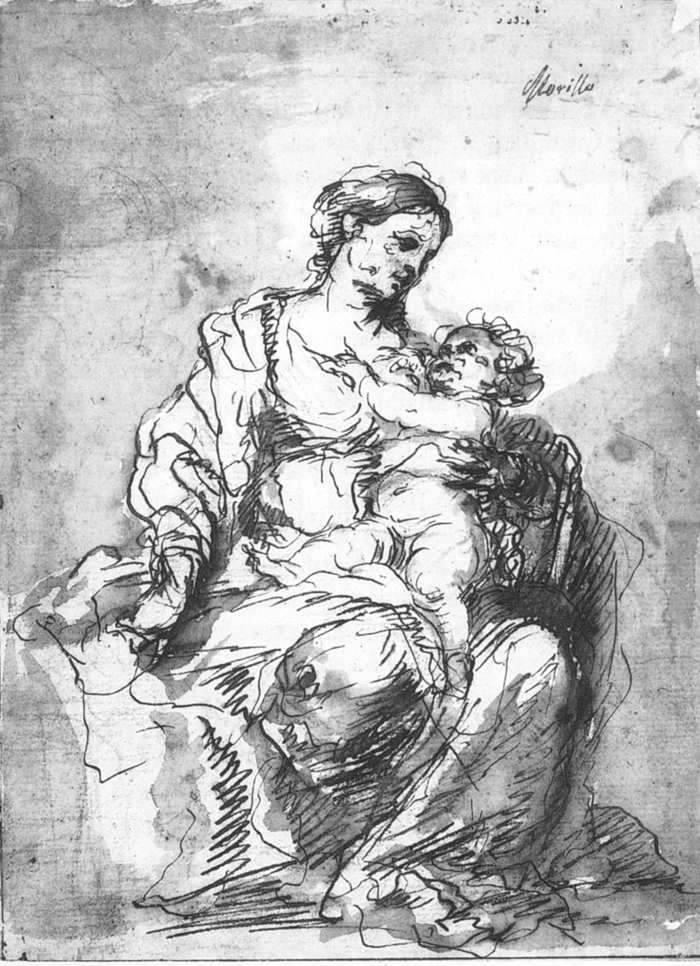
“Virgin and Child” by Bartolomé Esteban Murillo, dated around 1680, is a remarkably intimate interpretation of one of the most familiar themes in Christian art. Unlike Murillo’s polished oil paintings filled with glowing color and soft light, this work is a monochrome drawing that relies on ink, wash, and rapid, expressive lines. Yet within these apparently simple means, Murillo captures the tenderness between mother and child with extraordinary sensitivity.
The image shows the Virgin Mary seated, holding the Christ Child close to her chest. The lines are quick and fluid, the shading suggestive rather than precise, and the paper shows through in many places. Still, the emotional clarity is undeniable. Murillo distills the essence of the Madonna and Child motif down to its most basic elements: a protective embrace, a child leaning in trust, and the gentle sorrow that foreshadows the future Passion.
By examining this drawing in detail, we can better understand Murillo’s creative process, his approach to devotional imagery, and the way he used even the simplest materials to communicate deep theological and human truths.
Historical And Devotional Context
Bartolomé Esteban Murillo worked in seventeenth century Seville, at a time when religious imagery was central to public and private devotion. Churches, monasteries, and confraternities commissioned large altarpieces, while private patrons sought smaller works suitable for home contemplation. The theme of the Virgin and Child was especially beloved, as it joined the grandeur of divine incarnation with the everyday tenderness of motherhood.
This drawing belongs to Murillo’s late period, when his reputation as a master of sacred art was fully established. He had already produced many celebrated canvases of the Immaculate Conception, the Holy Family, and the Madonna with the Child. Drawings such as “Virgin and Child” may have served as preparatory studies for larger paintings, as exercises in composition, or as independent devotional images.
In the Catholic culture of seventeenth century Spain, images of Mary holding the Christ Child were not simply decorative. They were meant to encourage believers to meditate on the mystery of God made flesh and to find comfort in the idea of a divine figure who shares the vulnerabilities of human infancy and family life. Murillo’s approach, filled with warmth and naturalism, was perfectly suited to this spiritual goal.
Medium And Technique
One of the most striking aspects of this “Virgin and Child” is the medium. Murillo uses pen and ink combined with wash, allowing him to alternate between sharp, energetic outlines and soft areas of shadow. The drawing appears spontaneous, with some lines overlapping and others left intentionally incomplete. The wash creates delicate pools of gray that suggest volume in the drapery and bodies without becoming overly detailed.
This technique reveals Murillo’s confidence and speed. With only a few gestures of the pen he maps out the Virgin’s figure, the child’s limbs, and the billowing folds of cloth. The ink wash then reinforces important areas of light and shadow, giving weight to the seated figure and emphasizing the curvature of the child’s body.
The absence of color focuses attention on form and expression. Viewers can follow the path of the artist’s hand, seeing how he builds the composition from sweeping curves and intersecting diagonals. The drawing has the vitality of a moment captured in motion, as if Murillo were thinking on paper, searching for the most eloquent pose.
Composition And Overall Structure
Murillo organizes the composition around a strong triangular structure. The base of the triangle lies along the Virgin’s expansive skirt, which spreads across the lower part of the sheet. From this base her torso rises at a slight diagonal, and the child’s body curves diagonally in the opposite direction, creating a subtle X-shaped interplay that animates the group. The apex of the triangle coincides with Mary’s head, which bends gently toward the child.
This triangular arrangement gives the drawing stability and harmony. It echoes many Renaissance and Baroque compositions in which the Madonna and Child are framed within a pyramidal form that suggests both physical support and symbolic elevation. The empty space around the figures is carefully calibrated. Murillo leaves generous margins at the top and sides, which keeps the focus on the mother and child while also conveying a sense of airy openness.
The Virgin’s body is turned slightly to the viewer’s left, while the Child twists toward the right. This counter movement creates a dynamic relationship, preventing the composition from becoming static. At the same time, the close proximity of their faces and the encircling sweep of Mary’s arms unite the figures in an unbroken visual and emotional loop.
The Virgin Mary As Mother And Contemplative
Although the drawing is rapid, Murillo gives the Virgin Mary a remarkably expressive face. Her features are softly modeled, with downcast eyes and a slightly furrowed brow. She looks at the child with a combination of affection and quiet concern. The downward tilt of her head suggests humility and contemplation.
Murillo’s Mary is not a distant queen, but a mother absorbed in the child she holds. Her lips are gently closed, and there is a hint of sadness in the curve of her eyebrows. This emotional nuance hints at the dual role Mary plays: joyful mother of the infant Christ and sorrowful witness to his future suffering. Baroque artists often sought to capture this combination of happiness and foreknowledge in depictions of the Madonna.
Her body is enveloped in voluminuous drapery. The lines of the cloth swirl around her lap, cascade over her knees, and gather in heavy folds around her arms. These folds do more than indicate clothing; they function as a visual metaphor for her protective embrace. The encircling fabric seems to create a warm refuge for the child, symbolizing Mary’s role as a shelter for Christ and, by extension, for the faithful who seek her intercession.
The Christ Child And The Language Of Gesture
The infant Christ in this drawing is naked, his small body resting across Mary’s lap and chest. Murillo depicts him with chubby limbs and a rounded belly, emphasizing his true humanity. Yet his pose also reveals subtle hints of his divine mission. One arm wraps around Mary’s neck, pulling himself close in a gesture of trust and dependence. The other arm reaches across his body, perhaps touched to his chest or extended toward Mary’s garment.
His head is tilted back, cheek pressed against his mother’s chest, eyes half closed. This pose conveys a feeling of complete security and affection. The child is not posing for the viewer; he is absorbed in the comfort of his mother’s arms. This sense of relaxed intimacy is central to Murillo’s interpretation of the subject.
At the same time, the diagonal of the child’s body and the curvature of his neck echo classical depictions of reclining or fallen figures, subtly foreshadowing the later themes of sacrifice and death. Even in this tender scene of infancy, Murillo hints at the larger narrative of the Christian story. The cross is not shown, but it is present in the expressive logic of the pose.
Line, Movement, And The Expressive Energy Of The Drawing
Because this work is a drawing rather than a finished painting, the rhythms of Murillo’s line are more obvious. We can see where he pressed harder to define a contour, where he allowed the pen to glide lightly, and where quick hatch marks build up areas of shadow. These lines create a sense of movement that animates the entire group.
The draperies are particularly energetic. Rapid, looping strokes define the folds of Mary’s robe, suggesting cloth that is both heavy and alive with motion. These swirling lines frame the more delicately drawn forms of the faces and the child’s body. The contrast between vigorous drapery and softer anatomy enhances the emotional focus on the expressions.
Murillo does not obsess over perfect anatomical proportion. Instead, he prioritizes the overall gesture and the emotional relationship between the figures. The slightly exaggerated curves of the child and the broad sweep of Mary’s lap contribute to a sense of enveloping warmth. The drawing feels like a moment captured in the act of rocking or cradling, rather than a static pose.
Light, Shade, And The Use Of Wash
Although monochrome, the drawing has a nuanced play of light and shade created by ink wash. Murillo applies diluted ink in broad strokes to indicate shadows in Mary’s robe, under the child’s body, and along the folds that gather at the bottom of the composition. These washes are not smoothly blended; they retain visible edges and variations in tone, which give the image a lively, almost shimmering surface.
The artist leaves certain areas, such as portions of the faces and the child’s torso, relatively untouched by wash. The white of the paper there reads as highlights, bringing these parts forward and giving them visual prominence. This contrast between darker drapery and lighter flesh focuses attention on the emotional core of the scene: the meeting of Mother and Child.
The use of wash also creates a sense of atmosphere. Subtle gray tones in the background prevent the figures from floating on an empty sheet; they suggest a shallow space, perhaps the interior of a modest home, though no architectural elements are detailed. The emphasis remains on the sacred relationship rather than the surrounding environment.
Devotional Meaning And Spiritual Intimacy
“Virgin and Child” was likely intended to bring viewers into an intimate spiritual encounter. The drawing invites contemplation of Mary’s maternal tenderness and the vulnerability of the infant Christ. By stripping away color and complex setting, Murillo encourages a focus on the inner meaning of the subject.
For a believer in Murillo’s time, contemplating such an image might involve imagining oneself in Mary’s place, offering one’s life to care for Christ, or identifying with the Child seeking comfort in divine love. The tender embrace could symbolize the closeness between the soul and God, the sheltering presence of Mary as intercessor, or the mystery of incarnation in which the divine enters fully into human weakness.
The simplicity of the drawing makes it accessible for private devotion. Unlike a grand altarpiece, which can overwhelm by scale and splendor, this kind of work speaks quietly. It is easy to imagine it held in a sketchbook, pinned on a small wall, or cherished as a personal image for prayer. Murillo’s gentle style, evident even in quick lines, supports a meditative, affectionate approach to the sacred.
The Drawing Within Murillo’s Oeuvre
Murillo is widely known for his luminous oil paintings, yet his drawings reveal the foundations of his artistic language. Works such as this “Virgin and Child” show how he conceived his compositions in terms of gesture, emotion, and rhythmic line long before color and detailed modeling entered the picture.
Comparing this drawing with his painted Madonnas, one can see the consistent emphasis on motherly tenderness, soft contours, and flowing drapery. The drawing, however, emphasizes immediacy. It allows us to witness the artist’s searching process, the way he adjusted the angle of a head or the curve of an arm to achieve the desired expressive effect.
In the broader context of Spanish Baroque art, Murillo’s approach stands out for its gentleness. While contemporaries like Ribera often favored stark realism and intense drama, Murillo leaned toward sweetness and emotional warmth. This drawing, free of dramatic lighting or violent action, encapsulates that tendency perfectly. It distills his vision into pure line and wash, offering a kind of essence of his devotional style.
Enduring Appeal And Contemporary Reception
Today, “Virgin and Child” continues to attract attention not only from specialists studying Murillo’s technique, but also from viewers who respond instinctively to its emotional clarity. The sketch might seem humble compared to a fully finished canvas, yet its rough edges and visible corrections make it feel very human and immediate. We sense the presence of the artist as he thinks and feels his way through the image.
In a modern context, where highly polished digital images are ubiquitous, such a drawing can be particularly compelling. The visible pen strokes and uneven washes remind us of the tactile labor involved in traditional art. They also highlight the power of minimal means to convey complex emotion. Without color or elaborate detail, Murillo communicates a universal experience: the bond between a mother and her child.
For art lovers exploring the work of Bartolomé Esteban Murillo, this drawing offers a valuable glimpse behind the scenes. It demonstrates how the celebrated painter constructed his images, how he used line to search for expressive poses, and how deeply rooted his famous tenderness was in the earliest stages of his creative process.
Conclusion
“Virgin and Child” by Bartolomé Esteban Murillo, created around 1680, is a small yet profoundly expressive work that reveals the heart of the artist’s devotional vision. Through rapid pen strokes and delicate washes of ink, Murillo shapes a scene of intimate affection between Mary and the Christ Child. The triangular composition, the swirling draperies, and the quiet interaction of faces and hands combine to form a powerful meditation on love, vulnerability, and spiritual shelter.
Although it lacks the rich color and polished finish of his oil paintings, the drawing’s very simplicity heightens its emotional impact. Viewers are drawn into the gentle dialogue between mother and child, invited to contemplate the divine mystery that unfolds in an ordinary maternal embrace. As a piece of seventeenth century Spanish religious art, it embodies the era’s desire for images that are both doctrinally meaningful and deeply human.
Seen today, Murillo’s “Virgin and Child” still speaks with a clear and tender voice. It reminds us that great art does not always require grand scale or sumptuous materials. Sometimes a few lines of ink on paper are enough to convey the essence of love, faith, and the human longing for closeness with the divine.