Image source: wikiart.org
Introduction to Murillo’s “Virgin and Child”
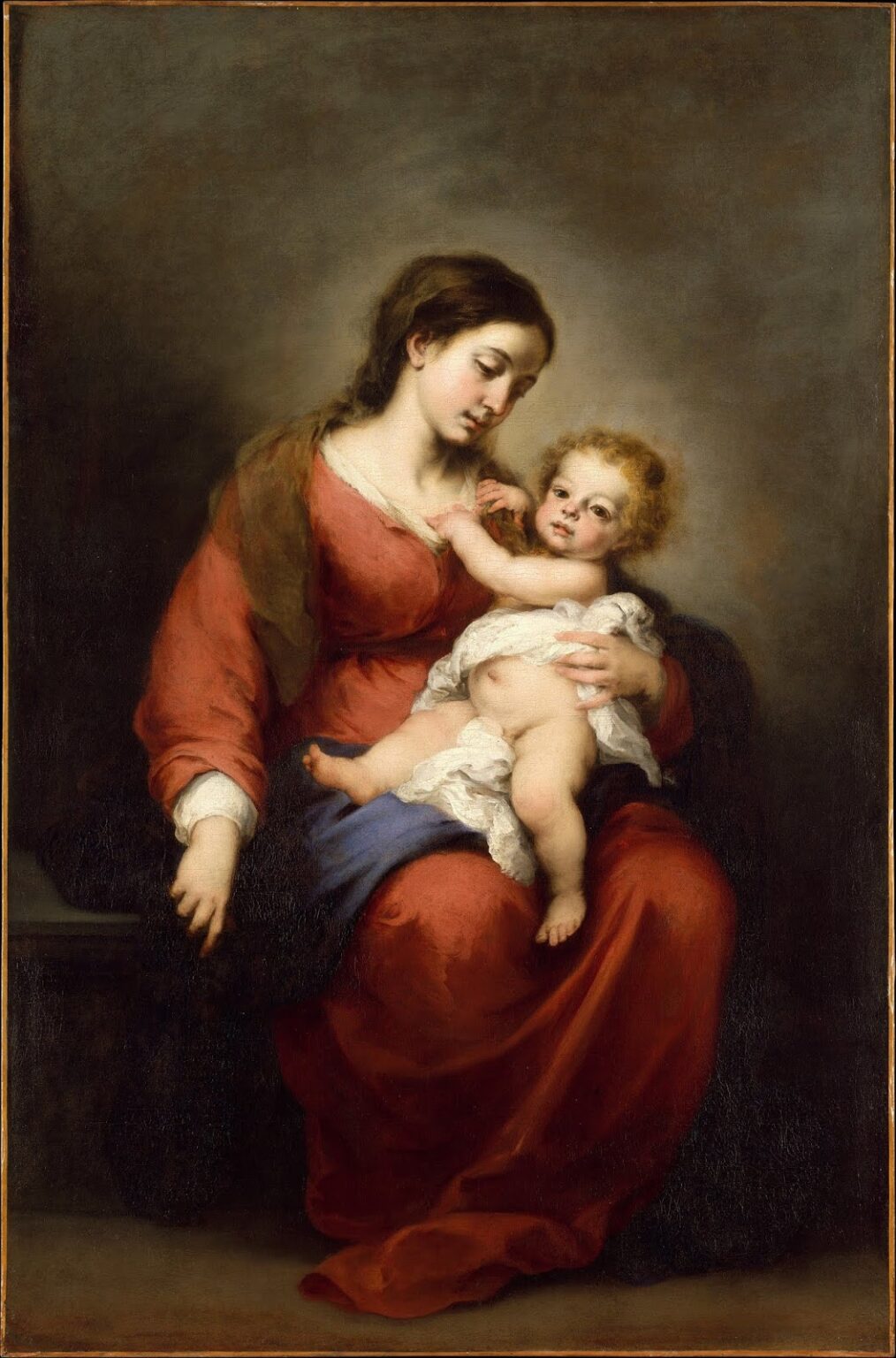
“Virgin and Child,” painted around 1680 by Bartolomé Esteban Murillo, captures a quiet, intimate moment between Mary and the Christ child. The work belongs to the final phase of Murillo’s career, when his style became especially soft, luminous, and focused on tender emotional exchanges.
The painting shows the Virgin seated, her body turned slightly to the viewer’s left. She cradles the infant Jesus, who lies across her lap, draped in a loose white cloth. Mary wears a deep red dress and a blue mantle, the traditional colors that identify her as the Mother of God. The background is dark and atmospheric, with no detailed setting, which allows the figures to stand out as the true focus of contemplation.
From the first glance, the canvas radiates warmth and maternal affection. There is nothing theatrical or overly dramatic. Instead, Murillo invites the viewer into a serene domestic world where the sacred is expressed through the everyday gestures of a mother and child.
Historical and Devotional Context
In seventeenth century Spain, images of the Virgin and Child were central to Catholic devotion. The Counter Reformation Church encouraged artworks that fostered personal, emotional bonds with sacred figures. Murillo, working in Seville, became one of the most celebrated painters of such images. His Madonnas were praised for their sweetness, humanity, and ability to inspire devotion in viewers of all social classes.
By 1680 Murillo had achieved great renown and was frequently commissioned by religious institutions, confraternities, and private collectors. A painting like this likely served either as an altarpiece in a small chapel or as a cherished work in a private or monastic collection. In either case, it would have functioned as an object for meditation, encouraging the viewer to reflect on Mary’s role as mother and intercessor and on the mystery of the Incarnation.
Murillo’s approach reflects the spiritual climate of his time. Devotional literature and sermons often urged believers to imagine themselves present in scenes from Christ’s life, especially his infancy. This painting answers that call by presenting the Holy Mother and Child in a way that feels both familiar and idealized, inviting the viewer to join them in quiet contemplation.
Composition and Pyramidal Structure
The composition of “Virgin and Child” is simple yet carefully calculated. Murillo arranges the figures in a pyramidal form, a structure that had long been associated with stability and harmony in Renaissance and Baroque painting. Mary’s seated body forms the base of the triangle, while her head, slightly bent toward the child, forms its apex.
The Christ child lies diagonally across her lap, his body creating a dynamic line that leads the eye from Mary’s chest down to his tiny feet. This diagonal energy enlivens the composition while remaining contained within the overall pyramid, keeping the scene calm rather than restless.
Murillo places the figures slightly to the left of center, leaving a modest area of open space on the right. This space is filled by soft, golden brown atmosphere rather than architectural elements, which gives the figures room to breathe visually and accentuates their three dimensional presence. The bench on which Mary sits is suggested with minimal detail, enough to ground her physically without disrupting the focus on the two figures.
The result is a carefully balanced image where everything leads back to the relationship between mother and child.
The Figure of the Virgin Mary
Murillo’s Virgin is youthful, graceful, and deeply human. She is not distant or regal but rather approachable, with a gentle tilt of the head and downcast eyes that rest lovingly on the child in her arms. Her features are characteristic of Murillo’s ideal of feminine beauty: oval face, smooth skin, delicate nose, and soft lips.
Her clothing reinforces her symbolic role. The red dress signifies love, sacrifice, and the humanity she shares with her son. The blue mantle that falls over her lap points to her heavenly dignity and her traditional title as Queen of Heaven. Murillo paints these fabrics with rich, flowing folds that anchor the composition. The red gathers around her knees and pools at her feet, while the blue wraps around her waist and supports the child.
Mary’s posture conveys both tenderness and responsibility. Her upper body bends slightly toward Jesus, but her shoulders remain steady. One hand gently secures the child’s back, while the other rests open and relaxed at her side, a gesture that suggests both readiness to serve and quiet acceptance of her role. She appears absorbed in contemplation of her son, as if meditating on the future events of his life.
The Christ Child and Sacred Childhood
The Christ child in this painting is robust and lifelike, the result of Murillo’s exceptional skill at depicting children. His body is chubby and natural, with round limbs and soft skin that catches the light. He is partially wrapped in a white cloth, which both emphasizes his vulnerability and hints at the linen that will later wrap his body in the tomb.
Unlike some earlier depictions where the infant is sleeping or clinging to his mother, here the child is alert and engaged with the viewer. His gaze moves outward rather than inward. One small hand lifts toward Mary’s neckline, playing with the edge of her dress, while the other rests lightly on his own chest. The pose combines playfulness with a sense of emerging awareness. He feels like a real child, curious and slightly restless, yet his expression has a quiet seriousness that hints at his divine nature.
This mixture of childlike spontaneity and spiritual significance is central to Murillo’s treatment of sacred childhood. The viewer is invited to admire the beauty of the infant while also recognizing that this is no ordinary child. The white cloth and glowing complexion subtly separate him from everyday reality, presenting him as both human and holy.
Color, Light, and Atmosphere
Color and light play a crucial role in the painting’s impact. Murillo uses a warm, harmonious palette dominated by reds, blues, and earthy browns. The rich red of Mary’s dress forms the visual core of the composition, immediately catching the eye. This red is balanced by the deep blue of her mantle and the creamy whites of the child’s cloth and skin.
The background is softly modulated in shades of brown, gray, and muted gold. Murillo avoids sharp contrasts between foreground and background, instead creating a gradual transition that makes the figures appear to emerge naturally from the surrounding atmosphere. This softly glowing environment is typical of Murillo’s late style and contributes to the sense of a spiritual haze enveloping the holy figures.
Light seems to come from an undefined source in front of and slightly above the figures. It falls most strongly on the child’s body and Mary’s face, leaving the lower portion of the canvas in deeper shadow. This selective illumination guides the viewer’s gaze to what matters most: the interaction between mother and child. The effect is gentle rather than dramatic, unlike the more intense chiaroscuro favored by some of Murillo’s contemporaries. Here, light is a symbol of grace, touching the figures and revealing their inner serenity.
Gesture, Expression, and Emotional Narrative
One of the most striking aspects of “Virgin and Child” is the way Murillo uses gesture and expression to build an emotional narrative. The physical closeness of Mary and Jesus sets the tone. The child lies across her lap in a relaxed, trusting posture, his weight fully supported by her arms and the folds of her clothing. This conveys complete dependence and a bond that is both physical and spiritual.
Mary’s downward gaze and slightly parted lips suggest that she might be speaking softly to him or simply contemplating him with love. There is a quiet intensity in her expression, a combination of affection, humility, and perhaps a trace of foreknowledge of his future suffering. This blend of joy and sorrow is often present in Marian imagery and invites viewers to reflect on the complexity of motherhood and sacrifice.
The child’s gestures add a note of spontaneity. His raised hand, reaching toward Mary’s chest, is at once a playful action and a symbolic reference to the heart of his mother, often associated with compassion and intercession. His direct gaze outward draws the viewer into the relationship, as though inviting participation in the exchange of love between mother and son.
These carefully calibrated gestures make the painting feel alive. It is not a static icon but a moment captured in time, filled with emotional resonance.
Symbolism and Theological Meaning
While the scene appears simple, it is rich in symbolic content. Mary’s red dress and blue mantle signify her dual nature as humble woman and exalted queen. The red can be read as a sign of charity and the human bloodline that links her to her son. The blue points to her spiritual purity and heavenly role.
The Christ child’s white cloth carries several layers of meaning. White traditionally symbolizes innocence and purity. At the same time, the cloth loosely wrapped around his body anticipates both the swaddling clothes of his birth and the shroud of his burial. Murillo quietly reminds viewers that the tender infant is destined for sacrifice.
The absence of elaborate background elements also has meaning. By placing the figures against a neutral, almost timeless space, Murillo emphasizes that the mystery of the Incarnation transcends any single historical moment. The viewer is not distracted by specific architecture or landscape but is drawn directly to the theological truth embodied in the figures: God made flesh, cared for and presented by his mother.
Moreover, the intimacy of the scene reinforces doctrines about Mary as the loving intercessor who brings believers closer to Christ. Her gentle embrace and meditative gaze model the attitude that viewers are encouraged to adopt. She holds Christ toward us, inviting us to contemplate him with the same devotion she does.
Murillo’s Painterly Technique and Style
From a technical standpoint, “Virgin and Child” showcases Murillo’s mature handling of paint. His brushwork is soft and fluid, particularly in the rendering of skin and fabrics. Rather than constructing forms with sharp outlines, he uses delicate transitions of tone to model volume. This creates the impression of flesh that is luminous and alive, a hallmark of his style.
The drapery is painted with broad, sweeping strokes in some areas and finer touches in others. Highlights on folds are gently placed, giving the fabric weight and movement without overly crisp edges. The background is handled with even looser strokes, blending colors into a smoky veil that recedes behind the figures.
Murillo’s use of glazes contributes to the warm glow that seems to emanate from the painting. Thin layers of transparent color allow light to penetrate and reflect back, giving the reds and blues a deep, resonant quality. This technical approach enhances the spiritual aura of the piece, as if light is not merely shining on the figures but radiating from within them.
In this work, Murillo also demonstrates his skill in capturing subtle differences in texture: the smoothness of skin, the softness of hair, the heavier weave of fabric. These tactile qualities make the figures feel tangible and real, even as their idealized features lift them above ordinary reality.
Place Within Murillo’s Oeuvre and Spanish Baroque Art
“Virgin and Child” fits into a long line of Marian images that Murillo painted throughout his career. From early works with stronger contrasts and more rigid compositions, he moved toward increasingly tender and atmospheric depictions. By 1680 his Madonna images had reached a refined simplicity, focused on emotional connection rather than complex narrative details.
Within the broader context of Spanish Baroque art, Murillo’s approach stands out for its warmth and accessibility. While other Spanish painters like Zurbarán or Ribera often emphasized asceticism, martyrdom, and stark contrasts of light and shadow, Murillo favored a softer, more lyrical style. His works invite empathy and affection rather than awe mixed with fear.
This painting encapsulates that distinctive vision. It offers a quiet, contemplative form of Baroque spirituality, one that speaks through gentle light, harmonious color, and the universal language of mother and child. It helped shape the popular image of the Virgin in Spain and beyond, influencing devotional art for generations.
Lasting Legacy and Contemporary Appeal
Today, “Virgin and Child” continues to captivate museum visitors, art students, and admirers of sacred art. Its appeal lies partly in its technical beauty and partly in its emotional clarity. Viewers from many backgrounds can recognize the tenderness of the scene, even if they are not familiar with its theological implications.
For those interested in religious symbolism, the painting offers a rich field for contemplation: the colors, the gestures, the interplay of humanity and divinity. For those drawn to the history of art, it represents a high point of Spanish Baroque painting and a key work in understanding Murillo’s influence on later devotional imagery.
In a modern world where images are often fast and fragmented, Murillo’s “Virgin and Child” invites a different kind of experience. It asks viewers to slow down, to notice the curve of Mary’s hand, the softness of the child’s skin, the quiet glow of the background. In that attentive looking, the timeless themes of love, sacrifice, and spiritual intimacy come to life once again.