Image source: wikiart.org
Introduction
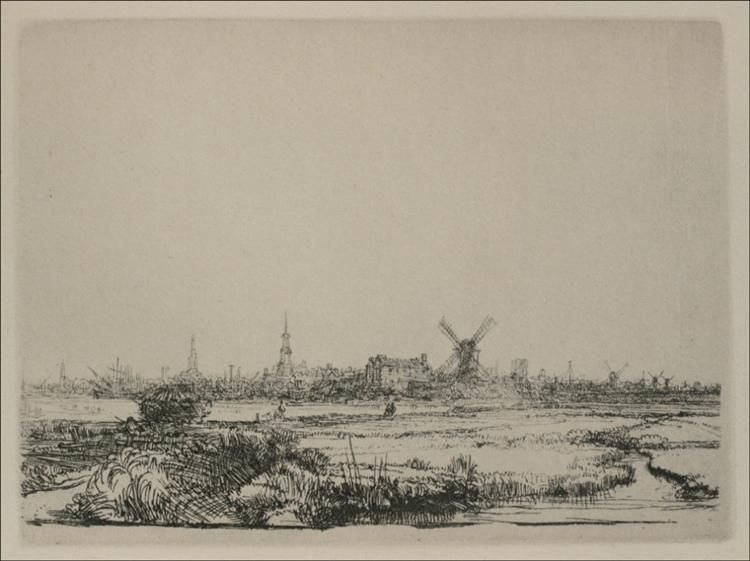
Rembrandt’s “View of Amsterdam” (1640) condenses a city’s character into a strip of horizon and a vast, breathing sky. Made as an etching, the image looks across low meadows and waterlogged ditches toward the compact silhouette of Amsterdam, its church spires and windmills pricking the distance. The foreground is a soft confusion of reeds, rushes, and polder grasses; the middle distance opens into fields worked by channels; the far band carries the urban rim like a low-relief frieze. With minimal means—lines of varying pressure, cross-hatching, small reserves of untouched paper—Rembrandt turns topography into atmosphere and civic pride into poetry. It is less a map than a memory of weather and work, a portrait of a republic seen from the land that sustains it.
A City Held by a Sky
The first thing the eye meets is not a building but space. More than two thirds of the plate is sky—nearly blank, save for the faintest gradient of tone near the edges. This emptiness is active. It presses gently on the thin, articulate band of city at the horizon, calibrating scale and mood. The Dutch landscape is a theater of air; Rembrandt honors that truth by letting the heavens dominate. The city does not conquer the sky; it participates in it, drawing light down to its roofs and quays, sending moisture back upward from canals and river. The picture begins, as weather does, with breath.
Composition and the Architecture of Distance
Rembrandt organizes the view into three horizontal registers. The foreground, dense with foliage and oblique strokes, anchors the image with tactile nearness. The midground opens into marsh meadows articulated by ditches and paths, their long, soft diagonals steering the gaze toward the city strip. The far band is a lacework of verticals—spires, cranes, masts, windmills—stitched onto a low skyline. This architecture of distance is enhanced by line economy: marks are heaviest and most varied in the front, lighter and more summary in the rear. The eye travels through these zones effortlessly, as though carried on the wind.
Horizon as Civic Signature
Amsterdam appears as a sequence of readable signs rather than enumerated buildings. Spires suggest the Oude Kerk and Zuiderkerk; blocky masses collect into warehouses and bastions; a mill with sails at mid-right becomes both landmark and motif. Rembrandt avoids literal cartography. He offers a legible impression—a civic signature—more durable than any precise inventory because it matches how the mind remembers a city: by heights, rhythms, and the way forms cut the sky.
The Polder Foreground and the Country’s Work
The low foreground is a study in managed nature. Reeds bow over dark water; hummocks and tufts cling to the bank; a sinuous ditch slides in from the right like a black ribbon of ink. These are not generic pastoral touches. They are the grammar of the Dutch polder, the land wrested from water and kept by diligence. In this zone Rembrandt packs the richest drawing vocabulary—scraped highlights, knotted grasses, hooked strokes for sedge—turning the viewer into a walker at the field’s edge. The urban horizon gains credibility because the ground under our feet is so convincingly handled.
Windmills and Spires: Technology and Spirit
The skyline alternates between ecclesiastical spires and the articulated crosses of windmill sails. The pairing is not accidental. Seventeenth-century Amsterdam balanced spiritual institutions with a technological culture that built ships, drained marshes, and milled grain and timber. Rembrandt’s horizon reads like a ledger of that balance: faith rising as tapered needles, industry as rotating arms. Neither dominates; both define the community. The mill in the middle distance, larger than its companions, acts as a pivot between field and city, a machine literally raised by and for the land.
Human Scale Without Pageantry
Tiny figures populate the middle distance: a walker on a path, perhaps a fisherman near a ditch, a distant cart—marks so small they are almost vibrations in the line. Their purpose is scale rather than anecdote. Rembrandt resists genre storytelling here; he prefers the humility of a lived moment. The city belongs to people at work, yet no single figure claims the scene. The effect is democratic. The republic appears as a low, continuous silhouette owned by the many rather than by a palace.
Etching as a Language of Air
Etching gives Rembrandt a light, responsive line that can be driven fast for grasses, slowed for masonry, and feathered for reflections. He modulates depth by cross-hatching density, biting some passages longer to darken them, leaving others to print as pale gray threads. The sky’s quiet is printing, not just drawing: the plate has been wiped cleanly to avoid a heavy film of ink, while a faint plate tone lingers near the horizon to soften the city’s edge. That press-room decision is the difference between a stiff outline and a living atmosphere.
Negative Space as Weather
The expanse of unmarked sky does crucial work as negative space. It creates a barometric calm that lets small events—mill sails, spire tips, masts—read as audible ticks of distance. In a more crowded plate these would be noise; here they are timekeepers. The emptiness also allows the midground’s marsh to shine with its own reflective light, as if the paper itself were wet. Rembrandt’s economy is rhetorical: by leaving much unsaid, he amplifies what he chooses to state.
Depth Cues and the Measured Walk
The viewer’s route follows the landscape logic. We begin among foreground reeds at the lower left, step outward along the bank, cross the shallow ditch, and enter the grazed meadows. Meandering channels lead diagonally toward a bright break in the city strip near the center, then our gaze slides along the skyline to the right where the large mill turns our attention back into the fields. Each shift is marked by a change in line direction or density. Depth becomes not a trick but a sequence of tactile cues—a walked distance you can feel in the ankles and lungs.
Mapping, Memory, and the Artist’s Point of View
This is not a view from a tower or a ceremonial vantage; it is a field-edge prospect, the sort a resident might see on a daily errand. Rembrandt’s Amsterdam is not a monumental façade but a city encountered in transit, half thought of while the wind works the grass. Such a point of view reflects the Republic’s ethos of practical mobility: harbors, ferries, towpaths, and dikes stitching town to countryside. The print records an everyday seeing that becomes, through art, a shared civic memory.
The Civic Mood: Prosperity with Modesty
Despite the many signs of enterprise—mills, cranes, church construction—the plate is quiet. There is no allegorical triumph, no bursting sun. The prosperity it records is sober and distributed, the sort that accrues through habits rather than spectacle. Rembrandt captures that mood with restrained contrasts and open air. The city looks assured but not boastful, embedded in the very fields that financed its rise.
Water as Structure and Mirror
Across the midground, water channels break the land into navigable parcels. Their zigzag not only structures the composition but also introduces reflections that double reeds and banks with slight tremor. These mirrors soften the architecture’s certainty; they remind us that in the Netherlands, permanence is always negotiated with water. Rembrandt treats the surfaces with delicate parallel strokes that imply movement without ripples—wind ruffling gently, not storming.
The Time of Day and the Slow Weather
The light is level and untheatrical. Shadows are short; the sky is pale; the horizon is crisp. The impression is of a late-morning or late-afternoon interval when the day has settled into itself. In such weather, labor continues steadily. The mood matches the subject: an industrious city seen under an industrious sky. Rembrandt rejects picturesque drama in favor of the truth most days know.
Relation to Rembrandt’s Painted Landscapes
Set beside his painted “Landscape with a Long Arched Bridge,” this etching feels spare, even ascetic. The painting deploys glowing color and a large storm front to orchestrate emotion; the etching relies on measure and breath. Yet both share crucial convictions: the dominance of sky, the civility of waterworks, the lyric junction of work and weather. The print reads like the painter’s shorthand for the same philosophy, carried in the pocket and reprinted for friends.
Printing, States, and the Breath of Paper
Rembrandt’s handling of the plate at press likely varied. Some impressions show faint veiling at the upper corners, others print almost stark white. Such adjustments subtly shift mood—from crisp autumn day to a more humid summer noon. The edges of the image retain a delicate plate mark, that embossed oval left by the copper under pressure, which further frames the view like a windowpane. Paper is not neutral in these small landscapes; it is the sky itself.
The Viewer’s Presence in the Scene
Because the foreground is so near and the horizon so low, the viewer feels physically present—standing on a slightly raised bank, maybe holding a walking stick or a folded portfolio. The print performs a gentle hospitality. It does not command awe; it invites company. That invitation remains irresistible because it is built from ordinary sight. You do not need to be a pilgrim to approach this city; you need only to walk out where the fields open and look.
The Poetics of Restraint
Every element of the etching models restraint. The city is an outline; figures are not individualized; the sky says almost nothing. Yet the whole is emotionally complete because the artist has supplied the structure in which the viewer’s own civic feeling can gather. The foreground grasses become our rustle; the channels our path; the skyline our remembered arrival. Restraint here is generosity. By doing less, Rembrandt allows the imagination to do more.
Enduring Relevance
Modern viewers recognize the ecological intelligence of the picture: a city scaled to its water, reliant on its wind, set low under sky. They also recognize the social intelligence: a community presented not as palace but as horizon, belonging to those who walk and work. In an age anxious about urban growth, the etching offers a different ideal—urbanity that honors landscape and air, technology and temperance. That is why this slight strip of copper and ink continues to feel like a future we could still choose.
Conclusion
“View of Amsterdam” distills a metropolis into fundamentals: sky, water, field, and a line of works where human purpose gathers. Rembrandt’s lines—tender in the reeds, succinct in the skyline—translate geography into feeling. The windmills turn without noise; the spires speak without sermon; the channels slip away like sentences finished under the breath. The city does not tower; it belongs. What remains after long looking is a sense of fitness—the conviction that place and people can be held together by air, habit, and the quiet pride of work well shared.