Image source: wikiart.org
Introduction
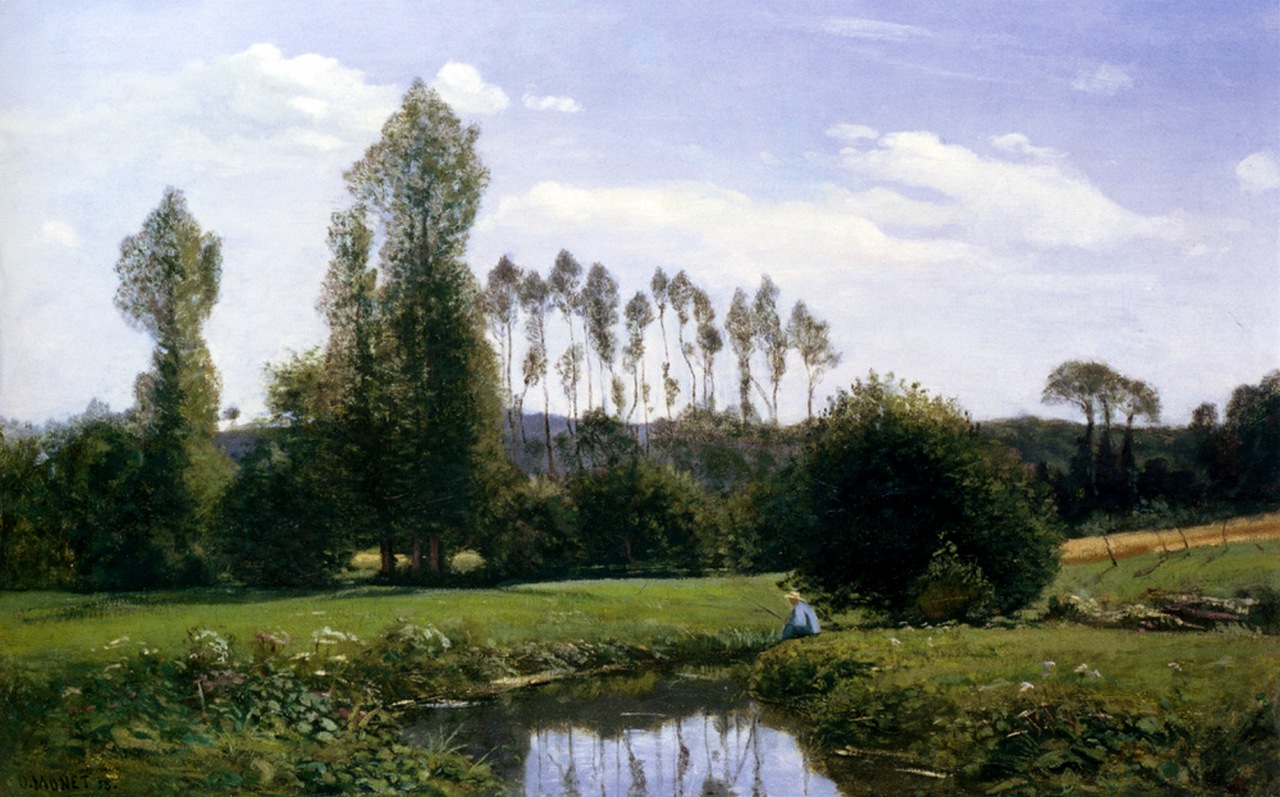
Claude Monet’s View At Rouelles Le Havre from 1858 is a remarkably revealing early landscape. At first glance, the painting appears simple and serene. A quiet stream reflects the sky, trees rise across the middle distance, and a lone figure sits near the bank, almost absorbed into the scene. Nothing dramatic happens. There is no storm, no crowd, no theatrical event. Yet that calm is exactly what makes the work so compelling. Monet transforms an ordinary rural view into a study of atmosphere, distance, and light, showing how deeply he already understood the emotional power of landscape.
This painting belongs to a formative moment in Monet’s career, long before his mature Impressionist fame. Because of that, it offers something especially valuable. It allows us to see not the fully developed master of water lilies and shimmering cathedrals, but the gifted young artist learning how to look at the world. In View At Rouelles Le Havre, the qualities that would later define Monet are not yet fully liberated, but they are unmistakably present. His fascination with natural light, reflective water, changing air, and the quiet poetry of outdoor space is already alive.
The painting is not built on spectacle. Instead, it depends on sensitivity. Monet asks the viewer to notice the softness of the sky, the calm spread of the lawn, the vertical rhythm of the trees, and the mirrored surface of the water. He also asks the viewer to linger. The more time one spends with the painting, the more one sees that its peace is carefully made. The composition is balanced, the atmosphere is delicately tuned, and the handling of green, blue, and earth tones is both observant and expressive.
What makes this landscape especially moving is the sense that it stands between traditions. It still belongs to the broader naturalist and landscape conventions of the mid nineteenth century, yet it also points forward to something more immediate and modern. Monet is studying nature closely, but he is not merely recording it. He is shaping an experience of seeing. The scene feels lived, felt, and remembered all at once.
A Young Monet Before Impressionism
In 1858, Claude Monet was still a very young artist. That fact matters because View At Rouelles Le Havre does not simply show talent. It shows direction. Even in youth, Monet was gravitating toward the subjects that would remain central throughout his life. He was already drawn to outdoor scenery, to the shifting relationship between land and sky, and to the ways water could hold both reflection and movement.
The title places the work near Le Havre, the coastal city where Monet spent part of his early life. Rouelles was a district near Le Havre, and the local character of the landscape gives the painting an immediacy that feels personal rather than invented. This is not a grand historical countryside. It is a real place, modest and familiar. That grounded sense of place matters because Monet’s art, even at its most famous, often turns ordinary locations into profound visual experiences. He does not need mythological scenery to achieve beauty. He finds beauty in fields, ponds, riverbanks, gardens, and weather.
At this stage in his development, Monet had not yet arrived at the broken brushwork and bright, flickering surfaces usually associated with Impressionism. The paint handling here is more blended and controlled. Forms remain legible. Trees are still described as solid masses rather than dissolving into patches of light. The composition is stable and carefully organized. Even so, the seeds of later innovation are easy to detect. Monet is already concerned with transient conditions rather than fixed outlines. The air seems to soften edges. Light seems to unify the whole scene. Reflection becomes as important as object.
There is also a youthful freshness in the painting. It does not feel overburdened by theory or ambition. Instead, it feels attentive. The young Monet is looking hard at what lies before him and discovering that nature is not static. It breathes, recedes, glows, and shifts. That discovery would become one of the great engines of his career.
What is striking is that the painting does not feel immature in the negative sense. It feels early, but not uncertain. Monet already knows how to guide the eye and how to make a landscape emotionally persuasive. He understands that calm can be as compelling as drama. He understands that the mood of a place can emerge through tone, spacing, and reflected light rather than narrative. These are not minor achievements. They show a painter already in conversation with nature at a deep level.
Composition and the Quiet Order of the Scene
One of the strongest features of View At Rouelles Le Havre is its composition. Monet arranges the landscape so that the viewer enters it gradually and naturally. The stream in the foreground acts as a visual invitation. Its reflective surface pulls the eye inward, while its curve gently leads the viewer toward the middle ground. This kind of compositional path is subtle but highly effective. Instead of confronting us with an abrupt wall of forms, Monet allows us to move through the landscape as though walking into it.
The water also provides a structural counterpoint to the land. The banks, flowers, grass, and shrubs create horizontal breadth, while the trees introduce vertical lift. This balance between horizontal and vertical elements gives the painting stability. The tall trees on the left and the slender row of poplars in the distance create a kind of natural architecture. They do not dominate the landscape, but they organize it. The eye reads them almost like columns, helping the scene feel ordered without seeming rigid.
Monet is careful with spacing. The large trees at left form a dense dark mass, while the more distant line of thin trees toward the center and right opens the space behind them. This creates depth not only through scale but through rhythm. Dense, open, dense again. The composition breathes because the visual weight is distributed rather than piled into one area. Bushes and darker foliage on the right answer the heavier cluster on the left, so the painting feels balanced across its width.
The small seated figure near the water is another important compositional element. It would be easy to overlook, yet its presence changes the whole experience of the scene. Without it, the painting would still be beautiful, but it would be more purely scenic. With the figure, the landscape becomes inhabited and contemplative. The figure gives scale to the setting, helping the viewer sense the size of the lawn, shrubs, and trees. More importantly, the figure suggests stillness within stillness. A person is present, but not active. This reinforces the mood of pause and quiet observation.
The horizon is placed low enough to allow the sky real presence, but not so low that the land loses authority. Monet wants both earth and atmosphere to matter. The result is a composition that feels open yet enclosed, peaceful yet structured. It is a rural scene with enough formal discipline to keep the eye engaged over time.
Light, Sky, and Atmosphere
If composition gives the painting order, light gives it life. The sky in View At Rouelles Le Havre is luminous without being overwhelming. Monet does not paint a dramatic sunset or a stormy sky. Instead, he offers a pale blue expanse scattered with soft white clouds. This kind of weather is gentle and ordinary, but Monet understands how powerful ordinary weather can be in painting. The sky does not merely sit above the landscape. It shapes the emotional register of everything below it.
The diffused daylight softens transitions throughout the scene. No form is isolated in harsh contrast. Instead, trees, grass, shrubs, and water are held together by a shared atmospheric condition. This is one of the most important aspects of Monet’s art, even at an early date. He is less interested in defining each object separately than in showing how light connects everything in a single visual field.
The water is central to this effect. Its reflective surface catches the brightness of the sky and repeats it in the foreground. Because of this reflection, the sky is not confined to the upper half of the picture. It descends into the lower half, doubling the sense of air and creating a visual echo that increases the painting’s calm. Reflection also introduces a subtle tension between solidity and instability. The land is firm, but the mirrored image is fluid. This contrast gives the painting quiet vitality.
The distant atmosphere is handled with notable sensitivity. The background trees and hills are softened, not sharply described. This softening creates recession, but it also evokes the feel of actual air. Monet is not just painting faraway objects. He is painting the veil between them and the viewer. That attention to atmospheric mediation would later become central to his mature work, where haze, mist, glare, and reflection often matter as much as the motifs themselves.
There is also a sense of season in the light, though Monet leaves it open enough that the painting does not become narrowly descriptive. The green grass is rich, the foliage full, and the sky bright, suggesting late spring or summer. Yet the overall tone remains restrained. This is not the hot intensity of high summer noon. It feels more temperate, more balanced, perhaps a day when the warmth is softened by passing clouds and fresh air.
Monet’s handling of light here is observational, but it is also emotional. The brightness never becomes empty prettiness. Instead, it produces serenity. The landscape seems suspended in a moment of calm awareness. That mood is one of the painting’s greatest strengths.
Color and the Language of Greens
Landscape painting often depends on green, but green is one of the hardest colors to make convincing. Too much uniform green can flatten a scene and make it decorative rather than alive. Monet avoids that problem by varying his greens carefully across the painting. The grass in the foreground and middle ground carries a different tone from the darker bushes, and both differ from the higher trees. Some greens are warm and yellowish, others cooler and deeper, and this variety keeps the landscape visually active.
The grassy areas are especially important. They are not a single blanket of color. They shift according to light, moisture, and distance. The meadow to the left of the stream is open and sunlit, while the foliage at the edges is denser and shadowed. These changes give the land volume and texture. The viewer senses where the ground opens, where it thickens, and where it begins to recede.
The trees are handled with particular care. The darker cluster on the left anchors the painting with rich shadow, while the slender trees in the background appear lighter and more fragile against the sky. This contrast between dense and airy foliage prevents monotony. It also creates one of the most elegant visual effects in the work: the thin treetops rising into the pale sky. Their delicacy offers a lyrical counterpoint to the darker masses below.
Blue plays a quieter but equally important role. The sky is a cool, clear blue, softened by white cloud forms, and the water reflects that same coolness. Because blue appears both above and below, it helps unify the composition. The small blue note of the seated figure is especially clever. It stands out gently against the greens and browns, drawing the eye without breaking the harmony.
Monet also includes earthy tones along the banks and within the darker undergrowth. These browns and muted ochres ground the composition and keep the palette from becoming too sweet. They remind the viewer that this is a real landscape with soil, moisture, and depth beneath the surface brightness.
The overall color structure is controlled rather than flamboyant. This restraint is part of the painting’s charm. Monet is not yet exploding the spectrum in the way he sometimes would later. Instead, he is building harmony through close tonal relationships. The result is a scene that feels coherent, natural, and deeply restful.
The Human Presence in a Landscape of Stillness
The small seated figure near the stream may seem secondary, but it has a profound effect on the painting’s meaning. It introduces human presence without disturbing the silence of the landscape. The figure does not dominate the scene or turn it into anecdote. Instead, it quietly confirms that this is a place of pause, attention, and inwardness.
Because the figure is so small, the landscape remains the true subject. Yet the figure encourages a human reading of the view. It suggests that this place can be experienced, not just seen. The viewer is invited to imagine sitting there, listening to the still water, watching the clouds drift, and feeling the softness of the day. In that sense, the figure functions as a bridge between the painted world and the viewer’s own body.
This tiny human element also reinforces the scale of nature. The trees appear taller, the open grass broader, and the surrounding growth fuller when measured against a seated person. Monet does not need grandeur to achieve a sense of space. He achieves it through proportion and restraint.
There is also something modern about the figure’s modest role. In many earlier landscapes, figures are present to tell a story, symbolize virtue, or enact rural labor. Here, the person is simply there. That simplicity is important. It shifts attention away from narrative and toward perception. The painting is less about what happens in the landscape than about what it feels like to be present within it.
Stillness is the governing mood of the work. The water does not rush. The trees do not bend in violent wind. The figure does not move. Even the clouds seem to drift gently rather than gather dramatically. This stillness is not empty. It is full of observation. Monet is discovering that a quiet scene can hold enormous richness when the painter is sensitive to light, reflection, and atmosphere.
That insight would remain central to his art. Many of Monet’s greatest paintings are built not on narrative climax but on sustained looking. View At Rouelles Le Havre already understands that the visual world offers its own drama, one based on change, subtlety, and attentiveness rather than event.
Nature, Place, and the Poetic Ordinary
One reason this painting remains so appealing is that it elevates an ordinary place without falsifying it. The landscape is not grandiose. It is a patch of countryside shaped by water, trees, field, and human proximity. Yet Monet finds in it a quiet poetry. He does not need mountain peaks or ruins to create significance. He discovers significance in balance, light, and lived familiarity.
That quality is especially meaningful in relation to Le Havre and its surroundings. This is not the bustling port city with ships and commerce that one might expect from a coastal region. Instead, Monet turns to a greener, more secluded view. The choice itself is telling. He is drawn not to civic identity or urban spectacle but to the restorative dimension of nature. Even at this early date, he seems to understand that landscape can be both descriptive and meditative.
The painting’s poetry comes from its refusal to exaggerate. The stream is narrow, the banks irregular, the shrubs slightly untamed, and the sky softly mottled. Nothing is polished into artificial perfection. This gives the scene credibility and tenderness at once. It feels observed in the world, yet also filtered through affection.
There is a notable intimacy in the work. The viewer is not placed at a heroic distance surveying a vast panorama. Instead, the viewpoint feels close to the ground and close to the water. This intimacy makes the painting more immersive. One can imagine the damp edge of the bank, the coolness of the shaded grass, and the quiet sound of air moving through leaves.
The ordinary becomes poetic because Monet sees relationship everywhere. Sky relates to water through reflection. Trees relate to open space through contrast. Near foliage relates to distant trees through scale and atmosphere. Human presence relates to nature through stillness. This network of relations gives the painting coherence and emotional depth.
In this sense, View At Rouelles Le Havre is not just a youthful landscape. It is an early statement of belief. Monet is already asserting that the visible world, carefully observed, contains its own beauty and meaning. That conviction would define his life’s work.
What the Painting Reveals About Monet’s Future
Looking at View At Rouelles Le Havre today, one of its greatest fascinations lies in what it foreshadows. The painting is not yet Impressionism, but it clearly points toward it. Monet is already captivated by weather, time of day, reflective surfaces, and the instability of visual experience. He is less concerned with sharp linear definition than with the unity created by light and atmosphere.
The stream anticipates the later centrality of water in Monet’s art. Reflection would become one of his most important tools, not only for beauty but for dissolving certainty. In reflection, the world is doubled, softened, and made less fixed. Here that process is still gentle and controlled, but it is unmistakably present.
The sky also points forward. Monet would later paint skies of dazzling complexity, but even here he understands that the sky is not a backdrop. It is an active force shaping color and mood across the whole scene. The same is true of distance. The softened background suggests an artist already attentive to how air alters sight.
At the same time, the painting preserves qualities Monet would later move beyond. The forms remain more solid, the composition more traditional, and the brushwork less fragmented than in his mature canvases. That makes the work especially valuable. It lets viewers see both continuity and change. The young Monet is learning within inherited conventions, but already nudging them toward a more immediate encounter with nature.
This early painting therefore has a double importance. It is satisfying on its own terms as a beautiful landscape, and it is historically revealing as a window into Monet’s development. It shows that the origins of his greatness were not sudden. They were rooted in patient looking, local landscape, and a deepening trust in perception.
Why View At Rouelles Le Havre Endures
View At Rouelles Le Havre endures because it captures something timeless. It offers a vision of nature that is peaceful without being empty, structured without being rigid, and intimate without being trivial. The painting rewards slow viewing because its beauty is cumulative. The more one looks, the more one notices the delicate balance between light and form, water and land, nearness and distance.
It also endures because it humanizes Monet. Viewers often encounter him first through his most famous works, where his style is already fully formed. This early painting reveals the beginning of that journey. It shows a young artist not yet celebrated, but already deeply serious about the visual world. There is something moving in that. One sees not just talent, but discovery.
The painting’s calm has its own lasting power. In a culture often drawn to spectacle, View At Rouelles Le Havre reminds us that stillness can be profound. A grassy bank, a line of trees, a reflective stream, a pale sky, and a seated figure are enough. Through sensitivity and formal intelligence, Monet turns them into a fully persuasive world.
That world remains inviting because it does not close itself off with symbolism or complexity. It is open, breathable, and humane. It welcomes the viewer into an experience of attentive seeing. That may be the deepest continuity between this early painting and Monet’s later masterpieces. Across decades of artistic change, he never stopped believing that light on the world could be a subject worthy of endless devotion.
In View At Rouelles Le Havre, that devotion is already visible. The painting may belong to Monet’s youth, but it carries the quiet authority of a true beginning.