Image source: artvee.com
Introduction
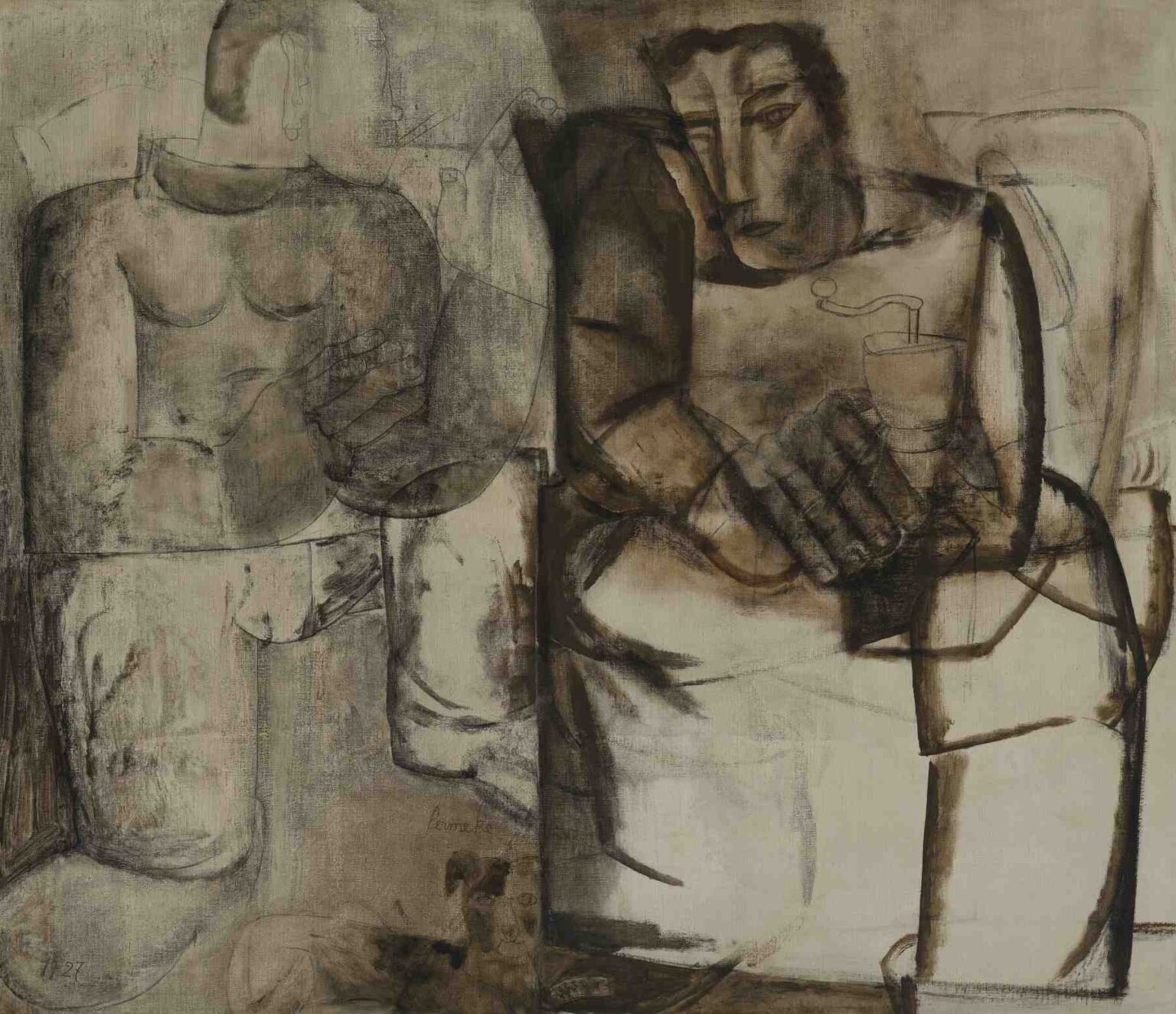
Constant Permeke’s Vespers (1927) stands as a poignant testament to the Belgian Expressionist’s mastery of mood and form. In this enigmatic work, Permeke depicts two figures caught in the twilight ritual of evening prayer—Vespers—yet rather than a serene devotional scene, the painting pulses with expressive tension. Through a muted palette of grays, browns, and chalky whites, layered brushwork, and a haunting compositional structure, Vespers transcends its subject to explore themes of faith, fatigue, and the search for solace in communal ritual. This analysis delves into the painting’s historical context, compositional design, use of color and texture, symbolic underpinnings, and its place within Permeke’s oeuvre and broader Expressionist practice.
Historical and Cultural Context
Painted in 1927, Vespers originates in the interwar period when Belgian society grappled with the aftermath of World War I. Permeke, who served briefly in the Belgian army and witnessed wartime suffering, returned to Flanders profoundly changed. He turned away from the horror of conflict toward the inner lives of rural communities—fishermen, farmers, and villagers—seeking to capture both their physical labor and spiritual endurance. The tradition of evening prayer, part of Catholic liturgy, resonated deeply in West Flanders, where religious observance remained woven into daily life. In Vespers, Permeke channels this communal faith against a backdrop of economic hardship and social rebuilding, reflecting both the solace and the existential weight of ritual in uncertain times.
Subject Matter and Narrative Ambiguity
At first glance, Vespers appears to show two seated figures—possibly a man and a woman—leaning slightly forward, heads bowed, hands clasped or resting on their laps. Yet Permeke deliberately leaves details indistinct: faces are sketched rather than fully modeled; bodies merge with the background in places, and the objects around them—perhaps a prayer book, a candle, or simple vessels—are suggested through a few bold strokes. This ambiguity transforms the scene into a universal meditation on prayer rather than a documentary portrait. Observers are invited to project their own experiences of communal ritual onto the canvas, sensing both the comfort of shared devotion and the weight of human vulnerability.
Compositional Framework
Permeke structures Vespers around a subtle yet powerful bipartite division: the left half of the canvas is dominated by a standing or seated figure rendered in lightly sketched grays, while the right half presents a more solidly painted, seated figure in darker browns and black. This vertical split echoes the liturgical duality of congregation and clergy, body and spirit, earth and transcendent. The figures’ heads align along a horizontal axis slightly below center, creating a calm, contemplative plane. Broad, sweeping arcs of brushwork unify both halves, suggesting the enveloping hush of the evening hour. The canvas’s edges remain open, as if the ritual extends beyond the frame, reinforcing the universal resonance of the scene.
Palette and Tonal Relationships
True to Permeke’s late style, Vespers employs a restrained, harmony-driven palette. Warm grays, umbers, and ochres provide the foundation, punctuated by chalky whites and deep charcoal blacks. These earth-inspired hues evoke both the humble interiors of rural chapels and the worn garments of villagers. Permeke strategically uses lighter tones on the left figure—its back and shoulders sketched in bleached grays—to suggest fading daylight or the retreat of color with dusk. The right figure, rendered in richer browns and black brushstrokes, anchors the composition and conveys gravity. Subtle tonal gradations and porous washes create an atmosphere of twilight, where physical and spiritual worlds meet in quiet contemplation.
Brushwork and Surface Texture
Permeke’s handling of paint in Vespers oscillates between vigorous gestural strokes and delicate line work. The left figure emerges from a veil of thin, almost transparent glazes, with the canvas weave occasionally visible beneath. This ethereal rendering suggests a soul ascending or a body merging with prayer. In contrast, the right figure is built up with thicker impasto and confident, sculptural strokes that define broad planes of fabric and flesh. The interplay of these textural strategies conveys both the fragility and the solidity of human faith. Permeke’s residual brush marks—swirls, smudges, and faint cross-hatching—remind viewers of the painting’s making, underscoring art as ritual in its own right.
Light, Shadow, and Mood
Rather than a single luminous source, Vespers is suffused with diffused, ambient light—an echo of dusk or the quiet glow of a distant lamp. Highlights appear as pale halos around heads and shoulders, guiding the eye from one figure to the other. Shadows, rendered in deep sepia and near-black, ground the forms and evoke the enveloping hush of evening prayer. This balanced chiaroscuro fosters a meditative mood: neither bright enough to dispel doubt nor dark enough to engulf hope. The painting’s overall dim luminosity mirrors the internal tension between human frailty and spiritual aspiration inherent in prayer.
Symbolism and Thematic Resonance
While Permeke avoids overt religious iconography, the symbolic dimension of Vespers is unmistakable. The bowed heads and folded hands recall centuries-old devotional practices, yet their anonymity universalizes the act of prayer. The bipartite composition suggests dualities—body and soul, work and worship, grief and solace. The left figure’s translucency may symbolize the soul’s yearning, while the right figure’s solidity speaks to the grounding power of community faith. Together, they embody the human quest for meaning amid hardship, using shared ritual as both anchor and catalyst for hope.
Spatial Ambiguity and Psychological Depth
Permeke eschews traditional perspective, flattening space to emphasize emotional over spatial depth. The background dissolves into woven lines and tonal sweeps, offering no clear indication of architecture or setting. This spatial ambiguity places greater emphasis on the figures’ psychological states. Viewers sense an inner chamber of the mind rather than a physical church. The figures exist in a liminal zone—a threshold between earth and heaven, self and other—where prayer becomes an intimate dialogue beyond the confines of walls.
Comparison with Permeke’s Other Interior Scenes
Vespers complements Permeke’s earlier interior works such as Pastry Stall (c. 1922) and Coffee Drinkers (1927). While those paintings celebrate communal commerce and sustenance, Vespers focuses on communal devotion. In each, Permeke transforms everyday rituals—eating, drinking, praying—into profound studies of human connection. The move from the tangible comfort of pastries and coffee to the intangible solace of prayer reveals Permeke’s expanding exploration of ritual as the locus of communal identity. Across these works, he maintains a consistent emphasis on sculptural form, earthy palettes, and expressive brushwork.
Technique and Material Analysis
Executed in oil on canvas, Vespers demonstrates Permeke’s facility with both additive and reductive painting techniques. Infrared reflectography reveals preliminary charcoal sketches underlying the thin glazes, indicating careful planning of compositional rhythms. X-ray imaging shows selective thickening of paint along the right figure’s jacket and the left figure’s upper back, lending those areas greater sculptural weight. Conservation records note that the original varnish has yellowed slightly, softening contrasts; careful cleaning has restored the painting’s intended somber luminosity and subtle tonal shifts.
The Role of Vespers in Permeke’s Legacy
Vespers occupies a crucial place in Permeke’s legacy, exemplifying his late-career shift toward interior, ritualistic subject matter. By portraying the spiritual dimension of rural life with the same empathy he afforded fishermen and farmers, Permeke broadened the thematic scope of Expressionism. His nuanced blending of figuration and abstraction in Vespers influenced younger Belgian artists exploring the intersection of faith and daily life. Internationally, the painting resonates with Expressionist explorations of existential themes, aligning Permeke with contemporaries who sought to translate inner experience into visible form.
Viewer Engagement and Interpretive Possibilities
Vespers continues to captivate audiences with its haunting ambiguity and emotional depth. Viewers are drawn to its atmospheric stillness, invited to contemplate their own experiences of prayer, meditation, or communal ritual. The painting’s refusal to specify context or identity encourages multiple readings: as a personal vignette of two congregants, as a universal allegory of faith, or as a metaphor for art-making itself. In exhibitions, Vespers often serves as a focal point for discussions on the spiritual dimensions of modern art, illuminating Permeke’s singular contribution to 20th-century painting.
Conclusion
Constant Permeke’s Vespers (1927) transcends a simple depiction of evening prayer to become a profound exploration of human resilience, ritual, and spiritual yearning. Through its evocative composition, muted yet nuanced palette, dynamic brushwork, and symbolic richness, the painting captures the fragile balance between doubt and hope that defines communal devotion. More than a liturgical scene, Vespers stands as a universal testament to the enduring power of shared ritual to provide solace and meaning. Over ninety years after its creation, Permeke’s vision remains powerful, inviting viewers into the quiet mystery of human faith.