Image source: wikiart.org
Introduction to Venus and Cupid
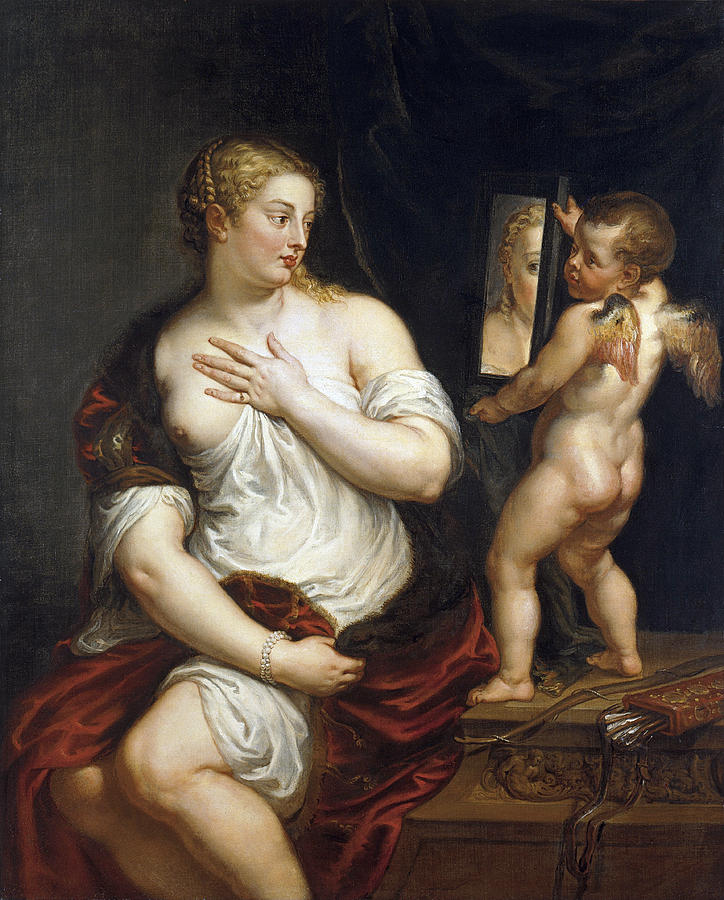
Peter Paul Rubens’s “Venus and Cupid” stages a quiet, intimate drama about beauty, desire, and the act of looking. A seated Venus, wrapped in creamy white drapery and a crimson mantle, turns toward a winged boy who presents a hand mirror. In the reflection appears Venus’s face, duplicated and slightly askew, while the child—Cupid—glances back at her with conspiratorial alertness. The setting is shallow and private, a chamber defined by dark textiles and a carved ledge strewn with Cupid’s quiver and bow. Nothing in the scene is loud or theatrical, yet everything vibrates with Rubens’s signature sensuousness: the softness of flesh, the gleam of pearls, the satin swell of fabric, and the charged exchange of glances that binds goddess and child, viewer and subject.
The Myth Recast as a Human Encounter
In classical tradition, Venus personifies love and beauty, and Cupid her winged son directs desire with his arrows. Rubens interprets the pair less as distant divinities and more as living figures caught mid-gesture. Venus is not enthroned or crowned; she is absorbed in the everyday act of viewing herself. Cupid is less a mischievous archer than a nimble studio assistant or stage manager, holding the mirror at the precise angle that will capture the face his mother is momentarily unable to see. This humanization places the myth within a domestic sphere. The gods behave like people, and their relationships—maternal, teasing, affectionate—feel immediate and real.
Composition and the Geometry of Looking
The entire composition turns on a triangle of sightlines. Venus inclines to her left, shoulder bare, hand raised to her breast. Her eyes travel toward Cupid, who looks back over his shoulder while presenting the mirror. The mirror returns Venus’s gaze, creating a loop: she looks at Cupid, Cupid looks at her, and the mirror looks at both. Rubens reinforces this loop with the positioning of limbs and props. The diagonal of Venus’s thighs leads toward Cupid’s body; the angled rectangle of the mirror echoes that diagonal; the carved ledge and the relaxed curve of the crimson mantle stabilize the movement with horizontal and serpentine lines.
The result is a tight, inward-turning choreography that pulls the viewer into a private circuit of desire and reflection. Although the space is shallow, the painting feels dynamically deep because sight itself creates spatial drama. We travel with Venus’s glance into the mirror, then out again through Cupid’s look, and finally back to the goddess’s living face.
The Mirror Motif: Vanity, Truth, and Self-Knowledge
The mirror has an ancient double meaning. It can signify vanity, the love of one’s own image, but also truth, since it reveals what the eye cannot directly see. Rubens plays both registers at once. Venus’s gesture—the fingertips resting lightly at her chest—reads as modesty tinged with awareness. She is not wholly seduced by her reflection; she acknowledges it, almost testing it, as if asking which image is more real: the luminous body we see or the ghost in glass at the edge of the frame.
The mirror also implicates the viewer. We, too, are caught admiring a beautiful body. By letting Venus study herself, Rubens legitimizes our looking while warning us about its risks. The painting becomes an essay on visual appetite. Cupid’s role sharpens the point: he literally aims erotic attention. Here his arrow is replaced by the mirror—another instrument that directs desire.
Cupid as Conspirator and Stagehand
Rubens’s Cupid is a small, sturdy child with ruddy cheeks and feathered wings, more mortal than ethereal. He balances on the ledge, one hand gripping the mirror’s frame, the other stabilizing its weight. His body twists in a lively contrapposto, a child’s version of Venus’s elegant turn. In many mythic scenes Cupid acts impulsively; here he is precise, almost professional. He knows exactly what he is doing: arranging sight, steering the drama, and gently disarming the viewer with his charm. The dark feathers on his wings, touched with gold, connect him visually to the deep backdrop and the bright flesh he frames.
On the ledge lie Cupid’s tools—the quiver and bow—resting for the moment while another device, the reflective glass, performs their work. The substitution is witty and telling. Desire can be inflamed not only by wounds of arrows but by the simple act of seeing.
Drapery, Flesh, and the Pleasure of Surfaces
Few painters could make cloth feel so alive. The crimson mantle pools across Venus’s lap and spills in folds that catch and release light like liquid. The white linen slips and bunches, alternately concealing and revealing, accentuating the roundness beneath. Rubens paints with a tactile delight that invites the eye to imagine touch: the crisp, cool edge of linen at Venus’s shoulder; the heavy silk weight of the red; the smooth chill of the mirror’s glass; the polished hardness of pearls on her wrist.
Flesh is modeled with warm, pearly tones that bloom into pink at cheeks, elbows, and knees. Rubens never treats skin as flat color; it is translucent and breathing, animated by tiny variations of temperature and light. The cool shadows along Venus’s back and the warm reflections under her arm make the body vibrate against the dark ground. In contrast, Cupid’s chubby limbs are painted with broader, more ruddy notes, marking the difference between goddess and child.
Color Strategy and Emotional Temperature
The painting’s palette is a disciplined triad: creamy whites, deep reds, and velvety blacks, punctuated by golds in hair, pearls, and accessories. The whites open the scene and lend a sense of innocence to nudity; the reds supply warmth and sensual charge; the blacks of curtain and ground confer privacy and depth. Rubens calibrates these hues so the eye rests first on Venus’s shoulder and face, glides across the red mantle to Cupid’s body, and then circles back through the mirror’s small blaze of reflected light.
The color story is also symbolic. White speaks to purity and the ideal; red to passion and life; black to secrecy and the intimate chamber. The combination lets Rubens frame erotic beauty within an atmosphere of dignity rather than vulgar spectacle.
The Theater of Modesty: Gesture as Meaning
Venus’s hand at her chest is small but eloquent. It is a modesty gesture derived from classical sculpture and Renaissance painting, signaling self-awareness rather than prudery. The other hand settles at her lap, balancing the seated pose. Together, these hands enact a delicate negotiation: she receives attention without capitulating to it, governs her body even as it is offered to sight.
Her head-turn complicates the effect. She does not gaze directly into the mirror but seems to look through it, past Cupid, toward something beyond the frame. That distance elevates the scene from simple self-admiration to a more thoughtful self-regard. It is as if she weighs what beauty means, not just how it looks.
Setting, Props, and the Learned Studio
Rubens sets the drama on a carved chest or table whose decorative relief hints at antiquity. A dark drape rises behind Venus like a theater curtain. The ledge is both a practical shelf for Cupid’s weapons and a symbolic threshold between art and life. On it, the quiver and bow proclaim the myth, while the mirror introduces the painter’s world: images, reflections, and the craft of seduction through sight.
This mixture of props evokes the intellectual space of a painter’s studio, where models pose, mirrors guide composition, and classical stories are reimagined. Indeed, the entire painting can be read as a portrait of the artist’s work. Rubens, like Cupid, arranges a mirror for Venus—his canvas—and invites the viewer to fall in love with what appears.
Venetian Echoes and Rubensian Transformation
The theme of Venus at the mirror has a celebrated lineage in Venetian painting, especially in Titian. Rubens knew those works and absorbed their lessons in color and flesh. Yet he reinterprets the model through his own Flemish-Baroque lens. His brush is broader and more elastic; his forms are plumper and more buoyant; his mood is less languorous and more conversational. Where Titian often creates a serene reverie, Rubens presents a quick-witted exchange. Light flickers, fabric rustles, a child clambers—beauty is lively, not static.
Workshop Practice and the Performance of Touch
Rubens led a large workshop and was famed for the speed and freshness of his hand. Paintings such as “Venus and Cupid” show why. The surfaces carry evidence of the brush in motion: soft scumbles across the drapery, thin glazes warming the flesh, flicks of highlight along pearls and polished wood. Rather than conceal the making, Rubens lets material process become part of the seduction. The painting looks made—lively, recent, responsive—like fresh speech rather than rehearsed oratory. That vitality enhances the theme of living beauty viewed in the moment.
Morality Plays Beneath the Silk
Early modern viewers would have recognized moral undercurrents beneath the sensual sheen. The mirror could warn against vain self-absorption even as it celebrates allure. The bracelet of pearls might signal chastity and conjugal virtue, a reminder that beauty finds its proper home in faithful love. The presence of Cupid, who both causes and manages desire, suggests that passion needs guidance lest it turn reckless. Rubens does not preach; he stages a debate and lets the viewer decide. The goddess’s thoughtful expression implies that she, too, weighs these questions.
The Gaze and the Viewer’s Involvement
A key pleasure of the painting is how it enrolls the spectator. Venus looks toward Cupid but also slightly toward us, as if aware we are watching. Cupid, half turned, seems to check whether the mirror does its work not only for Venus but for the audience. We become the third partner in their exchange, implicated in the act of seeing and judged by how we see. Do we look with tender admiration, with hungry curiosity, with scholarly detachment? The painting accommodates all of these responses and reflects them back, like the glass at its center.
Time Suspended and Narrative Hints
Rubens captures a single beat in an unspoken story. Venus is half undressed, as if recently risen from bath or bed. Cupid’s weapons are set aside, but the next moment he might pick them up. The mirror is angled for a fleeting reflection that could shift with the slightest movement. That sense of poised transition—before the viewer enters, before Cupid fires, before Venus decides—gives the painting its charge. Baroque art often seeks motion; here the motion is mental, the quick pivot of attention and self-awareness.
Beauty as Gift and Responsibility
Beyond myth and studio wit, the painting proposes a humane idea: beauty is a gift that brings joy, yet it demands care. Venus’s poised hands, her measured gaze, and Cupid’s careful service all suggest stewardship. The goddess tends her appearance not merely to please herself but to sustain the social and emotional forces that beauty sets in motion. In this, Rubens offers a subtle defense of adornment and self-presentation. Properly ordered, they foster affection, delight, and harmony.
Conclusion: The Intelligence of Seduction
“Venus and Cupid” is a meditation on how images work—how they attract, persuade, and return us to ourselves. Through a deft play of reflections, a choreography of glances, and a sumptuous dialogue of flesh and fabric, Rubens fuses mythology with the psychology of seeing. The painting flatters the senses, but it also sharpens thought. It does not scold desire; it educates it, teaching the viewer to balance pleasure with judgment, admiration with modesty. In the stillness of a draped room, a goddess and a child demonstrate what all art attempts: to hold up a mirror and make us love what it shows, while asking what, exactly, we love.