Image source: wikiart.org
Introduction
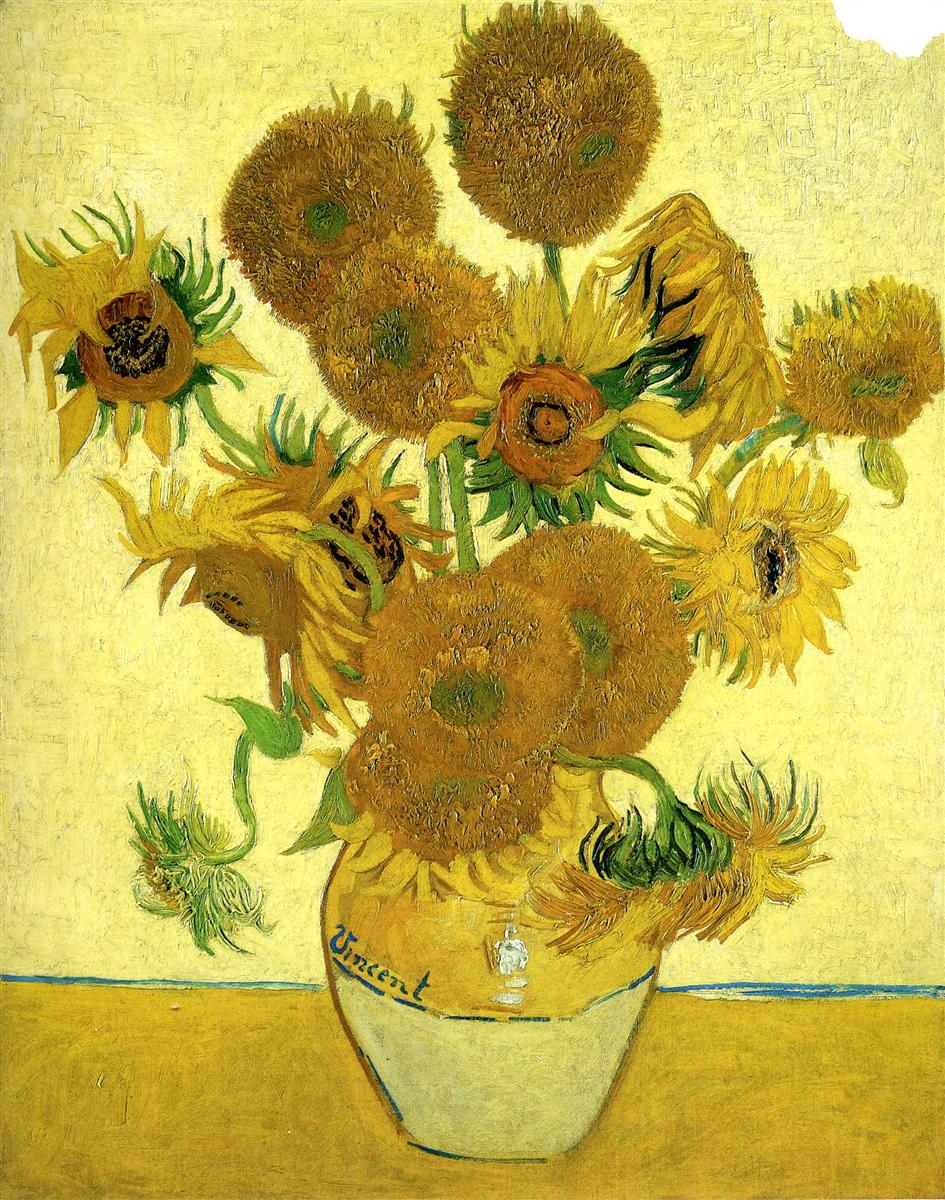
Vincent van Gogh’s Vase with Fifteen Sunflowers from 1888 is one of the most recognizable flower paintings in Western art, yet its familiarity can hide how radical it truly is. At first glance, the picture seems simple. A vase sits on a table and overflows with sunflowers in different stages of life. Some blooms open proudly toward the viewer, some droop under their own weight, and others have already begun to dry and curl inward. The background is spare, the arrangement is direct, and the subject appears humble. But the more closely the painting is examined, the more complex it becomes. This is not merely a decorative still life. It is a meditation on color, movement, mortality, friendship, artistic ambition, and emotional intensity.
Painted in Arles in 1888, this work belongs to one of the most important moments in van Gogh’s career. He had traveled south in search of stronger light, greater color, and a new direction for modern painting. In the sun-drenched atmosphere of Provence, he found the conditions that allowed his art to become bolder, brighter, and more original. The sunflower paintings emerged from that transformation. In Vase with Fifteen Sunflowers, van Gogh takes a familiar floral subject and turns it into something almost monumental. He does not present flowers as passive objects arranged for polite appreciation. He paints them as vivid presences, each one animated by thick brushwork, powerful color contrasts, and a sense of inner force.
This painting stands at the center of van Gogh’s artistic identity because it joins beauty with instability. The flowers are radiant, but they are also fading. The arrangement is harmonious, but it is never still in any conventional sense. Every surface appears to tremble with energy. The painting seems alive, as if the sunflowers are still growing, bending, and decaying before our eyes. That tension between vitality and impermanence is one of the reasons the work remains so compelling. It feels both joyous and fragile, celebratory and haunted. In a single vase of flowers, van Gogh captures the intensity of life itself.
The Historical Moment Behind the Painting
By 1888, van Gogh had reached a decisive phase in his development. His earlier Dutch paintings had been marked by dark earth tones, heavy forms, and a serious interest in peasant life. After moving to Paris, he encountered Impressionism and Post Impressionism, as well as the vivid color experiments of artists like Gauguin and the Neo Impressionists. These encounters changed his understanding of painting. He began to abandon dark tonalities in favor of brighter palettes and more daring color relationships. When he moved to Arles, he brought these discoveries with him and pushed them even further.
Arles offered van Gogh a new visual world. The southern light was sharper and warmer than anything he had experienced in the north. The local landscape, fields, flowers, and intense sun gave him fresh material and inspired a more expressive use of color. He dreamed of building an artistic community there, a place where painters could work together and create a new art for the modern age. The sunflower paintings are tied closely to that dream. They were not isolated studio exercises. They were part of van Gogh’s broader attempt to define himself and to prepare a welcoming environment for Paul Gauguin, whose arrival in Arles he eagerly anticipated.
In this context, Vase with Fifteen Sunflowers becomes more than a still life. It becomes a statement of artistic identity. Van Gogh wanted to create images that would stand out through their color intensity and emotional force. He understood that flowers, especially sunflowers, could become symbols of warmth, gratitude, and expressive power. The painting reflects his confidence during a moment of extraordinary productivity, but it also reflects his urgency. He worked quickly, intensely, and with a deep need to prove what painting could do. This urgency can still be felt in the canvas. The brushwork is not cautious or polished in the academic sense. It is immediate, searching, and alive.
The Power of the Composition
One of the painting’s greatest strengths is its composition. The bouquet fills much of the canvas, rising upward in a dense cluster that nearly presses against the picture plane. The vase is centered, but the arrangement above it is irregular, lively, and asymmetrical. This balance between order and freedom is crucial. Van Gogh gives the viewer a stable base in the vase and table, then allows the flowers to explode outward in unpredictable directions. The result is a composition that feels grounded and animated at the same time.
The flowers do not form a neat or idealized bouquet. Instead, they tilt, sag, turn away, and overlap in a way that creates rhythm and variety. Some heads face forward, showing dark centers ringed with textured petals. Others are seen from the side or from behind, with leaves and stalks twisting around them. This variety prevents the composition from becoming repetitive. Each sunflower occupies its own place in the arrangement and contributes a distinct visual note. Together they form a kind of chorus rather than a single unified mass.
Van Gogh also uses spacing very effectively. The flowers are close enough to feel abundant, but there is still enough room between them for the eye to move through the canvas. The stems rise through the middle, linking the bouquet to the vase, while the larger flower heads create focal points in the upper and central sections of the work. The edges of the arrangement feel active rather than closed. The bouquet seems to expand beyond itself, as though it cannot be fully contained.
The simplicity of the setting intensifies the impact of the composition. There is no elaborate interior, no decorative curtain, and no distracting accessory. The plain background allows the sunflowers to dominate the entire visual field. This stripping away of context is one of van Gogh’s great decisions. It gives the painting a directness that feels modern. The subject is isolated so that color, form, and emotion become the true content.
Color and the Triumph of Yellow
The first thing most viewers notice in Vase with Fifteen Sunflowers is the overwhelming presence of yellow. Van Gogh uses yellow not as a single flat tone but as a full spectrum. Pale buttery yellows, deep golden ochres, warm oranges, muted straw tones, and touches of green all interact across the surface. The effect is rich rather than monotonous. Although yellow dominates, it constantly shifts in temperature and intensity, creating subtle variety within apparent unity.
This concentration on yellow is one of the painting’s boldest achievements. In traditional European painting, still lifes often relied on strong contrasts between many different colors. Van Gogh does something more daring. He builds an entire image around variations of one dominant hue. In doing so, he proves that color relationships can be intense even without dramatic diversity. The yellows of the flowers echo the yellows of the background and table, binding the whole painting together. Yet these repeated yellows never dissolve into sameness because van Gogh adjusts them continuously through texture, contour, and neighboring accents.
The small areas of blue and green become especially powerful because the field of yellow is so extensive. The blue signature on the vase and the thin blue line at the table edge act like visual sparks. They sharpen the surrounding yellows and keep the composition from drifting into softness. Likewise, the green leaves and stems introduce cooler notes that refresh the eye and add structural clarity. Van Gogh understood that a dominant color becomes more vibrant when touched by strategic contrast.
Yellow in this painting also carries symbolic and emotional weight. It evokes sunlight, warmth, harvest, and life. At the same time, because these are cut flowers beginning to wilt, the yellow also becomes autumnal and fragile. It suggests ripeness at the edge of decline. This duality gives the painting much of its emotional depth. The color is full of happiness, but it is never innocent. It knows that brilliance fades.
Brushwork and Surface Energy
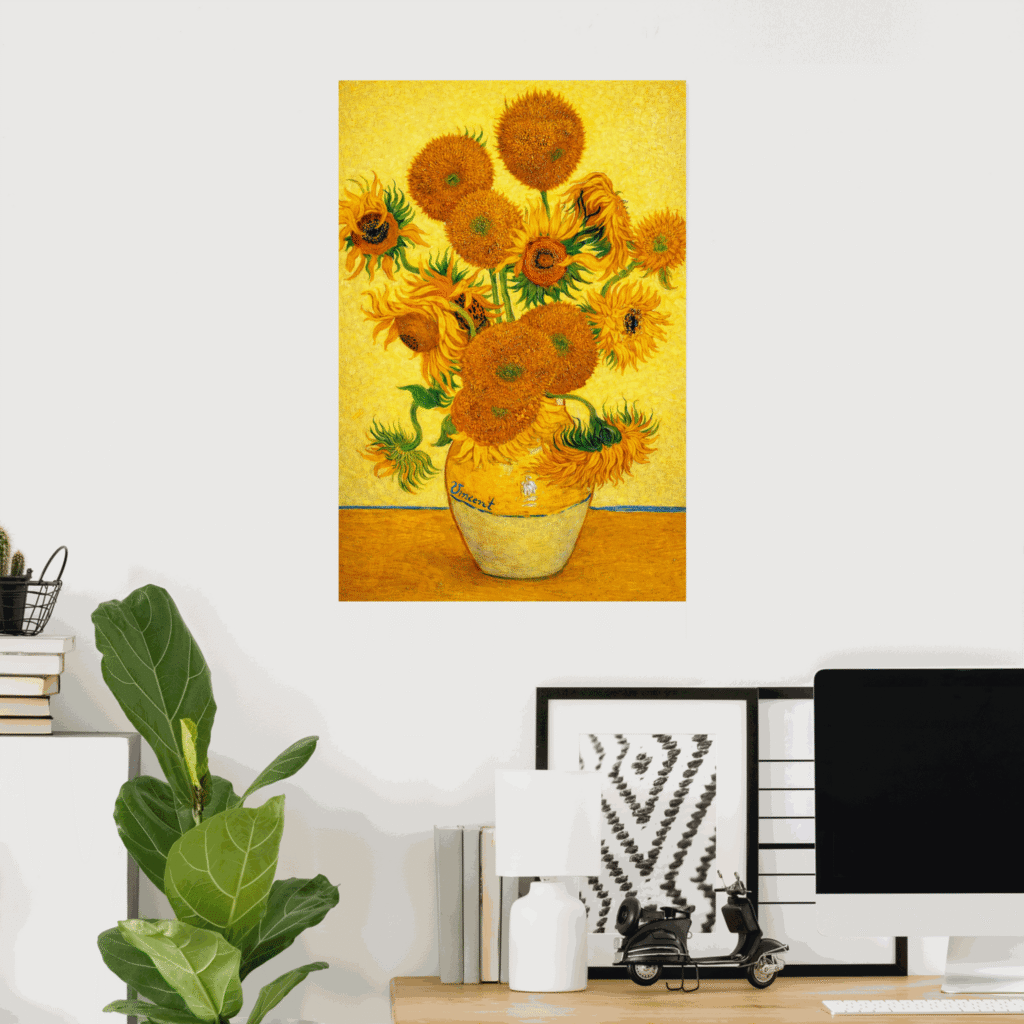
Van Gogh’s brushwork is essential to the painting’s meaning. The flowers are not described through smooth modeling or fine detail in the academic manner. Instead, they are built from thick, visible strokes that emphasize the act of painting itself. Petals seem to be laid on in urgent flicks and short curves. Seed heads are rendered with dense marks that create rough, tactile surfaces. The vase and background are also alive with directional strokes that prevent any part of the image from becoming inert.
This emphasis on surface energy transforms the still life into something almost sculptural. The paint does not simply represent texture. It becomes texture. The dried central disks of the sunflowers feel coarse and heavy because the brushstrokes themselves are coarse and heavy. The curling petals appear brittle because the paint has been manipulated to suggest that brittle movement. Even the background, which might have been a passive field in another artist’s hands, vibrates with its own network of marks. Every area contributes to the painting’s pulse.
The visible brushwork also creates immediacy. The viewer senses the speed and commitment of van Gogh’s hand. These marks do not feel hesitating or over-corrected. They feel decisive. That decisiveness gives the work emotional conviction. Van Gogh is not coolly describing flowers. He is responding to them with intensity, translating their forms into a language of touch and movement. The painting therefore becomes a record of perception and feeling as much as an image of a bouquet.
This quality helps explain why van Gogh’s still lifes can feel more alive than many figure paintings. He does not separate form from emotion. The brushstroke itself carries emotion. It conveys urgency, admiration, tenderness, and strain all at once. In Vase with Fifteen Sunflowers, the surface seems almost to quiver under the weight of that emotional investment.
A Still Life About Life and Death
Although the painting is radiant, it is not merely cheerful. One of its most profound qualities is its frank acknowledgment of change, aging, and decay. The bouquet includes flowers at different stages of existence. Some are open and assertive. Some are beginning to lose their petals. Some droop heavily, their heads bowed. Others have become almost skeletal, with shriveled forms that reveal the structure beneath their earlier fullness. Van Gogh does not conceal this process. He makes it central to the painting.
This choice gives the work an emotional seriousness that distinguishes it from many decorative floral paintings. The sunflowers are beautiful precisely because they are passing. Their fading condition does not weaken the image. It deepens it. Van Gogh seems fascinated by the entire cycle of life, from blooming to drying. In this sense, the bouquet becomes a compressed vision of time. Youth, maturity, and decline coexist in one arrangement.
Still life as a genre has long been associated with themes of transience. Flowers, fruit, and other perishable objects often symbolize the briefness of life. Van Gogh inherits that tradition, but he transforms it. Rather than using decay to moralize or warn, he presents it as part of a larger intensity of being. The wilted flowers are not treated as failures of beauty. They are part of beauty. Their twisting forms and roughened heads are as visually compelling as the fresher blooms.
This understanding of beauty is deeply characteristic of van Gogh. He is drawn not to perfect surfaces but to expressive truth. In these sunflowers, beauty does not depend on freshness alone. It comes from vitality, struggle, weathering, and endurance. The flowers have lived under the sun, and now they bear the marks of that life. The painting honors them in all their stages.
The Vase, the Table, and the Simplicity of Setting
The vase in Vase with Fifteen Sunflowers is modest, almost ordinary, but it plays an important role. It anchors the bouquet and introduces a solid geometric form beneath the more unruly organic shapes above. Its broad lower section stabilizes the composition, while its narrower neck gathers the stems into a coherent center. Without the vase, the bouquet would risk becoming chaotic. With it, the flowers have a home and a structural base.
Van Gogh paints the vase with the same attention he gives the flowers, but he does not overstate it. Its color harmonizes with the overall yellow scheme, allowing it to belong naturally within the canvas rather than standing apart as an object of luxury. This is not a silver vessel or a crystal jar. It is a simple container. That simplicity matters because it aligns with van Gogh’s broader interest in humble subjects. He often found dignity and emotional power in ordinary things. The vase shares in that dignity.
The table and background are equally stripped down. The tabletop is only lightly defined, and the junction between table and wall is marked by a thin horizontal line. This minimal setting creates just enough spatial clarity for the bouquet to exist without distracting from it. The flowers are not enclosed in deep illusionistic space. They are brought forward, close to the viewer, almost icon-like in their presentation.
This simplicity gives the painting a monumental quality. Because the surroundings are reduced, the bouquet becomes the entire world of the picture. The sunflowers are not part of a larger domestic scene. They are the scene. That concentration allows the emotional and visual weight of the subject to expand far beyond what might be expected from a vase of flowers.
Emotional Meaning and Personal Symbolism
The sunflower held special meaning for van Gogh. It was not simply a flower he found attractive. It became one of his personal emblems, tied to ideas of warmth, gratitude, artistic fellowship, and the light of the south. The sunflower paintings are often connected to his hope for friendship and collaboration, especially in relation to Gauguin. In that sense, Vase with Fifteen Sunflowers can be understood as a painting of welcome and generosity. It is full of offering. The flowers seem given rather than merely displayed.
At the same time, van Gogh’s emotional world was rarely simple. The painting’s exuberance exists alongside a sense of vulnerability. The flowers blaze, but they are fragile. They stand tall, but they also sag. This emotional duality gives the work unusual psychological depth. It expresses hope, but not naive hope. It is hope shadowed by impermanence.
The painting can also be read as a self-portrait in another form. Van Gogh often invested natural objects with human feeling, and these sunflowers possess striking individuality. They seem almost like gathered personalities, each with its own posture and mood. Some appear proud, some exhausted, some introspective, some open. Their differences create a social presence, as though the bouquet were a community of beings rather than a collection of specimens.
This emotional animation is one reason the painting continues to feel intimate. Viewers do not encounter the flowers as remote objects. They encounter them as presences charged with feeling. Van Gogh gives them a humanity without turning them into literal symbols. He lets painting itself do the work of emotional transformation.
Why This Painting Still Feels Modern
Despite being created in 1888, Vase with Fifteen Sunflowers remains strikingly modern. Part of this modernity comes from its simplification. Van Gogh eliminates unnecessary detail and focuses on what matters most: color, form, rhythm, and emotion. He does not aim for polished illusion. He allows the painting to declare itself as paint on canvas. This openness about the medium anticipates much of modern art’s later development.
The work also feels modern because it privileges subjective vision. These are not flowers seen with detached neutrality. They are flowers experienced through the intensity of van Gogh’s sensibility. The exaggerated color unity, the agitated brushwork, and the heightened presence of the bouquet all tell the viewer that art can interpret reality rather than merely copy it. This idea became central to twentieth century painting, but van Gogh was already making it vivid in the 1880s.
There is also a modern emotional honesty in the canvas. Van Gogh does not hide instability behind refinement. He allows tension and roughness into the work. The painting is beautiful, but its beauty is not smooth or complacent. It includes fatigue, strain, and mortality. That complexity makes it resonate with modern viewers, who often respond to art that acknowledges contradiction rather than avoiding it.
Even now, the painting feels fresh because it combines accessibility with depth. Almost anyone can respond to flowers, sunlight, and strong color. But the more time one spends with the canvas, the more it reveals about perception, time, and feeling. This balance between immediate appeal and lasting complexity is one of the marks of a great work of art.
Conclusion
Vase with Fifteen Sunflowers is much more than a famous floral still life. It is one of Vincent van Gogh’s clearest demonstrations that everyday subjects can hold immense emotional and artistic power. Through an arrangement of sunflowers in various stages of bloom and decline, he creates an image that is both joyful and sobering, simple and profound. The painting dazzles through its yellows, but its deeper force lies in its ability to hold opposites together. It is full of sunlight, yet haunted by fading. It is decorative, yet deeply serious. It is humble in subject, yet monumental in effect.
Van Gogh’s achievement here rests on the unity of composition, color, and touch. The asymmetrical bouquet feels alive, the concentrated yellows create a world of warmth and tension, and the brushwork transforms the surface into an arena of motion and feeling. Nothing is static. Even the background seems to tremble. The painting does not merely show flowers in a vase. It makes them pulse with presence.
What gives the work its lasting power is the way it turns a momentary subject into a timeless experience. Cut flowers cannot last, and van Gogh does not pretend otherwise. Instead, he paints their brief brilliance with such conviction that impermanence itself becomes memorable. The sunflowers are not preserved against time. They are seen within time, and that is what makes them moving.
In this painting, van Gogh found a visual language capable of expressing admiration, tenderness, longing, and mortality all at once. He transformed a bouquet into an image of life at its brightest and most fragile. That is why Vase with Fifteen Sunflowers continues to command attention. It reminds viewers that beauty is often most powerful when it is inseparable from change, and that art can make even the most fleeting things feel unforgettable.