Image source: wikiart.org
Introduction
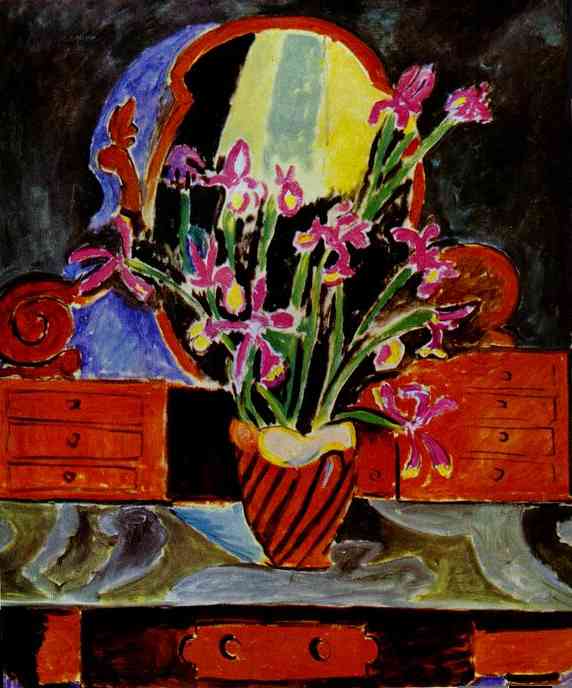
Henri Matisse’s “Vase of Irises” (1912) is a compact explosion of color staged on a dressing table. A striped red vase brims with magenta and lilac irises whose petaled arabesques surge upward and outward. Behind them an oval mirror catches a shaft of pale yellow light bordered by cool blue, like a luminous halo that crowns the bouquet. On either side sit red cabinet drawers and carved scrolls, their symmetry checked by the asymmetry of the flowers. The tabletop flows with marbling strokes of gray, green, and blue, while the surrounding ground is a velvety near-black that charges every hue with extra voltage. The picture is at once a still life and a miniature interior, but more than either it is a demonstration of how color, contour, and rhythm can make everyday things feel theatrical and alive.
Historical Moment
Painted in 1912, the canvas belongs to one of the most fertile years of Matisse’s career. He had just returned from Morocco, where the clarity of light and the decorative logic of Islamic architecture sharpened his use of broad color planes. At the same moment he was reworking studio motifs—flowers, mirrors, furniture—under the spell of this new clarity. “Vase of Irises” sits beside the goldfish pictures and the two versions of “Nasturtiums with ‘The Dance’,” sharing their combination of domestic subject and audacious color. While Cubism in Paris analyzed objects into crystalline facets, Matisse built a parallel modernism that fused forms into rhythmic wholes. This painting shows him using the private language of the studio to make a public statement about color’s power.
What the Painting Shows
The motif is intimate: a vase of irises placed on a dressing table or vanity, with drawers to either side and an oval mirror rising behind. The irises are rendered as starburst petals in pink-violet with lemon centers; their stems and leaves thrust upward in elastic diagonals. The vase, ribbed in diagonal red stripes, sits dead center like a drum. The mirror glows with a vertical band of light—soft yellow edged with a slice of cool blue—while its outer rim is ringed in warm red. The entire arrangement is framed by a dark field that reads as the surrounding room, deep enough to swallow detail and make the central actors blaze. The basic symmetry of furniture and mirror gives the flowers a stage on which their asymmetry can perform.
Composition as Orchestration
Matisse composes the canvas like a musician balancing chords and melody. The horizontal line of the tabletop acts as a baseline; the stacked drawers and twin scrolls form a steady beat of rectangular and spiral shapes. Over that beat he lets the irises improvise. Their petals curl, flip, and overlap in a series of arabesques that move the eye in loops and counter-loops. A vertical axis runs through the vase and mirror, anchoring the composition, but Matisse refuses strict bilateral symmetry: the left scroll is echoed by a different right scroll; the flowers on the right are heavier and lower, while those on the left shoot higher. This subtle imbalance gives the picture its living sway.
Color Architecture
Color carries structure and emotion at once. The background’s darkness is not simply black; it is a smoldering mixture of deep browns, violets, and blues that absorbs light and sets off the bouquet like a spotlighted performer. Reds dominate the furniture and vase, but they belong to different families: the drawers glow in dense, orange-red blocks; the vase’s stripes are sharper, nearer to vermilion; the mirror’s rim is a warmer, velvety red that softens where it meets the dark field. The irises sing in a constrained but radiant register of magenta, lilac, and rose, tipped with yellow notes that echo the mirror’s central glow. Green stems and leaves mediate between red and violet, linking warm and cool. The limited palette—black-ground, red furniture, violet flowers, green stems, yellow light—is deployed with orchestral precision so that every color is meaningful and no color is idle.
The Mirror as Pictorial Device
The oval mirror is the painting’s most ingenious device. It is both object and light source, plane and window, a surrogate sun that crowns the bouquet. Matisse avoids literal reflection; instead of rendering a detailed image of the room, he simplifies what the mirror holds into a vertical flare of pale yellow flanked by a cool blue. This column of light lifts the center of the picture and turns the bouquet into a kind of secular altarpiece. The mirror’s curved perimeter, outlined in warm red, repeats the vase’s rotundity and the petals’ scallops, tightening the painting’s thematic circle of rounded forms. By making a mirror behave like a luminous painting within the painting, Matisse also emphasizes the idea that light in art is constructed rather than copied.
Drawing and Line
Matisse’s line is elastic and decisive. The red cabinet drawers are edged with black that bites slightly into the color, while the scrolls are defined by fluent spirals that feel carved out of paint. The flowers are drawn as much by color juxtapositions as by outlines; where a pink petal overlaps the dark ground, the edge slices clean; where petal crosses petal, the edge softens and a halo of underpaint glows between them. Green stems are economical strokes that vary in width and pressure, so a single brush movement can suggest both firmness and spring. Most telling is the line of the vase’s mouth, a simple oval drawn with a loaded brush and a tremor that keeps it human. Everywhere line behaves like a dancer: poised, springy, and alive to rhythm.
The Vase and the Hand
The striped vase is more than a container; it is the composition’s fulcrum. Its diagonal red bands give direction, pointing upward into the stems and outward toward the petals. The highlight at the lip and the creamy yellow patch near the opening bind it visually to the mirror’s light, as if the vase were soaking up illumination and redistributing it into the flowers. The stripes also announce the hand—one can sense the sweep of the brush around the curve. The vase thus becomes a nexus where making and seeing coincide: the painter’s gesture and the bouquet’s growth share the same energy.
Texture and the Tabletop
The tabletop beneath the vase carries a marbled pattern of grays, greens, and blues, painted in swirling strokes that counter the rectilinear slabs of the drawers. Its movement is liquid, suggesting both stone veining and the eddies of water. This fluidity allows the tabletop to act as a bridge between object and ground: it belongs to the furniture but behaves like a pictorial field. The subtle shifts of value within these marbled strokes prevent the lower half of the painting from feeling heavy. The table becomes a lake on which the vase floats, the bouquet rising like a fountain into the mirror’s light.
Space Without Illusion
Depth is built not by perspective but by stacking and overlap. The drawers and scrolls sit on either side of a central void into which the mirror and bouquet advance. The tabletop’s front edge is barely suggested; its mass is indicated by the large drawer at the bottom and by the way the vase’s foot casts a slight, dark anchor. The mirror reads simultaneously as a solid object and as a luminous opening. This compressed, stage-like space keeps the eye at the surface, where color relations can be read clearly. Rather than inviting the viewer to “walk into” the picture, Matisse invites the viewer to sit close and feel the equilibrium of planes.
Rhythm of Symmetry and Asymmetry
One of the canvas’s pleasures is how deftly it balances opposing impulses. The furniture is symmetrically arranged; the bouquet is flagrantly irregular. The mirror is an orderly oval; the irises are serrated and frilled. The drawers’ knobs line up; the petals’ tips explode in different directions. These tensions create rhythm. The eye enjoys the security of symmetry, then is released into the play of natural variation. This is a formula Matisse exploits elsewhere—especially in placing patterned textiles against human figures—but here it feels particularly concentrated: domestic order meets botanical exuberance, and both benefit.
Light as Color, Color as Light
No logical lamp or window is described, yet the picture glows. Light is conceived chromatically: the yellow column in the mirror is light, the cool blue around it is its complement, the violet petals carry light in their saturated edges, and the red furniture radiates a heat that has nothing to do with illumination and everything to do with hue. Matisse’s achievement is to let color take over all the jobs normally done by modeled light and shadow. The result is a stable, resonant brightness that seems to emanate from within the painting’s own pigments.
The Studio as Theater
Like many of Matisse’s interiors, “Vase of Irises” transforms the studio into a small stage. The drawers are wings, the mirror is a backdrop, the table is the performer’s mark, and the bouquet is the star in the spotlight. The dark surrounding space functions as velvet curtains that recede and silence the noise of the room. By turning a common domestic object—the vanity—into a theater, Matisse elevates everyday ritual to art. The act of arranging flowers becomes a ceremonial presentation of color, and the viewer becomes the audience seated just beyond the footlights.
Dialogue with Tradition
Irises have a long pedigree in European painting, associated with gardens, spring, and the drama of unfolding shape. Matisse acknowledges that tradition but rewrites it in his grammar. Where earlier painters might describe each flower’s twist and ruffle with careful modeling, he renders them as simplified signs: loud petals, succinct buds, brisk stems. The mirror recalls the long tradition of still lifes with reflective surfaces, yet here it refuses literal reflection and becomes a radiant emblem. The painting thus participates in tradition while declaring its modern independence: resemblance is kept, descriptive redundancy is dropped.
Material Surface and the Evidence of Making
The surface reveals the painting’s construction. One can see where the black ground slips up to meet a petal, where a petal was broadened by a second pass, where the edge of a drawer was pulled with one steady drag of red and then pinned with a crisp black outline. In the mirror’s glow, thinly brushed light allows undercolor to flicker through, generating the sensation of radiance. In the table’s marbling, the brush scumbles and loops, letting the canvas tooth catch the paint. These traces are not accidents; they are the means by which the painting announces that it is both an image and an object, a picture of flowers and a field of colored paste.
Emotional Tone
Despite the high contrast and saturated color, the painting’s mood is one of controlled exuberance. The bouquet is lively but not wild; the furniture is warm but not oppressive; the dark ground is dramatic but not grim. Matisse’s oft-stated desire to create “an art of balance, purity, and serenity” finds concrete form here. The serenity does not come from quiet palettes or empty spaces; it comes from the tuning of strong sensations so that none overwhelms the others. The result is a domestic image that feels ceremonial—festive but measured, intimate yet grand.
Symbolic Hints
The painting invites symbolic readings without insisting on them. The mirror, a traditional emblem of reflection and time, sits behind flowers that represent freshness and transience; the drawers suggest storage and memory; the vanity recalls the rituals of grooming and presentation. In this light, the bouquet becomes a memento of a moment, lifted briefly into radiance before it fades. Yet Matisse resists allegory in words; he prefers allegory in color. The true symbols are the relationships—yellow set within blue, red cradling violet, dark ground lifting light. Meaning arises not from narrative but from the way the eye experiences these harmonies.
Relation to Matisse’s 1912 Series
“Vase of Irises” bears family resemblance to the year’s other studio pictures. Its dark ground parallels the nocturne mood of “Fish Tank in the Room,” where bright orange fish glow against deep blue-black; its central axis and haloing light recall the organizational clarity of “Nasturtiums with ‘The Dance’,” with a still life poised before a luminous field; its marbled tabletop and curling scrolls echo the decorative logic of Moroccan interiors translated into studio furniture. Seen together, these canvases show Matisse refining a consistent set of problems: how to make color carry structure, how to make domestic motifs feel monumental, how to keep movement and rest in productive tension.
Why the Painting Matters
The significance of “Vase of Irises” lies in how fully it performs Matisse’s modern credo within a small format. It demonstrates that a still life can be a complete world, that a mirror can be light rather than reflection, that a bouquet can be both subject and conductor. It shows that painting can abandon laborious modeling without losing presence, because color, properly tuned, can do the heavy lifting. For viewers, the canvas offers a lesson in looking: stare long enough at the relations of red, violet, green, and yellow, and you feel not only the objects represented but a state of mind—buoyant, focused, and calm.
Conclusion
“Vase of Irises” turns a vanity table into a radiant theater of color. The red drawers and scrolls supply structure; the marbled tabletop introduces flow; the striped vase anchors the center; the irises leap into a halo of luminous mirror-light. Around them stretches a deep, dark field that magnifies their brightness. Matisse’s economy is fearless: a handful of hues, a few decisive lines, and a balanced composition transform simple things into a memorable experience. The painting is not only a bouquet arranged for the eye but a demonstration of how color and line, in the right hands, can make the ordinary feel inexhaustible.