Image source: wikiart.org
An early Waterhouse vision of myth made intimate
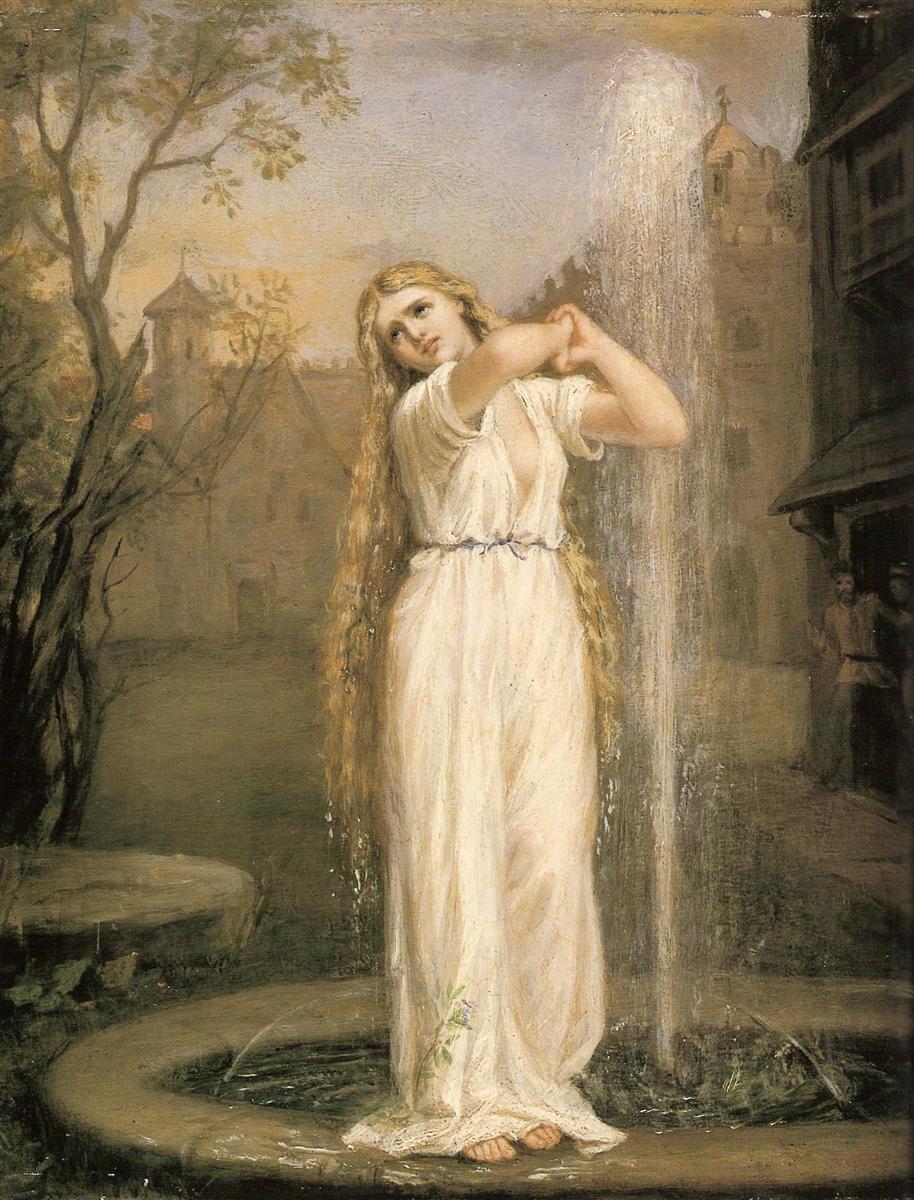
In Undine (1872), John William Waterhouse turns a legendary water spirit into something surprisingly close and human. Instead of presenting a grand spectacle of enchantment, he builds the scene around a single figure caught in a private moment, half ritual and half reverie. The result is a painting that feels hushed, almost as if the viewer has arrived a second too early. Undine stands beside a vertical sheet of falling water, her arms raised as if wringing moisture from her hair or gathering herself after emerging from the fountain. Her expression is not theatrical. It is inward, searching, and slightly distant, like someone listening for a voice that may or may not answer.
This is one of the most compelling qualities of Undine as an early work: it suggests a story without forcing a single, fixed plot. Waterhouse offers cues, then lets atmosphere do the rest. The medievalized architecture, the twilight palette, the soft cascade of water, and the figure’s luminous dress all point toward romance and legend. Yet the pose and the gaze feel psychologically modern. We are not simply being told, “Here is a nymph.” We are being invited to consider what it means to exist between elements, between worlds, and between innocence and longing.
The Undine legend and why it mattered in the nineteenth century
The name Undine comes with a whole tradition attached: a water spirit who is not fully human and who seeks something humanity possesses, often described as a soul, a stable identity, or the capacity for enduring love. In nineteenth-century retellings, Undine frequently becomes a figure of desire and danger at once. She embodies nature’s beauty, but also nature’s indifference. She can bless, seduce, purify, drown, or vanish. For Victorian audiences, this mythic structure offered a safe way to discuss intense themes: sexuality, marriage, betrayal, spiritual anxiety, and the fear that love can transform you in ways you cannot control.
Waterhouse does not spell all of this out, but he does not need to. By choosing Undine as a subject at all, he taps into a cultural fascination with water women, tragic heroines, and the idea that the feminine can be aligned with the fluid, the changeable, and the untamable. It is a subject that also anticipates many later Waterhouse paintings, where women from literature and myth occupy a similar emotional territory: poised between invitation and withdrawal, radiance and melancholy.
Setting as storytelling: the courtyard, the fountain, the distant tower
The scene is staged in what reads as a medieval courtyard: stone paving underfoot, a dark building mass on the right, and a tower rising in the background like a watchful presence. On the left, a tree stretches up into the pale sky, its branches and leaves rendered with a light touch that keeps them from becoming a competing focal point. Everything about the setting feels slightly muted, as if time itself has slowed.
This is important, because the architecture does more than provide historical flavor. It establishes containment. A courtyard is enclosed by design, a space where movement is limited and visibility is controlled. That enclosure mirrors Undine’s predicament in many versions of the story: a being tied to water, stepping into the human world, trying to inhabit human structures. The tower in the distance adds a subtle note of surveillance and separation. It suggests rules, lineage, and social order, all the things a mythic water spirit can desire and still never fully belong to.
Composition and the art of guiding the eye
Waterhouse organizes the painting so that the viewer’s gaze travels in a gentle loop. Undine’s pale figure is centered and immediately dominant, her white dress catching and holding light. The waterfall forms a vertical band to her right, echoing her upright stance while also framing her, like a translucent curtain. The darker building on the right creates a shadowed counterweight that makes her brightness feel even more pronounced. On the left, the tree softens the geometry with organic lines, preventing the scene from becoming too rigid.
The composition also plays with thresholds. The fountain basin sits at Undine’s feet, a circular opening into depth and water. The waterfall is a moving boundary. The dark passage on the right suggests an interior space beyond view. These are all liminal elements, and Undine herself becomes the central threshold, the figure who belongs to all of them and none of them at once.
Undine’s pose: a moment between emergence and concealment
Undine’s raised arms and turned shoulders create a sense of motion paused mid-gesture. It is a pose that can be read in multiple ways, which is part of its power. She may be squeezing water from her hair, a practical action made graceful. She may be stretching, as if tasting the air after leaving the water. She may be gathering her hair like a veil, instinctively protecting herself. The ambiguity keeps the scene alive. It suggests that Undine is not performing for an audience, but inhabiting her own bodily reality.
Her head tilts upward, and her eyes lift as if responding to something above or beyond the viewer. This upward gaze is a classic device for suggesting longing, prayer, or listening. In the context of Undine, it can imply a desire for transformation, for recognition, or for a voice that can name her. It also gives the painting an emotional direction. The water falls, the buildings loom, the courtyard confines, but her attention rises.
The white dress and the language of purity
The dress is central to the painting’s symbolism and its visual impact. White in Victorian visual culture often signals purity, innocence, or spiritual aspiration. Here, the whiteness does not feel merely moralizing. It feels elemental. Against the browns and grays of stone and shadow, the fabric becomes a surface for light itself. Waterhouse uses the dress to make Undine appear both present and slightly unreal, as if she is made of the same pale substance as the sky and the falling water.
The dress also reads as vulnerable. It is thin, soft, and unarmored, with none of the heavy ornament that would mark rank or social identity. That lack of social coding matters. It positions Undine outside the usual human categories. She is not a court lady. She is not a peasant. She is something else, dressed in a simplicity that makes her seem closer to a spirit than to a citizen.
Hair as identity: flowing gold and the trace of the water world
Undine’s long hair, rendered in warm gold tones, is one of the painting’s most evocative details. It cascades down, catching highlights, and appears damp, as though the water world still clings to her. Hair in nineteenth-century art often carries symbolic weight: sensuality, vitality, wildness, and the untamed self. For Undine, hair becomes a visual metaphor for her nature. Like water, it flows, it tangles, it reflects light, it refuses strict containment.
The way Waterhouse paints the hair also bridges the palette. It brings warmth into a scene otherwise dominated by cool stone and misted air. That warmth humanizes her. It suggests blood and sunlight, not only river depths. In this sense, her hair becomes the site of her duality: the water spirit whose body is beginning to speak the language of human warmth.
The waterfall as a veil, a barrier, and a signature motif
The falling water to Undine’s right is not just a setting detail. It functions like a semi-transparent wall. It divides the space while also shimmering with light. It is a veil that both reveals and conceals, which is exactly how myth often works. Myth promises access to another world, but only through filters, riddles, transformations.
Visually, the waterfall amplifies the painting’s themes. Water is motion and change, and yet here it forms a steady vertical sheet, almost architectural. It becomes the one “wall” that cannot be entered in a human way. You can stand beside it, touch it, listen to it, but you cannot live inside it unless you belong to it. Placing Undine beside this veil of water makes her relationship to it feel intimate and tense at the same time, like a bond that both comforts and confines.
Light, atmosphere, and the quiet drama of dusk
The sky is pale and softly graded, suggesting evening or early morning rather than midday clarity. This choice matters because dusk and dawn are themselves liminal times, moments when forms blur and boundaries soften. Waterhouse uses this atmospheric light to reduce hard contrasts and create a mood of suspended certainty. The world looks real, but not fully awake.
This softened atmosphere also supports the emotional tone. Undine’s expression is delicate, not anguished, but it carries a faint ache. The gentle light turns that ache into something lyrical rather than melodramatic. The painting’s drama is quiet, the kind that happens inside a person rather than in a battle or a storm.
Hidden observers and the tension of being seen
On the right side, in the darker area near the building, faint figures appear like onlookers. They are easy to miss, and that is part of their narrative function. They suggest that Undine’s privacy is not guaranteed. Even in a courtyard, even beside water that feels like sanctuary, the human world watches. If Undine is a being who longs for humanity, then humanity’s gaze becomes both tempting and threatening. To be seen is to be acknowledged, but also to be judged, possessed, or misunderstood.
These shadowed observers deepen the painting’s emotional complexity. Undine is illuminated, almost spotlighted by her own radiance, while others remain indistinct. That contrast can imply the loneliness of being different. It can also hint at the older theme of the supernatural woman turned into spectacle, the extraordinary presence that draws attention without ever fully consenting to the terms of that attention.
Waterhouse’s early style and his relationship to Pre-Raphaelite ideals
Although painted early in his career, Undine already shows Waterhouse’s attraction to literary subject matter and his gift for making myth feel tactile. His handling of the figure has a softness that differs from strict, hyper-detailed realism, yet the image retains a careful clarity where it matters: the face, the gesture, the fall of the dress. This balance aligns him with the broader orbit of the Pre-Raphaelite Brotherhood without making him a simple imitator.
The nineteenth century in England produced a deep appetite for medieval and legendary themes, not only for escapism, but for moral and emotional exploration through story. Institutions like the Royal Academy of Arts shaped expectations of narrative painting, while writers and critics including John Ruskin argued for sincerity, close looking, and a reverence for nature. Waterhouse absorbs these currents and redirects them into a language that is more atmospheric, more psychological, and often more sympathetic to female interiority.
Emotional meaning: longing, transformation, and the cost of crossing worlds
What ultimately makes Undine memorable is how it treats transformation as an emotional condition rather than a special effect. Undine stands at the edge of water, not triumphantly stepping into human life, not tragically drowning, but simply existing in the strain of in-betweenness. The gesture of wringing or gathering her hair suggests self-management, a small act of control. Her upward gaze suggests desire, a reaching. The courtyard suggests limits, the social world closing in. The waterfall suggests origin, a constant reminder of what she is and where she belongs.
In many Undine stories, the tragedy is not that she is supernatural, but that love and identity do not resolve cleanly. To become human is to accept time, betrayal, grief, and permanence. To remain a spirit is to be free and also unheld. Waterhouse captures that paradox in a single quiet pose. The painting does not need overt symbolism to communicate its stakes. The water falls, the light softens, and a figure stands shining against stone, as if asking whether belonging is worth the price.