Image source: wikiart.org
First impressions and the instant drama
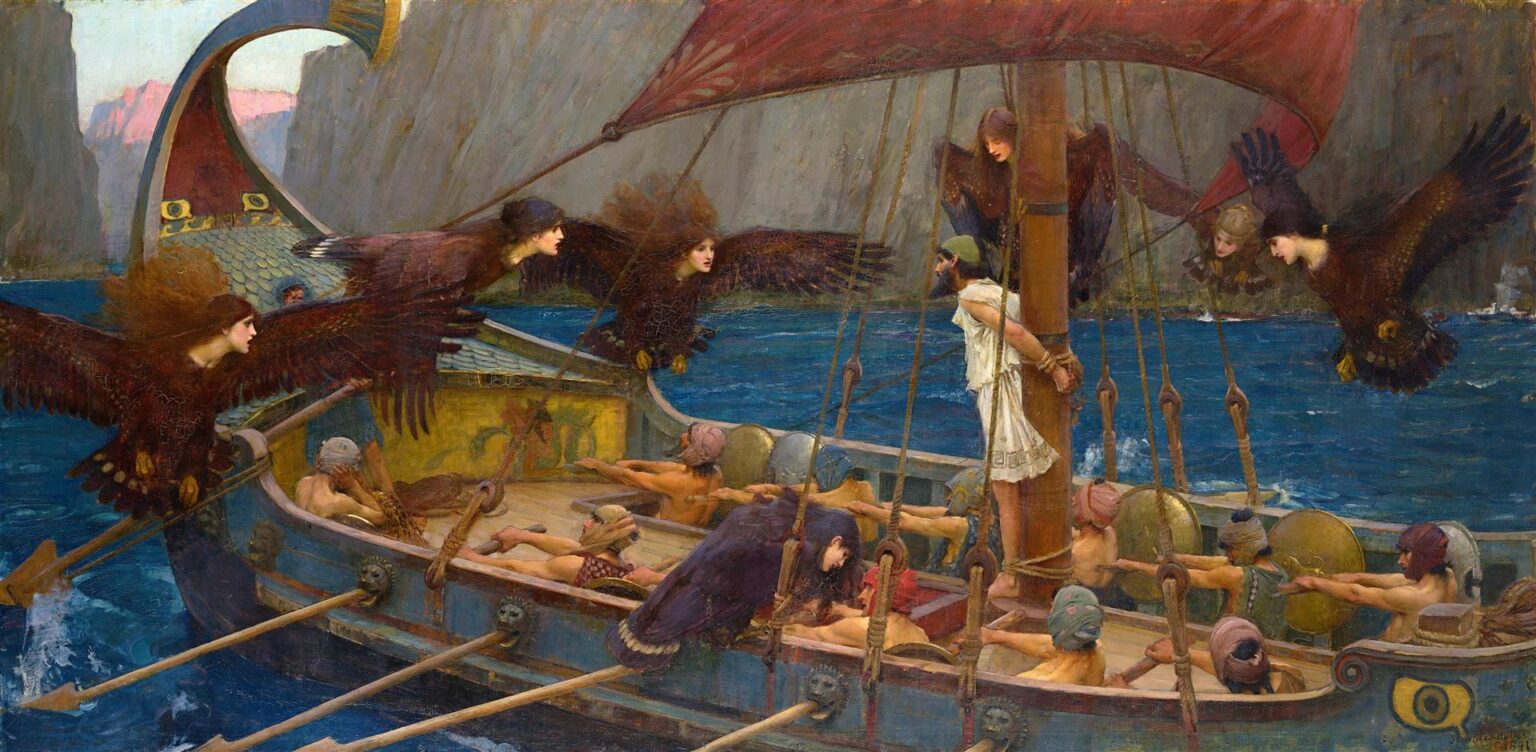
In Ulysses and the Sirens (1891), Waterhouse throws you straight into a moment where survival depends on attention. The scene is loud even in silence: the sea heaves, the oars bite the water, ropes strain under tension, and the air feels crowded by wings. Everything in the painting points to one central idea, temptation that arrives as beauty and tries to turn the mind away from duty.
The viewer’s eye lands quickly on the bound figure at the mast, then ricochets outward to the circling sirens. That back and forth motion is the picture’s emotional engine. We feel both the pull of the sirens and the human effort required to resist. Waterhouse does not treat myth as distant history. He paints it like a lived crisis, one that happens in real time on a real deck with tired bodies, salt air, and a horizon that offers no easy exit.
The myth behind the image
The story comes from Odyssey, where Ulysses orders his crew to stop their ears with wax so they cannot hear the sirens’ song, while he himself is bound to the mast so he can listen without steering the ship toward destruction. It is a myth about curiosity, leadership, and the cost of wanting to experience everything. Waterhouse chooses the most psychologically charged second of the tale: not the planning beforehand, not the aftermath, but the passage itself, when the danger is present and the will must hold.
That choice matters because it turns the painting into a study of competing instincts. The crew’s instinct is practical endurance. Ulysses’ instinct is desire mixed with pride, the wish to face the forbidden and still remain in control. The sirens embody the trap, not as crude monsters, but as a persuasive fantasy that seems almost reasonable in the moment.
Composition that feels like a test of will
The composition is built on a tight structure that mimics restraint. The mast is a vertical axis that locks the scene in place, and the ropes radiating from it form a web across the surface. Those ropes are not just nautical detail. Visually, they suggest a net, a boundary, a rule system made of knots and friction. The geometry of rigging and oars contrasts with the sirens’ more fluid shapes and sweeping wings.
Waterhouse also stages the action so that the ship becomes a kind of arena. The figures lie low and horizontal, pinned to labor, while the sirens occupy the air and the edges, approaching from multiple directions. The viewer senses encirclement. Even the distant cliffs feel like walls. There is open water, yet the space reads as constrained, as if the environment itself is collaborating with the sirens.
The ship as a world of work and vulnerability
The vessel is not romanticized as a heroic symbol alone. It is a working machine crowded with bodies, shields, and oars. The rowers are arranged in a rhythm of repeated poses: backs bent, arms extended, heads lowered or turned away. This repetition matters because it emphasizes discipline. These men are not individuals chasing glory in this instant. They are a coordinated force trying to survive the mile directly in front of them.
At the same time, the packed deck communicates vulnerability. There is hardly any personal space. The oars extend like spokes, and the hull rides close to the choppy water. Waterhouse paints the danger as immediate and physical. If focus breaks for even a moment, the whole system collapses. The ship becomes a metaphor for a mind under pressure: everything has to keep moving in harmony, or the crash arrives.
Ulysses bound to the mast
Ulysses stands upright, wrapped in a pale garment that catches the light and separates him from the crew. His posture reads as both powerful and helpless. Being vertical makes him look commanding, but the ropes around his body make clear that command has been surrendered, at least temporarily, to his own precaution. Waterhouse captures the paradox of a leader who must be restrained for the plan to work.
His head turns toward the sirens with an intensity that suggests fascination rather than simple fear. The scene implies that the sirens’ true weapon is not force but attention. Ulysses is the only one fully exposed to it. The crew can only win by refusing to perceive. Ulysses tries to win by perceiving without yielding, which is a far more precarious gamble.
The crew’s physical language of refusal
The men’s gestures communicate a spectrum of resistance. Some appear to press hands to ears or keep heads low, reinforcing the idea of blocking out the sound. Others strain forward with the oars, locked into motion. Waterhouse gives the crew a shared body language: effort as protection. Their refusal is not abstract virtue. It is muscle, sweat, and repetition. They resist by doing the next stroke.
This emphasis on labor is crucial to the painting’s moral atmosphere. Waterhouse suggests that temptation is defeated less by grand declarations and more by small acts sustained over time. The crew’s heroism is almost unglamorous, and that is exactly why it feels convincing. In contrast, Ulysses’ heroism is dramatic, and therefore riskier, because drama is close to spectacle, and spectacle is what the sirens trade in.
The sirens as predatory elegance
Waterhouse’s sirens are bird women, a form that aligns with older classical traditions. Their wings are broad and dark, their bodies weighted with feathers, and their human faces read as focused, intent, and eerily calm. They do not look frantic. They look confident, as if they know the rules of this encounter better than the sailors do.
Several sirens crowd close to the ship, some perched, others hovering at eye level, creating an uncomfortable intimacy. Their nearness is a kind of invasion. Waterhouse paints them not as distant singers on a cliff but as creatures that can physically overwhelm the deck. The myth becomes tactile. The sirens’ beauty is not soft. It is sharp, invasive, and strategically placed.
Wings, feathers, and the feeling of threat
The wings do a lot of narrative work. They enlarge the sirens, making them feel capable of dominating the space. They also create a visual echo of the sail above, so that air and cloth and feather start to rhyme. This resemblance is unsettling because it implies the ship’s own equipment participates in the sirens’ world. The very things that should carry the crew safely forward, wind and sail, are mirrored by the predators circling them.
Feathers also introduce a texture that contrasts with the smooth skin of the sailors and the hard surfaces of shields and wood. That contrast reads as sensory temptation. The sirens are made of tactile variety, while the ship is made of duty and blunt necessity.
Color, light, and the temperature of the scene
The palette sets up an emotional tension between cool and warm. The sea is a dense blue, broken by white flecks and darker currents. Against it, the sail glows with a muted red tone that feels like a warning signal hanging overhead. The sirens’ dark wings and hair deepen the surrounding air, while touches of gold and ochre in the ship’s decoration hint at civilization and tradition.
Waterhouse uses color to separate worlds. The water and cliffs feel cold, immense, and indifferent. The ship’s interior tones feel human and historical, touched by craft and ritual. The sirens bridge these worlds, appearing both natural and unnatural, part of the sea’s ecosystem yet driven by a purposeful intelligence.
The sea and cliffs as psychological landscape
The setting is more than background. The towering cliffs form a corridor that narrows the passage, making the journey feel like it has entered a trap. The water’s agitation suggests instability not only beneath the ship but within the minds of those aboard. The sea is the perfect environment for the sirens because it is already a metaphor for being overwhelmed. It swallows sound, reflects light unpredictably, and punishes mistakes instantly.
Waterhouse paints the distance with enough detail to suggest real geography, yet it still functions as psychological theater. The cliffs are like the boundaries of a test. You cannot walk away. You must pass through.
Detail, realism, and the credibility of the myth
One of Waterhouse’s strengths is how he makes a fantastical subject feel credible through careful observation. The ship’s construction, the rigging, the shields, the oars, and the movement of water are all rendered with enough specificity to anchor the story. This credibility matters because it keeps the painting from drifting into pure fantasy illustration. It feels like a historical world that could exist, which makes the supernatural intrusion more disturbing.
The shields lined along the side also add to the sense of a traveling band of warriors. They imply past battles and future ones. The encounter with the sirens is not the only danger, just the one that attacks from within, through desire rather than steel.
Waterhouse’s storytelling and the Pre-Raphaelite inheritance
Waterhouse is often linked with the atmosphere and narrative focus associated with Pre-Raphaelite Brotherhood, especially in his love of literary themes and his insistence on vivid, legible storytelling. In this painting, that legacy shows in the clarity of the episode and the careful staging of emotion. Even without knowing the myth, a viewer can read the basics: a man bound at the center, exhausted workers ignoring a threat, winged figures pressing close.
Yet Waterhouse also pushes beyond simple illustration. He builds an image that rewards extended looking, because the meaning is distributed across details: the tension of ropes, the direction of gazes, the repeated pattern of oars, and the way figures tilt toward or away from the sirens. The painting becomes a system of decisions, not a single gesture.
Themes of temptation, curiosity, and self-control
At its core, the painting is about what happens when longing meets consequence. Ulysses’ choice to hear the sirens is not necessary for survival. It is extra. It is a desire for experience, for knowledge, for the thrill of what is forbidden. Waterhouse treats that desire as deeply human. It is not villainy. It is curiosity with sharp edges.
The restraint, however, comes at a cost. Ulysses is physically bound, and the crew must deny a whole realm of perception to remain safe. The painting suggests that self-control often feels like loss in the moment, like missing out, like turning away from beauty. That is why it is hard. Waterhouse makes the struggle visible rather than preaching it.
Power dynamics and the burden of leadership
The myth also carries a leadership question: who gets to experience temptation, and who must simply endure the work of resistance? Ulysses delegates denial to his crew and reserves experience for himself, even if he does it safely. Waterhouse’s staging highlights this hierarchy. The crew’s bodies are low, anonymous, and tasked. Ulysses is upright, singled out, and narratively central.
That tension invites interpretation. Is Ulysses admirable because he plans carefully and seeks knowledge? Or is he selfish because he risks the group for personal experience, even with precautions? The painting does not close the question. It keeps it open, which is part of its lasting pull.
The painting’s emotional rhythm
The scene operates like a tightening spiral. The sirens appear in multiples, approaching from different angles, creating a sense of mounting pressure. The crew repeats the same action, stroke after stroke, which reads like a mantra against distraction. Ulysses is the emotional pivot, because his gaze and posture suggest internal conflict. The viewer feels the sirens’ closeness, then feels the ropes, then feels the water, then feels the sirens again.
This rhythm is what makes the painting memorable. It is not simply that something dangerous happens. It is that the viewer is made to experience the sensation of being pulled and resisted at once. The painting becomes a demonstration of the sirens’ tactic, even as it shows how to survive it.
Why this image still resonates
Ulysses and the sirens endure as symbols because they describe a pattern that repeats in different forms: distraction that promises pleasure, choices that require discipline, and the uneasy relationship between curiosity and safety. Waterhouse’s version remains compelling because it gives that pattern a concrete body. It is not a vague allegory. It is a particular day on a particular stretch of water, with a sail overhead, salt on skin, and wings beating close enough to touch.
Waterhouse also refuses to simplify the moral. The sirens are terrifying, but they are also magnetic. Ulysses is cautious, but he is also hungry for experience. The crew is loyal, but their loyalty requires blindness. The painting respects the complexity of the myth, and in doing so, it respects the complexity of human desire.