Image source: wikiart.org
Introduction
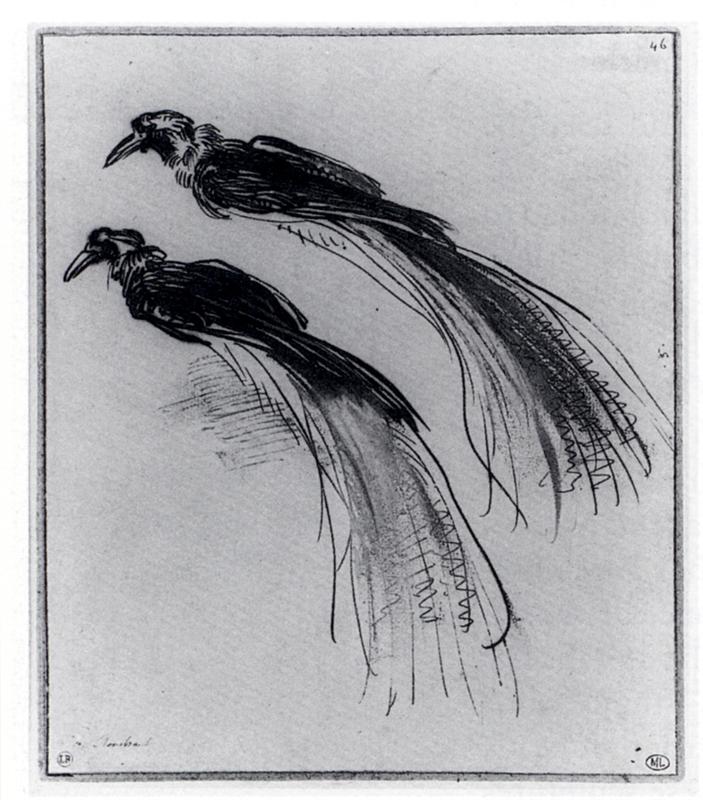
Rembrandt’s “Two Studies of a Bird of Paradise” (1630) is a compact drawing that feels as expansive as a sky in motion. On a bare sheet, the artist sets down two long-tailed birds poised on an invisible perch, one slightly higher and more elaborated, the other simplified and swift. With a few confident passes of pen and brush—and a haze of wash that turns mass into movement—Rembrandt converts a natural-history subject into a lesson in looking. The sheet is both observation and performance: he studies the structure of the birds even as he demonstrates how line can imitate the grace of flight and the weight of plumage.
A Leiden-Era Curiosity About the Natural World
In 1630 Rembrandt was still in Leiden, refining the nimble draftsmanship that animates his early etchings and small narrative pictures. While biblical and historical themes dominate, his sketchbooks and loose sheets reveal a parallel curiosity: faces of the elderly, beggars in motion, and, occasionally, animals and exotic specimens that circulated through Dutch collections. Birds of paradise, imported from the East Indies and prized for their extraordinary plumage, were among the marvels Dutch viewers encountered in Kunstkammern and merchant houses. Whether Rembrandt drew from a preserved specimen, a mounted bird, or a living captive, the sheet records a young master registering novelty with the same serious attention he gave to prophets and saints.
Composition That Balances Study and Style
The two birds occupy the upper half of the page, diagonally aligned from upper right to lower left. Their long tails sweep down in parallel arcs, leaving a generous expanse of untouched paper below. This asymmetry creates a light-filled arena for the tails to move through and prevents the drawing from feeling crowded. The upper bird is more fully modeled, as if Rembrandt began there, working out the head, beak, shoulders, and layered feathers before letting the line accelerate through the tail. The lower bird repeats the motif with fewer marks—its head abbreviated, the torso a compact dark, the tail handled with more open, elastic strokes. Together they read as two moments of the same subject: an initial, careful statement and a freer afterimage.
The Energy of the Pen
Rembrandt’s pen lines change character as they travel across the birds’ bodies. Around the heads and upper backs, the marks are short and directional, describing the build of the skull and the overlap of neck feathers. Along the wings, the pen becomes more calligraphic, laying down slanted strokes that separate coverts from flight feathers. In the tails the line loosens into long, elastic sweeps, punctuated by quick flicks and zigzags that suggest frayed, ribbon-like streamers. The variety is not mannerism; it is a record of attentiveness. Where structure matters, the line slows and follows anatomy; where motion or sheen matters, the line speeds up and courts the viewer’s eye.
Wash as Air and Weight
A diluted brush wash shadows the birds’ backs and powers the drama of the tails. By sinking certain zones into soft gray, Rembrandt gives the creatures mass and makes the surrounding paper feel like air. On the upper bird, a darker wash nests between wing and body, implying depth without cross-hatching; on the lower bird, a broad wedge of wash anchors the torso and lets the tail burst forward with greater contrast. Wash also doubles as motion blur. The slight feathering of tone along the tail edges persuades us that the plumes are light, flexible, and responsive to a faint breeze.
Negative Space as a Compositional Tool
Most of the sheet remains untouched. This reserve of paper is a deliberate choice and an essential part of the image. It isolates the birds’ silhouettes, heightens the visibility of their tails, and prevents over-description from flattening the subject. The empty space turns the drawing into an arena where line can perform. It also mimics the experience of looking up at a high perch against the sky—the birds are suspended, and the viewer’s attention is unencumbered by branches or background detail.
Observation without Fetishizing Detail
Natural-history illustration in the seventeenth century often chased exhaustive detail: every barb, every scale, every vein. Rembrandt goes the opposite way. He preserves enough specificity to convince—beak curve, head angle, the tiered fall of feathers—but he refuses to drown the sheet in minuteness. The brevity of the lower bird, especially, tells us this is a thinking drawing, a search for essentials: the posture, the massing of light and dark, the tempo of the tail. The result is paradoxically more lifelike than many hyper-detailed renderings because it leaves room for the viewer’s eye to supply motion and texture.
Two Studies, Two Intentions
The doubled motif allows Rembrandt to test alternatives. In the upper study the head tilts slightly downward and forward, predator-sharp and self-possessed, with the body stretched along the perch’s implied line. The tail curves with a sinuous, almost serpentine rhythm that stabilizes the composition. In the lower study the head lifts, and the back compresses into a dark wedge; the tail sweeps with more velocity, its strands more independent. Seen together, the pair reads like a sequence: the bird settles, then gathers itself to shift along the branch. The drawing thus moves beyond taxonomy toward behavior.
Calligraphic Invention and the Pleasure of Line
One of the sheet’s delights is its calligraphic daring. The tails become lines for their own sake—long, confident, and musical. Some strokes are continuous arcs; others are broken and varied, with a visible restart that gives the mark a living edge. A few squiggles at the very tips break the elegance with a touch of mischief, as if the artist could not resist showing that even beauty has unruly ends. These decisions place the drawing in conversation with Rembrandt’s pen portraits of beggars and old men: in all, he trusts that a line, properly chosen, can do the work of a paragraph.
Material Intelligence and Speed
The drawing demonstrates acute knowledge of how nib, ink, and absorbent paper behave. When Rembrandt wants crisp articulation—around the beaks, for instance—he presses lightly, keeping the ink thin and the stroke quick. When he wants softness, he draws into still-damp wash or drags the pen more slowly so the ink fans slightly into the fibers. The tails show controlled speed: long strokes laid down in a breath, their slight variation revealing the pressure of hand and the angle of the wrist. The technical confidence communicates itself to the viewer as liveliness—the sensation that the birds have just been caught and could fly off the page.
A Dialogue with Exoticism
Birds of paradise were objects of wonder in Dutch collections, often arriving as dried skins without legs or feet, which fed myths about birds that spent their lives in the air. Rembrandt’s studies push against such legend by grounding the creatures in observable structure. The neck attaches with plausible musculature; the wing origin is believable; the torsos carry weight. Yet he does not deny their strangeness. By simplifying the tails into ribbon-like streams, he honors the birds’ reputation for extravagance while retaining the credibility of an artist who has looked.
The Sheet as Practice for Painting and Etching
Rembrandt’s economy here is not isolated. The same shorthand appears in his early etchings of figures, where a few strokes conjure a coat’s weight or a face’s concentration. This sheet likely served as a technical warm-up and a store of visual rhythms he could draw upon later. The way the tails slice the picture space, for example, echoes the sweeping diagonals he favors in narrative compositions. The attention to how light and dark masses read from a distance anticipates his habit of designing paintings to be legible across a gallery.
Rhythm and Repetition
The two birds produce a visual rhythm: dark head and shoulder, tapering body, swelling into a cloud of tail; then again, similar but not identical. The repetition is soothing, yet the differences keep the eye alert. Rembrandt knows that repetition is not redundancy when each pass clarifies intention. The upper study teaches the form; the lower confirms and energizes it. Together they embody a discipline familiar to musicians and draftsmen alike: repeat to understand, vary to own.
Gesture as Knowledge
Even when drawing animals, Rembrandt builds understanding from gesture. The arch of the neck, the slope of the back, the angle of the tail relative to the body—these are not ornaments but propositions about balance and motive. The upper bird’s posture implies attentiveness without alarm; the lower bird’s compressed back and accelerated tail hint at imminent movement. Such gestural thinking makes the studies more than records; they are hypotheses about how these bodies navigate the world.
The Virtue of Leaving Things Unsaid
A faint scumble below the upper bird may indicate the lost edge of a perch or simply a note of shadow to keep the body from floating. Rembrandt resists the temptation to finish it. The birds remain perched on implication alone, and the drawing is better for it. The mind supplies what the hand withholds, and in that participation the viewer’s pleasure deepens. The same virtue governs the treatment of feather microstructure and iridescence—both notoriously hard to draw. Instead of laboring over minute barbs, Rembrandt suggests sheen by contrast and curve, trusting the eye to do the rest.
What the Drawing Teaches about Looking
Stand before this sheet and it trains your attention. You learn to separate essential from incidental, to read line for attitude, to feel weight in wash. You see how small variations in pressure alter meaning and how negative space keeps images breathable. You experience how a second attempt, simpler than the first, can be more persuasive because it reaches the core gesture faster. In this way the drawing is not only an image but also a pedagogy.
An Early Statement of Rembrandt’s Humanism
It may seem odd to call a bird study “humanist,” yet the term fits. Rembrandt’s approach to the natural world mirrors his approach to people: specificity without rhetoric, sympathy without sentimentality, beauty carried by truthful observation rather than by adornment. The same generosity he extends to beggars’ tattered cloaks and prophets’ lined faces appears here as patience with unfamiliar anatomy and delight in motion. The subject is exotic, but the method is domestic—careful, honest, and open-handed.
Longevity of a Small Sheet
Why does this modest page still feel fresh? Because it refuses fuss and believes in the eloquence of right marks in right places. Contemporary viewers, accustomed to speed and digital brevity, recognize the drawing’s directness as modern. At the same time, the sheet preserves something increasingly rare: evidence of a hand thinking in ink across paper, making adjustments on the fly, trusting that incompletion can be a kind of truth.
Conclusion
“Two Studies of a Bird of Paradise” captures Rembrandt at a fertile moment—curious, agile, and confident enough to let economy be expressive. Two birds, nearly mirrored, carry the entire composition on the strength of line and the intelligence of wash. The upper study describes, the lower dances; together they reveal how an artist turns observation into rhythm. No branch, no cage, no background taxonomy, and yet we feel the birds’ weight, temperament, and potential to move. The sheet is a reminder that mastery often announces itself not through finish but through choice, that a handful of marks, honestly placed, can persuade more deeply than an encyclopedia of detail.