Image source: wikiart.org
Introduction to Two Sleeping Children by Peter Paul Rubens
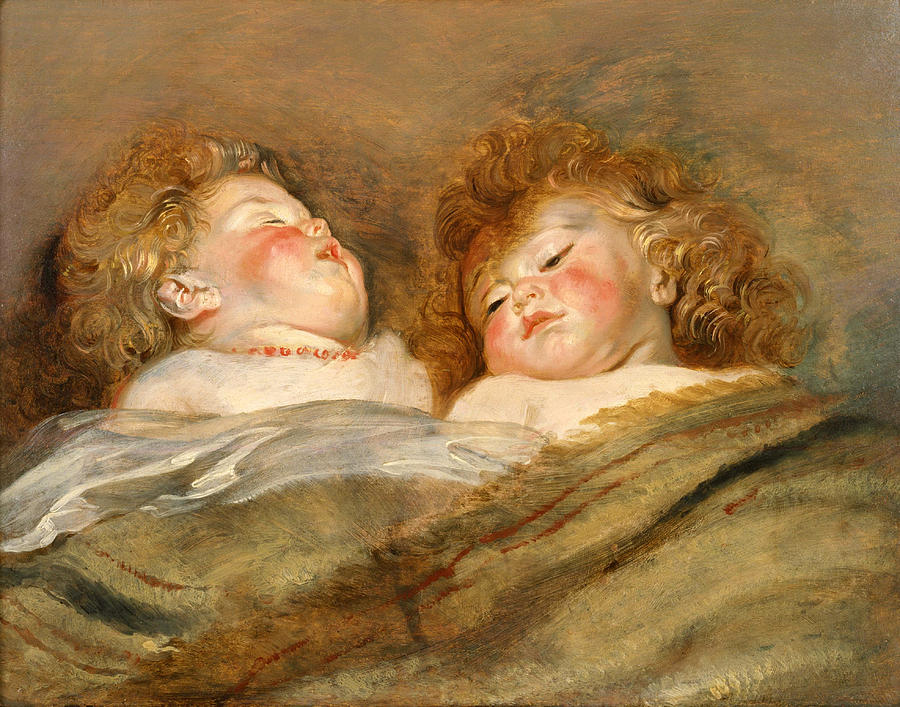
“Two Sleeping Children” by Peter Paul Rubens is a tender and intimate glimpse into the private world of the artist, far removed from the heroic mythologies and monumental altarpieces that made him famous. The painting shows two infants nestled together, their rosy faces softened by sleep, wrapped in loosely painted blankets that fill the lower half of the canvas. Their golden curls spill across the pillow and against the warm, neutral background.
At first glance, the work appears simple, almost casual. There is no elaborate setting, no symbolic object, no narrative drama. Yet the more closely one looks, the more striking the painting becomes. Rubens brings the same technical brilliance and emotional intelligence to these sleeping children that he devoted to kings and saints. He transforms a fleeting domestic moment into a timeless image of innocence, vulnerability, and parental affection.
Possible Identity of the Children and Personal Context
While the precise identity of the infants remains debated, many scholars believe that the painting depicts Rubens’s own children. Throughout his career, especially during his later years, he frequently painted family members, capturing his wives and offspring with a mixture of artistic observation and heartfelt love.
The children here have the plump cheeks, rounded chins, and slightly tousled hair typical of toddlers rather than very young babies. Their features are individualized: the child on the left has a slightly upturned nose and a deeper double chin; the one on the right has a more oval face and a gentler mouth. These details suggest that Rubens was not painting generalized cherubs but particular, familiar little people he knew well.
If the painting is indeed a portrait of his children, it reveals something about Rubens’s life beyond the studio and court. The great Baroque master, often engaged in diplomatic missions and monumental commissions, also experienced quiet evenings at home, watching his children sleep. “Two Sleeping Children” can be seen as a painted memory of such a moment, a father’s attempt to hold onto the fleeting sweetness of early childhood.
Composition and the Intimacy of Close Cropping
One of the most notable aspects of the composition is its close cropping. Rubens does not show the children’s full bodies or the room around them. Instead, he focuses on their faces and upper torsos, filling the frame with their presence. Their heads are turned slightly toward one another, almost touching, creating a sense of closeness and mutual warmth.
The canvas is oriented horizontally, echoing the position of a cradle or bed. The blankets and pillow form sweeping diagonals across the lower half, while the children’s faces emerge from this sea of fabric like two small islands of light and color. The tight framing makes the viewer feel as if they are leaning over the bedside, sharing the same intimate vantage point as a parent checking on sleeping children.
This compositional strategy also eliminates any distractions. There is no furniture, no decorative objects, and no distant window. The bare, softly toned background at the top of the painting pushes the infants forward, emphasizing their importance. Rubens wants our full attention on the fragile beauty of childhood and the calm of sleep.
The Expressive Power of Sleep
Sleep in art has long been associated with vulnerability, innocence, and an almost sacred sense of peace. In “Two Sleeping Children,” Rubens captures these qualities with extraordinary sensitivity. The child on the left lies with head tilted back, mouth slightly open, and eyelids firmly closed. The tilt of the neck exposes the soft crease folds and the delicate area under the chin. A faint string of coral beads circles the neck, thought in the seventeenth century to protect children and ward off illness.
The child on the right rests with head turned toward the viewer but with eyes fully shut, the lashes gently touching the flushed cheeks. The lips are closed and slightly pouting, suggesting deep, untroubled sleep. In both faces, the muscles are relaxed, free from the animation and mischief that would characterize them when awake.
By choosing to depict the children asleep rather than in lively play, Rubens shifts the emphasis from outward personality to inner tranquility. He invites viewers to contemplate the beauty of a moment when the world’s noise is shut out and the human being is at its most defenseless and trusting. The painting thus has a meditative quality, encouraging stillness and tenderness.
Color Harmony and the Warmth of Flesh Tones
Rubens is celebrated for his mastery of color, and even in this small domestic scene he orchestrates a harmoniously rich palette. The children’s skin is painted with warm, peachy hues, touched with pink at the cheeks, nose, and lips. These flushes of color convey both the warmth of sleep and the robust health of well-cared-for toddlers.
The surrounding fabrics and background are kept in a narrow range of earthy tones—soft browns, ochers, and muted greens. This restrained backdrop makes the rosy faces stand out more vividly. The blanket’s broad strokes of greenish-brown with subtle red accents add variety without drawing attention away from the children. The pillow and sheet introduce cooler whites and grays, particularly near the child on the left, where a sheer veil of fabric catches the light.
The hair of the children forms another important color element. Rubens paints their curls in shades of golden blonde, with streaks of copper and light brown. The highlights on these curls sparkle against the more subdued background, framing the faces like natural halos. Together, flesh tones, hair, and bedding create a warm, enveloping chromatic world that conveys comfort and security.
Brushwork and Texture: The Painter’s Hand at Play
Close inspection reveals the spontaneity and assurance of Rubens’s brushwork. He applies paint in swift, confident strokes that model form without fussiness. In the cheeks and chins, the flesh appears soft and rounded, built up with smooth transitions between light and shadow. The subtle blending mimics the delicate surface of a child’s skin.
In contrast, the hair is rendered more energetically. Rubens uses curling lines and dabs of lighter paint to build up the impression of individual locks and ringlets. Some strokes remain visible, giving the curls a sense of movement even though the children are still. This contrast between the velvety softness of the skin and the lively texture of the hair enriches the visual experience.
The blankets and pillow are painted more loosely still. Broad, sweeping strokes describe folds and creases in the fabric, suggesting weight and warmth rather than precise textile patterns. This looseness emphasizes that the fabrics serve primarily as a cradle for the children, not as objects of display. The viewer’s eye naturally returns to the smoother, more carefully modeled faces.
Rubens’s relaxed handling of paint, combined with his sure grasp of anatomy and light, gives the painting a sense of immediacy. It feels as if he painted it in one sustained session, directly from life, striving to capture the fragile moment before the children stirred awake.
Light and the Sense of Presence
Light in “Two Sleeping Children” is gentle but focused. It seems to fall from above and slightly from the left, illuminating the faces and upper bodies while leaving the lower blanket and background in softer shadow. This creates a subtle spotlight effect, isolating the children from the surrounding space and heightening the sense of intimacy.
The highlights on the cheeks, nose, and forehead are skillfully placed. A glimmer of light on the tip of each child’s nose, for example, gives the face dimensionality and a lifelike glow. Reflected light on the underside of the chin and around the jawline further enhances the illusion of three-dimensional form.
The overall effect of this lighting is to make the children appear tangible, almost touchable. The softness of their flesh, the warmth of their bodies beneath the blankets, and the gentle rise and fall of their breathing are all suggested through delicate modulation of light and shadow. This sense of presence invites the viewer into a virtual tactile experience, as if one could lean in and feel the warmth of these sleeping infants.
Emotional Resonance and Parental Love
Beneath its technical brilliance, the painting’s greatest power lies in its emotional resonance. The sleeping children evoke feelings of affection, protection, and nostalgia. Many viewers may be reminded of their own experiences watching children sleep, whether as parents, siblings, or caregivers.
Rubens taps into these universal emotions but heightens them through his composition and color. The way the children’s heads incline toward each other, almost like two petals of a flower, suggests a bond of closeness—perhaps the connection of siblings who have shared their lives from the very beginning. Their vulnerability underlines the responsibility of those who watch over them.
At the same time, there is an undercurrent of transience. The children will not remain this small and peaceful for long; they will grow, change, and face the complexities of life. The painting therefore becomes a kind of visual keepsake, preserving a moment that is already slipping away. Rubens, who knew the fragility of life in an era of disease and high infant mortality, may have been particularly sensitive to this theme.
Comparison with Rubens’s Other Depictions of Children
Rubens painted children in many contexts, from allegorical cherubs to royal heirs. In large altarpieces and mythological scenes, he filled the air with robust putti who participate in divine dramas. In portraits of noble families, he depicted sons and daughters in elaborate clothing, sometimes mixing playfulness with formality.
“Two Sleeping Children” stands apart from these public images. Here there is no symbolism of victory, no prophetic hint of future status, no theatrical gesture. The children are not idealized angels or future rulers; they are simply themselves, caught at a private moment of rest.
Nevertheless, Rubens’s experience with cherubs and mythological infants informs his treatment. The rosy cheeks, rounded limbs, and sumptuous curls recall the putti that populate his religious and classical compositions. Yet in this painting, these features are grounded in specific individuality rather than generic decoration. The result is a unique fusion of the ideal and the real—the divine charm of cherubs combined with the recognizable presence of real children.
The Domestic Baroque: Art in the Home
While many of Rubens’s patrons commissioned large works for churches or palaces, a painting like “Two Sleeping Children” was likely intended for a more intimate setting, perhaps a private chamber or family space. Such works reveal the domestic side of Baroque culture, where art did not only glorify rulers and saints but also celebrated everyday joys.
In a home, this painting would have functioned as a constant reminder of tenderness and familial bonds. It may have comforted parents who had lost children, reassured those anxiously watching over infants, or simply delighted visitors with its charm. Its small scale and gentle subject matter make it perfectly suited for contemplation at close range, encouraging a slower, more personal engagement than monumental altarpieces.
By bringing his full artistic powers to such a domestic theme, Rubens helps to ennoble the realm of family life. He shows that the beauty of a sleeping child is as worthy of serious artistic attention as the triumph of a king or the martyrdom of a saint.
The Timeless Appeal of Two Sleeping Children
Centuries after its creation, “Two Sleeping Children” continues to captivate viewers. Its appeal lies partly in its universality: anyone, regardless of cultural or religious background, can respond to the sight of peacefully sleeping infants. The lack of specific historical or religious symbols allows the painting to transcend its original context and speak directly to human experience.
At the same time, the work embodies hallmarks of Rubens’s artistry that art lovers admire: masterful color, expressive brushwork, and a profound understanding of the human body. Even in a scene of quiet repose, he infuses the canvas with life, warmth, and emotional depth.
For modern audiences, the painting can serve as a gentle reminder of the importance of tenderness amid a fast-paced, often chaotic world. It invites a pause, a moment of reflection on the fragility of life and the joys found in simple, everyday scenes. As viewers stand before it, they are drawn into the stillness of the children’s sleep and, perhaps, into memories of their own formative moments of care and affection.
Conclusion
“Two Sleeping Children” by Peter Paul Rubens is a small but luminous masterpiece that reveals a softer side of the great Baroque painter. Through close cropping, warm color, delicate lighting, and expressive brushwork, Rubens transforms a quiet domestic scene into a powerful meditation on innocence, love, and the fleeting nature of childhood.
Whether the infants are his own children or closely observed models, the tenderness with which he paints them suggests a deep personal connection. The painting celebrates not only the charm of young children but also the emotional world of those who watch over them. In doing so, it extends the scope of Baroque art beyond grand narratives and public spectacles, affirming the profound beauty of ordinary life.