Image source: wikiart.org
Introduction to “Two Peasant Boys and a Negro Boy”
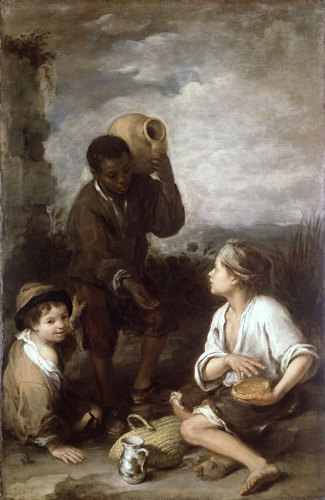
“Two Peasant Boys and a Negro Boy,” painted around 1660 by Bartolomé Esteban Murillo, is one of the most revealing works in the artist’s series of scenes of children in Seville. The painting shows three young boys gathered in a rustic outdoor setting. One sits on the ground with a shy smile, another kneels with a loaf of bread in his hand, and a third stands confidently, balancing a clay jug on his shoulder as he extends his palm.
Although the original title uses a term that is now understood as outdated and offensive, the work itself is an important document of how Black and poor children were seen and imagined in seventeenth century Spain. Murillo portrays these boys with warmth and individuality, drawing attention to their humanity rather than reducing them to stereotypes. At the same time, the painting does not hide the poverty and vulnerability that shape their lives.
This work allows viewers to explore issues of class, race, and childhood while appreciating Murillo’s mastery of light, color, and storytelling. It stands at the intersection of genre painting and social observation, revealing a side of Baroque art that is grounded in daily reality instead of grand religious or mythological themes.
Historical and Social Context
Seville in the mid seventeenth century was both wealthy and troubled. As a major port city tied to Spain’s American colonies, it was a hub of international trade and a meeting place for people of many ethnic backgrounds. At the same time, plague, economic decline, and social inequality created large populations of poor and orphaned children.
Murillo, who was deeply engaged with charitable institutions in Seville, often painted street children, beggars, and young workers. His images do not simply document misery. They also show playfulness, companionship, and resilience. In “Two Peasant Boys and a Negro Boy,” he brings together children of different backgrounds in a shared space, suggesting that poverty crosses ethnic lines.
The presence of the Black boy reflects the reality of Seville’s African and Afro-descendant population, a result of centuries of slave trade and migration. While the title reflects the racial language of its time, Murillo’s painting invites a more nuanced reading. He gives the Black child a central, active role in the composition and renders his features with the same care as those of the white peasant boys.
Composition and Spatial Structure
Murillo organizes the figures in a triangular arrangement that provides stability and intimacy. The seated boy at the left, the kneeling boy at the right, and the standing boy in the center form the three points of this triangle. The viewer’s eye moves around this structure, taking in each child’s expression and posture while always returning to the confident figure who carries the jug.
The ground and surrounding rocks create a shallow stage. There is no deep architectural perspective or elaborate background. Instead, a patch of sky opens above the boys, framed by a rugged wall and sparse vegetation. This simplicity keeps the focus on the figures while situating them firmly in a natural environment rather than a formal interior.
Murillo leaves a significant amount of space above the boys, filled with clouds and soft light. This vertical openness gives a sense of air and freedom, yet the boys remain close to the earth, barefoot and dressed in patched clothing. The tension between open sky and cramped foreground mirrors the contrast between childhood potential and the limits imposed by poverty.
The Seated Boy: Shy Companionship
On the left, a small boy sits directly on the ground, legs folded. He wears a broad-brimmed hat and a loose shirt that slips from his shoulder. His clothing is worn, but the white of his shirt catches the light, drawing attention to his face. He looks out at the viewer with a half-smile that suggests curiosity mixed with caution.
This boy’s role is partly to invite the viewer into the scene. He acknowledges our presence more openly than the others, functioning almost like a guide or intermediary. His relaxed posture indicates that he is comfortable among his companions, perhaps sharing in whatever food or play is at hand.
The detail in his features and the gentle modeling of his cheeks show Murillo’s delight in capturing the individuality of children. He is not a generic peasant type but a real person whose personality emerges through expression and stance.
The Kneeling Boy: Hunger and Expectation
On the right, another boy kneels with one leg tucked under him and the other extended. His clothing is simple and somewhat disheveled. The loose white shirt falls open at the chest, and his sleeves are rolled up. A cloth is tied around his head, hinting at the improvisations required when clothing is scarce.
He holds a round loaf of bread or a flat cake in one hand and turns his head toward the standing boy. His gaze is intent, and his mouth is slightly open, as if he is speaking or expecting a response. The bread indicates the central concern of these children: food. Whether they are about to share a meal or negotiate an exchange, sustenance is at the heart of their interaction.
The kneeling posture conveys both humility and alertness. He is close to the earth, his bare legs clearly visible, yet his upper body leans forward. He is ready to move, to offer, or to accept. Murillo captures this moment of anticipation with great sensitivity, making the viewer wonder about the story behind the scene.
The Standing Boy: Confidence and Agency
The central figure, described in the historical title as a Black boy, stands with a jug balanced on his shoulder. His stance is confident. One leg is bent, and his body twists slightly, giving a sense of motion. His right hand supports the jug, while his left hand is extended, palm up, toward the kneeling child.
His clothing is similar in kind to that of the other boys but rendered with special care. The brown jacket and breeches are patched and worn, but they fit him well. The white of his shirt shows at the cuffs and collar, catching the light and leading the viewer’s gaze to his expressive face.
He looks down toward the kneeling boy, and his expression mixes seriousness with friendliness. The extended hand could be asking for payment, offering water, or simply illustrating a point in conversation. Whatever the exact meaning, Murillo has positioned him as an active agent in the interaction, not a passive background figure.
By placing this child at the center and giving him such poised posture, Murillo challenges hierarchies that might otherwise marginalize him. The painting invites viewers to see him as a full participant in the shared life of these children.
Light, Color, and Atmosphere
Murillo’s handling of light is crucial to the painting’s emotional effect. The light seems to come from above and slightly to the left, illuminating the boys’ faces and the front surfaces of their clothing. The seated boy’s hat casts a soft shadow across his brow, while the standing boy’s cheek and forehead glow warmly.
The color palette is dominated by earthy browns, soft whites, and muted greens. These tones evoke the dust and soil of rural life. The sky is painted in gentle blues and grays, with patches of white cloud. Nothing in the landscape is harsh or dramatic. Instead, the atmosphere feels mild, as if the children are enjoying a moment of respite in a calm afternoon.
The ceramic jug, the woven basket, and the metal or clay pitcher near the boys provide bright accents. Their pale surfaces catch the light and highlight the material culture of the poor. These objects are not luxurious, but they are tangible, solid, and painted with loving detail. They root the painting in the realism of everyday life.
Gesture, Interaction, and Narrative Possibilities
One of Murillo’s strengths is his ability to suggest stories without spelling them out explicitly. In this painting, the gestures and glances between the boys create a web of possible meanings.
The standing boy’s extended hand might indicate that he is offering water from the jug in exchange for bread. The kneeling boy’s loaf and intent gaze support this reading. The seated boy, smiling at the viewer, may be watching the negotiation or waiting his turn.
Another interpretation could be that the standing boy is demonstrating something, telling a story, or teasing his friends. His energy and upright pose contrast with the passivity often associated with images of poverty. These children are not simply victims of circumstance. They have agency, relationships, and inner lives.
By leaving the exact narrative open, Murillo encourages viewers to engage imaginatively. The painting becomes a starting point for reflection on friendship, sharing, and survival in harsh conditions.
Representation of Race and the Need for Critical Viewing
The title of the painting, using an archaic term for the Black boy, reminds us that this image emerges from a society structured by colonialism and slavery. It is important to acknowledge this historical context when appreciating Murillo’s work.
Within the painting, the child of African descent is depicted with dignity and individuality. His posture is strong, his clothing comparable in quality to that of the other boys, and his central placement in the composition confers importance. Murillo avoids caricature. He models the child’s features with care, just as he does for the white peasant boys.
At the same time, the painting does not explicitly confront the realities of enslavement or racial discrimination that many Black people in seventeenth century Spain faced. The scene presents a moment of companionship, perhaps idealized. It is up to modern viewers to hold together appreciation for Murillo’s humanizing portrayal with awareness of the larger structures of inequality that shaped the world he painted.
By reading the work critically, we can see both its empathetic power and its limitations. The painting offers an opportunity to discuss how artists of the past depicted racial difference, how those depictions shaped attitudes, and how contemporary audiences can respond responsibly.
Everyday Objects and Texture
The objects scattered around the boys contribute significantly to the painting’s realism. At the bottom center, a small jug or pitcher sits near a woven basket and a cloth. The kneeling boy’s loaf of bread and the standing boy’s large clay vessel dominate the composition as signs of basic needs.
Murillo paints these objects with subtle highlights that convey their texture. The jug gleams with a soft sheen, the basket’s rough fibers catch the light at their edges, and the bread appears crusty and solid. These textures contrast with the softness of the boys’ skin and the worn fabric of their clothes.
Such details reveal Murillo’s interest in the Spanish still life tradition, where ordinary items are given almost sacred attention. In this context, the simple tools of survival become symbols of the children’s daily struggle and resourcefulness.
Landscape and Setting
The background landscape is understated yet evocative. A rough wall or rock formation rises on the left, partially framing the group. To the right, low grasses and open sky suggest proximity to fields or the outskirts of a town. The horizon is faint, merging with the sky in a quiet, atmospheric blend.
This setting can be read as both literal and symbolic. Literally, the boys may be resting on a road or near a rural dwelling. Symbolically, the open landscape contrasts with the constrained social space available to them. The broad sky hints at possibilities beyond their current poverty, while the rocky foreground reminds us of the challenges they face.
Murillo’s decision to place them outdoors rather than in a cramped alley or dark interior gives the scene a kind of innocent freshness. These children are not yet crushed by circumstances. They are still capable of play, conversation, and moments of shared joy.
Murillo’s Style and Interest in Childhood
“Two Peasant Boys and a Negro Boy” exemplifies Murillo’s broader fascination with childhood. Throughout his career, he returned repeatedly to images of children, both in religious contexts and in genre scenes. He had an extraordinary ability to capture the softness of young faces, the awkwardness of growing bodies, and the spontaneity of their interactions.
In this work, his brushwork is fluid but controlled. He uses soft transitions between light and shadow to model the figures and keep the mood gentle. There is no harsh outlining or rigid anatomy. Instead, the bodies feel natural and believable, as if caught in the middle of everyday activity.
Murillo’s sympathy for his subjects comes through in the careful attention he pays to their expressions. None of the boys appear idealized in a classical sense. Their teeth, hair, and skin bear the marks of their life conditions, yet they remain engaging and dignified. This blend of realism and compassion is one of the reasons Murillo’s depictions of children are still so compelling.
Emotional Impact and Contemporary Resonance
Emotionally, the painting produces a complex response. On one hand, viewers may feel charmed by the boys’ companionship and the gentle light that surrounds them. There is an air of camaraderie and shared humor, especially in the smile of the seated boy.
On the other hand, the bare feet, patched clothing, and makeshift picnic of bread and water remind us of the precariousness of their lives. The painting invites empathy rather than pity. It challenges viewers to see poor and marginalized children as subjects with their own relationships and stories.
For contemporary audiences, the inclusion of a Black child among the protagonists raises important questions about representation and diversity in historical art. The work offers an early image of multiracial childhood in European painting, encouraging discussions about how different communities have long been part of shared social spaces, even when power relations were unequal.
Conclusion
“Two Peasant Boys and a Negro Boy” by Bartolomé Esteban Murillo is far more than a charming genre scene. It is a nuanced study of childhood, poverty, and companionship in seventeenth century Seville. Through a carefully balanced composition, warm light, and subtle gesture, Murillo portrays three boys from different backgrounds who share a moment of interaction and mutual dependence.
The painting reveals Murillo’s deep empathy for children living on society’s margins and his skill in transforming humble subjects into powerful works of art. While its historical title reflects the language and racial attitudes of its time, the image itself invites modern viewers to recognize the dignity and individuality of each child.
By lingering over their expressions, the everyday objects by their side, and the open sky above them, we gain insight into a world where scarcity and friendship coexist. Murillo’s work continues to speak today, reminding us that behind every social category or label there are real human faces and stories waiting to be seen with compassion and respect.