Image source: wikiart.org
A quiet scene that still feels alive
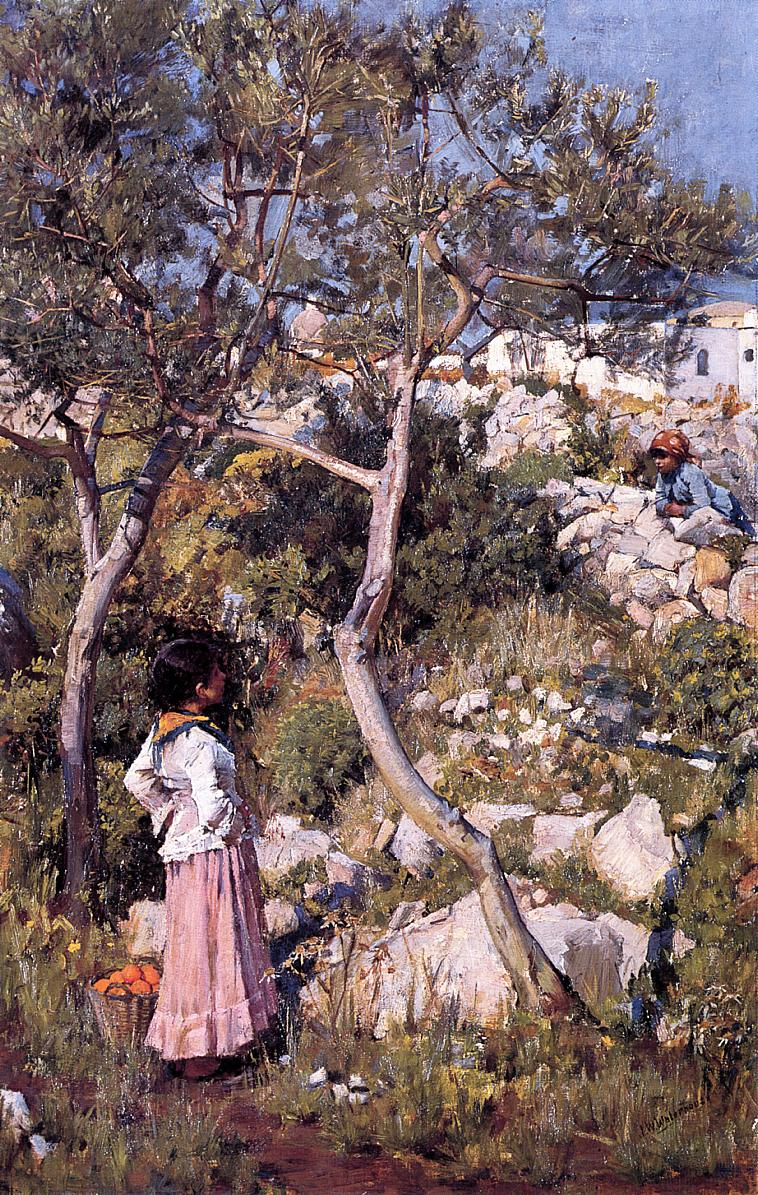
John William Waterhouse’s “Two Little Italian Girls by a Village” (1889) looks, at first glance, like a simple moment caught outdoors: two girls on a rocky hillside, olive trees shifting in the breeze, whitewashed buildings stepping back into light. The longer you stay with it, the more carefully constructed the “casual” becomes. This is a painting that turns everyday rural life into something memorable, not by forcing a dramatic story, but by letting light, distance, posture, and texture do the work.
What makes the scene so compelling is its balance between intimacy and openness. The setting is expansive enough to breathe, with sky and village receding into the background, yet the figures feel close and specific. Waterhouse invites you into a small human exchange without telling you exactly what it is. That openness is part of the painting’s charm: it suggests a narrative, but it does not lock you into one.
First impressions and the painting’s emotional temperature
The emotional tone is calm, warm, and observant. Even though the brushwork is energetic, nothing feels rushed. The girls are not posed like symbolic “types” in a studio setting. They belong to the hillside. Their body language reads as natural: one stands firmly in the foreground, turned toward the other; the second perches on higher ground, half in sunlight, half edged by shadow and stone.
The overall mood is not sentimental in a sugary way. Instead, it feels attentive and respectful, as if the painter is interested in the dignity of ordinary life. Childhood here is not staged innocence. It is a real presence within a real landscape, shaped by work, weather, and place.
Composition and how your eye moves through the scene
The painting is built on a gentle but effective zigzag. Your eye typically starts at the lower left where the standing girl anchors the foreground. From her, you move upward along the diagonal slope of stones and scrub toward the second girl on the right. Then the line continues behind her into the village structures and bright sky.
The olive trees are not merely decorative. Their trunks and branches act like guiding rails. One trunk bends subtly through the center, creating a visual hinge that ties foreground and background together. The canopy breaks the sky into fragments, which keeps the top of the painting from becoming a flat “blue ceiling.” This fragmentation is important because it echoes the broken surfaces on the ground: leaves, rocks, and brush all share a lively, irregular rhythm.
Waterhouse also makes smart use of spacing. There is enough open ground between the two girls to suggest distance, but not so much that they feel disconnected. That middle zone becomes the stage where the implied conversation happens.
The landscape as a character, not a backdrop
This hillside is painted with the kind of care usually reserved for faces. The stones are specific in shape and weight, and the plants feel rooted rather than patterned. The terrain looks uneven and sunbaked, with patches of hardy grass and shrubs that catch highlights in small flashes. The landscape tells you about climate and daily life without needing any added symbols.
The village in the background, with its pale walls, feels both near and far. It is close enough to read as inhabited, but distant enough to stay quiet. That distance matters: it suggests a world continuing beyond the figures, giving the scene a sense of lived reality rather than theatrical arrangement.
The olive trees, especially, define the painting’s identity. Their silvery leaves, twisted branches, and airy density create a recognizable Mediterranean atmosphere. Their presence also establishes a pattern of dappled light, which becomes one of the painting’s main visual pleasures.
Light, shadow, and the feeling of midday
Light is the invisible subject here. The sky is clear, and the illumination seems strong, likely midday or early afternoon, when shadows sharpen and highlights brighten. Yet Waterhouse does not paint the light as a single, uniform blast. Instead, it is filtered through foliage and broken by rock faces, producing many small variations.
Look at how the rocky slope is handled: highlights sit on edges and planes, while shallow shadows settle into crevices. The result is tactile. You can almost feel the heat stored in stone and the dryness of the ground. Even the whites in the distant buildings are not blank. They are warmed, cooled, and textured, suggesting sun striking uneven surfaces.
This attention to light does more than describe weather. It sets a mood of clarity. Everything can be seen, nothing is hidden, and yet the story remains unspoken. The painting becomes a meditation on presence: the world is bright, and the moment is simple, and that is enough.
Color choices and the harmony of warm and cool
The palette is a conversation between warm earth tones and cool atmospheric blues. The sky brings a broad cool field that stabilizes the scene, while the hillside introduces warm browns, ochres, and greens. The girls’ clothing then supplies concentrated notes of color that feel natural in the environment rather than pasted on top of it.
The standing girl’s pink skirt is especially important. It is not an artificial pink; it is softened, dusted, and varied, as if the fabric has absorbed sunlight and the wear of daily use. The scarf at her shoulders adds a yellow accent that echoes the sunlit grasses and the warm undertones in the rocks.
On the right, the second girl’s red headscarf provides a deeper, richer contrast, pulling attention upward and outward. That red is balanced by her blue clothing, which ties her visually to the sky. This is not just “pretty” color. It is structural color. The figures are linked to their surroundings through careful echoes and counterpoints.
The two figures and what their poses suggest
The standing girl feels grounded. Her posture is steady, with her weight set as if she has paused during a task. She looks upward toward the other girl, and the angle of her body suggests attention and patience. She is not reaching or running; she is waiting, listening, or perhaps calling quietly.
The second girl, higher on the slope, is perched among stones. Her pose is more dynamic, as if she has climbed or scrambled there. She leans forward slightly, engaged. The elevation difference between them matters: it creates a gentle tension. One is “below” and one is “above,” which can read as playful hierarchy, curiosity, or simply the natural result of moving over uneven ground.
Their relationship is implied rather than explained. They might be sisters, friends, or companions on an errand. Waterhouse leaves room for the viewer’s imagination, but he gives enough behavioral truth that the interaction feels believable.
Everyday work, hinted at through small details
The basket of oranges at the lower left is a quiet but powerful detail. It suggests purpose. These are not children placed in a landscape for decoration. There is food to carry, a task underway, and a rhythm of labor woven into daily life.
The oranges also serve a visual function. Their saturated color pops against the darker ground and anchors the foreground with a compact, rounded form. Among all the jagged stones and branching lines, the fruit introduces a simple geometry: circles. That contrast heightens the sense of observation, as if the painter enjoyed noticing how different shapes coexist in nature.
Even the clothing feels chosen for realism rather than fantasy. The fabrics hang with weight. The colors look sun-touched. These details support the painting’s broader theme: the beauty of ordinary life when it is truly seen.
Brushwork, texture, and the sensation of air
The surface handling suggests a painter interested in immediacy. Leaves are not meticulously outlined. They are suggested through broken strokes and shifting tones. Rocks are built with broad planes and sharp accents rather than polished blending. The result is a sense of air moving through the scene.
This approach also helps unify the painting. If every element were rendered with the same crisp precision, the landscape could feel stiff. Instead, the lively brushwork allows the eye to glide. The scene feels coherent because it is painted with a consistent energy, even when the subject matter changes from fabric to stone to foliage.
Importantly, the looseness is controlled. The figures remain readable and anchored, while the landscape becomes more fragmented where it should, especially in the trees and scrub. That balance between clarity and suggestion is part of Waterhouse’s skill here.
Space, distance, and the village beyond
Depth is created through layering rather than theatrical perspective lines. Foreground earth is darker and denser. Middle-ground vegetation is complex but slightly softened. Background buildings simplify into pale shapes, and the sky opens into a calm field.
The village is placed so that it does not compete with the figures, yet it gives them context. Without it, the scene could become timeless wilderness. With it, the hillside becomes lived space, near homes and paths. The painting therefore holds two realities at once: the private moment between the girls, and the quiet permanence of a settled place.
This sense of “beyond” is essential. It makes the painting feel like a slice of a larger day. The girls are not trapped inside the frame. They exist within a broader world that continues after you look away.
Possible narratives, and why the painting resists certainty
It is tempting to invent a story. Perhaps one girl has climbed to pick something, or to point out a view, or to tease the other. Perhaps the standing girl is waiting so they can continue their walk. Perhaps the oranges are meant for market or home. All of these readings can fit, which is precisely the point.
Waterhouse builds narrative potential without resolving it. He uses the simplest tools of storytelling: gaze direction, body orientation, distance, and props. Yet he avoids the obvious climax. There is no visible crisis, no dramatic gesture, no exaggerated facial expression. The result is a painting that rewards slow looking. The “story” is not an event. It is a relationship to place and to another person.
That restraint also protects the scene from cliché. Instead of telling you what to feel, the painting offers conditions for feeling: warmth, light, quiet attention, and the dignity of small moments.
Waterhouse in 1889 and the appeal of the Italian subject
Painted in 1889, this work sits in a period when Waterhouse was capable of both grand, literary themes and more observational scenes. Even without mythological figures or tragic heroines, he brings seriousness to a modest subject. The Italian setting allows him to explore intense light, textured terrain, and bright clothing set against pale architecture and blue sky.
The choice of subject also reflects a broader artistic fascination with regional life and recognizable local atmosphere. Rather than turning Italy into a theatrical stage for ancient drama, this painting finds interest in the present tense: children, work, and the landscape they inhabit.
What stands out is how naturally the painter blends figure and environment. The girls are not “pasted” onto scenery. They are integrated through shared color echoes and through the same light that touches everything else. That integration is what makes the scene feel convincing.
Themes that linger after you finish looking
One lasting theme is the relationship between childhood and responsibility. The basket of oranges and the steady stance of the foreground figure suggest that play and labor are not fully separate here. Another theme is communication across distance. The girls are close enough to interact, far enough that the space between them matters. The hillside becomes a metaphor for how people connect through environment.
There is also the theme of attention. The painting encourages you to notice textures and transitions: the way sun hits stone, the way leaves break the sky, the way fabric holds light differently than rock. In a sense, the painting is about seeing, about allowing ordinary reality to become beautiful through careful observation.
Finally, there is the theme of place itself. The village, the olive trees, the heat of the rocks, and the clarity of the sky create a specific atmosphere. Even if you do not know the exact location, you feel that it is somewhere real. The painting’s authenticity comes from that anchored sense of environment.
Why “Two Little Italian Girls by a Village” remains memorable
This painting endures because it does not rely on spectacle. Its power comes from how confidently it turns a small moment into a complete experience of light, space, and human presence. The composition quietly guides your eye. The color harmonies feel natural and satisfying. The brushwork suggests air and heat. The figures imply relationship without theatricality.
In a single frame, Waterhouse offers a world that feels both immediate and timeless. You can imagine the sounds and sensations: leaves shifting, distant village quiet, footsteps on stone, the weight of fruit in a basket. The painting does not shout its meaning. It simply keeps offering more the longer you look, which is often the surest sign of lasting art.