Image source: wikiart.org
First Impression and the Shock of Laughter
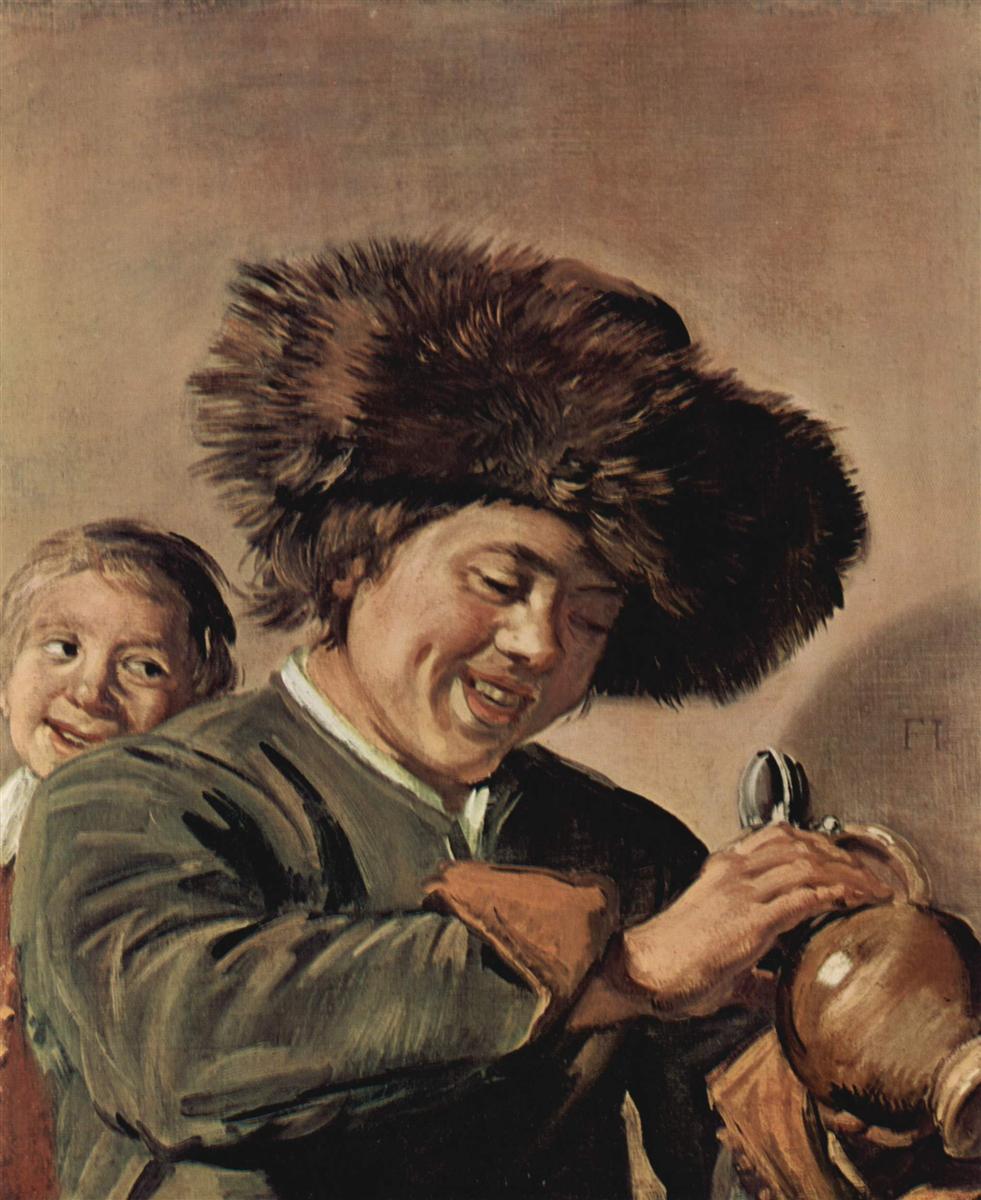
Frans Hals’s Two Laughing Boys with a Beer Mug (1627) feels like a burst of sound caught in paint. The scene is simple, almost aggressively so: two boys, one in the foreground with a huge fur hat, the other peeking from behind, both smiling in a way that suggests real, uncontained laughter. Yet within that simplicity Hals achieves something extraordinary. He turns a small moment into a study of vitality, camaraderie, and the contagious energy of youth.
The painting’s first power is its immediacy. The front boy’s face is tilted, eyes narrowed with amusement, mouth open as if mid-joke. The second boy appears over his shoulder, grinning toward the viewer or toward the older boy’s expression, as if sharing a private joke that we’ve just walked in on. Hals makes the scene feel discovered rather than arranged, like a candid glimpse rather than a posed image.
Even the title’s mention of a beer mug nudges the viewer toward an interpretation of mischief. This is not polite childhood. It is street energy, tavern energy, the kind of youthful play that brushes up against adult pleasures. Hals does not moralize loudly, but he does understand that this combination of laughter and drink carries social resonance in the Dutch Golden Age.
Genre Scene and Portrait Energy: Hals Blurs the Boundary
One of the reasons Hals’s “laughing” pictures remain famous is that they sit between genres. They are not conventional portraits intended to preserve a specific named individual in a formal setting. Yet they are not purely anonymous genre scenes either, because Hals paints faces with such specificity that they feel like real people rather than types.
In Two Laughing Boys with a Beer Mug, this boundary-blurring is central. The boys feel like recognizable individuals with distinct personalities. The front boy’s expression has a rough, confident humor. The boy behind seems more watchful, more delighted, like someone enjoying the spectacle of his friend’s laughter. This division of temperament creates narrative: one boy performs, the other responds, and the viewer becomes a third participant in the exchange.
Hals uses the intimacy of portraiture to intensify a genre subject. He gives the scene the direct human charge of a close encounter, making the painting less about “boys” in general and more about these two particular presences in a fleeting moment.
Composition: Cropping as a Tool of Immediacy
The composition is cropped tightly, which is part of why the scene feels so alive. The figures fill the space. There is no elaborate background, no architecture, no props beyond the mug. Hals eliminates anything that would dilute the emotional punch. The viewer’s attention is forced onto faces, hands, and the curve of bodies leaning into laughter.
The foreground boy’s fur hat dominates the upper portion of the image, creating a dramatic shape that both frames and exaggerates the head. This oversized hat gives the boy a larger-than-life silhouette, as if he is dressing up, playing at adulthood, or embodying a kind of theatrical swagger. The hat also creates compositional weight: its dark mass balances the lighter tones of the boy’s face and the brighter highlights on the mug.
The second boy’s head appears partially behind the first, creating depth through overlap. Hals uses this overlap not only to show space but to establish relationship. The boys are physically close, and that closeness reads as shared mischief. The tight cropping makes their intimacy unavoidable.
The Beer Mug: Object as Narrative Trigger
The beer mug is more than a detail. It is the painting’s narrative spark. Held at the right edge, it catches light and becomes a focal point that complements the faces. Its rounded form echoes the curve of the boy’s cheeks and the soft volume of the hat, tying the object into the painting’s overall rhythm.
In Dutch visual culture, drinking often carried moral associations. A beer mug could suggest conviviality and everyday pleasure, but it could also hint at disorder, temptation, or the loss of self-control. With children, this symbolism becomes sharper. The sight of boys with drink can imply rule-breaking, imitation of adults, or a playful transgression that viewers might find humorous or troubling depending on their temperament.
Hals keeps the meaning flexible. The mug could be part of a staged joke, a prop for laughter rather than an indicator of actual drinking. Yet its presence undeniably shifts the scene from innocent play toward a more complex social commentary about behavior, imitation, and pleasure.
Expression and the Art of Capturing a Moment
Hals’s greatest triumph here is facial expression. The front boy’s smile is not a polite curve. It is a grin that pulls the face into an uneven, human shape, emphasizing dimples, creases, and the slight asymmetry of real laughter. The eyes narrow and glint. The mouth opens. The expression suggests sound, movement, and breath.
The second boy’s expression is different. He smiles with a softer, amused delight, as if reacting to the first boy’s performance. This difference matters because it makes the scene relational rather than static. One boy seems to be the loud spark, the other the delighted witness. Together they create the emotional architecture of the painting: a joke shared, laughter reflected, joy multiplied.
This is also where Hals’s realism becomes almost daring. Many artists softened laughter into a controlled smile to maintain dignity. Hals embraces the awkward truth of laughter: the way it distorts the face, the way it breaks composure. That choice makes his figures feel alive and his images feel modern.
Costume and the Theatricality of the Fur Hat
The fur hat is a statement. Its size and texture suggest warmth, luxury, and performance all at once. It could be read as a fashionable accessory, but on a boy it also reads as playful exaggeration, a costume element that makes him seem older, bolder, and more theatrical. The hat transforms the boy into a character, someone adopting an adult persona for comedic effect.
Hals paints the fur with lively strokes that convey softness and depth. The dark mass of the hat becomes a dramatic crown, giving the boy an almost comic grandeur. This enhances the humor of the scene: the child looks like he is playing at being a swaggering adult, complete with drink and confident grin.
The clothing itself is restrained in color, allowing the face and hat to dominate. Hals keeps the palette subdued so the expression reads as the main event. The boy’s greenish garment provides a quiet field of color that supports the warm tones of skin.
Light and Texture: Skin, Fabric, Fur, and Metal
The painting is also a showcase of Hals’s ability to differentiate textures with paint. Skin is rendered with warm, lively tones, with highlights that suggest moisture and movement, as if the cheeks are flushed from laughing. The fur hat is painted with energetic marks that imply softness and thickness without requiring literal detail.
The mug’s surface introduces another texture: reflective, metallic, or glazed, catching light in a way that contrasts with the matte fabric and soft fur. Hals uses small bright highlights to make the mug feel solid and real. The object becomes convincing not through meticulous detail, but through confident suggestion.
This variety of textures contributes to the painting’s sensory richness. The viewer can almost feel the fur, the smoothness of the mug, the warmth of the boy’s flushed cheek. Hals’s realism is not only visual; it is tactile.
Brushwork and the Feeling of Speed
Hals’s brushwork often gives the impression of speed, but it is a speed guided by mastery. In this painting, the strokes feel quick and responsive, matching the subject’s energy. Laughter is momentary. Hals paints in a way that preserves the moment’s instability, as if the expression could change at any second.
Edges are sometimes soft, allowing forms to merge into one another in a way that mimics vision. The background is minimal and loosely handled, ensuring that nothing competes with the figures. Hals knows where to be precise: the glint of an eye, the edge of a smile, the highlight on the mug. Elsewhere he allows paint to remain expressive.
This technique creates a paradox. The painting looks spontaneous, but it is carefully organized. Hals’s genius lies in making artifice feel like life.
Humor, Moral Ambiguity, and Dutch Viewers
A painting of laughing boys with a beer mug would have carried multiple possible readings for a seventeenth century viewer. It could be enjoyed simply as humor, a lively depiction of youth and playful mischief. It could also be read as a moral reminder about temptation and the ease with which pleasure leads to excess. Dutch culture often held these two attitudes side by side: delight in everyday life and an awareness of its moral risks.
Hals does not choose one reading. He paints the boys with too much affection to turn them into warnings, yet he includes the beer mug with too much emphasis for it to be meaningless. The painting’s power lies in this ambiguity. It invites the viewer to laugh, but it also invites reflection on why laughter and drink together might feel both charming and uneasy.
This tension is part of what gives the painting depth. Without the mug, the scene might be purely lighthearted. With it, the scene becomes a more complex meditation on imitation, youth, and the social world that children observe and mimic.
Relationship Between the Two Boys: Complicity and Shared Space
The second boy’s placement behind the first is crucial to the painting’s emotional core. He is not just another face. He is an audience within the image, a companion who validates the laughter. His grin tells us the joke is real, or at least shared. He amplifies the main boy’s expression by echoing it.
This relationship makes the painting feel like a snapshot of friendship. The boys’ physical closeness suggests familiarity, perhaps a shared background or shared time spent in similar spaces. The scene might depict a moment in a tavern environment, or it might be a staged studio invention based on types Hals knew. Either way, the interaction feels convincing.
Hals’s ability to paint companionship is part of his broader achievement in social scenes. He understood that people are not isolated units. They exist in networks of glances, gestures, and reactions. Here, the entire painting is built from that network.
The Painting’s Place in Hals’s World of Laughter
Hals repeatedly returned to subjects of laughter, musicians, drinkers, and lively characters. These works were not merely comic entertainment. They were explorations of expression, of the human face in motion, and of social behavior as spectacle. In Two Laughing Boys with a Beer Mug, Hals distills that interest into a compact format.
Compared to his larger banquet scenes, this painting is intimate and concentrated. Yet it shares the same underlying fascination: how communal life looks when it is fully awake. The laughter here is not decorative. It is the painting’s subject, its energy, its reason for being.
In this way, the painting can be seen as a study in humanity’s most immediate social emotion. Laughter connects people, signals belonging, and breaks down formality. Hals paints it not as a gentle smile but as something that takes over the body, and in doing so he captures the truth of it.
Why the Painting Still Feels Contemporary
Modern viewers often respond to Hals because his figures feel uncannily present. Two Laughing Boys with a Beer Mug feels contemporary because it captures an emotion that is instantly recognizable and socially contagious. The boys do not behave like distant historical subjects. They behave like people you might encounter in a real moment of joking and teasing.
The painting also feels contemporary because of its visual economy. Hals’s close cropping, minimal background, and focus on expression resemble modern photographic instincts. He understands that a compelling image does not need elaborate staging. It needs a decisive moment.
Finally, the painting’s ambiguity remains relevant. We still recognize the mixture of charm and concern when youth imitates adult behaviors, and we still understand how laughter can be both innocent and slightly reckless. Hals captures that complexity without preaching.
Conclusion: A Small Painting with Enormous Vitality
Frans Hals’s Two Laughing Boys with a Beer Mug (1627) is a compact masterpiece of expression and social energy. Through tight composition, lively brushwork, and brilliantly observed faces, Hals turns a simple scene into a study of laughter as a physical and social force. The fur hat, the beer mug, and the second boy’s delighted presence create a narrative of performance and complicity, suggesting a playful moment that brushes up against adult rituals.
The painting endures because it feels real. It does not merely depict joy. It transmits it. The viewer is pulled into the shared joke, invited to smile, and then invited to notice the deeper cultural tension between pleasure and propriety. Hals achieves all of this with remarkable economy, proving that a small canvas can hold an entire world of human behavior.