Image source: wikiart.org
Introduction: Murillo and the World of Street Children
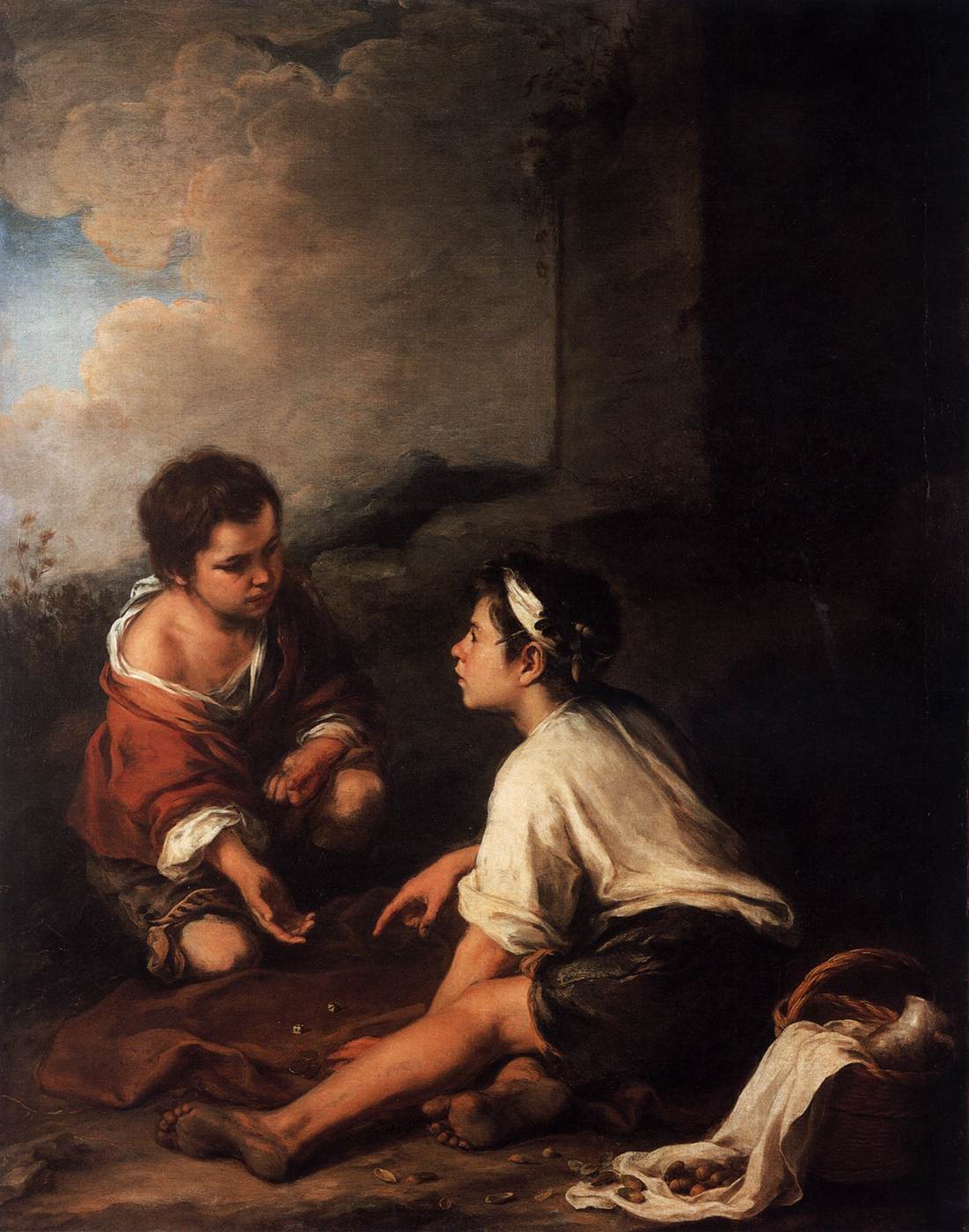
“Two Boys Playing Dice” by Bartolomé Esteban Murillo, painted around 1675, belongs to a remarkable group of works in which the Sevillian master turned his gaze away from saints and angels toward the everyday lives of poor children. At a time when religious commissions dominated Spanish painting, Murillo took the risk of devoting large canvases to barefoot boys who lived on the margins of society. Yet he did not treat them as caricatures or simple moral lessons. Instead he endowed them with the same tenderness and psychological depth that he gave to his sacred figures.
In this work, two youngsters sit on the ground absorbed in a game of dice. Their clothing is torn, their feet bare, and their surroundings modest. Yet Murillo presents them with dignity and a sense of inner life. The painting invites viewers into a quiet, intimate moment, while also prompting reflection on poverty, chance, and the fragile joys of childhood. Through subtle gestures, light, and composition, Murillo transforms a simple scene of play into a complex meditation on fortune and human vulnerability.
First Impression and Overall Composition
The canvas is vertical, but the main action takes place low in the picture, where the two boys sit on a reddish cloth spread across the ground. The left boy kneels, his torso turned slightly toward the viewer, his hand extended as if about to cast or collect the dice. The right boy sits cross legged, leaning forward with intense concentration on the game. Their heads incline toward each other, forming a tight triangular focus that concentrates the viewer’s attention.
Behind them rises a dark, almost featureless wall that pushes the figures toward the front of the picture plane. To the left, however, the space opens up into a lighter area with billowing clouds and suggestions of landscape in the distance. This contrast between an enclosing shadow and a luminous open sky is characteristic of Baroque staging. It creates drama while also hinting that the boys’ small world is set against a larger, unseen reality.
The lower right corner contains a wicker basket with a white cloth spilling out and a few nuts scattered nearby. These elements balance the mass of the boy in red on the left and introduce a series of still life details that echo the theme of modest sustenance and leisure. The composition is carefully constructed even though it appears spontaneous. Every detail reinforces the sense that we are witnessing a real moment captured as it unfolds.
The Two Boys: Character, Gesture, and Relationship
Murillo’s humane gaze is most evident in the way he individualizes the two children. They are clearly companions, yet distinct in temperament. The boy on the left wears a red garment over a white shirt that has slipped off one shoulder, revealing his chest. His knees are bent, one leg tucked under him. His gaze is directed downward toward the dice, and his expression is thoughtful, almost wary. The open palm of his left hand indicates that he might be waiting for his turn or asking for coins or nuts to continue the game.
The boy on the right, dressed in a light shirt and darker shorts, appears slightly older. His head is wrapped in a simple band of cloth, perhaps suggesting a working child who has been using it to keep sweat from his eyes. He sits with legs stretched out, toes flexed, body leaning forward. His profile shows alertness and keen interest, as if he is fully absorbed in the outcome of the throw. One hand points toward the dice, the other supports his weight, creating a sense of energy and engagement.
Their interaction is intense yet quiet. They are not laughing or shouting. Instead they are immersed in shared concentration. Murillo avoids sentimental exaggeration. He does not present them as pitiful victims nor as mischievous rascals. They are simply boys at play, temporarily forgetting their hardships in the excitement of the game. This balance between empathy and realism is one of the hallmarks of Murillo’s art.
Dice, Nuts, and Basket: Symbolism in Everyday Objects
At the center of the cloth between the boys lie a few small dice and coins or nut shells. The dice immediately introduce the theme of chance. In many seventeenth century moral texts, gambling was condemned as a temptation that could lead the poor into deeper misery. By choosing dice as the subject of play, Murillo hints at the fine line between innocent entertainment and risky behavior.
Yet the scene does not feel moralistic. The boys are not depicted as depraved or reckless. Instead the game seems modest, with tiny stakes scattered around. Nuts, shells, and possibly a few coins suggest a mixture of food and money. This mixture reflects the precarious economy of street children, for whom play, work, and survival were closely intertwined. They may be wagering the very things that will feed them later, a poignant reminder of their fragile security.
The basket on the right reinforces this theme. It appears to contain more nuts and perhaps a loaf wrapped in cloth. The white fabric draped over the edge introduces a touch of brightness and domestic order into an otherwise rough setting. It hints at some link to home or to a market where the boys might work. Yet the basket is set slightly aside from the game, as if the necessities of life are temporarily forgotten while they engage with fortune.
Light, Color, and the Baroque Atmosphere
Murillo uses light and color to shape the emotional tone of the painting. The overall palette is warm and earthy, dominated by browns, reds, and ochres that reflect the boys’ environment and clothing. Against these tones, the whites of their shirts and the cloth in the basket stand out, catching the light and drawing the eye.
A soft, diffused light falls from the upper left, illuminating the faces and limbs of the boys while leaving the background in deep shadow. This lighting recalls the influence of Caravaggio, whose dramatic contrasts were widely admired and imitated throughout Europe. Murillo, however, softens the starkness. Instead of harsh beams that split light from darkness, he uses gentle gradations that bathe the figures in a warm glow. The result is dramatic yet tender, reinforcing the sense of sympathetic observation.
The sky in the upper left corner introduces cooler tones of blue and gray, with clouds that seem to roll gently across the canvas. This patch of sky provides a visual breathing space in the composition. It prevents the scene from feeling claustrophobic and suggests the wider world beyond the boys’ immediate surroundings. The blend of warm earth colors and cooler atmospheric hues demonstrates Murillo’s mastery of tonal harmony.
Space, Setting, and the World Beyond the Frame
Although the foreground is carefully described, Murillo keeps the setting deliberately ambiguous. The dark wall behind the boys could be the side of a house, a ruined building, or simply a shadowed corner of a street. The ground is rough, strewn with shells and dirt. There is no clear indication of a specific location, yet the hints of landscape and sky suggest an outdoor space, perhaps near the outskirts of Seville where city edges and countryside blend.
This unspecific setting allows viewers to project their own understanding of poverty and urban life onto the scene. It also keeps the focus squarely on the boys rather than on picturesque architecture. The surrounding emptiness emphasizes their isolation. They are not watched by adults or surrounded by bustling markets. For the moment they inhabit a small world of their own making, defined by the circle of the cloth and the arc of their bodies.
At the same time, the suggestion of depth behind them invites the imagination to consider what lies beyond. Perhaps a road disappears into the distance, or a village stands just out of sight. The contrast between the immediate, tactile presence of the boys and the undefined space behind them mirrors the theme of uncertainty. Like the outcome of the dice, their future is open and unpredictable.
Social Commentary and the Picaresque Tradition
Seventeenth century Spain produced a rich literature about pícaros, or roguish street children and beggars who survived through cunning and luck. These stories, often humorous and critical, exposed social inequalities while entertaining readers. Murillo’s painting seems to share some kinship with this picaresque tradition. His boys are not sheltered angels but alert, resourceful youngsters navigating hardship.
However, Murillo’s treatment is more compassionate than satirical. While the boys may possess a touch of the rogue, they are not portrayed as morally corrupt. Instead the painting highlights their humanity and the small pleasures they carve out amidst scarcity. The artist’s focus on their bare feet, torn sleeves, and simple possessions underscores their material poverty, yet the dignity of their posture and the seriousness of their game suggest a rich interior life.
Viewers in Murillo’s time, many of them wealthy patrons or members of religious confraternities, would have been reminded of the Christian duty of charity. Paintings like this could stir empathy and encourage almsgiving to real street children encountered on the streets of Seville. At the same time, they allowed middle and upper class viewers to contemplate the lives of the poor from the safety of their homes or cloisters. Murillo walked a delicate line, balancing social critique with a sentimental appeal that made such images acceptable and desirable as works of art.
Childhood, Risk, and Play in Seventeenth Century Seville
“Two Boys Playing Dice” also invites reflection on the nature of childhood itself. These boys are clearly young, yet they inhabit an adult world of risk and scarcity. Their game mirrors behaviors associated with grown men in taverns and gambling dens, but here the stakes are small and the atmosphere intimate. The painting captures a moment when play and survival blend, illustrating how children in difficult circumstances adopt adult habits earlier than their more privileged counterparts.
The choice of dice emphasizes the theme of risk. A child’s future in seventeenth century Spain could be as unpredictable as a roll on the cloth. Disease, famine, and economic downturns were constant threats. For poor families, the line between stability and disaster was thin. The boys’ willingness to gamble even nuts or small coins can be read as a symbolic acceptance of this precarious reality. They learn early that fortune is fickle.
Yet Murillo does not present them as victims alone. There is joy in the intensity of their engagement, in their shared attention and mutual challenge. Even in harsh conditions, children find ways to play, compete, and dream. The painting honors this resilience. It suggests that play is a form of resistance to despair, a way of reclaiming agency in a world largely beyond their control.
Murillo’s Technique and Painterly Handling
Examining the surface of the painting reveals Murillo’s virtuosity with brush and pigment. He builds the forms of the boys with broad, confident strokes, particularly visible in the folds of their clothes and the modeling of their limbs. The red garment on the left boy is rendered with rich, layered color, its highlights catching the light to suggest worn yet substantial fabric. The white shirts are painted with looser strokes, using touches of gray and ochre to create volume and shadow.
Skin tones are warm and lifelike, achieved through subtle mixes rather than flat color. Murillo suggests the softness of youthful flesh by blending edges smoothly, especially on the legs and faces. The boys’ hair is depicted with economical brushwork, small strokes that describe texture without over detailing. This painterly approach invites the viewer to appreciate the materiality of paint even while being absorbed in the narrative.
The background and clouds are executed with more fluid handling. Swirling strokes create atmospheric depth, while darker areas near the wall are laid in with broader, more opaque layers. This contrast between detailed figures and more loosely painted surroundings keeps the focus on the central action and enhances the sense of depth.
Emotional Impact and Legacy of “Two Boys Playing Dice”
“Two Boys Playing Dice” occupies an important place in Murillo’s body of work. It exemplifies his ability to shift gracefully between religious themes and scenes of everyday life while maintaining a consistent tone of compassion. Although it lacks explicit sacred iconography, the painting expresses values deeply rooted in Christian ethics: empathy for the poor, recognition of human dignity, and awareness of life’s fragility.
For modern viewers, the painting continues to resonate. The theme of marginalized youth remains strikingly relevant. In many cities today, children still grow up in conditions of poverty, making their own games with whatever resources they find. Murillo’s boys could easily be contemporaries if we transposed their setting to a modern alley or street corner. The universality of their posture, their bare feet, and their intense focus on the game transcend time.
At the same time, the work is admired for its artistic qualities. The balanced composition, nuanced use of light, and convincing depiction of human emotion make it a compelling example of Spanish Baroque painting. Museums and scholars often highlight Murillo’s genre scenes as early forms of social realism, anticipating later traditions that would address the lives of workers and the poor more directly.
Ultimately, “Two Boys Playing Dice” succeeds because it respects both art and life. Murillo does not use his young subjects simply as vehicles for allegory. He allows them to exist as individuals, captured in a fleeting but fully realized moment. Through them he invites viewers to consider questions of chance, justice, and compassion, while also enjoying the sheer beauty of paint on canvas.