Image source: wikiart.org
A joyful glimpse into everyday life
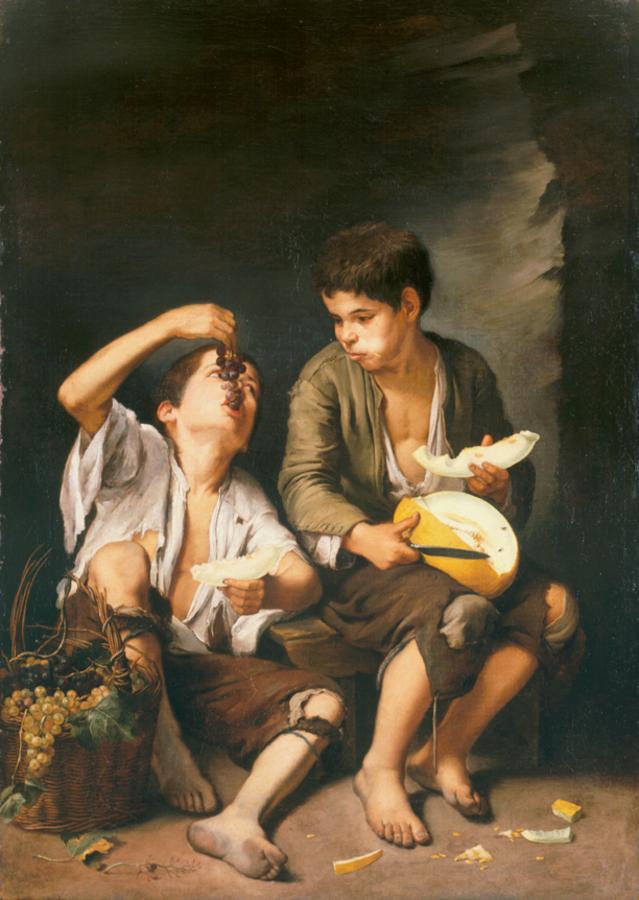
“Two Boys Eating a Melon and Grapes,” painted by Bartolome Esteban Murillo in 1646, is one of the most charming and memorable images from the Spanish Golden Age. The painting shows two ragged boys sitting on the floor, completely absorbed in the simple pleasure of eating fruit. One boy leans back with carefree abandon, holding a bunch of grapes above his open mouth. The other clutches a large melon, cheeks puffed with food, concentrating on his next bite. At their feet lies a wicker basket overflowing with grapes and scattered rinds, creating a lively still life within the scene.
Although the subject is humble, Murillo treats it with all the sensitivity and technical refinement that he devoted to his religious works. Light, composition and expressive detail come together to make this modest meal feel monumental. At the same time, the painting embodies Murillo’s unique humanism. These boys are poor, their clothes torn and their feet bare, yet they radiate energy, humor and dignity. The artist invites us to see beauty in their joy and to reflect on the complex reality of childhood in seventeenth century Seville.
Murillo and the world of street children
Seville in Murillo’s time was a bustling port city marked by economic contrasts. Wealth from trade with the Americas passed through its harbor, but the population also faced plague, famine and unemployment. Street children, or “pícaros,” were a common sight. They begged, stole, sold small goods or worked as errand boys, often living on the edge of survival.
Murillo became famous for his tender depictions of these children. Instead of showing them only as pitiable or dangerous, he painted them playing dice, eating fruit, searching for lice or resting after work. “Two Boys Eating a Melon and Grapes” belongs to this series of genre scenes, likely commissioned by foreign merchants and collectors who appreciated both their realism and their exotic Spanish flavor.
In taking poor children as his main subject, Murillo did something innovative. He elevated everyday life to the status of fine art. While some Northern European painters had depicted peasants and taverns before, Murillo brought a distinctive warmth and compassion to the theme that would influence generations of artists.
Composition that captures a fleeting moment
The composition of the painting is both simple and ingenious. The boys sit on the ground in the foreground, filling most of the frame. Their bodies form a loose triangle, with the basket of grapes anchoring the left corner, the melon on the right, and their faces forming the upper points. This triangular structure gives stability to what is otherwise a spontaneous, informal scene.
The boy on the left leans backward, knees bent and legs relaxed, his bare foot pointing toward the viewer. His raised arm holding the grapes creates a sweeping diagonal that energizes the composition. His other hand grasps a slice of melon resting on his lap. The open angle of his body gives a sense of carefree delight.
The boy on the right forms a complementary figure. He sits more upright, slightly turned inward, grounded by the round weight of the melon resting on his legs. His posture is less exuberant, more concentrated. The cheeks bulging with fruit add humor but also emphasize his seriousness about the meal.
The background is neutral and shadowy, with a subtle gradation of tone rather than detailed architecture. This keeps the focus firmly on the boys and their food. The floor is barely indicated, just enough to situate them in space. By stripping away distractions, Murillo turns this small domestic scene into a kind of stage on which the drama of eating unfolds.
Light, shadow and Baroque drama
Murillo’s use of light reveals his connection to the Baroque tradition and to masters like Velazquez and Caravaggio. A strong, focused light falls from the left, illuminating the boys’ faces, arms and legs, as well as the gleaming surfaces of the fruit. The background remains in soft shadow, creating a powerful contrast that makes the figures stand out with sculptural clarity.
The light accentuates textures. Skin glows warmly, with subtle variations of pink and ocher. The torn cloth of their shirts catches highlights along shredded edges and creased folds. The wicker basket shines along its rim, and the grapes glisten with tiny reflections that suggest freshness and juiciness. The melon’s pale flesh has a delicate translucence, while its rind shows rougher, more opaque tones.
This interplay of light and dark, called chiaroscuro, adds drama and depth to the painting. Even though the subject is everyday, the treatment gives it a sense of importance. The boys’ snack becomes almost heroic under this luminous spotlight, as if the joy of eating were a small but significant miracle.
The still life of fruit
The fruit is more than a prop. Murillo pays as much attention to the melon and grapes as many painters would to an entire still life. The basket on the left is packed with clusters of green grapes, some cascading over the edge. Loose grapes spill onto the floor, mingling with melon rinds and strips of peel. The melon in the lap of the right hand boy is sliced open to reveal its pale interior, another segment held in his hand.
In seventeenth century painting, fruit often carried symbolic meanings. Grapes could recall the wine of the Eucharist and therefore Christ’s sacrifice, while melons and other sweet fruits sometimes symbolized the pleasures and temptations of the senses. In the context of Murillo’s work, these layers of meaning sit alongside a simpler, more immediate interpretation. For these hungry boys, the fruit is primarily sustenance and delight.
Yet the lavish depiction of ripe fruit in the hands of ragged children creates an emotional tension. Abundance and poverty coexist in the same frame. The boys have plenty to eat in this moment, but their torn clothes and bare feet remind us that they usually lack basic security. The fruit may have been obtained through work, charity or perhaps a playful theft. Murillo does not tell us, leaving viewers to imagine the story.
Expressions that reveal character
The psychological subtlety of Murillo’s painting is one of its most compelling aspects. Each boy has a distinct expression that suggests his personality and mood.
The boy on the left, with his head thrown back and mouth open wide, exudes carefree enjoyment. His eyes roll upward as he dangles the grapes above him, fully focused on the imminent taste. He seems unselfconscious, perhaps the more spirited and impulsive of the pair. His torn shirt hangs loosely from his shoulders, emphasizing his relaxed attitude.
The boy on the right, by contrast, appears more reserved and thoughtful. His cheeks are puffed out, but his gaze is directed downward, almost suspiciously, perhaps checking that no piece of melon escapes his grasp. There is a hint of shyness or caution in his posture. He may be used to guarding what little he has.
The interaction between the two is subtle yet rich. They share the food and the space, but each is absorbed in his own way of eating. Murillo resists the temptation to turn them into simple caricatures. Instead he gives them layered personalities that viewers can recognize from their own experiences with children.
Clothing, poverty and dignity
The boys’ clothing speaks volumes about their social status. Both wear shirts that are badly torn at the sleeves and collar, exposing their chests and shoulders. Their trousers are patched and frayed, with holes at the knees and hem. They have no shoes. These details mark them as members of the urban poor, children who live largely in the streets.
However, Murillo does not present their poverty in a humiliating way. The fabric is painted with as much care as any rich garment, its folds and textures lovingly rendered. The boys’ bodies are healthy and robust, not gaunt or sickly. Their bare feet and limbs have a certain grace that recalls classical sculpture.
In this way, Murillo gives the boys dignity despite their material lack. He shows that their value lies not in fine clothes or social status but in their vitality and humanity. For viewers of the time, particularly wealthy patrons, this could serve as a quiet reminder of Christian teaching about the inherent worth of the poor and the duty of charity.
Realism and idealization
The painting strikes a delicate balance between realism and idealization. Murillo clearly observed real street children. Their poses are natural, their gestures spontaneous, and the details of dirt, tears and scuffs are convincing. Yet there is also a gentle softening of harsh reality.
The boys’ faces have a sweetness more typical of Murillo’s angels and religious figures. The background is clean, lacking the refuse or crowded chaos that often accompanied urban poverty. The light bathes the children in a warm, almost golden glow, lending them an air of innocence.
This blend of truth and idealization is characteristic of Murillo. His goal was not to document misery in a brutally literal way, but to awaken empathy and affection in the viewer. By showing the charm and playfulness of poor children, he encourages a response of compassion rather than mere curiosity or judgment.
Possible symbolic readings
While “Two Boys Eating a Melon and Grapes” can be enjoyed simply as a genre scene, several symbolic interpretations deepen its meaning.
The joyful consumption of fruit can be seen as a celebration of God’s generosity in creation. In Christian thought, food is often associated with providence and blessing. The abundance of grapes and melon, even in the hands of the poor, hints that divine grace can reach the most marginalized.
At the same time, the painting may also contain a gentle moral warning about gluttony and the transience of pleasure. The boys are completely absorbed in eating. Grapes and melon rinds scattered on the floor suggest a kind of careless indulgence. Viewers might be reminded that earthly delights, no matter how sweet, are short lived. Tomorrow these boys may be hungry again.
Another possible layer relates to the tradition of vanitas imagery, where still life objects symbolize the fleeting nature of life. Fruit that spoils quickly can stand for youth and beauty that fade. The boys, caught in a moment of exuberant appetite, embody the energy of youth, yet their precarious social situation hints at an uncertain future.
Murillo leaves these interpretations open. The painting does not preach directly. Instead it offers a richly layered scene that invites viewers to bring their own moral and emotional reflections.
The viewer’s place in the scene
Murillo positions the boys very close to the picture plane. Their bare feet almost touch the edge of the canvas, and the basket of grapes sits right in front of us. This proximity makes the viewer feel as if sitting on the ground with them, sharing the narrow patch of floor.
The boys, however, are too engrossed in their meal to notice us. This creates an interesting dynamic. We are witnesses to their joy, almost intruding on a private moment, yet we remain invisible participants. The scene may evoke memories of childhood for the viewer or elicit a spontaneous smile at the boys’ antics.
From a social perspective, the painting also bridges the gap between classes. Wealthy collectors, for whom the work was likely intended, are brought face to face with children they might normally pass by in the street. The intimacy of the scene encourages a more personal encounter with the poor, transformed by art into objects of affection rather than fear or indifference.
Place within Murillo’s oeuvre and the Spanish Golden Age
“Two Boys Eating a Melon and Grapes” stands among Murillo’s most celebrated secular works. Along with related paintings of street children, it helped build his reputation not only as a religious painter but also as a keen observer of everyday life. These genre scenes circulated widely through original works and later engravings, influencing artists in Spain and beyond.
Within the broader context of the Spanish Golden Age, the painting represents a distinctive voice. While artists like Velazquez and Zurbaran also portrayed humble subjects, Murillo’s approach is softer and more affectionate. He brings a lyrical sensitivity to the rough edges of life, finding in them an opportunity to express both beauty and moral reflection.
The picture also foreshadows later trends in European art. Centuries after Murillo, painters and photographers would turn to children of the streets as subjects charged with social and emotional meaning. In many ways, “Two Boys Eating a Melon and Grapes” anticipates this modern interest while remaining rooted in Baroque techniques and devotional values.
Conclusion
“Two Boys Eating a Melon and Grapes” is a masterpiece of narrative simplicity and emotional richness. In a single scene of two poor boys sharing fruit, Bartolome Esteban Murillo captures the resilience of childhood, the contradictions of poverty and abundance, and the enduring human joy found in the most basic acts of living.
Through careful composition, dramatic yet gentle light, vivid still life details and deeply felt characterization, Murillo transforms a humble snack into a timeless image. The painting invites viewers to smile at the boys’ exuberance, to feel compassion for their fragility and to reflect on their own relationship with material goods, generosity and pleasure.
More than three centuries after its creation, this canvas still speaks with warmth and immediacy. It reminds us that great art does not always require grand historical events or exalted heroes. Sometimes, two barefoot boys and a slice of melon are enough to reveal the complexity and beauty of the human condition.