Image source: wikiart.org
Introduction
Claude Monet is usually remembered as the painter of light filled landscapes, shimmering water, gardens, river scenes, and changing weather. Because of that reputation, a work like Trophies of the Hunt can feel surprising at first glance. Instead of a luminous outdoor setting, this painting presents a darker interior arrangement built from hunting equipment, suspended objects, and game laid out across a table. The mood is quiet, weighty, and controlled. It belongs to a very different visual world from the one most people associate with Monet, yet that difference is exactly what makes the painting so interesting.
Painted in 1862, Trophies of the Hunt comes from Monet’s early years, before Impressionism had fully taken shape as the movement that would make him famous. In this period, he was still testing subjects, methods, and ambitions. He was learning how to organize complex compositions, how to handle texture, how to use shadow, and how to make objects occupy space with convincing force. This painting shows a young artist working seriously within established traditions while already demonstrating an unusual sensitivity to atmosphere.
The subject places Monet in dialogue with the long European tradition of still life and hunting imagery. Yet even when he is working inside a conventional genre, he does not simply produce a dry academic exercise. There is feeling in the arrangement, drama in the contrasts, and a strong awareness of how objects relate to one another in space. The scene is dense, but not chaotic. It is full, but carefully measured. Monet turns a collection of ordinary and rustic objects into a thoughtful study of form, balance, surface, and mood.
What makes Trophies of the Hunt compelling is not only its subject matter, but also the way it reveals Monet before Monet became fully himself in the public imagination. This is the work of a young painter studying the material world closely, building skill through observation, and discovering how atmosphere can emerge even in an interior still life. The result is a painting that feels serious, grounded, and quietly impressive.
Claude Monet in 1862
In 1862, Monet was still at the beginning of his artistic path. He had not yet become the central figure of Impressionism, and he was still moving through a formative stage in which influences from realism, studio practice, and traditional genres remained strong. This context matters because Trophies of the Hunt reflects an artist who is still absorbing lessons from the past even as he begins to move toward something more personal.
The young Monet was ambitious. He wanted recognition, and he understood that technical authority mattered. Paintings of arranged objects, especially subjects involving hunting gear or game, allowed artists to demonstrate control over texture, color, design, and illusion. A still life of this kind was not simple at all. It required the painter to distinguish between soft feathers, polished wood, woven netting, smooth metal, fur, cloth, and plastered interior walls. It also demanded compositional discipline, because many separate elements had to be organized into a single coherent image.
This work shows Monet taking that challenge seriously. Rather than choosing a light and decorative arrangement, he embraces a subject that lets him explore darkness, density, and contrast. The painting becomes a test of his ability to create order out of complexity. That effort is important because it anticipates some of the strengths that would later define him. Even though the style here is not yet Impressionist in the mature sense, Monet is already deeply attentive to how light moves across surfaces and how color lives inside shadow.
There is also something revealing about his choice of mood. The painting does not rely on theatrical exaggeration. Instead, it builds quiet intensity through placement, texture, and tone. This restraint suggests an artist interested in observation more than sentimentality. He does not decorate the subject to make it easy or charming. He lets it remain earthy, tactile, and sober.
Seen in this way, Trophies of the Hunt is not an odd detour from Monet’s development. It is part of the foundation. It shows him learning how to paint matter itself, how to make objects hold presence, and how to turn arrangement into atmosphere.
First Impression and Overall Mood
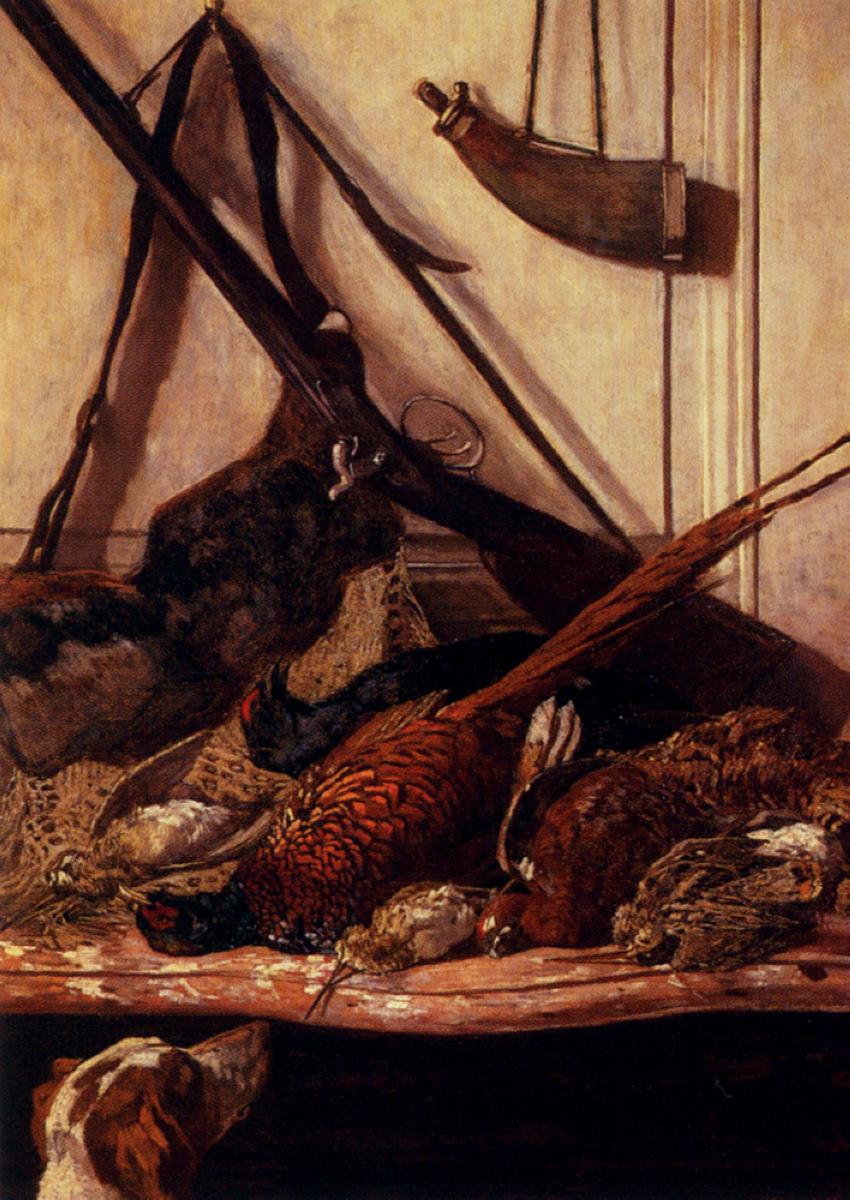
The first impression of Trophies of the Hunt is one of abundance and gravity. The composition is crowded with objects, yet it does not feel messy. Instead, the painting has the concentrated stillness of a room after activity has ended. The hunt is over. What remains are the material traces of that event: firearms, horns, bags, feathers, fur, and birds assembled as evidence of action that has already passed.
This sense of aftermath is central to the mood of the work. The painting is not about movement in the direct sense. It is about suspension. Everything has been gathered, hung, laid down, and fixed into place. The viewer confronts not the excitement of the chase but the silence that follows. That silence gives the picture its reflective quality. It is not merely descriptive. It invites thought about labor, possession, ritual, and display.
The atmosphere is intensified by Monet’s restrained palette. Browns, blacks, muted creams, russets, and warm earth tones dominate the surface. These colors create a feeling of enclosure and seriousness. There is little brightness in the modern decorative sense. Instead, light seems filtered and subdued, touching certain surfaces while allowing others to recede into darkness. This controlled illumination gives the work an almost theatrical calm, but it never becomes melodramatic.
The painting also has a distinctly masculine and rural character, rooted in hunting culture and practical tools. Yet Monet does not treat the subject as rough or crude. He paints it with care and nuance. The result is a scene that feels both ordinary and elevated. Everyday objects become worthy of close attention simply because they are so carefully seen.
Another striking aspect of the mood is the tension between fullness and quiet. The tabletop is loaded, diagonals cross the image, and textures overlap, but the overall effect remains still. Monet achieves this by locking the composition into a stable structure. Nothing seems accidental. Everything has been considered. This gives the painting a solemn dignity that goes beyond simple inventory.
Composition and Structure
One of the greatest strengths of Trophies of the Hunt is its composition. Monet arranges the scene through a network of diagonals that guide the eye across the canvas. The long gun leaning through the upper left portion of the image creates the dominant line, immediately establishing direction and tension. This diagonal is echoed by straps, netting, and the long tail feathers of the birds, so that the entire painting feels interwoven rather than static.
These diagonals prevent the still life from becoming too rigid. At the same time, Monet balances them with horizontal and vertical elements. The edge of the table forms a strong base, while the wall paneling behind the objects provides vertical stability. This contrast between slanted and straight lines gives the composition both energy and control. The viewer’s eye moves actively, but never loses orientation.
The hanging horn in the upper right is especially important. It acts as a visual counterweight to the darker concentration of objects on the left and center. Without it, the upper portion of the painting might feel too empty or too heavily tilted. Instead, it extends the composition upward and outward, making the whole image feel more complete. Monet understands that a successful still life depends not only on what is present, but also on how weight is distributed across the surface.
The accumulation of objects in the lower half of the painting creates density, but Monet avoids confusion by varying shape, tone, and direction. Rounded bodies contrast with linear weapons and straps. Dark masses are interrupted by lighter feathers and highlights. Textured surfaces break up broad areas of shadow. These differences allow the eye to distinguish one form from another even within the compressed space of the arrangement.
There is also a deliberate sense of layering. Some objects lie forward, others hang back, and some cut across the middle ground. This overlap creates depth without requiring a large or open space. Monet turns a narrow interior setting into a convincing visual field by carefully controlling placement. The painting feels spatially believable because each object occupies its own relation to the others.
The composition ultimately does more than display things well. It creates meaning. The crossed diagonals, suspended gear, and gathered game suggest a network of use, action, and consequence. The still life becomes not just a display of items, but a structured record of human activity.
Color, Light, and Surface
Although Trophies of the Hunt is far removed from the sparkling color of Monet’s later work, it already reveals a painter with a refined eye for subtle tonal variation. The palette is narrow, but it is not monotonous. Warm browns shift into red browns, black areas carry hints of blue or umber, and pale sections of wall or feathering soften the darker masses around them. Monet works within restraint, but he makes that restraint rich.
Light enters the painting selectively. It does not flood the scene. Instead, it touches edges, catches on feathers, glances off metal, and rests on the wall behind the arrangement. This scattered illumination helps separate forms while also reinforcing the inward, enclosed atmosphere. The shadows are deep, but they are not empty. Monet models them with enough nuance that they feel full of air and substance.
Surface handling is especially impressive. The painting invites the viewer to notice how different materials respond to light. Wooden elements appear dry and solid. The horn has a smoother, denser presence. The feathers of the birds vary from soft and downy to sleek and patterned. Netting introduces a rougher woven texture, while the straps and gun add firmness and linear precision. Monet is clearly interested in the challenge of making each material distinct.
This attention to texture is not mere display. It is part of the emotional and visual effect of the picture. By carefully differentiating surfaces, Monet deepens the realism of the scene and intensifies its physical presence. The viewer becomes aware of the painting not only as an image but as a meditation on the tangible world.
The color harmonies also contribute to the painting’s unity. Even when the pheasant introduces vivid reddish orange tones, those tones do not break the composition apart. Instead, they activate the darker browns around them. The brighter passages are contained within the overall harmony, giving the eye places to rest without destroying the somber mood.
What is most notable is that Monet treats shadow as a place where color still exists. This quality would become crucial in his later painting. Here, it appears in early form. Darkness is not simply blackness. It is made of warm and cool relations, soft transitions, and carefully modulated values.
Space, Setting, and the Interior World
The setting of Trophies of the Hunt is modest, but it is essential to the painting’s character. This is not an outdoor hunting scene. It is an interior arrangement, likely a studio or domestic wall where tools and trophies have been gathered for display. By choosing this kind of setting, Monet shifts the emphasis away from action and toward contemplation. The hunt itself is absent. What remains is the interior world of objects after use.
The wall behind the arrangement plays a major role in creating this effect. Its pale surface provides contrast against the darker forms, but it also suggests order and containment. The objects are not floating in an undefined space. They belong to a room, to a human environment shaped by routine and storage. This grounding gives the still life a practical realism.
At the same time, the setting does not become overly descriptive. Monet gives us enough information to feel the interior, but not so much that the background competes with the main arrangement. The wall paneling and neutral tones serve as a stage for the objects, allowing them to dominate without seeming isolated. This balance is one reason the painting feels so resolved.
The compressed space adds to the work’s intensity. There is very little distance between viewer and subject. The table edge is close. The objects seem almost to press forward. This intimacy heightens the physical immediacy of the scene. The viewer is not standing far back from a decorative display. The viewer is confronted by a dense cluster of things that occupy real space with tangible weight.
This close interior world also suits the still life tradition. Still life often invites careful looking rather than dramatic narrative reading. Monet uses the confined setting to focus attention on relationships of form, tone, and texture. The painting becomes an exercise in concentration. It asks the viewer to slow down and notice rather than simply glance.
That quality of attention is one of the most rewarding aspects of the work. The more one looks, the more structured the image becomes. What first appears as a dark and crowded arrangement gradually reveals itself as highly organized and visually intelligent.
Meaning and Symbolism
On one level, Trophies of the Hunt is exactly what its title suggests: a presentation of hunting trophies and equipment. Yet paintings like this often carry meanings beyond literal description. They can speak to ideas of skill, ownership, rural identity, tradition, and the human desire to preserve moments of action through objects.
The word “trophies” is important. These are not simply tools and remains arranged without thought. They are displayed. Display turns objects into signs. It suggests memory, pride, and selection. The painting therefore participates in a culture in which hunting could symbolize discipline, status, and familiarity with the natural world.
At the same time, the stillness of the painting complicates any easy celebration. The mood is too subdued for triumph. There is no boastful figure, no dramatic gesture, no active narrative. Instead, the painting gives us quiet material evidence. This quietness opens the work to more reflective meanings. It becomes a meditation on the end of action, on the transformation of living movement into still form, and on the way objects can outlast the events that produced them.
Still life painting has long been linked to themes of transience and mortality. Even when a work is not overtly symbolic, the arrangement of objects can suggest the passing of time and the fragility of life. In Trophies of the Hunt, this idea remains present, though understated. The subject carries a natural awareness of endings, but Monet does not push the point with theatrical symbolism. He lets the material facts of the scene speak for themselves.
The painting may also be read as an exploration of control. Hunting gear, display, and arrangement all involve systems of order imposed on the natural world. Monet mirrors that order in his composition. The objects have been gathered and composed by human hands, both within the image and by the painter himself. This creates an interesting parallel between the act of collecting and the act of painting.
The Painting’s Place in Monet’s Development
What makes Trophies of the Hunt especially valuable is the way it expands our understanding of Monet’s development. It reminds us that great innovators do not begin fully formed. They learn through tradition, experiment through convention, and build freedom on top of discipline. This painting shows Monet in that process.
Many of the qualities associated with his later art are not yet dominant here. The brushwork is more controlled, the subject more traditional, the palette darker, and the light less atmospheric in the open air sense. Yet certain instincts are already visible. Monet is attentive to the life of light on surfaces. He understands that tone and color can create mood. He is interested in the unity of the whole image rather than isolated detail alone.
The work also shows that Monet’s later achievements were grounded in strong observational training. His ability to dissolve forms into light in his mature years depended on first knowing how to construct those forms convincingly. In Trophies of the Hunt, he proves that he can organize a difficult composition and render complex material relationships with confidence.
For viewers who know Monet mainly through water lilies, haystacks, or riverside scenes, this painting can be unexpectedly revealing. It shows another side of his early ambition, one connected to studio practice and darker tonal harmonies. Rather than contradicting the later Monet, it enriches him. It shows that the artist who would eventually chase fleeting atmosphere was once deeply engaged in the solid presence of objects.
This makes the painting historically and artistically rewarding. It is not simply a curiosity. It is evidence of growth. It shows a young painter mastering inherited forms while preparing, perhaps without fully knowing it yet, for a new way of seeing.
Lasting Appeal
The lasting appeal of Trophies of the Hunt lies in its seriousness and craft. It asks for a slower kind of attention than many better known Monet paintings, but it rewards that attention generously. The work is rich in design, subtle in color, and full of tactile intelligence. It is a painting that becomes more impressive the longer one studies it.
Its appeal also lies in contrast. Because so many viewers approach Monet expecting lightness and color, this darker still life has the power to surprise. That surprise is productive. It broadens the meaning of Monet’s career and reminds us that artists are often more varied than their public image suggests.
There is also something timeless about the painting’s quiet concentration. It does not depend on spectacle. Its power comes from arrangement, atmosphere, and the transformation of ordinary things into a unified visual statement. That ability to elevate humble materials through observation and composition is one of the enduring strengths of painting as an art form.
Conclusion
Trophies of the Hunt is an early Monet painting that deserves close attention. It may not resemble the works that made him a household name, but it reveals essential aspects of his development. In its dense composition, controlled palette, tactile surfaces, and quiet atmosphere, the painting shows a young artist building mastery through careful looking and disciplined structure.
The work belongs to the tradition of still life and hunting imagery, yet it does more than repeat convention. Monet brings sensitivity, order, and mood to the subject, transforming a display of tools and game into a meditation on material presence and stillness. The arrangement feels weighty, but never clumsy. The darkness feels rich, not flat. The objects are specific, yet the image as a whole carries a broader reflective power.
Seen today, Trophies of the Hunt stands as both a strong painting in its own right and a valuable window into Monet before the full emergence of Impressionism. It reminds us that innovation often begins with close study of tradition. It also reminds us that even in an early and comparatively sober work, Monet was already learning how to make painting breathe.