Image source: wikiart.org
Rubens and the grand drama of faith
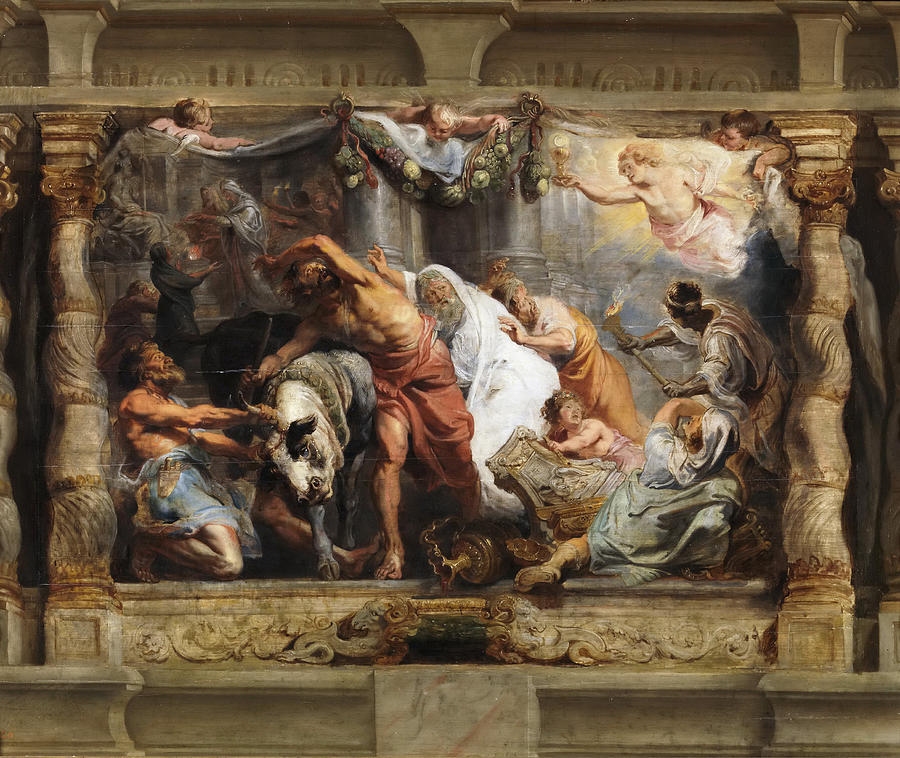
“Triumph of the Eucharist over Idolatry” is one of Peter Paul Rubens’s most spectacular visual arguments for the power of Catholic faith. Instead of a quiet devotional scene, Rubens presents a stage bursting with movement, smoke, stone, and flesh. At the heart of the painting the Old Testament language of sacrifice collides with the New Testament mystery of the Eucharist. Pagan idols and animal victims occupy the lower left, while radiant figures of angels and personifications of the Church proclaim the presence of Christ in the consecrated host.
The entire scene is framed as a sumptuous stone relief or shallow theater set. Massive twisted columns flank the action, heavy cornices press down from above, and sculpted ornaments push forward at the base. It is as if the viewer is standing in front of a marble altarpiece that has suddenly come to life. Bodies spill outward from the fictive architecture, fabrics swirl, and light breaks through the dusty air.
Rubens created this subject as part of a broader cycle celebrating the Eucharist, and the painting shows him working at the height of his Baroque powers. Composition, color, and symbolism are harnessed to a single goal, the exaltation of the sacrament as the true focus of worship and the conqueror of all false gods.
Historical setting and the Counter Reformation message
To understand the force of “Triumph of the Eucharist over Idolatry,” it helps to place it within the religious conflicts of Rubens’s time. The seventeenth century was marked by sharp divisions between Catholic and Protestant regions. Protestants questioned or rejected the doctrine of the Real Presence of Christ in the Eucharist and denounced many forms of Catholic devotion as idolatrous. Catholic rulers and theologians responded by reasserting the centrality of the Mass and the sacraments.
Rubens worked for powerful Catholic patrons, including the Habsburg archduchess Isabella Clara Eugenia in the Spanish Netherlands. She commissioned a series celebrating the Eucharist, intended for a convent setting where nuns would pray before brilliant images of the sacrament’s glory. This painting belongs to that program. Its very title declares its purpose, to show the Eucharist triumphing over idolatry rather than succumbing to it.
Instead of portraying Protestants directly, Rubens uses the safer language of classical and Old Testament idolatry. Pagan sacrifice, golden idols, and garlands of fruit and flowers stand for every form of worship that falls short of the true God. At the same time, Catholic viewers would have recognized contemporary undertones. The imagery proclaims that veneration of the consecrated host is not idol worship but the opposite, the overthrow of idolatry by the real presence of Christ.
The architectural stage and illusionistic frame
One of the most striking features of the painting is its architectural frame. Rubens does not simply paint a scene against a neutral background. Instead, he constructs a convincing illusion of carved stone architecture that surrounds and encloses the action. Heavy columns with spiraling shafts stand to left and right. Above, a projecting cornice and pediment cast deep shadows. At the bottom, scrolling brackets and mouldings form a base that pushes toward the viewer.
This painted architecture serves several functions. It recalls the framing of an altarpiece, reminding viewers that the central mystery being celebrated is the Eucharist itself, regularly displayed on church altars. It also gives the composition a strong sense of depth. The figures seem to occupy a shallow theatrical space within this stone box. Some lean out toward us, while others retreat into deeper shadow behind the columns.
The architectural setting also emphasizes the opposition between the old and the new. Pagan temples and Old Testament altars are associated with stone and sacrifice. Yet here, within that stone envelope, the light of the Eucharist bursts forth. The very space that seems to belong to idolatry becomes the stage where idolatry is defeated. Rubens uses the illusion of sculpted architecture to dramatize the transformation of space by divine presence.
The violent sacrifice at the lower left
The lower left corner of the painting is a whirlwind of brute force. Muscular men struggle with a bull, dragging the animal toward an altar as part of a pagan sacrifice. One man hauls on a rope tied to the beast’s head, straining backward with veins bulging. Another figure pushes or restrains from behind. The bull’s mouth is open, its eyes wild, its hooves braced against the floor.
Rubens paints this group with vigorous brushwork and powerful diagonals. Limbs and ropes slice across the composition, creating a sense of chaos and urgency. The bodies are lit from the right, casting strong highlights on shoulders and thighs, while shadows pool in the recesses of muscles and drapery. The sacrifice appears harsh and bloody even if the actual wound is not yet visible.
This violent activity functions as a symbol of idolatrous worship. The bull evokes ancient cults that offered animals to stone gods. The contorted bodies suggest the frenzy and effort of people trying to reach the divine by their own means, through external acts rather than inner transformation. In contrast with the quiet radiance of the Eucharistic host on the right, the sacrifice of the bull appears brutal and ineffective. It is all noise and struggle, no grace.
The central figure and the turning point of the scene
At the center of the composition a robed male figure turns away from the sacrifice. His body twists dramatically. One arm flung upward protects his head, while his legs brace against the ground. His red drapery whips around him, connecting visually with the garments of the men handling the bull. Yet his face is not set in rage. Instead, he seems caught between horror and revelation.
Behind him, partially wrapped in white, another figure leans forward as if urging him to turn. This pairing suggests the moment when a leader of idol worship recognizes the futility of his actions and begins to reject them. Rubens crystallizes the instant of conversion, the point where idolatry starts to crumble.
The central position of this turning figure is crucial. He divides the painting into two halves. On the left, the energies of pagan sacrifice still rage. On the right, the calm light of Eucharistic truth draws human attention. His body literally pivots between error and revelation. Through his twisted torso, Rubens turns the doctrine of the triumph of the Eucharist into a visible, bodily event.
The personification of Faith and the radiant host
On the upper right side of the scene a female figure floats in mid air, surrounded by brilliant light. She holds up a radiant host displayed in a golden monstrance, the vessel used to show the consecrated Eucharist to the faithful. Her pink and white garments flutter, and her hair streams back as if stirred by a divine breeze.
This figure can be read as a personification of Faith or of the Church. She does not merely carry an object. She displays it with a commanding gesture, offering it as the true focus of worship. The light that surrounds her is not just physical. It represents the spiritual illumination brought by belief in Christ’s sacramental presence.
Below her, a woman kneels with a torch, turning away from a fallen idol or broken altar-piece to look up at the monstrance. The torch that once served to light pagan sacrifices now serves to highlight the greater radiance of the Eucharist. Nearby, another female figure with a book or tablet seems to record or proclaim the new revelation. Their movement echoes the central man’s conversion, but it is more serene. As the host triumphs, human action becomes more ordered and peaceful.
Putti, garlands, and the unmasking of false worship
Across the top of the composition, small winged putti engage in a symbolic act. They tug at garlands of fruit and flowers that once decorated the pagan shrine. Some lift these garlands away, while others appear to cut them down. The result is a visual unmasking of idolatry. Decorations that made the temple seem appealing and prosperous are stripped away, revealing the emptiness beneath.
Rubens often used putti as carriers of meaning. Here they act as agents of divine intervention, dismantling the trappings of false religion. Their light bodies and playful gestures contrast with the heaviness of the columns and the brutality of the bull sacrifice below. Through their actions, the scene becomes less about human struggle and more about a celestial decree. God himself, through his angelic messengers, removes the ornaments of error.
The garlands they handle are painted with quick strokes that suggest grapes, leaves, and fruit without detailing every shape. This painterly freedom adds to the sense of movement. As the garlands sway and fall, they echo the larger collapse of idolatrous structures. What once hung proudly as festive decoration now drops like debris.
Color, light, and Baroque dynamism
Throughout “Triumph of the Eucharist over Idolatry,” Rubens uses color and light to guide the viewer’s eye and express the painting’s theological message. The left side, devoted to the sacrifice and idols, is dominated by darker tones. Browns, greys, and muted blues prevail. Light strikes the bull and the straining bodies, but it is a harsh, localized illumination that emphasizes physical effort.
On the right side, where the Eucharist is displayed, the palette becomes warmer and more luminous. Gold, white, and soft pinks dominate, especially around the figure holding the monstrance. The light here is broad and enveloping, spreading across the figures rather than spotlighting them. This contrast suggests that idolatry is lit from below by earthly flames, while true worship is bathed in heavenly radiance.
Rubens’s brushwork adds to the Baroque energy of the composition. Fleshy limbs are modeled with swirling strokes. Fabric folds are described with long, fluid lines of color that twist and turn. Highlights are applied with quick, bright touches that make armor, vessels, and stone sparkle. Instead of neat outlines, we see a surface alive with movement. This painterly vitality mirrors the spiritual drama unfolding within the scene.
The shattered idol and abandoned treasures
At the bottom right of the painting lies a broken statue or sculpted figure, perhaps representing a pagan god. Nearby, precious vessels, metal objects, and perhaps an incense burner are scattered and overturned. These details underscore the collapse of the old order. What once commanded reverence is now debris on the ground.
Rubens delights in painting these objects with gleaming metallic highlights and rich colors. Even in their ruin, the treasures remain visually attractive, which subtly reinforces the temptation of idolatry. Beautiful things that dazzle the senses can nonetheless lead to spiritual emptiness. Yet the very fact that these objects now lie discarded shows that their allure has been overcome.
The proximity of the shattered idol to figures who now look toward the Eucharist emphasizes the personal cost of conversion. To turn to the true God, one must abandon cherished images and precious objects. Rubens does not hide this pain. He shows mournful or astonished expressions among some of the figures. Nevertheless, the composition clearly favors the new allegiance, for only on the side of the Eucharist do we see true light and peace.
The tapestry connection and Rubens’s larger vision
“Triumph of the Eucharist over Idolatry” was designed in connection with a series of tapestries devoted to the Eucharist. Rubens created large oil sketches that we now experience as powerful paintings in their own right. These sketches guided skilled weavers who translated his dynamic forms into shimmering textile. In a convent or church setting the finished tapestries would have surrounded the viewer with images of the sacrament’s glory.
Within this larger program, each scene presented a different aspect of the Eucharist. Some images showed Old Testament prefigurations, others depicted Church triumphs or processions. This particular composition focuses on the destruction of false worship. Together, the series created a visual theology in woven color. Rubens’s inventiveness ensured that each scene felt distinct yet harmoniously related to the others.
The theatrical architecture that frames our painting would have echoed real church interiors, creating a rich play between painted illusion and actual stone. For the nuns or faithful who prayed before these works, the message would have been clear. Within the very walls of their convent, the Eucharist was enthroned as the source of spiritual victory, just as it was in the tapestries around them.
The painting’s continuing resonance
For modern viewers, “Triumph of the Eucharist over Idolatry” can be appreciated on multiple levels. As an artwork, it exemplifies Rubens’s mastery of composition, anatomy, and color. The muscular bodies, the swirling draperies, the busy crowd of angels and allegorical figures all demonstrate his ability to orchestrate complex scenes without losing clarity.
As a historical document, the painting sheds light on the religious and political tensions of the Counter Reformation. It reveals how art served not just to decorate sacred spaces but to defend doctrine and inspire loyalty. The violent sacrifice and shattered idol may no longer speak directly to contemporary religious debates, yet they remain powerful symbols of the human tendency to cling to false securities, and of the possibility of radical change.
Finally, on a more universal level, the painting can be read as an allegory of inner transformation. The shift from the dark, strenuous left side to the luminous, ordered right side suggests a passage from confusion to understanding, from restless striving to trust. Whether one interprets the Eucharist literally or metaphorically, the image of divine light breaking into a world of disorder retains its emotional charge. Rubens invites us to contemplate what “idols” we might still serve and what it would mean for a deeper truth to triumph in our own lives.
“Triumph of the Eucharist over Idolatry” is therefore more than a triumphant Catholic manifesto. It is a vivid visual poem about the clash between illusion and reality, violence and grace, human effort and divine gift, staged by one of the greatest painters of the Baroque age.