Image source: wikiart.org
Introduction to Rembrandt’s “Three Women and a Child at the Door” (1645)
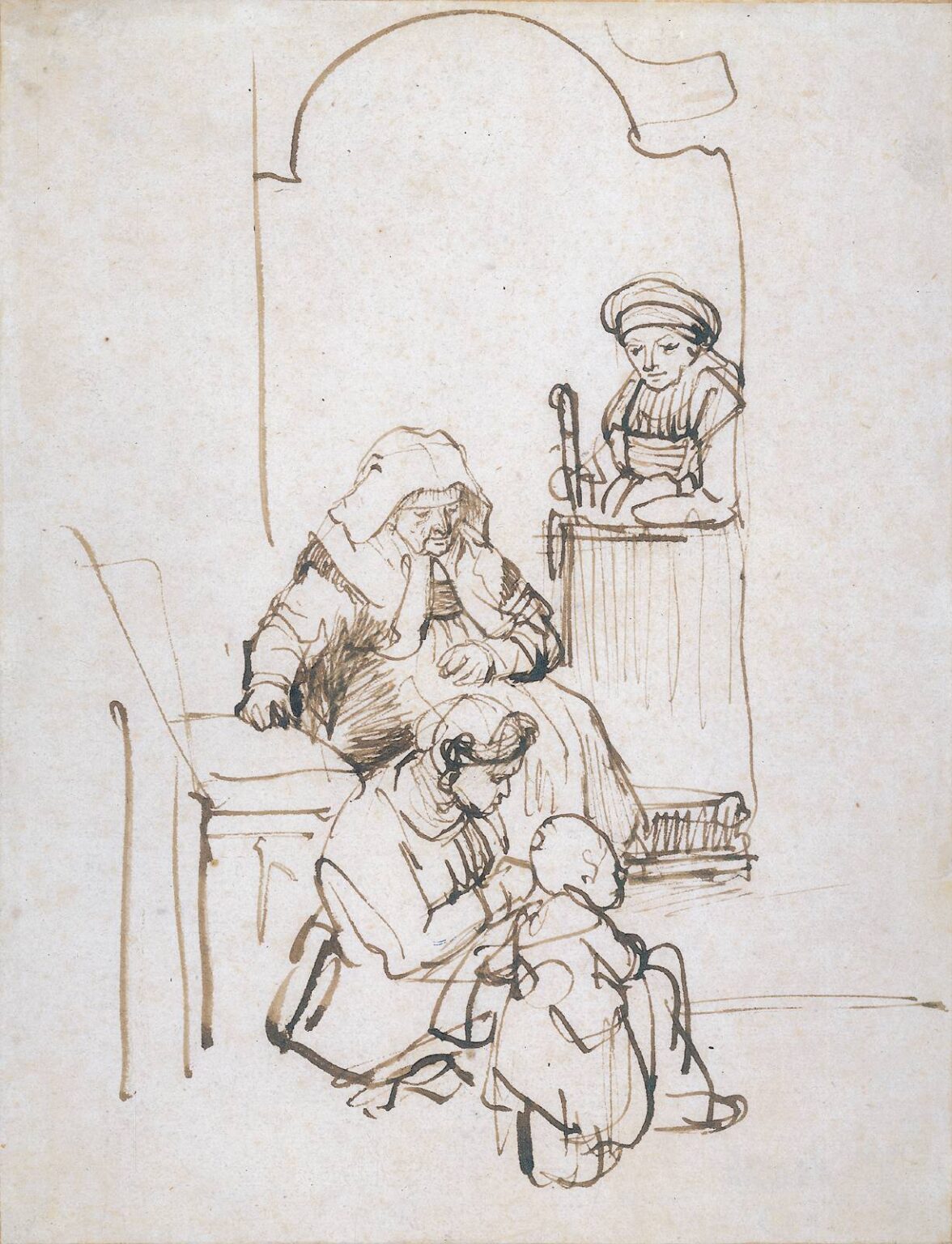
Rembrandt’s “Three Women and a Child at the Door” is a small, electrifying sheet that turns a handful of pen lines into a complete world. Dated 1645, the drawing shows a threshold framed by a shallow architectural arch. Two women occupy the doorway, one seated and old, the other standing behind a low barrier with a staff in hand. In front of them, nearer to us in the open air, a third woman kneels to adjust the clothing of a toddler who faces the group. Nothing in the sheet is belabored; everything is essential. With elastic, searching strokes and small pools of wash, Rembrandt composes a scene where family, age, and place braid together with the natural authority of life observed.
A Threshold That Becomes a Stage
The title tells us the setting: a door. Rembrandt outlines it with a few confident arcs that suggest an arched lintel and a shallow vestibule behind. This architectural trace does more than locate the action; it is the instrument that makes the action legible. Thresholds recur throughout Rembrandt’s work because they gather opposites—inside and outside, public and private, work and rest, youth and age—and allow them to converse. Here the door is a shallow stage where the seated elder may remain at home while participating in the social life of the street, where the standing woman can receive visitors without stepping out, and where a young mother and child can approach without intrusion. The drawing is a sociology of space: architecture becomes etiquette.
Composition as Conversation
The four figures form a diagonal dialogue from rear right to front left, with the child as the hinge. The standing woman leans over her barrier, staff tucked to the side; the elder sits just within the doorway, heavy cloak encircling her shoulders; the kneeling mother bends toward the child, whose rounded head and padded garment give him a compact presence. This simple arrangement produces a sophisticated circulation of attention. The eye travels from the poised watcher in the doorway to the elder’s lowered face, down to the kneeling woman’s concentrated gesture, and finally to the child—then back again along the same path, as if retracing a spoken exchange. The page breathes with this oscillation between distance and nearness, authority and care.
Economy of Line and the Generosity of Suggestion
The drawing’s authority lies partly in what it leaves out. There is no background scenery, no street furniture beyond the door-frame, no elaboration of costume. Contours of garments are sketched with a few long strokes; hands and faces are abbreviated almost to shorthand. Yet these lines are not careless; they are discriminating. Thickened accents gather where weight or shadow matters—under an elbow, at the elder’s hood, along the slats of the barrier—while attenuated, exploratory marks search for the curve of a knee or the bend of a child’s shoe. This alternation of stated and suggested facts permits the figures to breathe. The viewer supplies detail and, in supplying it, becomes the drawing’s collaborator. Suggestion here is a form of generosity.
The Child as Center of Gravity
Although the women occupy more paper, the child is the scene’s center of gravity. His rounded head, the simplest form on the page, concentrates the eye and sets the scale for everyone else. Two or three marks make his ear; a few loops declare the padded seams of his outfit; a single curve suggests the tilt of his attention. The kneeling woman’s hands move at the child’s collar, a choreography that every parent recognizes. Rembrandt gives the child neither precocious expression nor sentimental cuteness. He is busy with being helped, a task he undertakes with the seriousness of the very young. Through this quiet focus, the sheet becomes a meditation on how adults arrange a world for children and how children, by needing help, organize the adult world in return.
Portraits of Age Without Rhetoric
Rembrandt’s sympathy for age shows in the elder’s posture. She sits a little back, cloak pulled up, head inclining toward the action while her hand supports her cheek in a gesture that hovers between weariness and attentive rest. Her presence anchors the door’s interior life. The standing woman plays a complementary role: upright, engaged, hands busy with staff and edge, she is the household’s steward at the threshold. Neither woman is reduced to type. The elder is not a symbol of decline; she is a participant whose vantage—and likely experience—gives her a different kind of agency. The standing figure is not an emblem of authority; she is a neighborly witness, visible and ready. Together they show how households distribute roles across generations without the need to sermonize about it.
Gesture as Speech
The sheet is nearly silent in its marking, but the bodies speak. The kneeling mother bends into a protective C-shape around the child, her head lowered so conversation can be kept at the child’s height. The elder’s head is bowed in the same spirit, creating a visual rhyme that connects them across the threshold. The standing woman’s inward lean acknowledges the visitors; her staff, tucked casually, reads less as weapon than as tool—something set aside when attention is required. These gestures make words unnecessary. The viewer reads intention through posture, the way we do in real life when we notice kindness first in the angle of a body before we hear it in a voice.
The Architecture of Care
Rembrandt’s door is not an abstract arch; its sketched proportions are sturdy and generous, with enough width to sit comfortably and enough depth to register as a place in itself. The barrier where the standing woman rests her arms resembles a half gate or low fence, a modest device that structures approach without forbidding it. Such domestic engineering is common in seventeenth-century Dutch life—the half-door that lets air and light in while keeping toddlers from wandering out. By including it, Rembrandt quietly points to the way care is built into things: doors, gates, steps, and ledges. The social world is not only in bodies; it is in the thresholds they inhabit.
Ink and the Temperature of Light
The sheet’s palette is the warm brown of ink and the off-white of paper; yet within that simplicity Rembrandt conjures light. Linear densities gather like shadows under the door-seat and within the elder’s hood. Elsewhere, the line thins until it reads as light grazing a surface—the top arc of the doorway, the mother’s shoulder, the gleam along the barrier’s slats. The paper’s untouched field becomes air. In a drawing concerned with the domestic exchange of care, this light behaves ethically: it reveals enough to understand and leaves enough veiled to protect privacy. Even at the level of tone, the sheet models courtesy.
The Speed of Life and the Honesty of Incompletion
Rembrandt’s pen moved quickly here. We feel his decisions as he rethinks a contour or lets a search line remain visible. A diagonal at the left margin starts and stops, perhaps indicating another doorway or a thought discarded. Such incompletions are not sloppiness; they are honesty about process. The sheet seems alive because it is a record of a mind looking, choosing, and refusing to overwork. That speed matches the scene’s tempo—a minute between tasks when a child is buttoned and the day resumes.
Everyday Theology Without Emblems
Though the drawing is secular in subject, it carries an undertone of reverence for ordinary life that animates Rembrandt’s sacred scenes as well. The threshold reads as a place of welcome; the elder’s participation hints at an ethic of honoring the old; the kneeling mother embodies service that is not subservience; the standing woman at the door performs watchfulness. None of this is symbolized with attributes. The theology is enacted, not announced. If grace visits this scene, it does so in the way lines gather around care.
Comparisons Within Rembrandt’s Domestic Drawings
“Three Women and a Child at the Door” belongs to a constellation of mid-1640s drawings where Rembrandt explores how little is needed to render a complete social moment. Sheets of women bathing children, mothers reading, beggars at steps, and neighbors talking across thresholds share the same economy of means and warmth of observation. In each, negative space plays a decisive role, and the story survives with almost no props. Compared to Rembrandt’s narrative etchings, which sometimes present crowds and architecture, these drawings are chamber music—fewer instruments, more intimacy, the same mastery of rhythm.
The Viewer’s Place in the Scene
The vantage places us just outside the door, slightly to the left and near enough to feel that a small step would carry us into the conversation. This nearness demands etiquette from the viewer: remain a guest; lower your voice; don’t block the light. Rembrandt’s threshold thus instructs our looking. It tells us that seeing people well requires accepting the boundaries that keep their lives intact. Artful as the drawing is, its deeper achievement is to civilize the gaze.
Child, Line, and the Future the Page Holds
Even in this still moment the child’s presence makes the page about time. The kneeling mother’s touch, the elder’s attention, the standing woman’s watch all point forward to futures that their care will enable. Rembrandt encodes that forwardness in line itself. Look at the quick strokes that trail from the child’s garment or the lightly indicated steps at the door; they resemble paths. The drawing says, without words, that early kindness becomes a road.
The Poetics of Clothing
Clothing is handled as structure rather than ornament. The elder’s hood is a felt hill of fabric that houses her face like a small room; the kneeling woman’s robe falls in practical folds that accommodate motion; the standing woman’s headwrap and bodice read as garments chosen for work rather than display. The toddler’s padded outfit looks out-sized, a tender mismatch common to children who grow faster than the wardrobe. By treating clothing as architecture for bodies and signs of use, Rembrandt keeps his focus on function and care.
Negative Space as Social Air
The large field of untouched paper above the arch and to the left is not empty; it is social air. It keeps the group from crowding the page and provides room for voices to travel. In pictorial terms, that white space prevents heaviness and refreshes the eye; in moral terms, it respects the figures’ freedom by refusing to overdefine their world. The sheet demonstrates how blankness can be a form of kindness.
The Staff and the Problem of Power
The staff in the standing woman’s hand could signal authority, vulnerability, or simple habit. Rembrandt refuses to clarify. Its top is round and blunt, more walking stick than weapon; it tucks into the crook of her arm as if idle in a moment of talk. The ambiguity suits a setting where power is negotiated gently—where the older woman’s wisdom, the standing woman’s oversight, and the young mother’s immediate competence share the stage without competition. The staff becomes an emblem of potential power subordinated to listening.
The Rhythm of Lines and the Music of Speech
Although silent, the drawing has a music. Long swoops of line—door arch, robe hems, barrier slats—establish a legato; short, clustered strokes—hands, faces—supply a staccato of attention. The alternation mimics the rhythm of conversation: long phrases of welcome, short bursts of instruction, pauses where hands work. Rembrandt’s calligraphy is not mere flourish; it is orchestrated speech translated into graphic form.
Humanity Without Heroics
What makes this modest sheet so moving is its refusal of heroics. The subject is not crisis but continuity: a household that breathes with the neighborhood; a child cared for in passing; elders included by design; work briefly paused for tenderness. Rembrandt’s art often locates the sublime in such continuities. He knows that the most durable dramas happen at doorways and tables, in stairwells and along canals, where love takes the shape of everyday acts.
Why the Sheet Matters Now
Modern viewers will recognize the wisdom encoded here: architecture that fosters community, intergenerational presence as a resource, public space designed for safety and welcome, the centrality of caregiving to the social fabric. In a time tempted to celebrate only the exceptional, Rembrandt’s drawing argues for the beauty of the habitual and the ethics of small attentions. Its minimal means align with that message: when little suffices, surplus can be love.
Conclusion: A Door Open to Attention
“Three Women and a Child at the Door” is a door open to attention. With a few strokes and washes, Rembrandt builds a place where people meet, help, watch, and include. The sheet’s power lies in how fully it trusts the ordinary. Nothing is forced, and so everything rings true: the kneel, the lean, the downward gaze, the protective fold of a garment, the half-gate that both guards and welcomes. The drawing is not a preview for a larger, more finished work; it is a finished act of seeing. Standing before it, we learn to approach thresholds—on paper and in life—with the same mixture of tact, curiosity, and care.