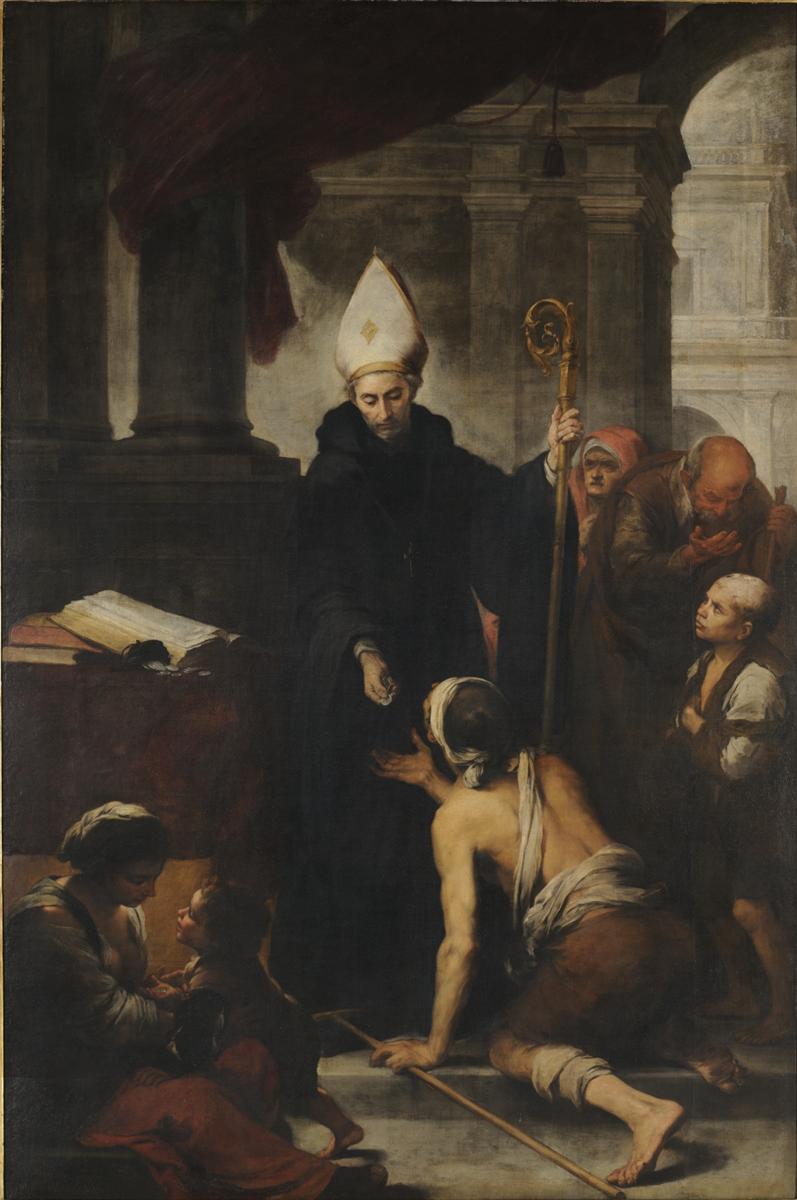
Image source: wikiart.org
Historical Context of “Thomas of Villanova giving alms to the poors”
“Thomas of Villanova giving alms to the poors” was painted by Bartolome Esteban Murillo in 1678, during the final decade of his life. Murillo was at that time the most celebrated painter in Seville, admired for his religious works filled with tenderness and luminous color. Seventeenth century Spain was marked by economic hardship, plague, and social inequality, and charitable institutions played a central role in caring for the poor. Murillo worked closely with many of these organizations, providing altarpieces and devotional images that promoted the Christian virtues of compassion and mercy.
Thomas of Villanova, a sixteenth century Augustinian friar and archbishop, was famed for his radical generosity. He gave away his wealth, founded orphanages and hospitals, and was popularly known as the “father of the poor.” Murillo’s painting was designed to celebrate this saint as a model of charity for viewers of his own time. The work likely hung in a religious institution that served the needy, where it would remind both benefactors and the poor themselves that divine grace flows through acts of human kindness.
The Main Scene and Its Dramatic Setting
The painting presents Thomas of Villanova in the center, dressed in a dark habit with a white bishop’s mitre on his head. He stands slightly elevated on a step, leaning forward as he extends his hand to a kneeling beggar. The saint holds a golden crozier in his left hand, a symbol of episcopal authority, but his posture and gesture make it clear that he uses this authority in service of the least fortunate.
The setting is a grand architectural interior with tall columns, broad stone steps, and an atmospheric background of arches and pilasters. This monumental architecture contrasts with the destitution of the figures who surround the saint, emphasizing the distance between institutional power and the suffering poor. At the same time, the architecture frames the central figure of Thomas as a moral pillar, his generosity acting as a bridge between heaven and earth.
At the upper left, a large book rests on a table covered with a red cloth, illuminated by soft light. The book likely represents the Scriptures or the rule of his religious order, grounding his actions in sacred teaching. Above, a heavy curtain is drawn aside, as if revealing this episode to the viewer. This theatrical device, familiar in Baroque painting, heightens the sense that we are witnessing a significant and exemplary moment.
The Gesture of Charity
The heart of the painting lies in the simple gesture of the saint’s extended hand. Thomas of Villanova holds a coin between his fingers, passing it to the beggar who kneels before him. The recipient is a man with a bandaged head and bare back, his body twisted as he supports himself on one arm while reaching up with the other. His posture conveys both desperation and hope. He stretches forward from the shadow toward the light that falls upon the saint’s hand.
Murillo captures the instant of encounter between giver and receiver. The saint’s face is calm and introspective, as if he performs this act of kindness not out of obligation but as a natural expression of his inner life. There is no hint of condescension. He looks downward with gentle seriousness, fully attentive to the needs of the man before him. The beggar, though clearly impoverished, retains a sense of dignity in the way he looks up and opens his hand.
This delicate balance between misery and dignity is one of Murillo’s hallmarks. By focusing on the shared humanity of saint and beggar, he transforms charity from a mere transaction into a meeting of souls. Viewers are invited to imagine themselves in both positions: as those who give and those who receive.
The Assembly of the Poor
On the right side of the canvas, a small group of figures presses forward. An elderly woman wrapped in a red shawl peers anxiously toward the saint, while a bent old man beside her brings his fingers to his mouth in a gesture that suggests both pleading and gratitude. A barefoot boy stands just behind them, his eyes fixed on Thomas of Villanova with a mixture of wonder and expectation. These figures stand in a narrow vertical column that echoes the upright form of the saint, visually linking the vulnerable crowd to their benefactor.
In the lower left corner, Murillo introduces another poignant vignette. A seated woman cradles a young child in her lap. The child looks up at her, and she leans toward him with tender attention. Though they are not directly engaged with the saint at this moment, their presence expands the meaning of the scene. They represent the wider community of the poor who depend on charity for survival, particularly women and children. The mother’s bare foot on the cold stone floor and the child’s fragile posture convey the harshness of their situation.
Together, these groups create a chorus of need around the central figure of Thomas. The variety of ages and conditions suggests that poverty is not limited to one type of person but touches every stage of life. Murillo invites the viewer to read individual stories in each face: the weary resignation of the elderly, the innocence of the child, the hope of the kneeling man.
Light, Shadow, and Spiritual Meaning
Murillo was a master of chiaroscuro, the manipulation of light and shadow to create depth and drama. In “Thomas of Villanova giving alms to the poors,” he uses light not only to model forms but also to convey spiritual meaning.
The upper background and the grand architecture are largely cast in shadow, creating a somber setting that hints at the severity of worldly conditions. Against this dark backdrop, the saint’s white mitre and pale face glow softly, becoming the brightest elements in the painting. This luminous focus suggests that divine grace shines through his actions. The light flows downward from his head and hand toward the kneeling beggar, who is partially illuminated as he reaches up. The path of light thus traces the line of charity from God through the saint to the poor.
Other pockets of light appear strategically throughout the composition. The open book on the table catches a beam of illumination, linking scripture with action. The child in the lower left is gently lit, as if reminding the viewer that the future of society depends on caring for its youngest members. The boy on the right side also stands in a patch of light, his bare chest and face visible among the darker tones of the crowd. Murillo uses these highlighted figures to underscore the moral message: charity brings light into the darkest corners of human existence.
Composition and Movement
The composition of the painting is carefully orchestrated to guide the viewer’s eye and to communicate the hierarchy of importance. The vertical figure of Thomas of Villanova stands slightly off center, acting as an anchor around which the other elements are arranged. His crozier traces a strong vertical line from top to bottom, echoing the architectural columns behind him. This verticality conveys stability and authority.
At the same time, there is a strong diagonal movement running from the lower left corner, through the kneeling beggar, up to the saint’s hand and mitre, and then to the group of onlookers on the right. This diagonal energizes the scene and suggests an invisible flow of compassion. The begging man’s outstretched arms, the old man’s cupped hands, and the boy’s uplifted gaze all follow this diagonal movement, reinforcing the directional flow toward the saint.
The curtain at the top left curves downward, its dark folds adding a sweeping sense of motion and framing the scene like a stage. The table with the book and cloth balances the cluster of figures opposite it, preventing the composition from feeling lopsided. Murillo’s arrangement is both dynamic and harmonious, reflecting the complex interplay between authority, need, and mercy.
Details of Costume and Gesture
Murillo’s attention to detail enriches the narrative. Thomas of Villanova’s garments are painted in deep blacks and soft whites, with minimal ornamentation. This restrained attire reflects his reputation for humility despite his high office. The golden crozier he holds is intricately rendered, yet it does not overpower his figure. Instead, it serves as a visual reminder that the Church’s authority should be exercised in service to others.
The beggars’ clothing is ragged and patched. The kneeling man’s shirt slips from his shoulder, revealing a thin back and muscular arm that speak of both physical hardship and resilience. Bandages wrap his head and legs, suggesting illness or injury. The old man on the right clutches a simple walking stick and wears a worn cloak. The mother and child on the left share a shawl, emphasizing their shared vulnerability. Bare feet appear repeatedly, stressing the material deprivation of these people.
Gestures are equally expressive. The saint’s hand opens downward in a calm, practiced motion, indicating that giving has become a habit rather than an exceptional event. The kneeling man’s hands are raised in expectation, his fingers spread as though ready to receive not only money but also acknowledgment. The old woman’s eyes peer forward, her mouth slightly open as if forming a prayer. The child at her side stands with clasped hands, mirroring the humble posture of devotion. Murillo uses these gestures to build a complex emotional atmosphere of need, hope, and gratitude.
Theological and Moral Themes
On a theological level, the painting illustrates the Christian virtue of caritas, or charity. Thomas of Villanova embodies the ideal of the bishop as shepherd of the poor. His almsgiving is not portrayed as a distant act of institutional charity but as a personal, face to face encounter. The saint bends toward the poor, closing the physical and symbolic distance between Church hierarchy and marginal people. Murillo thereby emphasizes that authentic holiness is measured by concrete acts of mercy.
The scene also reflects the Catholic teaching about the corporal works of mercy, which include feeding the hungry, clothing the naked, and caring for the sick. The bandaged bodies and hungry faces in the painting represent those who depend on such works. By depicting them inside a monumental church interior, Murillo suggests that the appropriate place for the poor is not outside the doors but within the community of faith.
For viewers in seventeenth century Seville, the painting would have resonated deeply. Economic crises and plagues had left many destitute. Religious confraternities and charitable hospitals frequently commissioned images like this one to encourage generosity among the wealthy and to affirm the dignity of those who sought help. Murillo’s compassionate treatment of his subjects reflects his own involvement with such institutions and his belief in the redemptive power of charity.
Murillo’s Style and Mature Vision
“Thomas of Villanova giving alms to the poors” belongs to Murillo’s late style, when his palette became softer and his brushwork looser yet more confident. The dark tonalities and strong contrasts reflect the influence of earlier Spanish masters such as Ribera, while the graceful handling of light and the gentle faces show Murillo’s own distinctive sensibility.
The saint’s expression is typical of Murillo’s mature religious figures: contemplative, mild, and inwardly focused. He does not display ecstatic emotion or theatrical gestures. Instead, his serenity suggests an interior life deeply rooted in prayer. This quiet spirituality informs the entire painting. Even though the subject involves desperate poverty, the overall mood is not one of despair but of hopeful reliance on divine and human compassion.
Murillo’s careful balance between realism and idealization is also evident. The poor are rendered with accurate physical detail, yet they are not grotesque or caricatured. Their faces retain a certain beauty, and their bodies, though marked by suffering, possess graceful lines. This approach encourages empathy rather than repulsion. Viewers are invited to recognize themselves in these figures, not to distance themselves from them.
Contemporary Resonance and Interpretation
For modern audiences, “Thomas of Villanova giving alms to the poors” continues to speak powerfully about social responsibility. The painting raises questions about how societies treat their most vulnerable members and about the relationship between institutions and individuals in providing aid. The grand church architecture can be read as a metaphor for contemporary systems of power, while the figure of Thomas of Villanova suggests how those systems might be humanized through compassionate leadership.
The painting also invites reflection on the nature of giving. Murillo portrays an act of charity that is neither patronizing nor detached. The saint and the poor share the same space, occupy the same light, and are linked through touch and gaze. This emphasis on closeness challenges modern habits of distant or purely transactional charity. It suggests that true solidarity requires personal engagement and recognition of the other’s dignity.
Furthermore, the presence of women and children broadens the painting’s relevance. It reminds viewers that poverty often has a generational dimension and that families suffer together. The mother and child at the lower left form a quiet counterpoint to the official act of almsgiving. Their intimate exchange suggests that compassion also takes the form of nurturing within the family, even when material resources are scarce.
Conclusion
“Thomas of Villanova giving alms to the poors” is a deeply moving work that brings together Murillo’s technical mastery, spiritual sensitivity, and social awareness. Painted in 1678, it presents the saint as a model of compassionate leadership, extending his hand to the poor who surround him in a grand yet shadowed interior. Through careful use of light, composition, and expressive detail, Murillo transforms the simple act of giving a coin into a rich meditation on mercy, dignity, and human solidarity.
The painting speaks across centuries because it addresses questions that remain urgent today. How do we respond to poverty in our midst? What responsibilities accompany positions of authority? How can generosity respect the dignity of those who receive it? Murillo does not offer theoretical answers, but he gives us an image of a man who allows his faith to guide him toward the marginalized. By contemplating this canvas, viewers are encouraged to examine their own attitudes and actions toward those in need.
In “Thomas of Villanova giving alms to the poors,” the artist shows that true greatness lies not in splendor or power but in humble acts of service. The saint’s quiet gesture, repeated countless times in his life, becomes a beacon of light in the gloom of the church interior. Murillo invites us to see in that small coin the radiance of charity, which has the power to illuminate both giver and receiver.