Image source: wikiart.org
Introduction
John William Waterhouse’s Thisbe (1909) arrives late in the artist’s career, at a moment when his painting often feels like a quiet argument with time. The subject is drawn from the tragic tale of Pyramus and Thisbe, a story best known through Ovid’s Metamorphoses and later retellings that turned it into a prototype for star crossed lovers. Yet Waterhouse does not stage the narrative’s famous climax in a burst of action. Instead, he chooses the tense interval that precedes catastrophe, the instant when a life can still be changed, when the future is not yet sealed, but the air is already charged with dread.
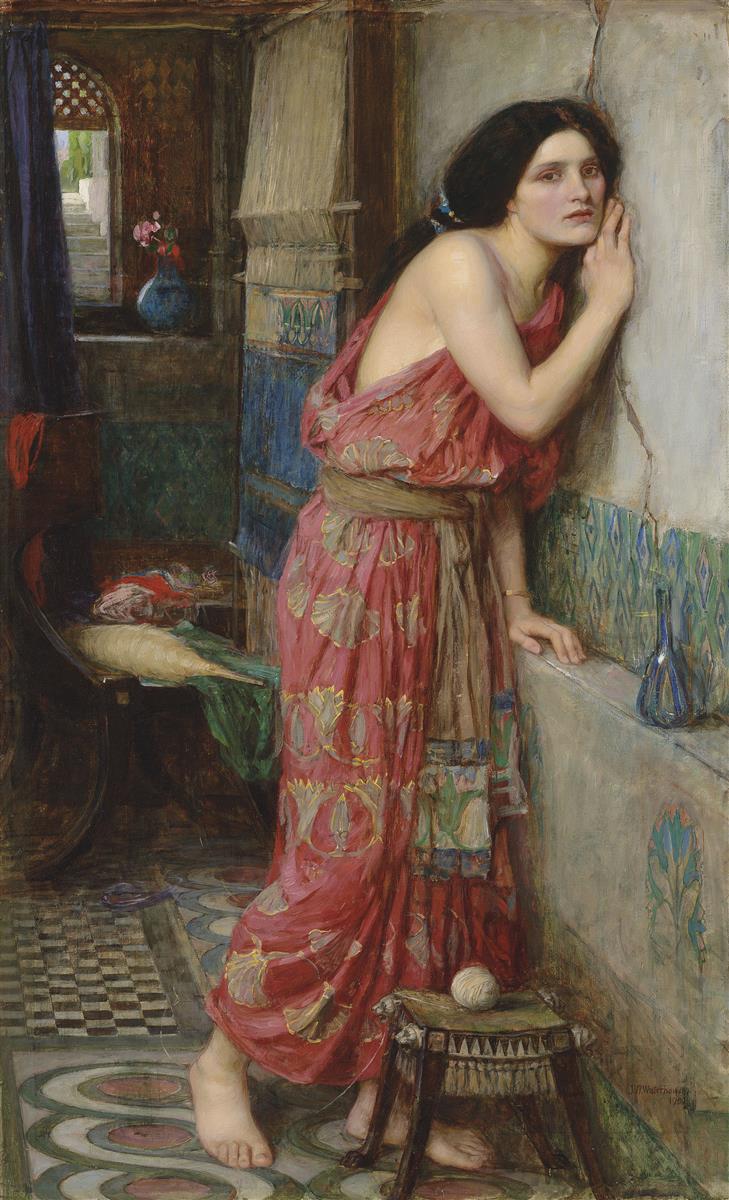
In this work, Thisbe is not a distant allegory. She is a present, breathing figure caught in a private act of listening. Her pose is simple, almost domestic, yet it carries the full emotional weight of myth. Waterhouse translates legend into a lived interior moment, inviting the viewer to recognize a universal human experience, the feeling of waiting at a threshold, straining to hear what is coming, hoping for a sound that will confirm safety, fearing the sound that will confirm loss.
The Myth of Pyramus and Thisbe and Waterhouse’s Choice of Moment
The tale revolves around two young lovers separated by family hostility. They communicate through a crack in a wall, then plan to meet beyond the city, under a mulberry tree near a tomb. Thisbe arrives first and, startled by a lioness, flees, dropping her veil. The lioness, fresh from a kill, mauls the veil with bloody jaws. Pyramus arrives, sees the bloodied cloth, assumes Thisbe is dead, and kills himself. Thisbe returns, finds him dying, and takes her own life. The myth ends with transformation, the mulberries stained dark as a memorial to their blood.
Waterhouse’s brilliance lies in not showing the lioness, not showing the tree, not showing the bodies. He paints the story as anticipation, the psychological hinge on which the tragedy turns. Thisbe listens at a wall as if the wall itself were fate, a barrier that both shelters and confines. By focusing on the moment before the lovers’ meeting, Waterhouse makes suspense the real subject. We are not asked to witness death. We are asked to inhabit the anxious minutes when love is pure intention, when the heart believes it is walking toward reunion, and the world prepares its cruel interruption.
Composition and the Language of the Body
Thisbe’s figure dominates the vertical canvas, her body angled toward the wall in a posture that is both intimate and defensive. The bend of her torso, the tilt of her head, and the placement of her hands create a chain of gestures that read as listening, leaning, and bracing. One hand presses near the wall as if to steady herself. The other rises toward her face, a protective reflex that suggests vulnerability. Waterhouse choreographs her anatomy so that it communicates thought and feeling without theatricality.
Her stance is grounded, bare feet on patterned flooring, as if she has stepped out in haste without fully preparing, or as if she exists in a liminal space between home and the unknown outside. The body is soft, luminous, and human, not an idealized statue. This physical honesty strengthens the psychological truth of the scene. She is not a symbol of tragedy, she is a young woman caught in uncertainty.
Waterhouse also uses the line of the wall as a compositional force. It rises beside Thisbe like a vertical boundary, a plane that takes on emotional meaning. The wall becomes an obstacle between desire and fulfillment, echoing the myth’s crack through which the lovers once whispered. Here, the wall is not only architectural. It is the embodiment of separation, the presence of something that cannot be crossed without consequence.
Setting, Space, and the Mood of Interior Stillness
The environment is richly detailed but restrained in effect. Behind Thisbe, Waterhouse constructs a small interior world of patterned tiles, textiles, and objects that suggest a Mediterranean or Near Eastern atmosphere, a romanticized antiquity filtered through late nineteenth century aesthetic taste. This space feels enclosed, private, and hushed. The open window or doorway in the background offers a view outward, but it does not liberate the scene. It functions like an invitation to danger, a reminder that outside lies the meeting place and the unknown.
The room’s depth is articulated through carefully arranged planes, the wall, the alcove, the patterned floor, and the receding doorway. Yet the deeper the space goes, the quieter it becomes. Waterhouse keeps the background from competing with Thisbe’s emotional presence. The interior reads like a pause, a holding of breath. It is the kind of space where sound matters, where a footstep, a whisper, or a sudden silence can change everything.
This controlled stillness is essential to the painting’s suspense. Waterhouse does not need dramatic motion because the entire scene is built as a moment of waiting. The viewer senses the narrative beyond the frame, the planned meeting, the path to the tomb, the shadow under the mulberry tree. The interior becomes a chamber of foreknowledge, where the mind projects what the eyes cannot yet see.
Color, Light, and the Emotional Temperature of the Scene
The palette is one of Waterhouse’s most expressive tools here. The dominant note is Thisbe’s rose and crimson drapery, a warm, saturated field that draws the eye immediately. This color suggests passion, youth, and vitality, but it also quietly anticipates blood. Waterhouse often uses red as a bridge between sensual life and impending sorrow, and Thisbe is no exception. The dress seems to glow against the more muted stone and tile, making her feel like the beating heart of the painting.
Light falls softly across her skin and fabric, creating a gentle modeling rather than harsh contrast. The illumination is calm, almost tender, which heightens the tragedy by refusing to shout. The scene is not lit like a catastrophe. It is lit like an ordinary moment that the viewer knows will become extraordinary. This mismatch between the calm light and the ominous story intensifies the emotional impact.
The surrounding colors, greens, blues, and earthy browns in the tiles and furnishings, provide a cooling counterpoint to the warmth of her garment. These cooler tones stabilize the scene visually while also suggesting a world that is indifferent to her feelings. The room’s decor is beautiful, but beauty is not protection. Color becomes a quiet drama, passion set against stone.
Costume, Pattern, and the Poetry of Ornament
Waterhouse lavishes attention on Thisbe’s clothing, and the ornament is not mere decoration. The patterned fabric carries an air of luxury and delicacy, as if her life is still wrapped in youth’s promise. The sash around her waist gathers the drapery, emphasizing the body’s curve and suggesting the moment’s immediacy, she is caught mid decision, mid listening, mid step.
The surrounding patterns, mosaic floor motifs, tile designs on the wall, and the textiles in the room, create a visual rhythm that contrasts with Thisbe’s stillness. Ornament implies continuity, the long life of culture, craft, and domestic routine. Thisbe’s story, by contrast, is about a life cut short. Waterhouse sets the fragility of a single human fate against the enduring repetition of pattern, as if to say that tragedy happens in rooms where ordinary life is meant to continue.
This tension between the permanence of decoration and the impermanence of youth is one of the painting’s quieter themes. The tiles will remain. The room will remain. The story will become legend. But Thisbe, as a living person in this painted instant, is about to step into the irreversible.
Facial Expression and Psychological Ambiguity
Thisbe’s face is not overtly dramatic, and that restraint is crucial. Her expression holds uncertainty, sadness, and concentration without collapsing into melodrama. She looks outward and slightly toward the viewer’s space, but not directly, as if her attention is divided between listening at the wall and thinking beyond it. Her gaze feels heavy with intuition. She does not look like someone thrilled by a secret rendezvous. She looks like someone who senses that hope has teeth.
Waterhouse paints her as psychologically complex. Thisbe is both brave and afraid, both devoted and cautious. The slight tension in her mouth and the softness around her eyes suggest an inner debate. Should she go? Has something changed? Is she hearing what she expects to hear, or what she fears? This ambiguity gives the painting lasting power, because it mirrors real human experience. We rarely know we are stepping into a turning point. We feel something, but we cannot name it until it is too late.
Symbolic Objects and the Silent Narrative
Waterhouse includes objects that feel like fragments of story, a vase with flowers, a small vessel on the ledge, fabrics and furnishings that hint at a domestic life. These elements do not explain the myth directly, but they enrich the emotional context. Flowers can suggest fleeting beauty, love, and the fragility of youth. The vessels evoke containment, something held and soon to be spilled, an echo of the narrative’s impending rupture.
The open view to the outside functions as a symbolic portal. It is both escape and exposure. The architecture frames the world beyond as bright but distant, a place of possibility that is also the stage of disaster. Waterhouse’s mythic painting often works this way, symbolic without being didactic. He offers a mood, an arrangement of cues, and lets the viewer’s knowledge of the story fill the silence.
Even the wall itself is symbolic in the most direct way. In the myth, the lovers’ relationship is mediated by a barrier. The wall is the physical manifestation of society’s refusal, family hostility, and the cruel accidents that separation invites. Here, Thisbe presses close to it, as if intimacy must be negotiated through stone.
Technique, Brushwork, and the Late Waterhouse Touch
By 1909, Waterhouse’s handling often balances detailed passages with softer, more atmospheric transitions. In Thisbe, skin and face are modeled with care, but the surfaces around her can feel more painterly and suggestive. This mixture creates a dreamlike realism, the figure is tangible, the world is slightly hushed, as if we are seeing memory rather than immediate reportage.
Fabric is a particular showcase. Waterhouse captures the weight and fall of drapery, the way folds catch light, the way pattern follows form. The result is sensuous without becoming purely decorative. The paint surface seems to breathe, giving the scene an emotional softness that suits its theme.
The overall effect is that of a story told in a lowered voice. Waterhouse does not aim for shock. He aims for inevitability. The technique supports that aim by keeping the scene coherent, gentle, and quietly intense.
Themes of Separation, Waiting, and the Tragedy of Misreading
At the heart of the Pyramus and Thisbe story is misinterpretation. A veil becomes evidence of death. Silence becomes proof. A moment of fear becomes the trigger for irreversible action. Waterhouse’s focus on listening emphasizes the fragile role of perception. Thisbe listens for a sign. Pyramus will later read a sign. Both are attempting to interpret the world’s signals, and both will be betrayed by circumstance.
The painting, therefore, is not only about romance. It is about the peril of incomplete information, the way love can be destroyed by a gap in knowledge. The wall, the distance, the unseen outside, all reinforce this theme. Waterhouse shows that tragedy often does not arrive as a villain. It arrives as a misunderstanding, a late arrival, an object dropped at the wrong time.
Waiting becomes a form of vulnerability. To wait is to be open to what comes. Thisbe’s posture embodies this openness, her body literally angled toward the unknown. The viewer shares her suspense, and in that shared suspense the myth becomes immediate again.
Waterhouse and the Pre Raphaelite Inheritance
Although Waterhouse is often associated with the Pre Raphaelite circle in spirit, his work also carries its own temperament. In Thisbe, the influence appears in the love of literary subject matter, the attention to costume and pattern, and the fusion of beauty with melancholy. Yet Waterhouse differs from earlier Pre Raphaelite intensity by favoring mood over minute narrative detail. He does not crowd the scene with explanatory symbolism. He relies on the figure’s emotional truth.
The painting’s romantic antiquity, its textured surfaces, and its seriousness about a woman’s inner life align with a broader late Victorian and Edwardian fascination with myth as psychological mirror. Thisbe is not merely a classical heroine. She is a study of emotion under pressure, an image of how the private self meets public fate.
Why Thisbe Still Feels Contemporary
What makes Thisbe enduring is its emotional recognizability. Almost everyone knows the experience of listening for something that will confirm safety, waiting for a message, a step on the stairs, a knock at the door, a voice in the next room. Waterhouse turns myth into that universal moment. Even without knowing the story, a viewer can feel the tension in her body and the sadness in her face.
The painting also speaks to the theme of women in myth as bearers of emotion and consequence. Waterhouse often paints women at thresholds, physically and psychologically, and he treats them with sympathy. Thisbe is neither femme fatale nor passive victim. She is the human center of the story, the one who feels the future approaching.
In a world saturated with loud drama, Thisbe offers a quieter kind of intensity, the intensity of a single moment that contains a whole tragedy. It reminds us that the most decisive events can begin in stillness, and that sometimes fate enters not with noise, but with a silence that forces us to lean closer.