Image source: wikiart.org
Introduction to Rubens’s “Thetis Receiving the Arms of Achilles from Vulcanus”
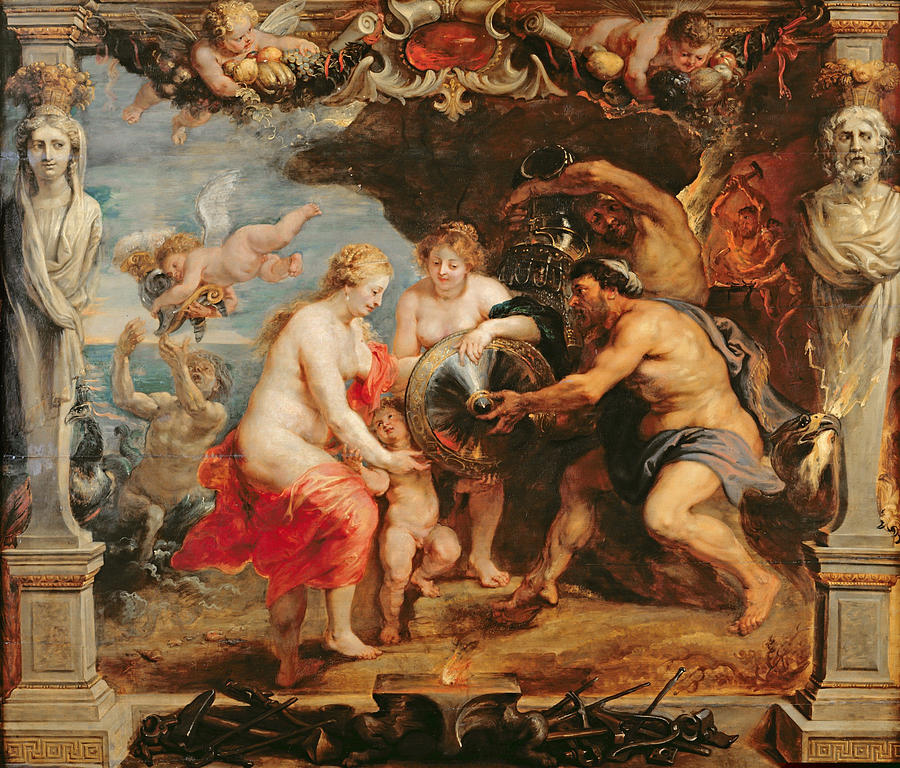
“Thetis Receiving the Arms of Achilles from Vulcanus” is one of Peter Paul Rubens’s most exuberant mythological compositions. The canvas is crowded with powerful gods, soft-bodied goddesses, bustling putti and glittering armor, all staged within an elaborate architectural frame. At the center of the scene stands Thetis, the sea nymph and mother of Achilles, accepting the magnificent armor that the god of fire and metalworking, Vulcan (Hephaestus), has forged for her son.
Rubens turns this classical story into a richly theatrical spectacle. The painting celebrates divine craftsmanship, maternal devotion, and heroic destiny, while simultaneously showing off the artist’s command of anatomy, movement and luxurious surface effects. Swirling draperies, polished steel, rosy flesh and flickering flames work together to create a visual symphony that epitomizes the Baroque love of drama and sensuous abundance.
Mythological Background and Narrative Focus
The subject comes from Homer’s “Iliad.” When Achilles’ friend Patroclus dies wearing Achilles’ armor, Hector strips the body and keeps the equipment as spoils of war. Achilles, grief-stricken and enraged, needs new arms before he can return to battle. His mother Thetis appeals to Vulcan, who forges a new set of armor of unparalleled beauty and power.
Rubens chooses the moment when Vulcan hands over the completed arms to Thetis. Rather than showing Achilles in battle, he concentrates on the transfer of objects that will shape the hero’s fate. This choice allows him to place female figures and a muscular god at the center, emphasizing the roles of love, craft, and divine intervention behind the scenes of war.
In the foreground, Thetis stands slightly to the left, partially draped in a vivid red cloth that clings to her hips and legs. Her upper body is nude, in keeping with classical conventions for sea nymphs and goddesses. She leans forward, her hand resting on the great round shield that Vulcan presents. Behind her, another female attendant or Nereid supports the shield, while a small child—often interpreted as a young Cupid or as a symbolic putto—clutches at Thetis’s thigh and touches the armor, linking divine love and heroic destiny.
On the right, Vulcan kneels powerfully, his body twisted as he pushes the heavy shield toward Thetis. He is semi-nude, wearing only a blue drapery around his hips, his massive torso and arms glowing with the warmth of the forge. Behind him, his assistants—cyclopes or muscular smiths—hoist additional pieces of armor: a helmet, a breastplate, greaves and other war gear.
The background includes details that situate the scene in a mythological world. On the left, we see the sea and figures rising from it—Nereids and tritons supporting more weapons. Above, playful putti hold festoons of fruit and flowers, while architectural elements, herms and sculpted heads frame the entire composition like a monumental altar. Rubens blends narrative illustration with decorative magnificence, transforming Homer’s story into an almost ceremonial presentation.
Composition, Framing, and Spatial Organization
The composition is strongly horizontal yet crowded with vertical and diagonal accents. The two principal figures, Thetis and Vulcan, anchor the center. Their opposed movements—the nymph leaning inward from the left, the smith pushing from the right—create a dynamic X-shaped structure. The large, gleaming shield functions as the visual pivot, catching the light and acting as a round counterbalance to the flowing diagonals of bodies and draperies.
Rubens sets this central action within an elaborate architectural frame painted as part of the scene. On both sides, tall herm-like female figures act as pilasters, their columnar bodies crowned with vegetal capitals. At the top, an entablature supports seated putti and garlands. This framing device serves several functions. It makes the scene resemble a monumental relief or a framed altarpiece, heightening its grandeur. It also helps organize the many figures by giving them architectural boundaries, preventing the composition from dissolving into chaos.
Within these boundaries, space remains fluid rather than rigidly constructed. Figures overlap and interlock; some stand firmly on the ground, while others float, soar or emerge from the sea. The foreground is crowded with legs, armor and tools, but Rubens uses light and color to guide the eye clearly through the complexity. From the bright red drapery of Thetis, the gaze passes to the radiant shield, then to Vulcan’s bronzed flesh and blue drapery, and finally to the darker forge behind him. Auxiliary groups—the Nereids in the water and the putti above—form secondary focal points that reward closer inspection without distracting from the central exchange.
Light, Color, and Surface Effects
One of the painting’s most remarkable features is its orchestrated color scheme. Warm flesh tones dominate the composition: the creamy skin of the goddesses, the more ruddy complexion of Vulcan, and the pink bodies of the putti. These flesh colors are set off by strong accents of red, blue, gold and black.
Thetis’s red drapery provides the loudest color accent. Its folds shimmer with orange and crimson, echoing the glow of the forge while also evoking love and passion. Vulcan’s blue cloth offers a cooler counterpoint that helps separate his form from the surrounding warm tones. Gold appears in the ornamental frame, in the fruits and garlands, and most strikingly in the glowing metal of the armor.
Rubens is famous for his ability to depict different materials convincingly, and this painting is a showcase of that talent. The armor gleams with reflections and highlights, rendered through bold strokes of white and yellow over darker underpainting. The viewer can almost feel the chill smoothness of polished steel. In contrast, the skin is soft and luminous, built up with semi-transparent layers that suggest the subtle play of blood and muscle beneath the surface. Draperies are painted with energetic, swirling brushstrokes that convey both weight and movement.
Light seems to come from multiple sources. A general ambient glow suffuses the scene, but stronger beams highlight the bodies of Thetis and Vulcan and the shield between them. Background figures are more shadowed, especially the smiths near the forge on the right, where we glimpse hints of fire and smoke. This complex light system contributes to the sense of divine, otherworldly radiance rather than strictly natural illumination.
The Representation of Bodies and Baroque Dynamism
Rubens’s treatment of the human body is central to the painting’s impact. The figures are robust, fleshy and highly animated—typical of his mature style. Thetis and her attendant possess the full, rounded forms that scandalized later neoclassical tastes but were celebrated in the Baroque era as signs of vitality and abundance. Their limbs curve gracefully, and the subtle twisting of their torsos gives them a sensuous liveliness.
Vulcan’s physique is of a different type: muscular, knotted and powerful. His bent knees, bulging calves and straining arms emphasize the physical effort required to forge and present the arms. He embodies constructive strength, the masculine counterpart to Thetis’s nurturing femininity.
The supporting figures contribute to the overall dynamism. Putti swirl through the air, one on the left dangling upside down as he clutches armor emerging from the waves. A triton lifts a shield from the sea with straining arms. The cyclopean smiths in the background hoist heavy armor overhead. Even the architectural herms appear to lean inward, their stone gaze directed toward the central action.
This sense of movement is heightened by Rubens’s use of diagonal lines. The angle of Vulcan’s body, the tilt of the shield, the flowing red drapery, the swooping garlands and the arms of the minor figures all create a network of diagonals that propel the viewer’s eye around the canvas. The painting feels like a snapshot of continuous action, frozen at the moment of dramatic exchange.
Symbolism of Armor, Love, and Heroic Destiny
Beyond its narrative content, “Thetis Receiving the Arms of Achilles from Vulcanus” carries rich symbolic resonances. The armor itself is the most obvious symbol. It represents not only physical protection in battle but also the glory and burden of heroic fame. By placing the shield front and center, Rubens stresses the importance of Achilles’ forthcoming exploits: this armor will make possible his revenge on Hector and his climactic role in the Trojan War.
The close involvement of Thetis and the attending Nereids underlines the maternal dimension of heroism. While Achilles is absent from the scene, the painting reminds viewers that his fate depends heavily on his mother’s divine advocacy. Her bare breasts and the child at her side reinforce associations with nurture and care, yet she negotiates with a powerful male deity over instruments of war. Rubens thus presents motherhood as both tender and formidable.
The presence of Cupid-like putti and eroticized nudes introduces the theme of love’s role in heroic stories. Achilles’ wrath in the “Iliad” is triggered by the loss of Briseis, and the entire Trojan War stems from the love-and-beauty contest that awarded the apple to Venus. In the painting, the combination of voluptuous female bodies and deadly weapons hints at the close interplay of eros and thanatos, love and death.
The decorative architectural frame can also be read symbolically. The herm figures and sculpted heads recall classical temples and triumphal monuments, places where heroes and gods were celebrated. By embedding the story within such a frame, Rubens implies that the event being shown is worthy of monumental commemoration. The garlands of fruits and flowers carried by the upper putti symbolize prosperity and abundance, perhaps suggesting that war, when guided by divine favor, can lead to victory and peace.
Rubens’s Artistic Intent and Possible Patronage
Although the exact date and patronage of this work are unknown, its subject and scale suggest that it may have been created for an aristocratic residence or a royal collection. Rubens frequently painted mythological scenes for patrons who wished to adorn their palaces with images that were both erudite and sensuously attractive. The theme of Achilles’ armor was especially resonant for rulers who saw themselves as modern embodiments of classical heroes.
In choosing to depict the moment of Thetis receiving the arms rather than Achilles using them, Rubens emphasizes divine gift and preparation over actual violence. This focus may have appealed to patrons interested in celebrating their own power as sanctioned by the gods or by destiny. The painting could be read as an allegory of princely armament: like Achilles, a ruler receives his instruments of war as a divine trust, mediated by wisdom and love.
Rubens, who was himself a diplomat as well as an artist, understood the political uses of mythological imagery. He often tailored his compositions to support the ideological aims of his patrons—exalting peace, just war, dynastic continuity or marital alliance. In this painting, the combination of armor, gods, and maternal intercession offers a multifaceted allegory of power granted, tempered and glorified by higher forces.
Technique, Workshop Practice, and Painterly Energy
Rubens directed a large workshop, and many of his large mythological canvases involved collaboration with assistants. Yet even when others helped block in forms or draperies, he usually reserved key passages—the principal heads, hands and expressive details—for his own brush. In “Thetis Receiving the Arms of Achilles from Vulcanus,” one senses his personal touch in the faces of Thetis and Vulcan, the handling of the shield, and the lively brushwork in the putti and garlands.
The painting exhibits the rapid, loaded strokes typical of Rubens’s mature technique. Paint is often applied wet-into-wet, allowing colors to blend softly at the edges while maintaining crisp highlights at key points. The cranial planes of the faces, the muscles of Vulcan, and the reflections on the armor are all modeled with broad, confident gestures rather than meticulous, linear detail. This painterly energy contributes to the sense of life and movement, as if the forms are still in the process of coming into being.
Rubens’s use of underpainting is also evident. Dark, warm grounds peek through in the shadows, unifying the composition and giving depth to the overlying colors. In some areas, especially the background and secondary figures, the paint is thinner and more sketch-like, suggesting that Rubens prioritized the impact of the central group. This hierarchy of finish was common in Baroque painting, where the focal narrative elements received the most refinement.
Reception and Contemporary Relevance
Modern viewers may approach “Thetis Receiving the Arms of Achilles from Vulcanus” in various ways. Some are drawn to its sheer visual splendor—the glowing skin, shimmering metal, and swirling fabrics. Others are fascinated by the gender dynamics of the scene, in which naked female bodies and a powerful male craftsman negotiate the instruments of masculine warfare.
The painting also encourages reflection on the hidden forces behind heroic actions. Today, when discussions of conflict often focus on the logistics of arms production, alliances and supply chains, Rubens’s mythological version offers a poetic analogue: armor as the product of divine technology, requested by a mother for her son. It reminds us that acts of valor are rarely individual; they are supported by complex networks of care, craft and authority.
Furthermore, the work exemplifies how artists like Rubens used classical myths as flexible metaphors for contemporary concerns. For viewers interested in the intersection of art, politics and storytelling, the painting offers a rich case study in how images can both entertain and encode ideas about power, destiny and the responsibilities of leadership.
Conclusion
“Thetis Receiving the Arms of Achilles from Vulcanus” stands as a brilliant demonstration of Peter Paul Rubens’s ability to transform a literary episode into a sumptuous visual drama. Through complex composition, bold color, masterful handling of light, and deep engagement with mythological symbolism, he turns the simple act of handing over armor into a grand allegory of heroism, love and divine craftsmanship.
The painting invites prolonged looking. Each area—from the gleaming shield and Vulcan’s straining muscles to the playful putti and solemn architectural frame—rewards attention with new details and connections. At its heart, however, lies a simple, powerful encounter: a mother receiving the tools that will both empower and endanger her son.
In capturing this moment, Rubens melds tenderness and grandeur, sensuality and martial vigor, narrative clarity and decorative richness. The work remains a compelling testament to Baroque imagination and to the enduring power of myth to express human hopes and anxieties about war, destiny and the bonds of family.