Image source: wikiart.org
Introduction to “Theseus Leading the Athenian Soldiers Against the Amazons”
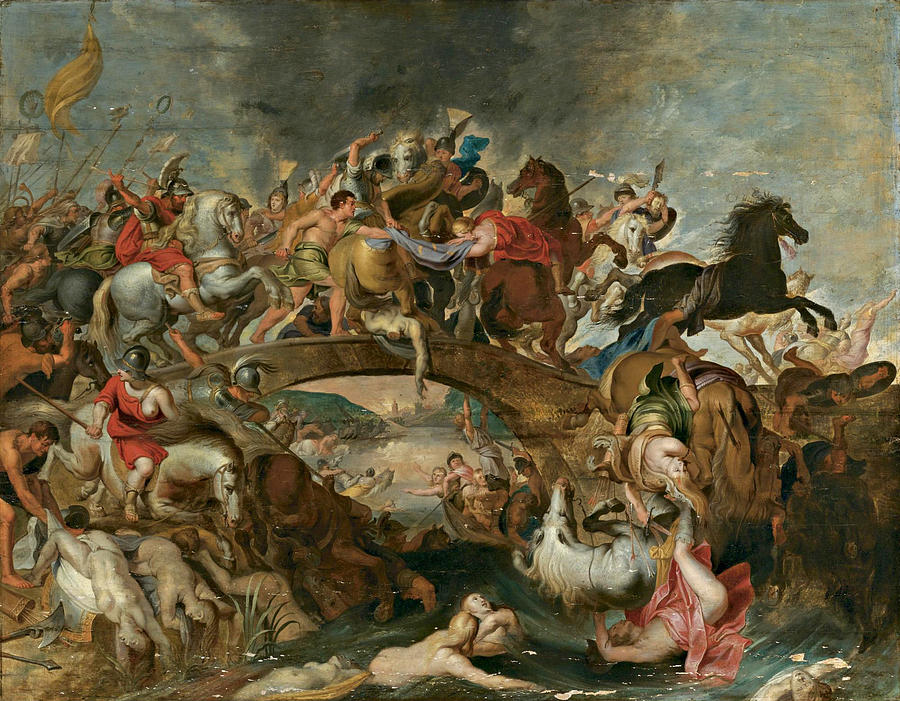
“Theseus Leading the Athenian Soldiers Against the Amazons” presents Peter Paul Rubens at his most spectacular and theatrical. The painting explodes with motion: rearing horses, tumbling warriors, falling Amazons, and swirling drapery all collide on a narrow stone bridge that arcs across a turbulent river. The viewer’s eye is pulled into a vortex of action where classical myth, Baroque energy, and Rubens’ fascination with the human body meet in one monumental clash.
Although the exact date is unknown, the work clearly belongs to Rubens’ mature period, when he was celebrated across Europe for his grand mythological and historical scenes. Here he tackles a legendary battle between the hero Theseus and the warrior women known as the Amazons, transforming an episode from Greek myth into a visceral spectacle of steel, flesh, and foam.
Mythological Background and Narrative Focus
The subject comes from the myth of the Amazonomachy, the war between the Athenians led by Theseus and the Amazons who invaded Attica. In some versions, the conflict begins when Theseus abducts the Amazon queen Hippolyta or Antiope; in others, it is part of a wider narrative about the clash between Greek civilization and foreign warrior women. For Rubens and his patrons, this story offered rich possibilities: it combined heroism, exotic adversaries, and an underlying theme of civil order triumphing over perceived barbarism.
Rubens chooses the climax of the conflict, setting the scene on a stone bridge crammed with combatants. Theseus, identifiable at the center by his commanding posture and red cloak, leads a surge of mounted Athenian soldiers against the Amazons. Around him women in armor struggle, fall, and are trampled under hooves or hurled into the river below. The narrative is not a simple triumphal moment; it is a chaotic melee where victory is still being violently contested.
The painting’s focus is not limited to a single hero. Instead, Rubens portrays the battle as a collective experience, emphasizing the mass of bodies and horses in motion. Theseus stands out, but he is part of an entire army, and the Amazons are depicted with equal physical strength, making the struggle feel genuinely perilous.
Composition and the Arc of the Bridge
The most striking structural element in the painting is the stone bridge that spans the composition like an arch. It functions as both literal setting and compositional device, dividing the painting into upper and lower zones while visually binding them together. On the bridge, the main clash of cavalry takes place; beneath it, fallen warriors and drowning figures dramatize the cost of battle.
The bridge’s curve also creates a dynamic rhythm. It lifts the eye from one side to the other, passing through Theseus at the center before descending toward the chaos of the river. This arch shape is echoed elsewhere: in the rearing necks of horses, the arcs of raised shields, and the sweeping lines of billowing cloaks. Rubens orchestrates these repeating curves to give the scene a sense of swirling motion rather than linear progression.
The composition is dense yet carefully balanced. A cluster of riders and banners on the left counterweighs the violent tumble of horse and Amazon on the right. In the lower section, bodies and animals are arranged diagonally, guiding the eye to the central space beneath the bridge where the landscape opens up to a distant horizon. This tiny pocket of calm, a small strip of sky and land beyond the carnage, intensifies the drama of the foreground by contrast.
Light, Color, and Atmospheric Drama
Rubens uses light and color to heighten the emotional impact of the scene. A cool, luminous sky contrasts with the warm, earthy tones of armor, flesh, and stone. Sunlight breaks through clouds to strike key figures—Theseus, several Amazons, and the pale bodies of those who have already fallen—creating a sequence of highlights that structure the viewer’s attention.
The Athenians are largely dressed in reds, golds, and metallic armor, colors that gleam in the light and signal heroic status. The Amazons, though equally colorful, sometimes wear more varied fabrics and exposed flesh, which accentuates their vulnerability as they are thrown or trampled. Yet Rubens does not paint them as passive victims: many Amazons are shown in active poses, drawing bows or striking with spears, their brightly colored garments rippling in counterpoint to their movements.
The water beneath the bridge is painted in greenish, turbulent tones, shot through with reflections of armor and flesh. It becomes a second stage of drama where drowned or drowning figures add a tragic undertone. Smaller touches of color—a scarlet cloak sweeping across a horse’s flank, a bright blue garment flaring against a dark mount—punctuate the composition like visual exclamation marks.
Atmospheric effects play a supporting role. The sky darkens toward the right, where the battle feels most desperate, while lighter clouds on the left suggest a glimmer of hope or triumph for the Athenians. This shifting weather amplifies the sense that nature itself is responding to the clash.
Horses as Engines of Baroque Movement
No one painted horses with the same muscular vigor as Rubens, and this painting is a showcase of his equine mastery. The animals are not mere props; they are central actors in the drama. They rear, buck, plunge into water, and twist midair, their bodies rendered with anatomical precision and expressive power.
On the bridge, horses are packed so tightly that their flanks and heads overlap, emphasizing the crush of combat. Their eyes roll, nostrils flare, and mouths foam, suggesting terror and exertion. The variety of poses—from a horse plunging headfirst into the river to another rearing almost vertically at the right—allows Rubens to explore the full range of equine motion.
Horses also serve symbolic functions. They embody uncontrolled energy that both sides struggle to harness. When they throw their riders, they become instruments of chaos, blurring the boundary between human intention and animal force. In a mythological battle where themes of control, civilization, and wildness are at stake, this interplay is meaningful: the mastery or loss of a horse becomes visual shorthand for victory or defeat.
The Representation of the Amazons
The Amazons, female warriors from the fringes of the Greek world, fascinated early modern artists as embodiments of gender inversion and exotic otherness. Rubens treats them with a mix of admiration and dramatic exploitation. They are shown as formidable fighters—some wearing helmets and wielding spears, others drawing bows from horseback. Their musculature and dynamic poses match those of the male warriors.
At the same time, their vulnerability is emphasized through exposed limbs, flowing hair, and the frequent depiction of their defeat. Several Amazons fall from horses or are trampled; others are cast into the river, their pale bodies echoing classical river nymphs. Rubens uses this mixture of strength and exposure to heighten the emotional impact of the battle. The viewer feels both the thrill of struggle and the pathos of loss.
This duality reflects broader Baroque attitudes toward powerful women. Amazons could symbolize martial virtue and exotic charm, but they also offered a narrative framework in which female power is ultimately subdued by male heroes. In the painting, Theseus and his men appear to be gaining the upper hand, yet the fierce resistance of the Amazons prevents the image from becoming a simple celebration of domination.
Gender, Power, and Civilizational Conflict
The myth of the Amazonomachy was often interpreted as a clash between order and disorder, civilization and barbarism, patriarchy and female militancy. Rubens’ painting plays into these themes through visual contrasts. The Athenians, aligned with Theseus, represent Greek civic identity; their banners and armor hint at organized warfare. The Amazons, though disciplined fighters, are portrayed as less formally uniform, their flowing garments and bare limbs connecting them to nature and passion.
However, Rubens complicates this dichotomy. The turbulence of the composition suggests that war itself is inherently chaotic, regardless of who fights it. Athenian soldiers fall into the water alongside Amazons; horses of both camps panic and throw their riders. The river becomes a universal grave, indifferent to gender or allegiance.
In this sense, the painting can be read not only as a glorification of heroic conquest but also as a meditation on the cost of conflict. The presence of nude or semi-nude figures struggling in the water introduces a tragic, almost allegorical quality. They evoke the vulnerability of human life in the face of violent upheaval, reminding the viewer that mythic wars, like real ones, exact a terrible price.
Baroque Dynamism and Rubens’ Painterly Technique
“Theseus Leading the Athenian Soldiers Against the Amazons” is quintessentially Baroque in its dynamism, complexity, and sensory richness. Rubens organizes the composition so that there is no single calm resting point; wherever the eye lands, something is in motion. Diagonals crisscross the surface—spears, limbs, horse necks, and banners all create slashing lines that energize the painting.
His brushwork further enhances this effect. In many areas, especially where drapery and clouds are concerned, strokes are loose and fluid, suggesting movement rather than fixed outline. The glint of metal on helmets and shields is achieved through small, sharp highlights that catch the light as if they were truly reflective surfaces. In contrast, the flesh of humans and horses is modeled with softer gradations, giving a sense of solidity and weight.
Rubens’ layering of paint also contributes to the drama. Thin glazes over underpainting create depth in the sky and landscape, while thicker, more opaque applications bring foreground figures into sharp relief. The overall surface has a vibratory quality, as though the scene is in the process of unfolding before the viewer’s eyes rather than being a frozen moment in time.
Landscape and Spatial Depth
Though the battle dominates the canvas, Rubens does not neglect the landscape. Beyond the bridge and the tangle of bodies lies a distant riverbank and rolling hills, rendered in cooler, lighter colors that recede into atmospheric perspective. Tiny figures and horses can be seen continuing the combat in the distance, expanding the scale of the conflict beyond the immediate foreground.
This spatial layering serves several purposes. It anchors the tumultuous action in a wider world, preventing the painting from feeling claustrophobic. It also reinforces the idea that the battle is part of a larger campaign, not an isolated duel. The contrast between the near, chaotic drama and the far, orderly landscape replicates how such events might appear to an observer: intense detail up close, generalized movement beyond.
The river itself is central to the composition and meaning. It cuts across the bottom of the painting, reflecting bits of sky and bodies, serving both as barrier and grave. Its currents take fallen warriors away, giving a sense of time passing even within the single depicted instant.
Allegorical and Courtly Resonances
While rooted in myth, Rubens’ painting likely had contemporary resonances for its original viewers. The Amazonomachy subject could be interpreted as a flattering allegory for a ruling dynasty or city, presenting them as the victorious Athenians defending order against chaos. The heroic figure of Theseus might stand in for a modern prince, asserting his role as protector of the state.
Rubens, often employed by courts and aristocratic patrons, was skilled at embedding such allusions. Elements like banners, armor styles, or the prominence of particular colors could subtly reference his patrons’ heraldry or political aspirations. At the same time, the universal themes of courage, sacrifice, and fortune in war made the painting accessible to a wide audience.
For modern viewers, the allegorical layer may be less specific but still legible. The painting becomes a reflection on leadership and responsibility amid chaos. Theseus is not shown standing apart from the fray; he is in its thickest point, urging his soldiers forward. Heroism is portrayed as participation and risk rather than distant command.
Emotional Impact and Viewer Experience
Encountering “Theseus Leading the Athenian Soldiers Against the Amazons” in person, one is struck by its overwhelming energy. The viewer’s eye rarely rests. Instead, it cycles from one dramatic incident to another: a horse plunging into the water, an Amazon about to be trampled, a soldier raising his spear, a drowning figure reaching for help that will not come.
Rubens carefully manipulates emotional response. The grandeur of the composition inspires awe, while the suffering depicted—particularly among the fallen—elicits pity. Admiration for Theseus and the Athenians is tempered by sympathy for the defeated Amazons. In this way, the painting offers a complex emotional experience aligned with Baroque ideals of engaging the viewer fully, both intellectually and viscerally.
The use of diagonals and swirling forms creates a sense that the action could burst out of the frame. As spectators, we feel almost too close to the battle, as if a panicked horse might rear into our space or a body might tumble at our feet. This involvement is key to the painting’s lasting power.
Conclusion
“Theseus Leading the Athenian Soldiers Against the Amazons” stands as a masterful example of Peter Paul Rubens’ ability to transform classical myth into a living drama. Through a daring composition dominated by an arched bridge, a kaleidoscope of figures and horses, and a rich orchestration of light and color, he captures the chaos and glory of battle. The painting is not merely a celebration of heroic victory; it is a nuanced exploration of gender, power, and the human cost of conflict.
Rubens’ technical virtuosity—his rendering of muscular bodies, his understanding of equine anatomy, his dynamic brushwork—serves a larger expressive goal. The viewer is drawn into the heart of the Amazonomachy, experiencing simultaneously the thrill of action and the pathos of loss. Even centuries after it was painted, the work retains its capacity to awe, unsettle, and invite reflection on the enduring themes of courage, violence, and the fragile line between order and chaos.