Image source: wikiart.org
Introduction
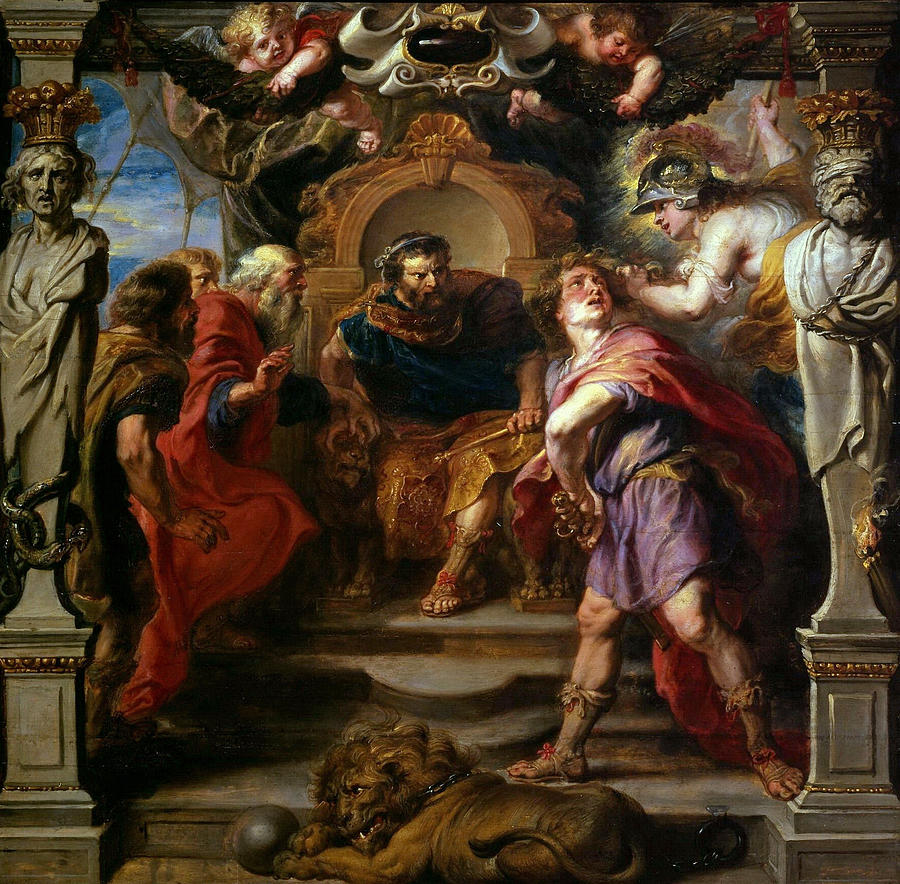
“The Wrath of Achilles” by Peter Paul Rubens captures one of the most explosive moments in all of Greek mythology. Drawn from Homer’s “Iliad,” the scene shows the instant when Achilles, humiliated by Agamemnon’s demand for his captive Briseis, nearly kills the Greek commander in a rage. Rubens freezes the story at the height of tension: Achilles whirls away from the throne with his hand clenched near his sword, Agamemnon glowers from his seat, counselors lean in alarm, and the goddess Athena rushes in to restrain the furious hero.
In Rubens’s hands, this mythological quarrel becomes a grand Baroque theater of gesture, color, and light. The painting is crowded with muscular bodies, swirling draperies, marble architecture, and symbolic creatures. Yet amid the spectacle, the central conflict is crystal clear: the clash between pride and authority, between human passion and divine restraint.
Mythological Background and Narrative Moment
The story comes from the opening of the “Iliad.” After a plague strikes the Greek army, Agamemnon agrees to return his captive Chryseis to her father. To compensate himself, he demands Briseis, the war-prize of Achilles. Insulted and enraged, Achilles confronts Agamemnon before the assembled council. In his fury he nearly draws his sword to kill the king, but the goddess Athena appears, visible only to him, and seizes him by the hair. She urges him to restrain his anger and settle the dispute with words, not violence.
Rubens chooses precisely that suspended moment of decision. Achilles’s body twists in violent motion, his face flushed with anger, while Athena leans in, grasping his hair and speaking urgently at his ear. Agamemnon sits high on his throne in the center, tense yet resolved. Around them, other Greek leaders watch anxiously, aware that this quarrel could tear the army apart.
By focusing on this instant, Rubens dramatizes the psychological struggle inside Achilles: the temptation to unleash his wrath versus the divine call to self-control. It is the turning point that will lead to Achilles’s withdrawal from battle and the tragedies that follow.
Composition and Architectural Framing
The composition of “The Wrath of Achilles” is framed like a monumental stage set. Massive architectural elements form a vertical structure on each side: tall pillars topped by sculpted figures wearing crowns, their bodies wrapped like ancient statues. These caryatid-like forms give the scene the feeling of an ancient temple or ceremonial hall, emphasizing the official, public nature of the quarrel.
Within this stone framework, the action unfolds on a central set of steps leading up to Agamemnon’s throne. The king sits in the exact middle of the canvas, slightly elevated, anchoring the entire composition. His seat is a rounded niche, bathed in warm light. The other figures arrange themselves around him in a sweeping arc, with Achilles standing to the viewer’s right and the counselors grouped to the left.
At the very top, putti and clouds swirl around an ornamental cartouche, reinforcing the Baroque love of elaborate decoration. At the very bottom, a chained lion lies across the steps, its massive paws resting on a metal sphere. This lion serves not only as a decorative flourish but also as a loaded symbol of power and restrained ferocity—a mirror of Achilles himself.
The overall structure guides the viewer’s eye from the architectural frame inward, from the lion on the steps up through the figures toward the crown of clouds and putti. The painting feels like a vertical column of energy, with Agamemnon’s throne as its fulcrum and Achilles’s twisting body as its most volatile element.
Achilles: The Embodiment of Wrath
Achilles dominates the right side of the painting. Rubens portrays him as a powerful young warrior, his muscular legs and arms strained with tension. He wears a short purple tunic and a red cloak that whips around his body in a dramatic swirl, emphasizing his sudden movement. His bare legs and feet are bound with decorative straps, underscoring his heroic athleticism.
The hero’s body twists away from the throne, yet his head is turned back, eyes blazing. One arm is raised as if he had just reached for his sword; the other hand clenches at his hip. The posture captures a moment mid-turn, a pivot from confrontation to reluctant retreat. Rubens’s ability to freeze such a complex pose heightens the sense of movement and internal conflict.
Achilles’s face is vibrant with emotion. The open mouth, furrowed brow, and flaring nostrils convey outrage and humiliation. Yet, because Athena has seized him from behind, he also appears startled, caught between his initial impulse and the divine intervention. The viewer senses the tremendous effort it will take for him to master his rage.
In Achilles, Rubens visualizes wrath as something both magnificent and dangerous. The hero’s body is beautiful, almost sculptural, but it is also on the brink of ungoverned violence. The painting invites admiration for his strength and sympathy for his wounded honor, even as it hints at the destruction such passion could bring.
Athena: Divine Restraint in the Midst of Chaos
To Achilles’s right, the goddess Athena appears in full armor—helmet adorned with plumes, breastplate gleaming, white drapery swirling across her body. Rubens paints her as a figure of radiant energy and determination. She leans forward, gripping Achilles’s hair with one hand while gesturing persuasively with the other. Her expression is intense but controlled, a sharp contrast to the hero’s fiery rage.
In Homer’s text, Athena is invisible to the other characters, seen only by Achilles. Rubens follows this idea visually by making her presence feel almost supernatural. Her body is outlined against glowing clouds, and the light around her is more luminous than that cast on the other mortals. She seems to arrive from above, a sudden incursion of divine reason into the earthly dispute.
Athena’s intervention exemplifies a central theme: the necessity of self-control and wisdom to govern raw power. While Achilles represents unbridled emotion, Athena embodies strategic intelligence and moderation. Her hand on his hair is firm but not violent; she redirects rather than crushes his energy. Rubens’s depiction of these two figures locked together physically expresses the inner struggle between impulse and restraint.
Agamemnon and the Council of Leaders
Agamemnon occupies the center of the painting, seated on his ornate throne. He wears a rich golden garment and a dark blue cloak, symbols of his royal authority. Rubens paints his face with a mix of anger, anxiety, and stubborn pride. He leans slightly forward, fists clenched on the arms of his seat, as if bracing himself for Achilles’s fury and the possible consequences of his own decision.
To the king’s left, a group of Greek leaders and elders surround him. Their bodies form a cluster of overlapping cloaks and bearded profiles. One elder with white hair raises his hand in a calming gesture, perhaps attempting to mediate the conflict. Another leans in to speak urgently to the king. Their worried faces and restrained gestures reflect the political dimension of the scene: the dispute between Achilles and Agamemnon threatens not only personal pride but also the success of the entire expedition against Troy.
Through these secondary figures, Rubens shows that Achilles’s wrath is not a private affair. The entire community is drawn into the drama. Some men appear to sympathize with Achilles, others with Agamemnon, but all are aware that an act of violence would be catastrophic. The painting thus becomes a study in leadership under stress and the fragile balance of armies and alliances.
Symbolism of the Lion and Architectural Statues
At the base of the steps lies a chained lion, its tawny fur painted with Rubens’s characteristic vigor. The animal rests one paw on a metal sphere and glances outward, jaw slightly open. The chain attached to its collar glints in the dim light. This lion is more than a decorative flourish; it serves as a potent emblem of both royal power and controlled ferocity.
The lion can be read as a symbol for Achilles himself—mighty, dangerous, and only barely restrained by the chain of Athena’s intervention. The metal sphere under its paw suggests the world under dominion, a reminder that unruled passion has global consequences. At the same time, the lion may also allude to Agamemnon’s kingly authority, resting on the ability to keep such powerful warriors in check.
Flanking the composition, the architectural statues add another layer of meaning. These figures, crowned and draped, fuse human and column. They resemble ancient kings or deified ancestors, turned to stone and integrated into the architecture of the hall. Their immobility contrasts with the living drama unfolding between Achilles and Agamemnon. They stand as reminders of past rulers, of law and tradition that frame the present conflict. The serpentine form wrapped around the base of the left statue introduces an additional hint of danger and cunning, recalling the complex politics of the Trojan War.
Light, Color, and Baroque Drama
Rubens’s use of light and color heightens the emotional intensity of the scene. Strong contrasts of light and shadow—chiaroscuro—illuminate the main figures while plunging parts of the architecture into darkness. Light pours in from the left, catching the golden embroidery of Agamemnon’s garment, the pale skin of Achilles, and the glint of Athena’s armor. This directional lighting pulls the viewer’s focus toward the central conflict.
The color palette is dominated by rich reds, deep blues, glowing golds, and warm flesh tones. Achilles’s cloak is a vivid red that swirls like a flame, symbolizing his hot temper. Agamemnon’s blue-and-gold attire conveys royal dignity. Athena’s white and metallic hues mark her as a divine presence. The surrounding architecture is rendered in cooler greys and browns, providing a neutral backdrop that enhances the vibrancy of the figures.
Rubens’s brushwork is energetic and varied. Draperies are painted with broad, sweeping strokes that convey the weight and motion of cloth. Flesh is modelled with smoother, more blended touches, giving bodies a tactile, living presence. The lion’s fur is indicated with quick, expressive marks that suggest rough texture. This lively surface, combined with the swirling lines of poses and garments, creates a sense of perpetual movement characteristic of the Baroque style.
Emotional and Moral Themes
Beyond its mythological content, “The Wrath of Achilles” explores universal human themes. At its core is the destructive potential of wounded pride. Achilles feels dishonored by Agamemnon’s demand, and his immediate response is to seek violent revenge. The painting captures the frightening beauty of this passion: Achilles’s body is magnificent, his stance compelling, yet his impulse leads toward murder.
Opposed to this is the necessity of restraint and wisdom. Athena does not deny Achilles’s grievance; she simply urges him to channel his anger through speech and strategic withdrawal rather than impulsive killing. Her intervention raises the question of what it means to be truly heroic. Is greatness found in unrestrained power, or in the capacity to master one’s emotions for a higher purpose?
Rubens also touches on the burden of leadership. Agamemnon’s face shows the weight of command, the difficulty of balancing personal honor with the needs of the army. The anxious elders around him embody the voice of counsel and tradition. Together, they illustrate how conflicts between individual glory and collective welfare can strain any political community.
The painting does not offer a simple moral lesson but presents the tensions vividly, inviting viewers to reflect on the cost of anger, the role of reason, and the fragile fabric of social order.
Rubens’s Interpretation of Classical Antiquity
Rubens was deeply learned in classical literature and art, and “The Wrath of Achilles” showcases his ability to transform ancient stories into vibrant Baroque pictures. He does not attempt archaeological reconstruction; the architecture and costumes are imaginative fusions of classical and contemporary elements. Sandals and tunics coexist with elaborate helmets and capes that owe as much to seventeenth-century court fashion as to Greek antiquity.
This creative approach allows Rubens to adapt the myth to his own time. Viewers in his day would have recognized in Agamemnon’s court echoes of European monarchies and in Achilles’s rage the volatile temperament of powerful nobles or generals. The painting thus becomes not only an illustration of Homer but also an allegory for contemporary politics, where the passions of individuals could shape the fate of nations.
Rubens’s command of anatomy, his love of dynamic poses, and his flair for theatrical staging all find perfect expression in this subject. The result is an image where antiquity feels immediate and alive, not remote or academic.
Conclusion
“The Wrath of Achilles” by Peter Paul Rubens is a grand synthesis of myth, psychology, and Baroque spectacle. Through a tightly organized composition framed by monumental architecture, Rubens stages the climactic moment when Achilles’s fury is checked by the goddess Athena. Every element—the chained lion, the anxious counselors, the splendid throne, the swirling cloaks and glowing armor—serves to heighten the drama of that inner struggle between passion and self-control.
The painting invites viewers to marvel at its visual opulence while contemplating timeless questions about anger, honor, leadership, and the role of reason in human affairs. Achilles stands at the edge of violence, held back by a divine hand; Agamemnon sits on a throne that may crumble if he misjudges his warriors; and the entire army, symbolized by the surrounding figures, waits for the outcome. In capturing this suspended instant with such intensity, Rubens offers a powerful meditation on the fragile balance that holds societies together and the tempests that rage within every human heart.