Image source: wikiart.org
Introduction
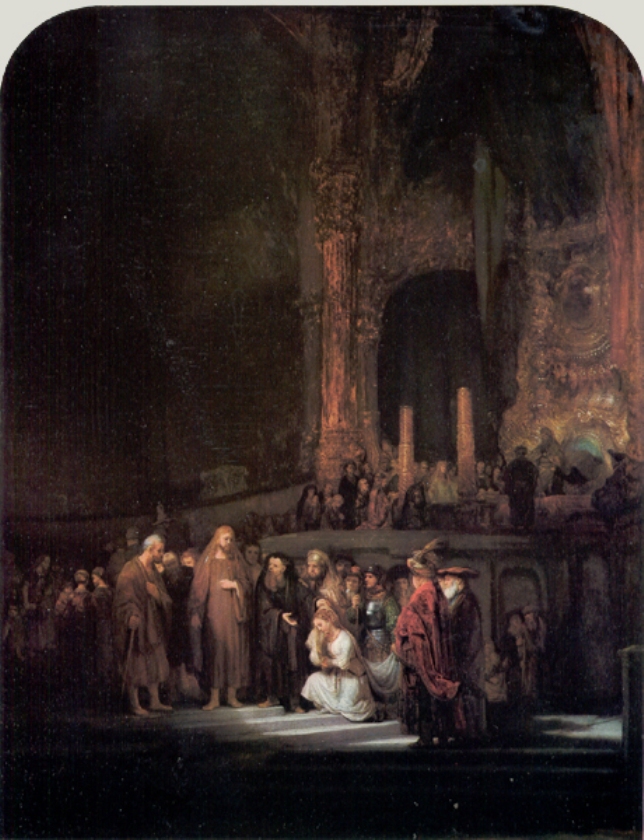
Rembrandt’s “The Woman Taken in Adultery” (1644) condenses one of the Gospel’s most charged episodes into a theater of light and conscience. The painting shows the accused woman kneeling at the threshold of a vast interior while Christ, calm and luminous, stands beside her. Around them clots a crowd of scholars, priests, and onlookers; above them rises an overwhelming architecture—glittering, columned, and deep with shadow—that seems to belong as much to memory and ritual as to brick and stone. Instead of staging a violent interruption, Rembrandt slows the event to the seconds before judgment becomes grace. He uses light to separate motive from noise, scale to humble power, and gesture to translate theology into human action.
The Biblical Narrative and Rembrandt’s Choice of Instant
The story, from the Gospel of John, is simple and perilous. Scribes and Pharisees bring to Jesus a woman caught in adultery and ask whether she should be stoned, “as Moses commanded.” It is a trap: if Jesus demands execution, he betrays his mercy; if he forbids it, he violates the law. Christ answers with a sentence that has outlived the controversy: “He that is without sin among you, let him first cast a stone.” The accusers leave, one by one. In many depictions the key note is confrontation. Rembrandt selects a quieter instant—the charged pause after the question, when mercy has not yet been spoken aloud. The accused kneels; the crowd presses; Christ stands with one hand lowered in a stilling gesture. The words are almost audible because everything else is hushed.
Composition as Moral Architecture
The composition is anchored by a low stage of light at the lower left and an immense, shadowy sanctuary that climbs the right half of the canvas. This asymmetry is purposeful. The small platform becomes the court of conscience; the larger architecture stands for habit and history, the weight of institutions and the inertia of spectacle. The kneeling woman, tiny but piercingly bright, occupies the apex of a triangle formed by Christ’s vertical figure and the slanting band of light that crosses the pavement. The accusers form an arc that both encircles and isolates her, their bodies knotted with the rhetoric of indignation—pointing fingers, bent necks, the unease of borrowed certainty. The eye returns, again and again, to the simple alignment of Christ and the woman: upright mercy beside humbled vulnerability.
Light as Judge and Advocate
Rembrandt’s light is never neutral. Here it pours from the unseen left and spreads across the floor like a summons, catching the woman’s white garments, washing Christ’s robe in warm halftones, and grazing the faces nearest the center. Shadows thicken toward the edges and climb the architecture in burnt umber and bitumen browns, until golds flare on capitals, carvings, and a high altar. The moral program is clear without being preachy: true light belongs to compassion and truthful seeing; borrowed glitter dazzles but cannot guide. Christ and the woman wear light as if it originates in them; the bystanders are lit only where they turn toward the truth.
The Woman’s Gesture and the Dignity of Kneeling
Rembrandt refuses melodrama in the woman’s posture. She kneels not in collapsed despair but in gathered readiness. Her torso leans forward; her hands draw to her chest; her head inclines toward Christ while her gaze stays low, away from the crowd’s devouring attention. The whiteness of her clothing is not sentimental purity; it’s a painter’s strategy to make our sight kneel with her. She is the brightest form in the painting, and yet she does not claim the scene. The light protects her as it exposes hypocrisy elsewhere.
Christ’s Stillness and the Authority of Restraint
Christ stands with the quiet of someone who does not need volume to be heard. One hand hangs slightly forward, palm partly open; the other rests near his robe, anchoring the body. His face holds attention rather than force; his stance builds a vertical that moors the painting against the crowd’s horizontal press. Many artists give Jesus a theatrical gesture at this moment; Rembrandt gives him gravity. That gravity, rather than any one movement, is the argument: authority that refuses spectacle.
The Crowd as Chorus of Motives
The nearest accusers are rendered with the specificity Rembrandt usually reserves for portraits. Brows furrow; lips tighten; hands point or fold. Some lean in with the hunger of righteous victory; others hesitate, already feeling the edge of their own implication. Farther back, faces dissolve into the mass psychology of spectatorship: eyes that want a miracle of condemnation, bodies that have followed noise into a room of judgment. The garment textures—coarse wool, polished fur, heavy velvet—carry social codes of rank and office, but Rembrandt lets brushwork fray the edges. People are more than their positions; their certainty will soon feather into doubt.
The Temple Interior and the Weight of Habit
Rembrandt’s architecture is less a historical temple than a psychological one: towering, ornate, fragmentary, and saturated with the gold of long usage. Great columns glow and sink into shadow; an archway opens into deeper darkness; an altar or high niche glitters with sculptural relief. This world is not evil; it is simply heavy—a machine of tradition that can grind people down when unmoored from compassion. By letting the nave dwarf the figures, Rembrandt stages the audacity of grace: a truth so small it fits onto a patch of floor, yet so strong it changes the climate of the room.
Color, Paint, and the Felt Surface
The palette builds from warm brown-black grounds laced with orange glazes and punctuated by cool, milky whites and touches of red lake in costumes. The woman’s garment is a stack of off-whites—lead white warmed by ochre and stained by translucent shadow—that vibrate against the dark pavement. Christ’s robe carries earthy reds and siennas brushed thin where light passes through, thicker where the form needs weight. The accusers’ clothes are painted with abbreviated strokes that suggest pattern without obsession. In the architecture, Rembrandt alternates thin scumbles (to haze distance) with proud impastos (to catch candlelight). The craft serves meaning: brittle surfaces belong to brittle motives; softened paint belongs to mercy.
The Stage of the Floor and the Drama of Edges
The floor is a masterpiece of minimal means. A few long, horizontal pulls of the brush and several crisp edges suffice to make flagstones, while three lighter bands act like moral beams directing the eye. The kneeling woman sits at the hinge of these bands; Christ oversteps one with a sandal, as if crossing an invisible line on her behalf. The edges of light are sharp near them and blur as they move away, a visual rhetoric that concentrates clarity where it is most needed.
Sound, Silence, and the Implied Breath
Although painting is silent, Rembrandt insinuates a soundscape. The crowd’s low murmur, the hiss of a robe on stone, the distant echo under the arch, all seem present. Central, though, is a pocket of silence around Christ and the woman—an acoustic halo that isolates their encounter from the theater of accusation. In that silence we almost hear the words that will scatter the crowd. The orchestration of visual noise and quiet is itself a theological claim: mercy requires a space where the heart can breathe.
Gender, Power, and the Redistribution of Attention
The image is an anatomy of who gets looked at and why. The accusers bring the woman forward as spectacle; Rembrandt returns to her the privacy of a human face. She is visible but not exposed; we witness her vulnerability without consuming it. Christ’s placement reassigns authority from the loudest men in the room to the gentlest one. The woman’s kneeling does not signify inferiority but the position from which transformation can begin. Those structures of attention—who commands light, who is condensed into shadow, who is given air—quietly rewrite the politics of the scene.
The Viewer’s Position and the Ethics of Witness
We stand slightly to the left, low enough to look across the floor and high enough to appreciate the oppressive grandeur of the sanctuary. That vantage makes us complicit in the crowd’s initial curiosity but free to move, with the light, toward compassion. Rembrandt trusts the viewer to complete the moral arc: to enter as spectator and leave as witness. The composition’s empty left field invites our conscience into the painting, asking us to decide where to stand when accusation gathers.
Comparisons within Rembrandt’s Oeuvre
The picture belongs to a family of Rembrandt works in which a small pool of light resists an ocean of darkness: “The Night Watch,” the candle-lit apostles, and numerous etchings of scholars by lamp. But here the contrast serves not civic bravura or intellectual concentration; it announces a change of heart. The humility of the kneeling figure anticipates later masterpieces like “The Return of the Prodigal Son,” where forgiveness reshapes identity. Compared to more crowded versions of the subject by other painters, Rembrandt’s restraint feels radical: he trusts a single gesture and a few faces to carry the full spiritual weight.
The Moment Before the Stones Fall—or Don’t
Many depictions show stones in hands, violence averted at the last second. Rembrandt removes weapons entirely. The danger in his scene is subtler and more modern: reputational murder, public shaming, the mob’s appetite for certainty. By refusing props, he insists that the crisis is interior. What will each person do with the truth that the demand for punishment often hides a fear of one’s own reflection?
Reading the Painting as a Meditation on Law and Mercy
The painting offers a careful argument that neither discards the law nor lets it weaponize others. The temple is there, the scrolls are there, the authorities are present; yet the decisive light lands on the person at risk. Christ neither excuses nor humiliates; he redirects judgment inward, where it belongs first. Rembrandt paints that logic not as slogan but as atmosphere. The architecture remains standing, but its authority is re-anchored to compassion.
Technique, Revisions, and the Hand at Work
Close looking reveals pentimenti where positions were adjusted—small shifts of hands, the tightening of a sleeve, the exaggeration of architectural shadows to heighten focus. These changes chart Rembrandt’s journey from narrative fullness to distilled clarity. He pulls paint thin in the left expanse to let the panel’s tone contribute to darkness; he heaps it on certain gilded ornaments to make the temple breathe with a life of its own. The material history of the surface resonates with the spiritual history onscreen: both aim toward concentration rather than accumulation.
What the Painting Teaches about Looking
At heart, the work is a lesson in how to look at a person under accusation. The recipe is simple and difficult: attend to the quiet figure rather than the loud ones; notice the light that does not advertise itself; honor the complexity of spaces—public, private, sacred—without letting any space swallow a human being. Rembrandt does not tell us what happened next; he teaches us how to be present until the heart can speak.
Enduring Relevance
Centuries later, the image reads like a commentary on the rhythms of public outrage and private shame. The woman’s kneeling could happen in a courtroom, a tabloid, or a social feed. The crowd’s faces are our own when we are most eager to judge and least eager to reflect. The painting’s hope is not naïve: it imagines transformation beginning with a pause, a reallocation of light, and a sentence that turns stones into mirrors.
Conclusion
“The Woman Taken in Adultery” (1644) is Rembrandt’s great study of justice as the art of attention. He builds a sanctuary of shadow so that a small square of brightness can matter; he surrounds the accused with faces so that one calm presence can free her; he raises a temple of paint so that conscience can sound within it. By the time we leave the picture, the crowd has not yet dispersed, but our eyes have. We have learned to stand with the light that protects rather than the darkness that condemns. Few paintings teach such a precise and tender way of seeing.