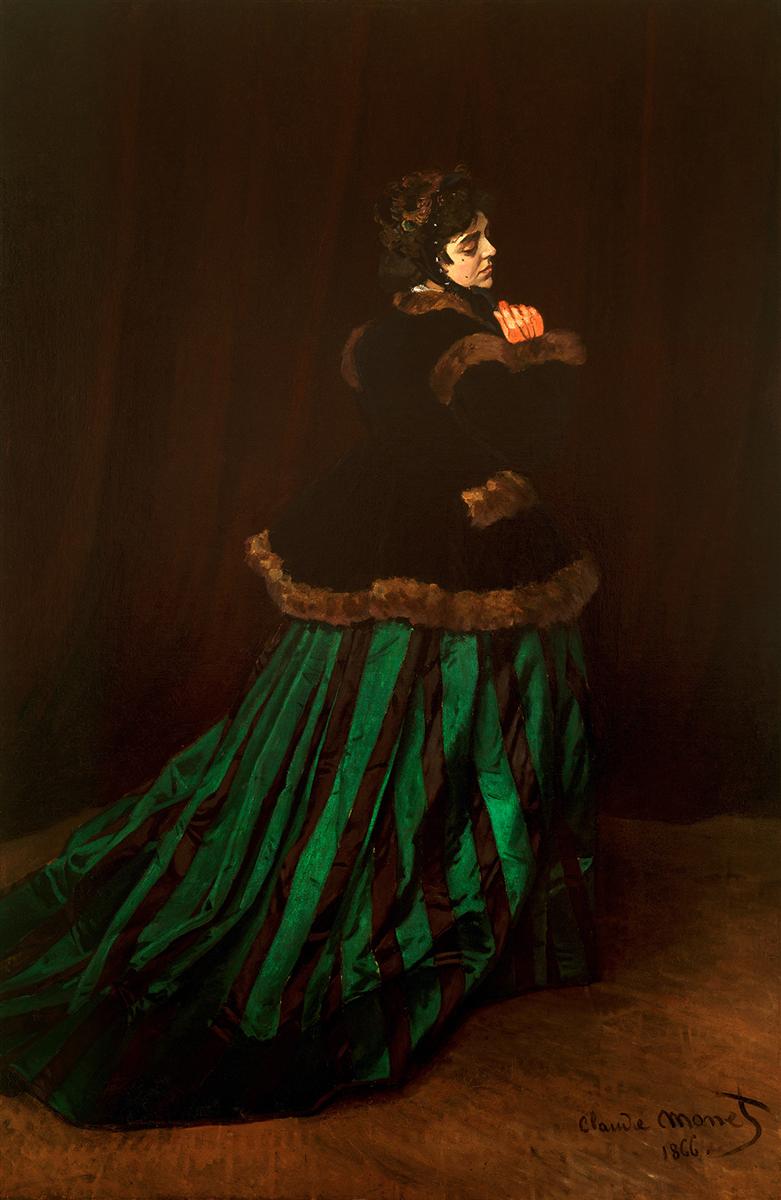
Image source: wikiart.org
Introduction
Claude Monet’s The Woman in a Green Dress from 1866 is one of the most striking early portraits in his career, and it remains one of the clearest demonstrations of how quickly he was moving beyond convention. At first glance, the painting seems simple. A fashionable woman stands before a dark curtain, turned partly away from the viewer, her face seen in profile, her body wrapped in a dramatic black jacket and a vivid green dress that spreads across the floor in rippling folds. Yet the power of the work comes precisely from the way Monet transforms this apparently straightforward scene into something far richer. He turns fabric into movement, elegance into mood, and portraiture into an exploration of light, color, and modern life.
The painting is often admired for its beauty, but beauty alone does not explain why it continues to hold attention. The work feels poised between intimacy and performance. The woman appears near enough to be real, yet distant enough to remain mysterious. Her back is mostly turned, and that refusal of direct engagement gives the portrait a curious tension. We are invited to look, but not fully admitted into her inner world. That mixture of immediacy and reserve is part of what makes the image unforgettable.
What also makes this painting so important is its place in Monet’s development. Before he became known for Impressionist landscapes, gardens, haystacks, poplars, and water lilies, he was already demonstrating a remarkable ability to capture modern visual sensation. In this portrait, one can already see the young artist’s fascination with surfaces, fleeting effects, and the relationship between light and material. The painting shows a Monet who is not yet the painter of late atmospheric dissolution, but who is already determined to make painting feel alive.
Historical Context and Early Monet
When Monet painted The Woman in a Green Dress, he was still a young artist trying to establish himself in the Paris art world. This was a period when success in the official Salon still mattered enormously. Large, polished, impressive canvases could launch a reputation, and portraiture remained one of the most visible ways for an artist to prove skill, ambition, and seriousness. Monet understood that a successful portrait could help secure both recognition and income, yet even within that framework he found a way to make the work feel fresh rather than formulaic.
The Paris of the 1860s was a city obsessed with appearance, fashion, spectacle, and status. Clothing was not merely decorative. It signaled class, taste, and modern identity. Painters who represented the contemporary world had to reckon with the visual force of urban fashion, especially in women’s dress, where texture, silhouette, and detail could become almost theatrical. Monet was working in a culture in which modernity was visible in public display, in shop windows, in boulevards, in opera houses, and in portraiture itself. The dress in this painting belongs fully to that modern world.
At the same time, Monet was not simply accommodating Salon expectations. He was absorbing influences from Realism and from artists such as Édouard Manet, while also pushing toward a freer, more responsive treatment of paint. The result is a portrait that functions on two levels. It is refined enough to satisfy the demands of public exhibition, yet energetic enough to suggest a different future for painting. This tension between the official and the experimental makes the work historically fascinating. It shows Monet learning how to use the language of traditional success while quietly changing the meaning of that language from within.
The Presence of the Figure
The woman in the painting is often identified as Camille Doncieux, who would later become Monet’s wife and one of the most important figures in his early life and art. Whether a viewer knows her identity or not, the painting creates a compelling human presence. She is not presented as a static emblem, nor as a stiff social symbol. Instead, she seems caught in a moment of turning, as though she has just paused and may move again in the next second. That sense of transition gives the portrait unusual vitality.
Her pose is essential to the work’s psychological effect. Rather than facing outward in a straightforward formal stance, she angles away, showing much of her back and only the delicate profile of her face. This makes the viewer more attentive. We search for expression in the line of her cheek, in the tilt of her head, in the placement of her hands. Because the face is partly withheld, the portrait becomes less about explicit identity and more about atmosphere and character. She seems self-possessed, elegant, and slightly remote.
The body language contributes to this impression of reserve. Her gloved hands rest near the fur trim of the jacket, not dramatically gesturing, but quietly gathered. The posture suggests poise rather than display. And yet there is also a theatrical quality. The long train of the dress unfurls behind her like a stage effect, and the curtain deepens that feeling of presentation. Monet balances natural presence with visual drama so skillfully that the figure feels both real and composed.
This is one of the reasons the painting has such lasting power. The woman is not reduced to a type. She is fashionable, certainly, but she is not merely a fashion plate. Her individuality is sensed rather than fully explained, and that subtlety allows the portrait to feel alive even now.
Color as the Soul of the Painting
The title immediately directs attention to color, and rightly so. The green dress is not a minor feature but the emotional and visual core of the painting. Monet uses green with extraordinary boldness, making it luminous against the dark surroundings. The dress does not sit quietly in the composition. It radiates, catches the eye, and sets the entire picture into motion.
What is especially impressive is the complexity of the green itself. It is not a flat, single tone. Monet modulates it through shadow, reflection, and the shifting angles of the folds. Some areas appear bright and jewel-like, while others sink into deeper passages that verge on black. This variation makes the fabric feel substantial, but it also gives the dress an almost living quality. It seems to shimmer and breathe under the changing light.
The surrounding colors are chosen with equal intelligence. The dark curtain behind the figure creates a rich, warm field that allows the green to stand out more intensely. The black jacket, softened by brownish fur trim, anchors the upper half of the figure and prevents the image from becoming merely decorative. The pale skin of the face and the warm tone of the gloves introduce small but vital accents of light. These touches keep the eye circulating across the canvas.
Monet’s use of color here is already distinctively modern. He is not simply describing local color, the expected color of an object. He is orchestrating relationships between colors so that the painting as a whole becomes dynamic. Green is not isolated. It is activated by brown, black, flesh tones, and golden floor tones. That orchestration is part of what makes the painting so memorable. The color is descriptive, but it is also expressive. It conveys elegance, luxury, freshness, and visual daring all at once.
Light, Texture, and the Sensation of Fabric
One of Monet’s greatest achievements in The Woman in a Green Dress is his handling of fabric. Many painters could describe clothing accurately, but Monet does more than describe. He makes the viewer feel the texture and weight of the garments. The satin-like dress seems crisp in some areas, heavy in others, and constantly responsive to light. The fur trim appears soft and dense. The gloves feel smooth and fitted. These effects are not merely technical accomplishments. They are central to the painting’s meaning.
Fashion in this portrait is inseparable from perception itself. The dress is a surface on which light performs. Every fold becomes an opportunity for transformation. Highlights skim across ridges, shadows gather in recesses, and the material shifts from brilliance to darkness within short passages. Monet is clearly fascinated by how a modern dress can become a field of visual incident. This is a painter’s fascination, not just a dressmaker’s or a social observer’s.
The train of the dress is especially important. It drapes and extends across the lower left of the composition, creating a sweeping motion that broadens the picture’s emotional range. Without this train, the portrait would be elegant. With it, it becomes grand. The fabric carries the eye outward and downward, filling the space with movement even though the figure herself is still.
Monet’s brushwork reinforces this sensation. He does not labor over every detail in a hard, rigid manner. Instead, he allows paint to suggest as much as it defines. This gives the fabric a sense of immediacy. We feel that the artist is responding to the changing look of the dress rather than mechanically recording it. That responsiveness is one of the early signals of the artist he would become. Even in a portrait rooted in the world of fashion and formal presentation, Monet is already painting sensation.
Composition and the Drama of Space
The composition of The Woman in a Green Dress is deceptively simple, but it is carefully constructed to maximize drama. The figure stands slightly off center, and her turning posture creates a sense of asymmetry that keeps the image from feeling static. The large dark background might seem empty at first, yet it plays a crucial role. It gives the figure room to emerge and intensifies her isolation. There is nothing around her to distract the eye. The painting is about presence, silhouette, and the unfolding of form.
The curtain behind her serves as both background and theatrical device. It suggests an interior setting, but without specifying any narrative context. This ambiguity allows the work to hover between portrait and performance. The woman could be in a private room, a studio arrangement, or a stage-like environment created purely for effect. That uncertainty enhances the painting’s atmosphere.
The flow of the composition is masterful. The eye begins near the illuminated face, moves across the dark upper garment, then sweeps down into the brilliant green dress and along the extended train. From there, the gaze returns upward through the folds and vertical accents of the skirt. This circulation keeps the canvas active. Monet ensures that the viewer never simply stops at one point. The portrait must be experienced as a whole.
The sense of scale also matters. The figure occupies a large portion of the canvas, and the dress amplifies her physical and visual presence. She is not miniaturized within an elaborate setting, nor overwhelmed by props. Instead, the painting makes the figure monumental through clothing, color, and controlled space. This monumentality contributes to the work’s authority. It announces ambition. Monet was not making a minor society picture. He was making a statement.
Fashion, Modernity, and Social Meaning
To understand the full richness of this painting, it is important to see that the dress is not just beautiful clothing. It is a sign of modern life. In the 1860s, fashionable dress was deeply tied to questions of urban identity, social visibility, and contemporary taste. By choosing to give so much attention to costume, Monet was not avoiding seriousness. He was engaging directly with one of the most important visual languages of his time.
The woman’s attire conveys sophistication and presence. The dark jacket with fur trim suggests seasonal elegance, while the green dress introduces opulence and flair. This is not rustic simplicity or timeless allegory. It is modern femininity presented through style. Yet Monet does not reduce the figure to an object of display. The painting remains too psychologically nuanced for that. The clothing carries meaning, but the woman wearing it retains dignity and inwardness.
There is also something revealing about the balance between individuality and impersonality in the portrait. Fashion can make people legible as social beings. It can place them within a world of taste and class. At the same time, fashion can conceal as much as it reveals, wrapping the self in surfaces and conventions. Monet captures that duality beautifully. The dress tells us much about the world she inhabits, yet it does not fully disclose who she is. The portrait remains suspended between social image and personal presence.
This tension makes the work feel modern in a profound sense. Modern life often turns identity into appearance, but not completely. Something remains private, elusive, ungraspable. In The Woman in a Green Dress, Monet turns that condition into art. He lets the viewer admire the public surface while sensing the hidden life behind it.
Technique and the Young Monet’s Painterly Intelligence
Although this portrait belongs to an earlier phase of Monet’s career, his painterly intelligence is already unmistakable. One of the most impressive aspects of the work is the way he balances finish and freedom. Certain areas, especially around the face and costume, appear carefully resolved, while other passages feel more fluid and immediate. This selective handling allows the painting to maintain both authority and vitality.
The face is rendered with delicacy, but Monet does not overwork it. He understands that too much finish can deaden a portrait. The features are clear enough to establish character, yet loose enough to preserve freshness. The same is true of the costume. The dress is richly described, but never in a fussy manner. Brushstrokes remain visible, and that visibility keeps the surface alive.
This is important because Monet’s real subject is not just the woman or her dress, but the act of seeing. He paints how forms appear under light, how colors shift, how materials register differently depending on angle and shadow. His technique is already rooted in observation rather than formula. Even where the composition feels carefully arranged, the paint itself suggests responsiveness and immediacy.
The lower passages of the dress are especially revealing in this respect. Monet does not spell out every fold with linear precision. Instead, he uses tonal contrasts and directional strokes to create an impression of cascading fabric. The result is convincing, but more than that, it feels alive. It allows the eye to participate in completing the form. This active relationship between painting and perception would become central to Impressionism, and one can sense its beginnings here.
The Painting’s Psychological Atmosphere
Beyond its color and technical brilliance, The Woman in a Green Dress is memorable because of its mood. The painting is not cheerful in any simple sense. It has elegance, but also gravity. The dark background, the black upper garment, and the partial turning away of the figure all contribute to an atmosphere of restraint. The work feels quiet, poised, and slightly enigmatic.
This mood depends on what Monet chooses not to reveal. He does not give us a direct frontal expression that would explain the sitter emotionally. He does not surround her with narrative objects that would tell a story. He does not turn the portrait into anecdote. Instead, he leaves the viewer with a fragment of a moment and invites interpretation. Is she thoughtful, distant, self-aware, melancholic, composed? The painting does not settle the question, and that openness is one of its greatest strengths.
There is also a subtle emotional contrast between the richness of the costume and the inwardness of the figure. Splendor often suggests display, confidence, and social ease. Yet this figure feels somehow apart from spectacle, even while embodying it. She is dressed for visibility, but psychologically she remains partly hidden. That tension gives the portrait unusual depth.
Monet’s sensitivity to this emotional ambiguity sets the work apart from more routine fashionable portraiture. He is not merely praising elegance. He is observing how elegance can coexist with mystery, reserve, and complexity. The result is a portrait that continues to invite close looking because it never fully resolves into a simple statement.
The Woman in a Green Dress in Monet’s Career
This painting occupies a crucial place in Monet’s artistic development because it shows how broad his talent already was. Many viewers think of Monet primarily as a landscape painter, and with good reason. His fame rests on his exploration of light, atmosphere, and natural motifs. Yet The Woman in a Green Dress reminds us that he was also capable of major figure painting and ambitious portraiture.
The work reveals a young artist who could meet public expectations while still asserting his own vision. It helped establish his reputation and demonstrated that he possessed not only technical skill but also a distinct modern sensibility. That matters because it complicates any overly narrow understanding of Monet. He was not simply an instinctive outdoor painter who stumbled into greatness through gardens and ponds. He was a highly intelligent artist who understood composition, social imagery, painterly effect, and the demands of the art world.
Seen from the perspective of his later career, the painting is also fascinating because it contains both continuity and difference. The continuity lies in Monet’s responsiveness to light and color, his delight in visual transformation, and his refusal to let painting become rigid. The difference lies in subject and structure. Here the work is centered on a single monumental figure in an interior-like setting, rather than on dispersed atmospheric phenomena outdoors. Yet the underlying eye is recognizably the same eye.
That is why this portrait deserves more attention than it sometimes receives. It is not merely an interesting early effort. It is a major statement in its own right and an essential key to understanding how Monet’s art evolved.
Why the Painting Still Feels Fresh
More than a century and a half after it was painted, The Woman in a Green Dress still feels immediate. Part of that freshness comes from the image’s visual clarity. The dark background, the strong silhouette, and the unforgettable green of the dress make the painting instantly legible. It has the kind of formal strength that survives changing tastes.
But freshness also comes from its subtle modernity. The painting does not trap the viewer in a fully explained narrative or a rigid symbolic program. Instead, it offers presence, mood, and sensation. Those qualities remain powerful because they do not depend on academic conventions that have faded from view. A contemporary viewer can still respond to the painting’s atmosphere, elegance, and mystery without needing extensive background knowledge.
The work also feels fresh because it understands something enduring about human perception. We do not encounter people all at once in complete psychological transparency. We see surfaces, gestures, clothing, posture, fragments of expression. Meaning emerges gradually and incompletely. Monet builds the portrait around that truth. He shows enough to captivate, but not enough to exhaust the viewer’s curiosity.
Finally, the painting remains compelling because it demonstrates how beauty can coexist with seriousness. The luxurious dress is undeniably attractive, yet the work never collapses into mere prettiness. It remains thoughtful, controlled, and emotionally resonant. Monet turns fashion into form, form into atmosphere, and atmosphere into enduring art. That transformation is why the painting continues to command attention and why it remains one of the finest early achievements of his career.
Conclusion
The Woman in a Green Dress is far more than a stylish portrait from Claude Monet’s youth. It is a work in which technical skill, modern subject matter, emotional subtlety, and painterly intelligence come together with remarkable force. The painting captures a fashionable woman in a moment of poised turning, but it also captures something larger: the visual culture of modern Paris, the expressive possibilities of color, and the emergence of a major artistic voice.
Its greatness lies in balance. It is elegant but not shallow, ambitious but not stiff, descriptive but not merely literal. The dress dazzles, yet the figure remains human. The composition is controlled, yet the paint feels alive. The portrait belongs to its era, yet still speaks vividly to the present. Monet transforms a single woman in a magnificent dress into an image of mystery, movement, and modern perception.
To look closely at this painting is to see an artist already thinking beyond convention. Even before the landscapes that would make him world famous, Monet was proving that he could reinvent what a portrait might do. He could make cloth shimmer with life, use color as emotional architecture, and create a figure who remains unforgettable precisely because she does not reveal everything. In that sense, The Woman in a Green Dress is not simply an early success. It is a declaration of artistic intent, and one that still feels powerful today.
