Image source: wikiart.org
Introduction
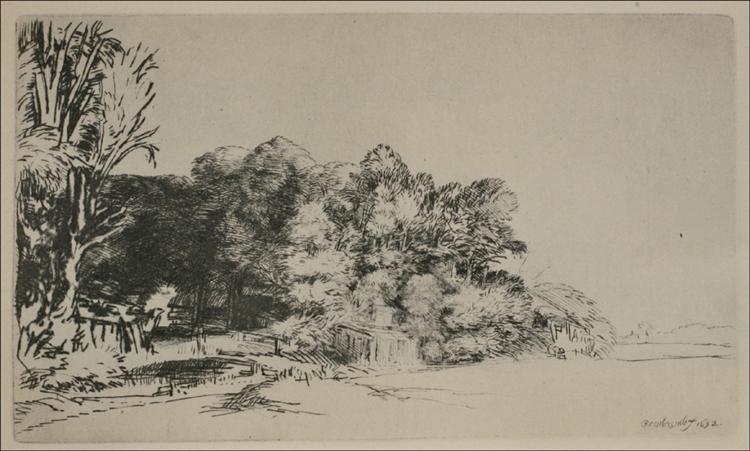
Rembrandt’s “The Vista” (1652) is a landscape etching that feels like a slow breath taken at the edge of open country. At left and center a dense stand of trees rises in layered tones; to the right, the paper opens into an expanse of unmarked light that reads as sky and water at once. Low structures—a shed, a fence, the slope of a thatched roof—nestle at the treeline, and a footpath threads quietly into the scene. With a few registers of line and a disciplined use of negative space, Rembrandt stages a meeting between shade and air, enclosure and distance, the known and the not yet known. The sheet is modest in subject and spectacular in looking; it converts an ordinary pause in the countryside into an experience of depth, weather, and time.
A Landscape Of The 1650s And The Dutch Eye
By the early 1650s Rembrandt had matured into a landscape etcher of uncommon freedom. Dutch art already valued the observation of low horizons, big skies, and waterlines that dissolve into light; Rembrandt respects that tradition while bringing to it the psychological density he gives to human faces. “The Vista” belongs to the same period as his great night scenes and intimate biblical interiors, and it shares with them an ethics of attention: the preferred subject is any place where light, matter, and silence negotiate their boundaries. Rather than modeling a grand panorama, he offers a bit of ground one might actually walk, recorded with the authority of lived sight.
Composition As A Conversation Between Mass And Air
The design is anchored by a large, nearly triangular mass of foliage that occupies the left and central sections of the plate. This dark, textured body pushes against a bright, nearly empty right side. The tension between these halves is electrical: the eye ricochets from the intricate shadow of leaves to the unmarked openness beyond. At the base of the trees, a cluster of planks, fences, and low buildings knits the earthly to the airy. A narrow path curves in from the left foreground, slips behind the structures, and appears to continue toward the pale distance. That curve is the invitation; it turns the viewer from a spectator into a walker.
Light And The Grammar Of Space
Rembrandt’s most radical choice is what he refuses to touch. The entire right third of the sheet is almost blank, the plate barely bitten. In landscape this is not negligence but strategy: paper becomes light, light becomes space, and space becomes the believable atmosphere into which the wooded bank projects. Against that white breadth, the etched trees deepen in tone, articulating interior pockets where light snags on leaves. The result is a grammar of space written in contrasts: dark registers near the viewer, middle grays where the foliage thins, and open light where distance begins. You do not so much see depth as feel your eyes adjust to it.
Drawing Trees Without Formula
Rembrandt draws trees the way he draws people, without clichés. No two crowns repeat; each trunk, limb, and tuft behaves with its own rhythm. He sets out a scaffolding of broad, diagonal hatches to mass the shade, then overlays quick, scumbled curls to indicate leafage. In a few spots he lets parallel lines drift apart, and the ground beneath the canopy breathes with light. The density at far left suggests a stand of older growth; toward the center, the leaf forms grow small and crisp, registering sunlight. The variety is not virtuosity for its own sake; it is an ethics of specificity that makes the scene convincing.
Fences, Sheds, And The Human Scale
Domestic signs—planks of a fence, squared timbers of a shed, the slope of a thatched roof—anchor the human measure of the scene. Rembrandt draws them with the same economy he applies to foliage: a few perpendiculars, a shadow notch, a roofline shaped from two confident strokes. These structures do not monumentalize labor; they belong to it. Their presence tells us that the view is not wilderness but a shared, worked edge where people move between shade and field. The mood is not pastoral fantasy; it is neighborly.
The Pathway And The Drama Of Access
The path is the picture’s quiet drama. It begins near the lower left, a broken bright strip among darker hatching, and heads toward the structures before sliding behind them. Because the path disappears, the mind supplies its continuation into the sunlit distance. That ellipsis keeps the image alive after the first look; we are always on the verge of turning the corner. In Rembrandt’s landscapes, access is a form of narrative—the story of where the viewer might go if they had a few more minutes and the right weather.
Etching As Weather: Line, Burr, And Plate Tone
Technically the sheet moves between three modes. There is the tight hatch, cut cleanly by the needle, which establishes architecture and trunk planes. There is the looser, fuzzed burr of drypoint that catches on the paper and turns shadow into soft matter, perfect for foliage masses. And there is plate tone—a faint veil of ink left on the plate—that tints select passages and rounds forms without drawing them. Together they simulate weather: the left bank feels humid and cool, the right openness feels dry and bright. You could imagine the smell of leaves and the faint sting of sun where the view breaks open.
Negative Space As Narrative Time
The empty right side acts not only as space but as time. It reads like an hour that has not yet happened, an afternoon that will be crossed. In Dutch landscape painting, white paper often stands for sky, but here it also functions like future. That sense of temporal distance is strengthened by the modesty of the figures (if any are present, they are mere hints). Rather than populate the view with actors, Rembrandt leaves it available, a page for the viewer’s next steps.
The Edge Of Settlement
Look closely at the structures tucked into the trees. One seems half-decayed, a pentimento of slanted boards; another has a fresh thatch-form. A low fence draws a ragged boundary between tended ground and thicket. This border registers an urban reality of seventeenth-century Amsterdam: the city gave way quickly to peri-urban plots, orchards, and sheds where wood was stored and water managed. “The Vista” is likely an image of such a threshold place, dear to the artist because thresholds are where light changes and stories begin.
The Left Margin As Stage Wing
At far left, large trees and a darker, almost theatrical curtain of marks form a stage wing. That wing frames the view and intensifies the sense that we are peeking from a shaded place toward open land. It is an old pictorial device, used by painters to control the viewer’s entry, but Rembrandt’s execution is fresh because the “curtain” is also plausible as vegetation. The artifice hides inside credibility. The viewer accepts the framing because it feels like a real grove.
Quiet Signs Of Water And Sky
Though no water is drawn explicitly, the pale band at right suggests a river or canal lying level with the land. A few faint horizontals hint at reflections, then recede so the paper’s light can carry the rest. Above, where most artists would model a sky, Rembrandt abstains. The absence enforces calm. The air is not streaked by clouds or dramatized by rays; it is simply there, a clear day the etching allows you to inhabit without commentary.
Time Of Day And The Temperature Of Light
The distribution of tone points to late morning or early afternoon, when sun rides high and washes the right side of things. The trees’ outer edges sparkle with tiny white flecks where the needle leaves gaps; these become leaf tips catching light. Beneath, midtones gather in layered bands, creating the impression of cooler recesses. The temperature is gentle rather than theatrical—no long evening shadows, no storm brewing. The sheet’s calm suits the title: this is a vista, not a spectacle.
Kinship With Rembrandt’s Other Landscapes
Rembrandt’s landscape etchings range from panoramic river views to intimate clumps of trees, from heavily worked plates to very light ones. “The Vista” sits in the middle register. It is neither scribble nor showpiece; it is resolved without being fussy. Compared to the broad, horizontal “View over the Amstel from the Rampart,” this sheet is more secluded; compared to quick studies of willows and paths, it is more architected. It embodies the mature balance of the early 1650s: maximum presence with minimum means.
The Viewer’s Body And The Ethics Of Scale
This print is sized for the hand, not the gallery wall. Held close, the dark hatching merges into velvet; the open right brightens into air. You sense the path at your feet and the shelter of trees at your shoulder. That physical intimacy fosters an ethic of looking appropriate to landscape: quiet, patient, unhurried. Rembrandt’s scale enforces the behavior the scene deserves.
Sound, Smell, And The Haptic Imagination
Good landscape activates senses beyond sight. In “The Vista” you can almost hear a soft rustle where leaves shift in a light breeze, a distant plash if the right side is a canal, a creak from a fence rail. The nose supplies damp earth at left and warm straw where the roof bakes. Etched textures invite touch: the furry burr of foliage, the slick plane of a worn plank, the fibrous drag of thatch. The haptic imagination completes what the eye begins.
Close Looking: Passages Of Remarkable Economy
Several details reward attention. The small shed near center is constructed from only a handful of verticals and diagonals plus a wedge of shadow, yet it sits on the ground with persuasive weight. The fence is little more than a rhythm of short uprights tied by a single bar; the eye reads it as weathered wood. The path is a bright incision through darker hatching; where it passes under foliage, a single cross-stroke turns daylight to shade. The leftmost tree trunk begins as a thick black and dilutes into separate lines as it climbs, a transition that reads as bark catching light. Each micro-decision increases credibility without clutter.
Why The Image Still Feels Contemporary
Contemporary viewers, saturated with panoramic photography, often find freshness in pictures that build space from subtraction. “The Vista” anticipates that aesthetic. Its reliance on negative space, its trust in a few honest textures, its refusal of spectacle in favor of atmosphere—all feel strikingly modern. Designers and photographers alike recognize in Rembrandt’s etching a rule for clear seeing: remove what is not needed, then let materials breathe.
The Vista As State Of Mind
Beyond location, the title suggests a mental condition: a mind clearing, a prospect opening. The sheet enacts that movement. From the dense thought-forest at left, the eye steps into lucid breadth at right. The passage is not violent; it is a release. This ability to convert topography into psychology is one reason Rembrandt’s landscapes have uncommon staying power. They are not merely places; they are ways of feeling time and light.
Conclusion
“The Vista” is a study in how little a picture needs to be generous. With a dense knot of trees, an honest scatter of sheds and fences, a path that threads into quiet, and a great field of untouched paper, Rembrandt composes an experience of entry and rest. The plate’s left side gathers the textures of shade; the right side opens into air; between them a human scale of buildings and paths mediates the passage. The etching’s weather is made from line, burr, and restraint; its mood is neighborly and contemplative. Long after you set it down, the path continues, the air brightens, and the mind returns to that meeting of mass and light where attention begins.